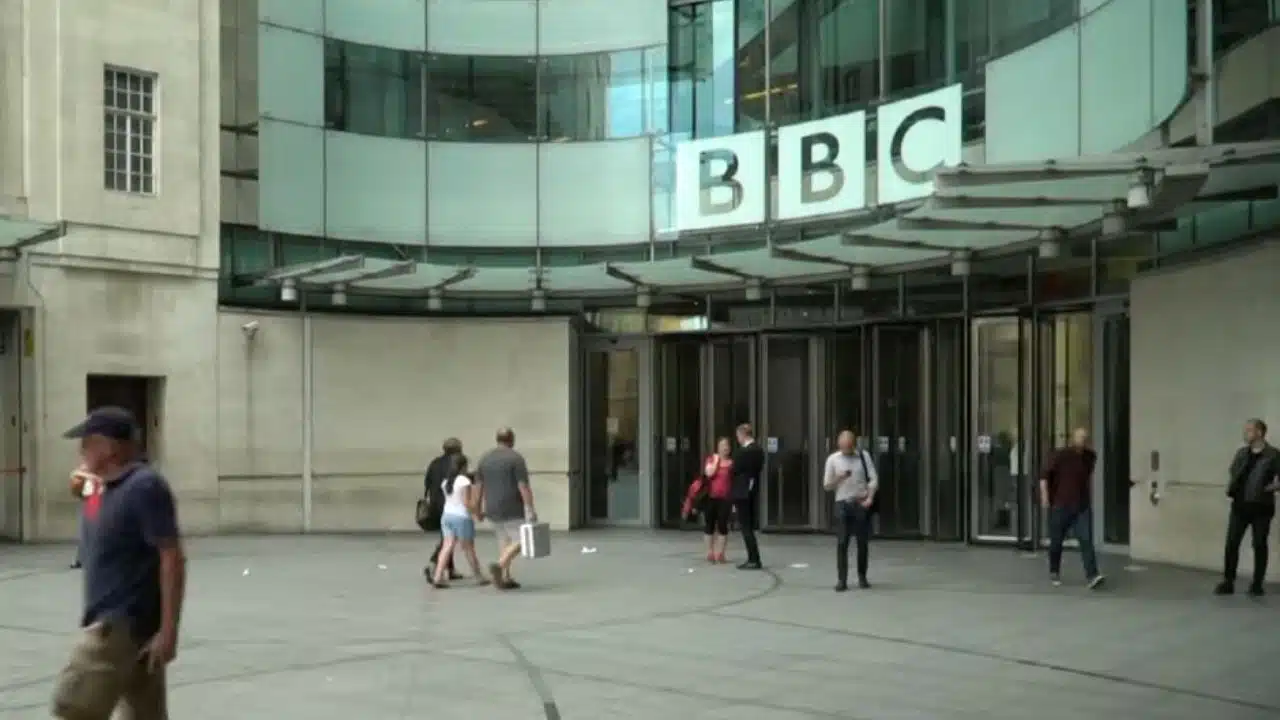
U.S. President Donald Trump has launched a new legal battle — this time against the BBC — threatening to sue the British public broadcaster for no less than $1 billion in damages. His legal team sent a formal letter to the BBC demanding a full retraction and apology over a controversial Panorama documentary that allegedly misrepresented his words from a 2021 speech.
According to Trump’s lawyers, the program, which aired just before the 2024 U.S. presidential election, edited and spliced parts of his January 6 Capitol speech in a misleading way that made it seem as though he had incited the violent riot. The lawsuit threat comes amid one of the biggest editorial scandals in the BBC’s modern history, leading to the resignation of Director General Tim Davie and News Chief Deborah Turness on Sunday.
The letter, sent by Trump’s Florida-based legal representatives, accuses the BBC of “defamation, malicious editing, and reckless disregard for truth.” It gives the broadcaster a deadline of November 14 to issue what Trump calls a “full and fair retraction.” Failing that, he vows to initiate legal action seeking at least $1 billion in compensation.
A spokesperson for Trump’s legal team confirmed the move, saying: “President Trump will continue to hold accountable those who traffic in lies, deception, and fake news. The BBC knowingly produced a false and defamatory portrayal that misled millions of viewers worldwide.”
The documentary at the heart of the controversy — “Trump: A Second Chance?” — was meant to explore Trump’s political comeback ahead of the 2024 election. However, a leaked internal dossier from within the BBC later revealed that the program edited together two different moments from Trump’s January 6 speech, removing crucial context. The edits combined his phrases “we’re going to walk down to the Capitol” and “fight like hell” — spoken at different times — into a single sequence that appeared to show him directly encouraging violence.
In reality, the original speech also contained Trump’s words urging supporters to act “peacefully and patriotically.” By omitting that part, critics say, the broadcast distorted the tone and intent of his remarks. The revelation triggered public outrage, political scrutiny, and a series of resignations inside the BBC.
BBC Chairman Samir Shah publicly apologized for what he called an “error of judgment.” He acknowledged that the edit “gave the impression of a direct call for violent action,” but denied that the BBC operates with systemic bias. He said the broadcaster “deeply regrets the mistake” and will “review editorial standards to prevent similar incidents in the future.” Despite this, Trump’s team insists the apology is insufficient, calling it “a public relations exercise that fails to address the gravity of the defamation.”
The incident has shaken confidence in the BBC’s reputation for impartiality. Internal reports describe the case as symptomatic of “serious and systemic problems” in editorial oversight. Sources within the broadcaster said that senior producers raised concerns about the edit before the program aired, but that those warnings were “brushed aside under deadline pressure.” The fallout has been described by insiders as “the most damaging credibility crisis since the Martin Bashir–Princess Diana scandal.”
Trump’s lawyers argue that the BBC’s false portrayal caused “immense reputational harm” to the president globally and “interfered in the U.S. election narrative by influencing public opinion through deception.” They accuse the broadcaster of “foreign election interference under the guise of journalism.”
The letter sent to the BBC includes a series of legal demands. These include the complete removal of the documentary from all platforms, a public and televised retraction, and a formal apology to Trump. It also instructs the BBC to preserve all internal communications, footage, metadata, and editorial notes related to the production — a sign that the president’s lawyers are preparing for litigation if the BBC fails to comply.
In response, a BBC spokesperson issued a short statement on Monday saying, “We have received correspondence from Mr. Trump’s legal representatives. We will review the letter carefully and respond directly in due course.”
Meanwhile, the resignations of Tim Davie and Deborah Turness were followed by strong reactions from both media watchdogs and political figures in the UK. Prime Minister Keir Starmer’s office commented that “clearly mistakes have been made” but rejected the claim that the BBC is institutionally biased or corrupt. Government sources indicated that while the BBC remains independent, it will need to “rebuild public trust through transparency and accountability.”
Within BBC headquarters, morale is reportedly low. Employees fear that Trump’s potential lawsuit — combined with the internal investigation — could lead to stricter political oversight and a crisis of confidence in international reporting. Some insiders argue that the issue was “blown out of proportion,” insisting that the edit was a “production mistake, not a conspiracy.” Others say the problem reflects deeper flaws in the organization’s culture, with one producer describing it as “a newsroom too eager to dramatize political coverage.”
Trump’s decision to take legal action against the BBC also fits into his broader strategy of confronting what he calls “fake news.” Over the past decade, he has filed or threatened lawsuits against several U.S. outlets including CNN, ABC, CBS, and The New York Times — though few of these have reached court. His team says the BBC case is different because the broadcaster operates internationally and “deliberately altered factual material.”
The controversy comes at a politically sensitive time. Trump is once again a central figure in U.S. politics, campaigning for the 2024 election with strong momentum. The Panorama documentary aired just days before the vote, prompting accusations that the BBC influenced the global media narrative about his candidacy.
Analysts say the dispute could test the boundaries of international media law. Because the BBC is based in the UK but broadcasts globally, a defamation case filed in a U.S. court — especially under Florida law — would raise complex jurisdictional questions. Legal experts note that even if Trump proceeds, enforcing a U.S. judgment against a British public broadcaster could prove difficult.
Still, the threat alone has already caused significant fallout. British MPs are calling for an independent review of the BBC’s editorial practices. U.S. commentators are using the incident to highlight how global media networks can shape political perception across borders.
For the BBC, the challenge now is to repair its image. Its leaders have promised to overhaul fact-checking and editing policies and to require stricter oversight for politically sensitive content. But critics argue that no procedural reform can undo the damage already done to public trust.
For Trump, the confrontation allows him to reinforce his long-standing narrative that the media unfairly targets him. The lawsuit threat plays into his broader political messaging — portraying himself as a victim of media distortion while appealing to supporters who already distrust mainstream journalism.
As of now, the BBC has not publicly retracted the documentary. Trump’s legal team maintains that if there is no retraction or apology by the November 14 deadline, they will file suit for at least $1 billion in damages. Whether this turns into a courtroom battle or a negotiated settlement remains to be seen — but the case has already become one of the most dramatic clashes between a global broadcaster and a U.S. president in recent memory.
A Broader Test for Media Integrity and Accountability
The dispute between Donald Trump and the BBC represents more than a personal grievance — it underscores the global tension between press freedom, political accountability, and editorial responsibility. The BBC, often regarded as the world’s benchmark for impartial journalism, now faces questions about how its editorial processes can fail so dramatically in such a high-stakes moment.
The leaked dossier that exposed the editing error also pointed to deeper systemic concerns: a tendency toward “agenda-driven storytelling,” internal pressure to “sensationalize complex political issues,” and a “lack of robust fact-verification in visual editing.” These revelations have triggered renewed debates in the UK about whether the BBC’s governance structure and oversight mechanisms are sufficient for today’s hyper-politicized global media landscape.
At the same time, Trump’s move raises questions about the use of legal threats as a political weapon. While defamation law allows public figures to defend their reputations, critics argue that repeated lawsuits against journalists and media institutions can chill free speech. Media rights advocates warn that billion-dollar claims — even if not ultimately successful — can intimidate reporters and editors, making them more cautious in covering powerful figures.
Still, even among Trump’s critics, few dispute that the BBC’s edit was a serious failure. By combining lines from different parts of a speech and removing key context, the broadcaster produced a version of events that changed the meaning of what was said. In an age of video virality and rapid online dissemination, such errors can have global consequences within hours.
Experts in media ethics say the BBC incident will likely become a case study in newsroom responsibility. It demonstrates how even well-resourced institutions with rigorous editorial codes can stumble when speed and narrative pressure override accuracy. For international media organizations, it also highlights the risk of cross-border accountability — when one country’s media decisions can have legal and political repercussions in another.
Trump’s threatened lawsuit, whether pursued or not, has already achieved one goal: forcing one of the world’s most trusted broadcasters to publicly confront its own editorial failings. It has reignited global discussion about what “truth” means in political journalism and how easily that truth can be bent by editing choices, whether intentional or accidental.
As the deadline for the BBC’s response approaches, both sides remain firm. Trump wants a retraction, apology, and billion-dollar damages. The BBC insists it is reviewing the situation internally and will respond “in due course.” What happens next could shape not only the future of the BBC’s credibility but also set a new precedent for how political figures challenge the global media in the age of instant, worldwide communication.
The Information is Collected from BBC and MSN.