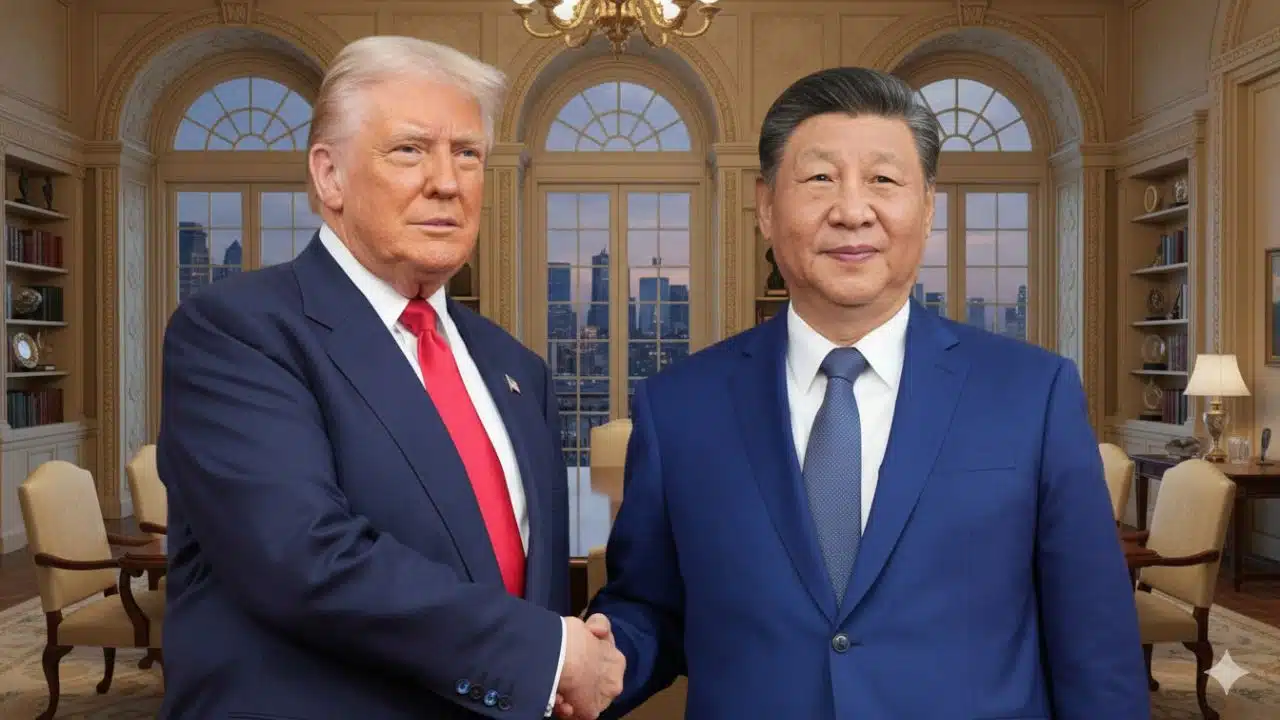
US President Donald Trump and Chinese President Xi Jinping agreed to a significant de-escalation in the nations’ simmering trade conflict on Thursday, following their first face-to-face meeting in six years. Aboard Air Force One, President Trump announced he reduced tariffs on Chinese goods from a combined 57% to 47%, a move exchanged for major Chinese concessions on fentanyl, rare earths, and agricultural purchases.
Key Facts: The Busan Agreement
- Tariff Reduction: The overall US tariff rate on a basket of Chinese goods will be cut by 10 percentage points, from 57% to 47%.
- The Fentanyl Factor: The cut is directly tied to the 20% “fentanyl tariff” imposed by the Trump administration earlier this year, which will now be halved to 10%.
- China’s Concessions: In exchange, President Xi pledged to “work very hard” to crack down on the export of fentanyl precursor chemicals.
- Rare Earths ‘Settled’: China agreed to a one-year, renewable deal to end its recent export restrictions on critical rare earth minerals, a major source of recent tension.
- Soybeans to Resume: Beijing will “immediately” resume large-scale purchases of US soybeans, a key demand from Trump’s political base in the farm belt.
- Historic Meeting: The summit, held on the sidelines of the APEC forum, was the first time the two leaders have met in person since 2019, during Trump’s first presidential term.
A High-Stakes Thaw in Busan
The 100-minute meeting at Gimhae airbase in Busan, South Korea, concluded what has been a volatile year for US-China relations. Since returning to office in January 2025, President Trump has escalated economic pressure on Beijing, imposing new tariffs linked to the fentanyl crisis and threatening a 100% tariff escalation just weeks ago in response to Chinese curbs on rare earth minerals.
The meeting, which Trump later described to reporters as an “amazing meeting” and “a 12” on a scale of one to 10, appears to have successfully pulled both nations back from the brink of a full-blown trade war.
“A lot of things we brought to finalization,” Mr. Trump told reporters on Air Force One. “We have a deal.”
President Xi, who had not met Trump in person since the G20 summit in Osaka, Japan, in 2019, struck a conciliatory tone. He told Trump it felt “very warm seeing you again” and noted that while differences are “normal,” the two nations “should be partners and friends.”
According to Chinese state media, Xi confirmed that their respective economic teams had reached a “basic consensus” on addressing major concerns, paving the way for the leaders’ agreement.
Deconstructing the Deal: Fentanyl, Rare Earths, and Soybeans
The agreement reached in Busan is a transactional détente, targeting the three most acute points of friction that have developed in 2025.
The 10-Point Tariff Cut (The Fentanyl Factor)
The centerpiece of the announcement is the tariff reduction. This is not a broad rollback of all existing tariffs but a specific, targeted cut.
- Overall Rate Change: The combined tariff rate on the affected Chinese goods drops from 57% to 47%.
- Specific Mechanism: This 10-point drop comes from halving a specific 20% tariff that the Trump administration had imposed earlier in 2025, explicitly linking it to China’s role in the fentanyl crisis.
- The Quid Pro Quo: “I put a 20 per cent tariff on China because of the fentanyl coming in… and based on his statements today I am going to reduce that by 10 per cent,” Trump explained to reporters. This is in direct exchange for Xi’s new commitment to aggressively police precursor chemical exports.
Settling the ‘Roadblock’: Rare Earths Secured
Perhaps the most significant economic outcome is the resolution of the rare earths dispute. Earlier this month, China tightened export controls on the critical minerals, which are essential for defense, electronics, and high-tech manufacturing. The move threatened to cripple Western supply chains and prompted Trump to threaten retaliatory tariffs of 100% starting November 1.
That threat is now “effectively off the table,” according to US officials.
President Trump was definitive: “All the rare earth issue has been settled. That roadblock is gone now, there’s no roadblock at all on rare earths.
The agreement establishes a one-year deal for China to ensure the flow of these minerals, which will be renegotiated annually. This provides immediate stability to global tech markets but builds in a point of future leverage for both sides.
A Lifeline for the Farm Belt
In a major political win for President Trump, China has agreed to restart agricultural purchases that had been frozen by the trade tensions.
“They’re going to start immediately buying tremendous amounts of soybeans and other farm products,” Trump stated.
This concession is a direct appeal to American farmers, a critical part of Trump’s political base, who were hit hard by previous trade wars and the recent freeze. The resumption of soybean purchases signals a return to the more transactional trade relationship seen during Trump’s first term.
Official Responses: ‘A Consensus Reached’
President Trump, striking a triumphant tone, announced he would visit China in April 2025, with a reciprocal visit from Xi to the US “sometime after that,” signaling a return to more regular leader-level diplomacy.
China’s official response was more measured but positive. The Ministry of Foreign Affairs in Beijing released a statement confirming the meeting, noting, “President Xi Jinping Meets with U.S. President Donald J. Trump in Busan. The statement emphasized that the two sides reached “consensus” and should “lengthen the list of cooperation.”
President Xi told Trump that “dialogue is better than confrontation,” according to the official Chinese readout, stressing that “China and the U.S. economic and trade relations have experienced ups and downs,” but should “serve as the anchor and driving force” for the relationship.
Analysis: A Fragile Truce, Not a Lasting Peace
While global markets are expected to react positively to the immediate de-escalation, analysts caution that the fundamental rivalry between the two superpowers remains unchanged.
The Busan agreement is a classic Trump-style transactional deal: a tit-for-tat exchange on tangible goods (fentanyl, soybeans, rare earths) rather than a structural resolution of deeper conflicts over technology, national security, or global influence. The 47% tariff rate that remains on this basket of goods is still exceptionally high by historical standards, and the one-year-deal on rare earths simply sets a new deadline for future conflict.
As one US official, speaking anonymously after the meeting, told reporters, “Both sides managed the volatility. The deeper rivalry endures.
What Wasn’t in the Deal: Taiwan and Tech
Just as telling as what was agreed upon is what was left out.
- Taiwan: In a move that will be scrutinized in both Taipei and Washington, President Trump confirmed to reporters that the sensitive issue of Taiwan’s sovereignty “never came up” during the 100-minute discussion.
- Technology: Broader US controls on advanced technology remain firmly in place. While Trump mentioned that Beijing would be “talking to Nvidia’s CEO,” he clarified that this would not involve the company’s most advanced Blackwell AI chips, which are barred from sale to China. Furthermore, the fate of TikTok, which US Treasury Secretary Scott Bessent had suggested would be “consummated” at the summit, was not mentioned in the final readouts.
The war in Ukraine was discussed “very strongly,” according to Trump, with a vague commitment to “work together… to get something done,” but no concrete deliverables were announced.
A Volatile Relationship Stabilized, For Now
The Busan summit succeeded in its primary goal: averting an immediate economic catastrophe. The threat of a 100% tariff war is gone, supply chains for rare earths are secured for the next year, and a path for dialogue has been reopened.
However, the agreement is a temporary truce, not a peace treaty. By focusing on tangible “wins” like soybeans and fentanyl while deliberately avoiding systemic issues like Taiwan and advanced chip controls, the Trump-Xi meeting has effectively traded short-term stability for long-term strategic competition. The stage is now set for the next round of high-stakes negotiations when President Trump visits Beijing in April.