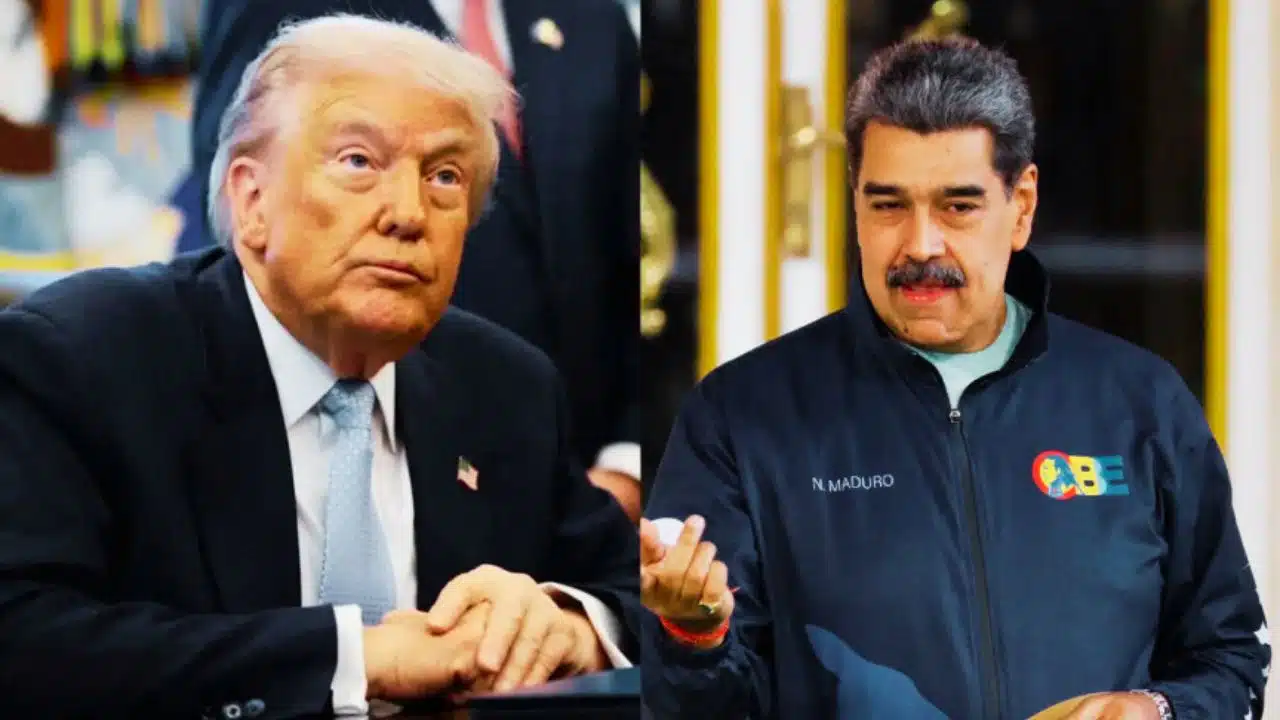
US President Donald Trump has confirmed that he recently held a phone call with Venezuelan President Nicolás Maduro, acknowledging rare direct contact amid fast‑rising tensions between Washington and Caracas. The disclosure comes as the United States builds up military pressure around Venezuela and debates how far to go in trying to force Maduro from power.
Trump confirms rare contact
Trump told reporters aboard Air Force One that he had indeed spoken with Maduro in recent days but declined to share details, characterizing it simply as a phone conversation and stressing that it should not be over‑interpreted. According to reporting from multiple US outlets, the call is believed to have taken place late last week, after weeks of internal discussion in Washington over whether the president should engage directly with the Venezuelan leader. The White House has not issued a formal readout of the exchange, and officials in Caracas have likewise avoided confirming specifics, even as sources close to both governments acknowledge that the communication occurred.
What was reportedly on the table
US media reports, citing anonymous officials, say the two leaders discussed the possibility of a face‑to‑face meeting in the United States, though no date or concrete plan has been set. Some accounts suggest that potential terms for Maduro’s exit were floated, including ideas around safe passage or amnesty if he were to resign, reflecting Washington’s long‑stated desire to see him leave office. One report describes Trump using the call to deliver a stark ultimatum, indicating that Maduro and his family could be allowed to leave Venezuela unharmed if he stepped down quickly, though Caracas has not publicly confirmed that version of events.
Military buildup and airspace warning
The revelation of the call coincides with a significant US military presence in the Caribbean and nearby waters, officially justified as a campaign against drug‑trafficking networks linked by Washington to the Maduro government. US forces have already carried out air and maritime strikes against suspected trafficking targets, operations that rights advocates say have caused dozens of deaths and raised legal questions about the scope of the campaign. Over the weekend, Trump posted that the airspace above and around Venezuela should be considered closed, a statement that fueled speculation about imminent action before he later told reporters that the warning did not necessarily signal an immediate strike and should not be seen as a definitive precursor to war.
Caracas and international reaction
Venezuela’s government has harshly condemned Trump’s talk of closing its airspace, describing it as a colonial‑style threat intended to intimidate the country and undermine its sovereignty. Maduro and senior officials argue that Washington is using anti‑drug rhetoric to disguise a broader push for regime change and potential control over Venezuela’s vast oil reserves, while calling on allies in Latin America and beyond to oppose any US military move. Regional analysts note that relations between the two countries have been frozen for years, with no embassies and minimal formal cooperation, making this direct presidential contact even more striking against a backdrop of mutual hostility.
What the call could mean next
Diplomats and experts say the phone call underscores a dual‑track approach in Washington, where intense pressure and threats of force coexist with sudden openings for high‑level dialogue. Some analysts see the outreach as an attempt by Trump to gain leverage—either to warn Maduro personally of the risks of holding on or to test whether a negotiated transition is still possible—while also keeping military options on the table. Others caution that without a clear diplomatic framework, mixing bellicose rhetoric, expanding strikes and opaque leader‑to‑leader conversations risks miscalculation, with potentially severe consequences for Venezuelan civilians already living under deep economic and political crisis.