The true scale of the Trump immigration policy 2026 impact is no longer a matter of speculation; it is a measurable economic and social reality that has redefined the nation in just 365 days. On January 20, the White House released a celebratory dossier, “365 Wins,” lauding a historic 99% drop in illegal border crossings. Yet, simultaneously, a coalition of civil rights organizations released a counter-report dubbed the “Dirty Dozen.”
This harrowing document details twelve specific, aggressive mechanisms, from retroactive vetting to census weaponization, that have effectively replaced the physical wall with an impenetrable bureaucratic iron curtain.
The Cost of Victory
As the administration takes its victory lap, a chilling economic forecast from the Brookings Institution tells a different story. Their latest data warns that this aggressive severance of labor supply chains has triggered a “self-inflicted recession.”
- The Official Narrative: The “open border industrial complex” has been dismantled.
- The Economic Reality: A labor supply shock is threatening to reverse U.S. economic growth by mid-2026.
This analysis moves beyond the headlines to expose the operational mechanics of the “Dirty Dozen,” the silent crisis in the American labor market, and the geopolitical shockwaves of the new travel bans. This is the story of how a campaign promise became a policy sledgehammer, and what the debris looks like for the future of the United States.
The “Dirty Dozen”: A Bureaucratic Siege
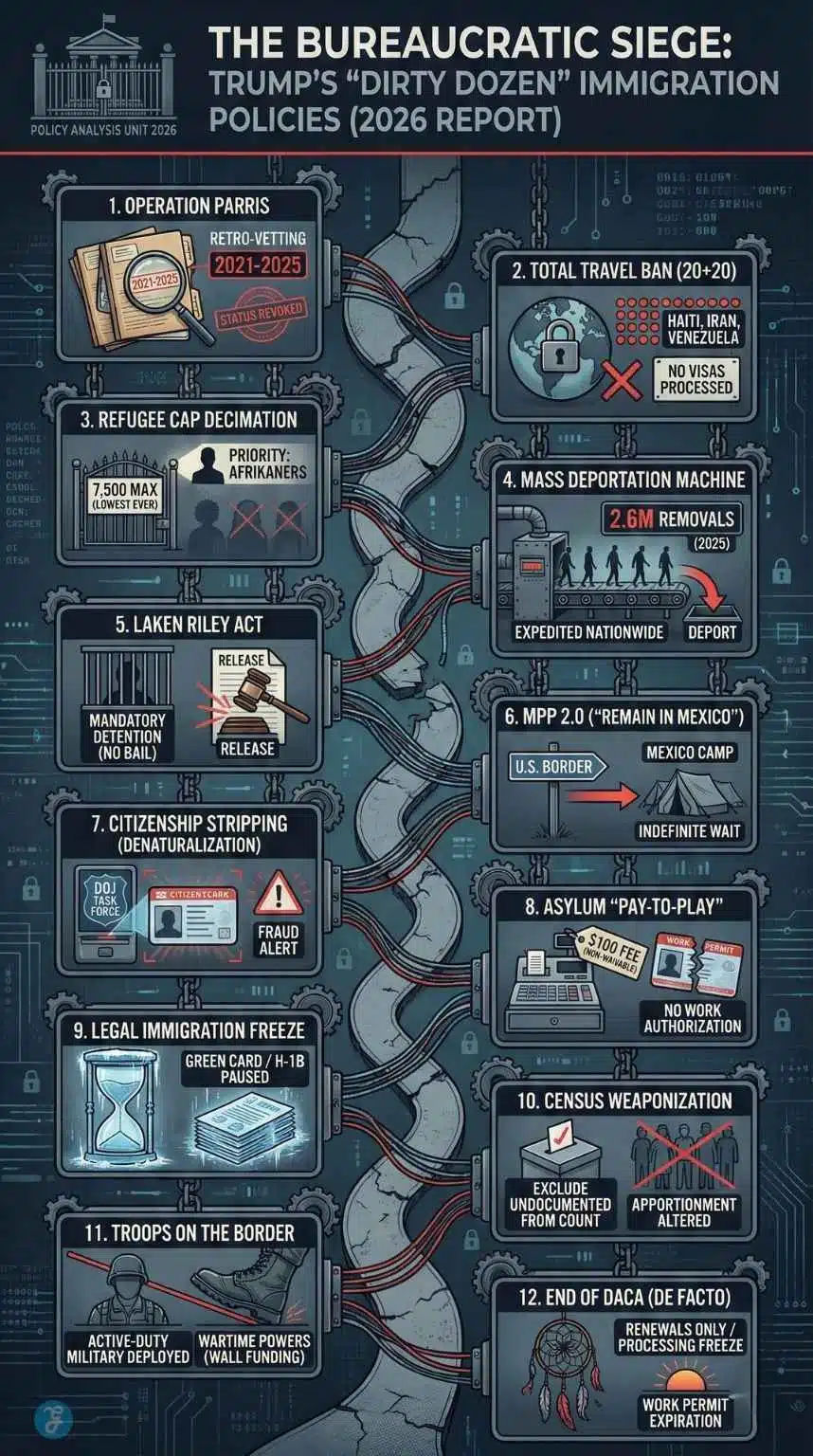
The “Dirty Dozen” report categorizes the administration’s actions not merely as enforcement, but as a “total war” on movement. Unlike the first term, which relied heavily on executive orders that were often overturned in court, the 2025–2026 strategy has utilized a mix of “wartime” powers, administrative loopholes, and coordinated agency action (Project 2025) to bypass judicial review.
The “Dirty Dozen” Policy Snapshot
It summarizes the complex policy mechanisms into a quick-reference guide.
| Policy Name | Mechanism | Primary Target | Immediate Impact |
| 1. Operation PARRIS | Retroactive vetting of 2021–2025 statuses | Refugees already in the U.S. | Revocation of legal status for minor clerical errors. |
| 2. Total Travel Ban (20+20) | Visa suspensions for 40 nations | High-overstay & specific nations | Complete halt on entry from countries like Haiti & Venezuela. |
| 3. Refugee Cap Decimation | Ceiling lowered to 7,500 | Global South applicants | 95% drop in admissions; priority given to “Afrikaners.” |
| 4. Mass Deportation | Expedited removal nationwide | Undocumented residents | 2.6M removals in 2025; bypass of immigration courts. |
| 5. Laken Riley Act | Mandatory detention without bail | Immigrants charged with crimes | Explosion of private prison population; no judicial discretion. |
| 6. MPP 2.0 | “Remain in Mexico” made permanent | Asylum seekers | 100% bar on entry pending court dates; border camps expand. |
| 7. Denaturalization Task Force | AI-driven fraud detection | Naturalized Citizens | Citizenship stripping for past “fraud” or “anti-American” ties. |
| 8. Asylum “Pay-to-Play” | $100 fee + No Work Permit | Low-income asylum seekers | Financial barrier forcing applicants to drop cases. |
| 9. Legal Freeze | Green Card/H-1B processing pause | Skilled workers | Tech sector “brain drain” & family separation. |
| 10. Census Weaponization | Exclusion from apportionment | Undocumented residents | Undercounting of urban populations & funding loss. |
| 11. Troops on Border | Active-duty military deployment | Border crossers | Militarization of the border zone; bypass of the Congressional budget. |
| 12. End of DACA | Processing freeze (Silent Death) | Dreamers | Gradual expiration of work permits; loss of legal status. |
1. Operation PARRIS: The Retroactive Dragnet
Perhaps the most controversial of the twelve policies is Operation PARRIS. Named obscurely to avoid initial scrutiny, this initiative represents a paradigm shift in refugee management. Historically, once a refugee was granted status in the U.S., they were considered safe. Operation PARRIS has upended this norm by launching a retroactive review of all refugee statuses granted between 2021 and 2025.
Under the guise of “national security auditing,” the Department of Homeland Security (DHS) has reopened thousands of cases, searching for minor inconsistencies in paperwork, a misspelled name, a discrepancy in dates, to allege fraud. The “Dirty Dozen” report highlights that this is not about catching terrorists; it is about retroactively lowering admission numbers. For families who have lived in the U.S. for years, established businesses, and sent children to school, PARRIS introduces a permanent state of precariousness. Legal scholars argue this effectively ends the concept of “asylum” as a permanent protection, turning it into a revocable temporary license.
2. The “Total” Travel Ban (20+20)
The Trump travel ban list 2026 makes the 2017 version look modest. The administration has implemented a dual-tier restriction system affecting 40 nations, covering nearly a quarter of the world’s population.
- Tier 1 (Total Ban): 20 countries, including Afghanistan, Haiti, Iran, and Burma, face a complete prohibition on entry. No visas, tourist, student, or business, are being processed.
- Tier 2 (Partial Ban): Another 20 countries, specifically targeting nations with high overstay rates like Venezuela, Colombia, and Nigeria, face a suspension of immigrant visas.
The inclusion of Venezuela is particularly significant. It effectively traps those fleeing the destabilized post-Maduro region, forcing them into the hands of smugglers or leaving them stranded in transit nations. The “Dirty Dozen” analysis suggests this policy is less about security and more about a demographic filter, systematically cutting off migration from specific regions of the Global South.
3. Refugee Cap Decimation & The “Afrikaner” Pivot
The FY2026 refugee ceiling has been slashed to 7,500, the lowest in U.S. history. However, the raw number is less shocking than the allocation. The “Dirty Dozen” report exposes a racialized priority system where a significant portion of these limited spots are earmarked for “religious and cultural minorities facing persecution in South Africa” (a coded reference to white Afrikaners). Meanwhile, allocations for Latin America and Africa have been virtually zeroed out. This explicit racial prioritization in refugee admissions is unprecedented in modern American history, drawing sharp rebukes from the UN High Commissioner for Refugees, yet remaining firmly in place under executive prerogative.
4. The Mass Deportation Machine
The pledge to deport millions was not rhetoric. In 2025 alone, ICE removed 2.6 million undocumented individuals. The “Dirty Dozen” details how this was achieved: by expanding “expedited removal” authority to the entire interior of the United States. Previously, this fast-track deportation (which bypasses immigration judges) was limited to border zones. Now, an undocumented immigrant apprehended in Kansas or Ohio can be deported within days without ever seeing a courtroom. This policy has effectively turned every state into a border state, and every local police encounter into a potential immigration raid.
The Enforcement Complex: Criminalizing Existence
The second quadrant of the “Dirty Dozen” focuses on the criminalization of presence and the removal of judicial discretion.
5. The Laken Riley Act (Mandatory Detention)
Named after a victim of a crime committed by an undocumented immigrant, this federal law has removed the power of bond hearings for non-citizens. The act mandates the detention of any undocumented immigrant charged with any theft or violence-related offense, regardless of conviction. The “Dirty Dozen” report notes that this has led to the explosion of the private prison population. With county jails overflowing, the federal government has commandeered decommissioned military bases to house detainees, creating a sprawling, opaque detention archipelago where access to legal counsel is severely restricted.
6. End of “Catch and Release” / MPP 2.0
The “Migrant Protection Protocols” (MPP), or “Remain in Mexico,” is no longer a pilot program; it is the default law of the land. Asylum seekers are largely barred from entering the U.S. pending their court dates. However, unlike the 2019 iteration, MPP 2.0 comes with almost no humanitarian infrastructure. Tens of thousands are camped in northern Mexican cities, which have become zones of extortion and violence. The U.S. government’s stance, as outlined in the “365 Wins” dossier, is that these conditions serve as a necessary deterrent, a feature, not a bug, of the policy.
7. Citizenship Stripping (Denaturalization)
A chilling addition to the DOJ’s mandate is the new task force dedicated to denaturalization. This unit uses AI-driven data matching to scan the histories of naturalized citizens, looking for “fraudulent” prior asylum claims or undisclosed ties to “anti-American” organizations. While the administration claims it targets criminals, the “Dirty Dozen” report cites cases where citizens were targeted for political activism or minor clerical errors made decades ago. This policy strikes at the very foundation of citizenship, suggesting it is a conditional privilege rather than an inalienable right.
8. Asylum “Pay-to-Play”
Access to safety now has a price tag. The administration has implemented a $100 non-waivable fee for asylum applications. For a family fleeing with nothing but the clothes on their backs, this sum is insurmountable. Furthermore, applicants are now barred from receiving work permits while their cases are pending appeal. This “starve them out” strategy forces legitimate asylum seekers to either work illegally (risking immediate deportation under the Laken Riley Act) or abandon their claims entirely.
The Civil Conflict: Operation Metro Surge
While the border remains the rhetorical focus, the true friction point of 2026 has shifted to the American interior, specifically within “Blue State” jurisdictions resisting federal enforcement. The flashpoint of this conflict is Minneapolis, where the administration launched “Operation Metro Surge” in early January, a deployment of 2,000 additional federal agents to a single metropolitan area.
The situation turned deadly on January 7, 2026, when an ICE agent fatally shot Renee Macklin Good, a U.S. citizen, during a chaotic attempted arrest of an undocumented neighbor in South Minneapolis. This incident has triggered a constitutional crisis. Minnesota Attorney General Keith Ellison has filed an emergency injunction to halt federal operations, citing the 10th Amendment, while the White House has threatened to invoke the Insurrection Act to federalize the Minnesota National Guard.
This is no longer just about immigration; it is a battle over state sovereignty. “Operation Metro Surge” is widely seen as a pilot program. If the administration successfully subjugates Minnesota’s local law enforcement, who have ceased all cooperation with DHS, similar surges are planned for Chicago and New York by Q3 2026. The “Dirty Dozen” report underscores that this militarization of American cities is the inevitable endgame of a mass deportation policy that lacks local consent.
The “Invisible Wall”: Economic Suicide?
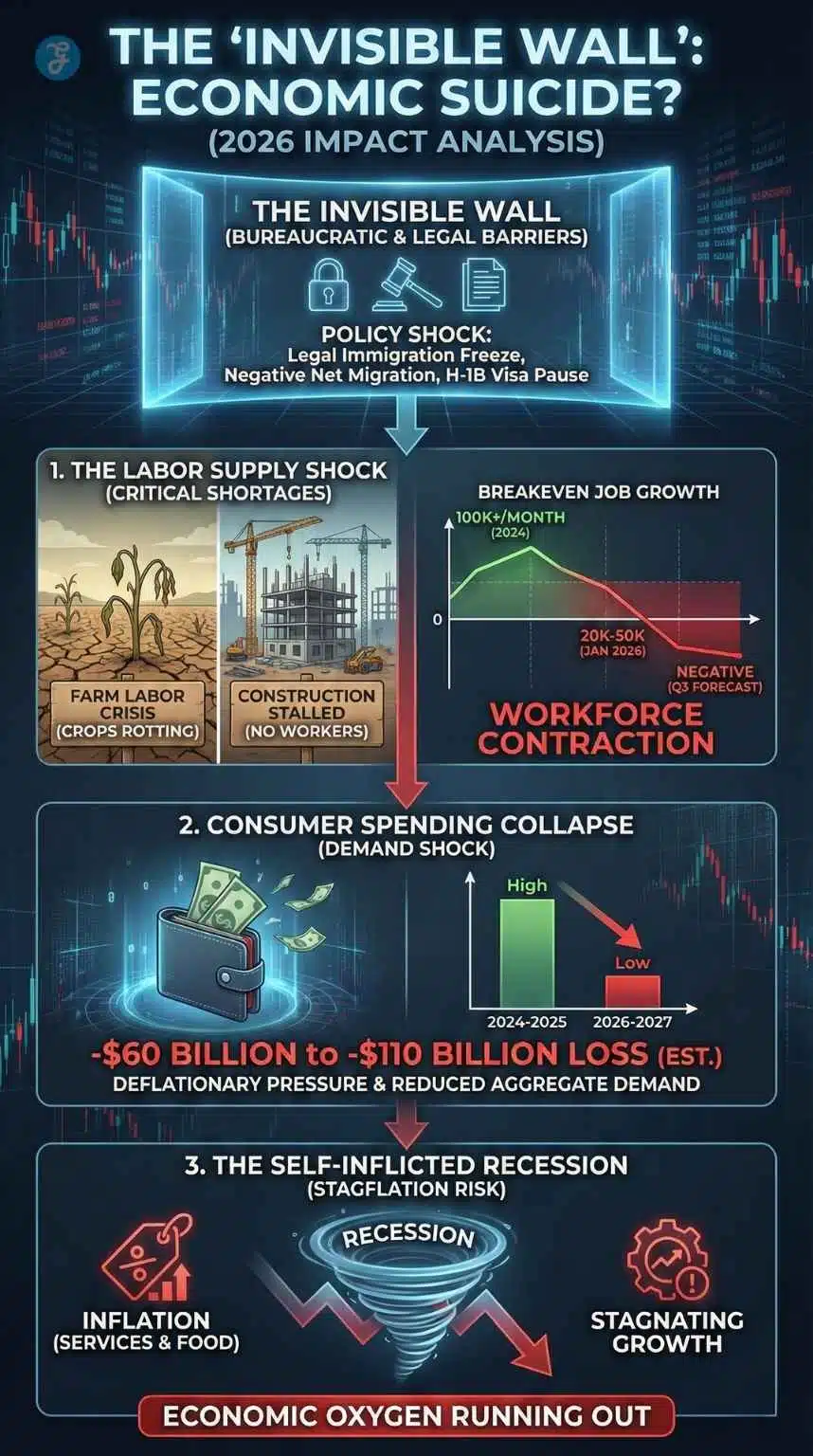
While the first eight policies focus on physical movement, the final four, and the resulting economic data, reveal the long-term structural damage. This is where the US net migration 2026 statistics paint a dire picture.
9. The Legal Immigration Freeze
The administration has placed an indefinite pause on Green Card processing for nationals of “Ban” countries and frozen H-1B visa expansions. This bottleneck has stranded thousands of skilled workers and family members in bureaucratic limbo. Tech companies in Silicon Valley and Austin are already reporting a “brain drain” as talent relocates to Canada and Germany, where immigration systems have been streamlined to capitalize on the U.S. closure.
10. Census Weaponization
An Executive Order now directs the Census Bureau to exclude undocumented immigrants from the population counts used for congressional apportionment. While this faces legal challenges, the immediate effect has been to terrify immigrant communities into silence. Census workers report record non-compliance rates in immigrant-heavy districts, which will lead to a massive undercounting of resources and funding for the next decade, disproportionately affecting urban centers.
11. Troops on the Border
The shift from National Guard support to active-duty military deployment has normalized the militarization of the border. Using “wartime” emergency powers, the President has reallocated billions from the Department of Defense budget to complete the border wall and sustain the troop presence. This bypasses Congressional “power of the purse” and sets a precedent for the use of the military in domestic law enforcement.
12. The Death of DACA
While no single order “killed” DACA, the “Dirty Dozen” describes its “death by a thousand cuts.” First-time applications are rejected outright. Renewals are processed at a glacial pace, causing thousands to lapse out of status each month. The administration has signaled a move to end work authorization for all recipients by late 2026, pushing nearly 600,000 “Dreamers” out of the formal economy and into the shadows.
The Economic Fallout: A Self-Inflicted Recession
The administration’s “365 Wins” report frames these twelve policies as a triumph of sovereignty. However, the laws of economics are exacting a heavy toll. The Brookings Institution’s January 13 report, “Macroeconomic implications of immigration flows in 2025 and 2026,” provides the counter-narrative to the political victory lap.
Negative Net Migration
For the first time in half a century, the U.S. is experiencing negative net migration. Brookings estimates that net migration in 2025 was between -10,000 and -295,000. This means more people are leaving the U.S. than entering. This is a demographic earthquake. The U.S. economy relies on population growth to fuel consumption and fill labor gaps. Without immigration, the U.S. population is effectively shrinking.
The Labor Supply Shock
The most immediate impact is on the labor market. “Breakeven” employment growth, the number of jobs the economy needs to add to keep up with population growth, has dropped from roughly 100,000 per month to a meager 20,000–50,000.
- Agriculture: Farmers in California and the Midwest are reporting a crisis. With the H-2A visa program entangled in new “security” red tape (part of the Legal Freeze), crops are literally rotting in the fields. Wholesale food prices are already creeping up as a result.
- Construction: The housing market, desperate for new inventory to lower prices, is stalled. Construction firms cannot find workers to frame houses or pour concrete. The “Dirty Dozen” policies have removed the very workforce needed to solve the housing affordability crisis.
The Economic Cost [The “Brookings” Gap]
This is to visualize the sharp contrast between the “success” of border enforcement and the “failure” of economic health, highlighting the “Self-Inflicted Recession” argument.
| Economic Indicator | Pre-Crackdown Status (Est. 2024) | Current Status (Jan 2026) | Forecast (Q3 2026) |
| Net Migration | Positive (+1M approx.) | Negative (-10k to -295k) | Continued decline (Population shrinkage) |
| Border Apprehensions | High (Crisis levels) | Lowest since 1970s (-99%) | Near Zero (Total closure) |
| “Breakeven” Job Growth | ~100,000 / month | 20,000 – 50,000 / month | Negative (Labor force contraction) |
| Ag/Construction Labor | Tight but functional | Severe Shortage | Widespread crop rot; halted housing projects |
| Consumer Spending Impact | Stable Growth | -$60 Billion (Loss) | -$110 Billion (Deflationary pressure) |
Consumer Spending Collapse
Immigrants are not just workers; they are consumers. They buy food, rent apartments, and pay sales taxes. The mass deportations and the exodus of voluntary leavers are projected to wipe out $60–$110 billion in consumer spending over the next two years. This reduction in aggregate demand is a deflationary force that could tip the U.S. into a recession by mid-2026, a phenomenon economists are calling the “Exodus Contraction.”
The Health Crisis: Rural Hospitals on Life Support
The economic data on labor shortages finds its most dangerous expression in the healthcare sector. The administration’s new $100,000 H-1B Visa Fee (implemented via executive order in late 2025) was designed to force tech companies to hire Americans. Instead, it has devastated rural healthcare.
Rural hospitals, which rely on International Medical Graduates (IMGs) for nearly 64% of their staffing, are now facing bankruptcy. They simply cannot afford the six-figure surcharge to sponsor a single doctor.
- The “Global Nurse Force v. Trump” Lawsuit: A coalition of healthcare staffing agencies filed suit this month, arguing the fee is an illegal tariff. However, with the courts moving slowly, the damage is immediate.
- The Impact: In January alone, 17 rural clinics in the Midwest announced closures. The “brain drain” is measurable: foreign-trained doctors are rejecting U.S. residency matches in record numbers, opting for Canada or the UK.
For the 60 million Americans living in rural areas, the “America First” immigration policy has ironically resulted in “Americans Last” for healthcare access. With the flu season peaking in February, the lack of personnel is expected to drive rural mortality rates to their highest levels since the 2020 pandemic.
Case Study: The “Self-Deportation” Experiment
Nothing illustrates the cynical efficiency of the new regime better than the deportation stipend DHS initiative launched on January 21, 2026.
The CBP Home App Initiative
In a move that blends tech-startup tactics with enforcement, the Department of Homeland Security introduced a new feature on the “CBP Home” mobile app. It offers undocumented immigrants a “Voluntary Departure Package”: a free one-way flight and a $2,600 resettlement stipend if they agree to self-deport and waive their right to a future hearing.
The administration markets this as a cost-saving measure. They argue that paying $5,100 (flight + stipend + admin) is far cheaper than the $18,245 it costs to detain and forcibly remove an individual. However, critics see it as psychological warfare. By combining the threat of the “Dirty Dozen” policies (mandatory detention, family separation, prison) with a financial carrot, the government is coercing individuals to abandon their legal rights.
Early data suggest the program is seeing high uptake among those exhausted by the “invisible wall” of bureaucracy. Yet, the long-term cost to the U.S. is ignored. The $2,600 payout is a one-time expense, but the loss of that individual’s future tax contributions and economic activity is permanent. It is a “penny-wise, pound-foolish” strategy that prioritizes short-term deportation stats over long-term fiscal health.
The Northern Front: Canada’s Wall of Silence
While the world watches the Mexican border, a quiet crisis is unfolding to the north. Fearing a spillover from the U.S. crackdown, Canada has effectively ended its era of open arms. In a move that strained diplomatic relations, Prime Minister Trudeau’s government has begun rejecting nearly 3,700 visitors per month, a spike of 20% compared to previous years, citing fears that U.S. visitors will claim asylum.
The tension escalated when President Trump threatened to impose a 25% tariff on Canadian goods if Ottawa did not “seal the northern backdoor.” In response, the Canadian Border Services Agency (CBSA) has thickened the border, turning away U.S. residents and third-country nationals at record rates.
Refugee advocates call this the “Northern Trap.” Thousands of asylum seekers who fled north to escape Operation PARRIS are now finding themselves stuck in a freezing limbo between a hostile U.S. administration and a fortified Canadian border. The “Safe Third Country Agreement,” once a bureaucratic formality, has become a geopolitical weapon, leaving vulnerable families with literally nowhere to turn.
Final Thought: The High Price of a Closed Door
As we analyze the Trump immigration policy 2026 impact, the verdict is stark. For the administration, the mission is accomplished: the “Dirty Dozen” policies have effectively sealed the border and dismantled the asylum system, validating the “365 Wins” victory lap.
However, the broader view reveals a nation sanctioning its own economy. The Brookings data confirms that by engineering negative net migration, the U.S. is courting a “self-inflicted recession.” We are now witnessing a labor supply shock that promises stubborn inflation and stagnating growth, stagflation born not of external crisis, but internal policy.
In 2026, the door is bolted shut. The coming months will determine if the political satisfaction of a closed border is worth the heavy price of a broken economy.