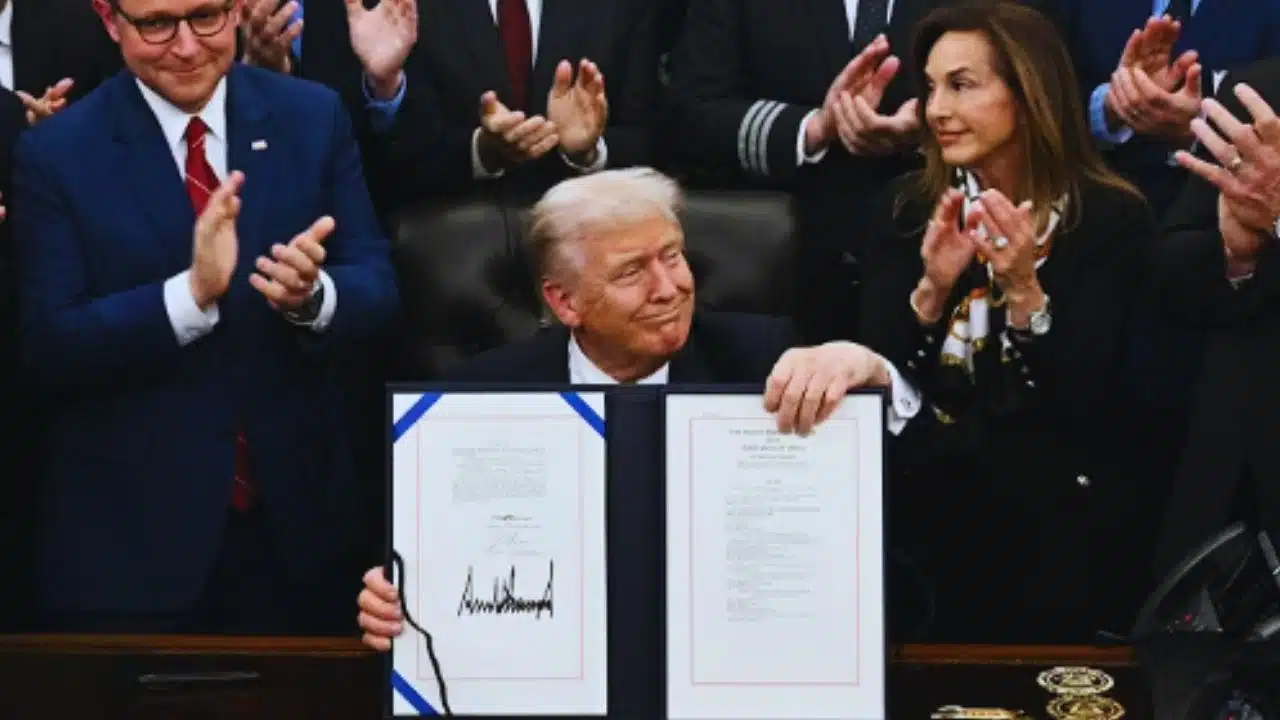
After 43 days, the United States has finally emerged from the longest government shutdown in its history, a standoff that halted key government functions, disrupted federal services, and placed hundreds of thousands of federal employees under profound financial strain. As operations begin to restart, federal workers will soon see their pay restored, travelers can expect air travel to stabilize after weeks of delays and staffing shortages, and essential services—from passport processing to national parks—are beginning to reopen. Yet behind this administrative relief lies a deeper political story about strategy, miscalculation, anger, and shifting power dynamics in Washington.
The shutdown began when Senate Democrats, though a minority in the chamber, used the parliamentary filibuster to block a Republican-backed temporary funding bill. They sought a commitment to extend federal health insurance subsidies for low-income Americans, a policy that millions rely on and one they argued could not be allowed to expire at year’s end. By refusing to move forward without this assurance, Democrats triggered a confrontation that quickly expanded beyond budget lines and policy demands, becoming instead a test of will between two political parties entrenched in ideological conflict.
But their strategic stand fractured sooner than many expected. A small group of Democrats crossed party lines and voted to reopen the government, accepting only a non-binding promise from Republican leaders that the Senate would eventually hold a vote on the subsidies. Crucially, this promise lacked any guarantee of support from Republican senators and did not bind the House of Representatives to even consider the issue. In practical terms, Democrats walked away from the shutdown without achieving the policy objective they had staked their credibility on.
This perceived retreat ignited fury within the party. Progressive Democrats, who had encouraged a firm stance against Republicans, openly accused Senate Democratic leader Chuck Schumer of failing to defend their position. Some charged him with being “complicit” in the compromise; others accused him of strategic failure. Even though Schumer himself voted against reopening the government, critics claimed his leadership during the shutdown was inconsistent, poorly communicated, or too cautious for the moment.
The frustration extended beyond the party’s left wing. Gavin Newsom, Governor of California and a prominent Democratic figure with clear national ambitions, publicly denounced the agreement as “pathetic” and “a surrender.” His reaction reflected broader disappointment: many Democrats believed that after recent off-year election gains, the party had entered the shutdown with political momentum. Instead, they felt they had ceded ground without extracting meaningful concessions.
Newsom, known for defending President Joe Biden even during politically difficult moments, warned that Democrats were still using outdated playbooks in a political era reshaped by Donald Trump. His remarks were a stark indicator of the mood within the party: frustration mixed with anxiety about leadership, strategy, and how Democrats intend to position themselves ahead of the next election cycle.
Meanwhile, the practical consequences of the shutdown continue to ripple across the country. Federal employees who endured more than a month of uncertainty are only now beginning to regain financial footing. National Park closures, postponed hearings, and disruptions across agencies such as the FAA and TSA exposed how deeply everyday American life depends on federal operations running smoothly. The shutdown’s economic toll—lost productivity, delayed services, and the ripple effects across communities with large federal workforces—will take additional time to quantify. But its political impact is already clear: the shutdown may be over, yet the conflict it created is far from resolved.
As Democrats grapple with internal divisions, Donald Trump has seized the moment to project strength and celebrate what he frames as a decisive Republican victory. Only days after the Senate standoff ended, Trump’s tone shifted from patience to triumph. Speaking at a Veterans Day commemoration at Arlington National Cemetery, he applauded congressional Republicans and labeled the vote to reopen the government “a very big victory,” insisting the country is “opening up” again and that it “should have never been closed.” His remarks signaled an effort not only to claim credit but to frame the shutdown’s resolution as evidence of Republican unity and Democratic weakness.
Trump intensified this messaging during a Fox News interview, where he targeted Chuck Schumer personally: “He thought he could break the Republican Party, and the Republicans broke him.”
The statement tapped directly into Democratic frustrations, further amplifying divisions on the opposing side. Throughout the shutdown, Trump had moments of public irritation—particularly when Senate Republicans refused to abolish the filibuster to speed the reopening process. Yet in the end, he conceded little, changed little, and still managed to walk away claiming the upper hand.
Although the shutdown dented Trump’s approval numbers, the long-term political consequences for him remain limited. He does not face another election. Republicans, meanwhile, have nearly a year before the midterms—time enough to shift narratives, pass legislation, or focus on other political battles. Inside the Republican Party, the end of the shutdown appears to be giving them room to return to their legislative priorities.
Yet the path ahead is not straightforward. While the shutdown-ending agreement funds several federal departments through September, Congress must still pass additional spending bills by the end of January to keep the rest of the government open. That sets up the possibility of another confrontation—one that Democrats, still smarting from criticism and frustrated by unmet policy goals, may approach more aggressively.
Moreover, the very issue that triggered the shutdown—healthcare subsidies—remains unsettled. Millions of low-income Americans face skyrocketing insurance costs once these subsidies expire. If Congress does not take action, healthcare affordability could quickly become a major national crisis, placing significant political pressure on Republicans. Ignoring the issue risks alienating not only Democratic voters but also independents and moderate Republicans who rely on affordable insurance.
The political landscape became even more unpredictable when the shutdown’s conclusion was overshadowed by a separate controversy. On the same day lawmakers voted to reopen the government, attention shifted to renewed efforts in the House of Representatives to release federal files related to Jeffrey Epstein, the late convicted sex offender whose case has long fueled public scrutiny. Congresswoman Adelita Grijalva, upon being sworn in, became the 218th signer on a petition forcing the House to hold a vote on directing the Justice Department to release all Epstein-related documents. Reaching the 218 signature threshold triggers mandatory action under House rules.
Trump expressed anger that the Epstein investigation was dominating the news cycle, complaining on his Truth Social account that Democrats were trying to “bring up the Jeffrey Epstein Hoax again” to distract from the shutdown’s political fallout. Regardless of intent, the timing illustrated a familiar reality in Washington: political narratives can shift suddenly, often derailing carefully crafted strategies.
As federal workers resume their jobs and government operations normalize, Congress returns to work with urgent deadlines and renewed internal tensions. Democrats must decide whether to challenge Republicans again in January or pursue different legislative leverage. Republicans must address healthcare subsidies before millions face severe financial consequences. And Trump, emboldened by what he portrays as a major victory, continues to influence congressional calculations from outside formal office.
For now, the shutdown is over. But the political struggle that caused it—and the unresolved issues at its core—remain very much alive. The next confrontation may be closer than Washington expects.