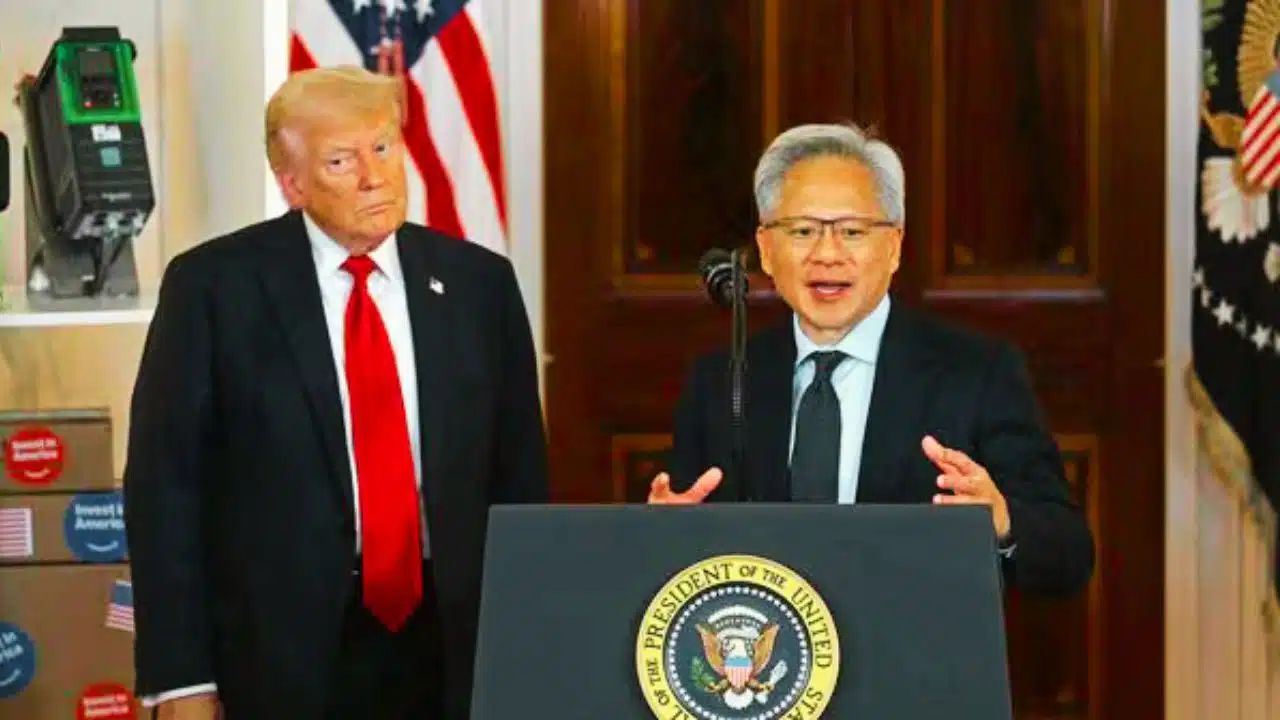
US President Donald Trump has approved a new arrangement that allows Nvidia to sell its H200 artificial intelligence chips to approved customers in China, in exchange for a 25% share of the revenue from those sales flowing to the US government.
The move marks a sharp escalation from an earlier deal in August, under which Nvidia and rival AMD agreed to pay 15% of their China chip revenue to Washington in return for export licenses for downgraded AI processors. The decision aims to balance US national security concerns with pressure to support American chipmakers, but it has already sparked warnings from security hawks in Congress and analysts who fear it could strengthen China’s AI capabilities.
How the 25% Nvidia–China deal works
Trump announced on 8 December 2025 that Nvidia’s powerful H200 data-center chips can be shipped to selected customers in China and other markets, provided a quarter of the resulting sales revenue is paid to the US Treasury. The 25% cut is significantly higher than the 15% revenue-sharing arrangement agreed over the summer for exports of Nvidia’s H20 chip and AMD’s MI308, both of which were designed to comply with earlier US export rules. Nvidia welcomed the latest approval as a way to restore access to a critical market, while Trump framed the deal as a way to protect national security, create US jobs and generate new income for American taxpayers.
Key terms of the new chip deal
| Item | Detail |
| Chips newly allowed | Nvidia H200 AI accelerators for approved customers in China and other markets. |
| US government revenue share | 25% of sales revenue from those H200 exports paid to the US Treasury. |
| Previous share | 15% on China sales of Nvidia H20 and AMD MI308 under August 2025 deal. |
| Companies covered | Nvidia; similar 25% structure to apply to AMD and potentially other US chipmakers. |
| Customer screening | Shipments limited to approved buyers under Commerce Department licensing. |
Timeline of US AI chip curbs on China
The latest deal comes after three years of tightening US export controls that initially blocked China’s access to Nvidia’s most advanced GPUs, then shifted to a more flexible green zone approach for lower-powered chips. Under President Joe Biden, Washington in 2022 and 2023 restricted exports of top-end AI processors such as Nvidia’s A100 and H100 to China, while Nvidia developed special models like the H20 to stay below performance thresholds; Trump’s return to office saw a temporary halt even for these compliant chips in early 2025, followed by gradual reopening tied to revenue-sharing. By late 2025, Trump had publicly ruled out exporting Nvidia’s flagship Blackwell chips to China for at least several years, even as he signaled openness to selling somewhat downgraded versions in future.
Major milestones in US AI chip policy toward China
| Date / Period | Policy event and impact |
| Oct 2022 | Biden administration imposes sweeping export controls on advanced AI chips and tools to China. |
| 2024 | Nvidia launches H20 chip tailored to stay within US export limits for China. |
| Jan 2025 | AI Diffusion rule further codifies performance-based controls, blocking H100 and H200 sales to China. |
| Apr 2025 | Trump administration halts even green-zone AI chip exports such as H20 to China. |
| Jul–Aug 2025 | Trump reverses course, allowing H20 and AMD MI308 exports under a 15% revenue-sharing deal. |
| Nov 2025 | Trump says Blackwell chips will remain reserved for US users, though hints a downgraded version could be discussed. |
| 8 Dec 2025 | Trump authorizes H200 sales to approved Chinese customers with a 25% US revenue cut. |
Security, political and market reaction
National security analysts warn that even controlled access to more capable GPUs like the H200 could accelerate China’s progress in training large AI models, strengthening both its commercial and military technology base. Critics argue that tying policy to a revenue tax on exports risks sending mixed signals to allies and undermining the original strategic goal of slowing China’s access to cutting-edge compute power. A bipartisan group of US senators has already introduced legislation that would bar the administration from easing current AI chip controls on China for two and a half years, setting up a likely clash between Congress and the White House over the new deal.
Financial markets reacted positively to signs that Nvidia can resume higher-value shipments into China, which had been a major source of data-center revenue before the strictest controls took effect. However, some industry analysts question whether frequent policy reversals and case-by-case deals will encourage US chipmakers to keep investing heavily in products tailored to the Chinese market, given the risk that access could be cut off again. Beijing, for its part, has reportedly warned domestic firms in the past about relying too heavily on export-compliant Nvidia chips, while accelerating efforts to build home-grown AI accelerators and reduce dependence on US suppliers by around 2027.
What it means for the AI race and what comes next
The H200 deal underlines how central Nvidia has become to the global AI race, with Washington seeking to use its leverage over the company both to constrain China and to extract direct fiscal gains through revenue-sharing. By keeping the most advanced Blackwell chips off-limits while allowing a somewhat less powerful generation into China under tight licensing and a 25% cut, the administration is betting it can preserve a significant US performance edge even as it partially reopens a market estimated to be worth tens of billions of dollars over time.
Much now depends on how strictly approved customers are vetted, whether Congress succeeds in limiting further relaxations, and how quickly Chinese rivals can close the gap with domestic AI chips. For Nvidia, AMD and other US semiconductor firms, the agreement offers short-term revenue relief but also entangles their China business model more tightly with direct political bargaining in Washington, suggesting that future access to the world’s second-largest AI market will remain contingent on changing US strategic calculations.