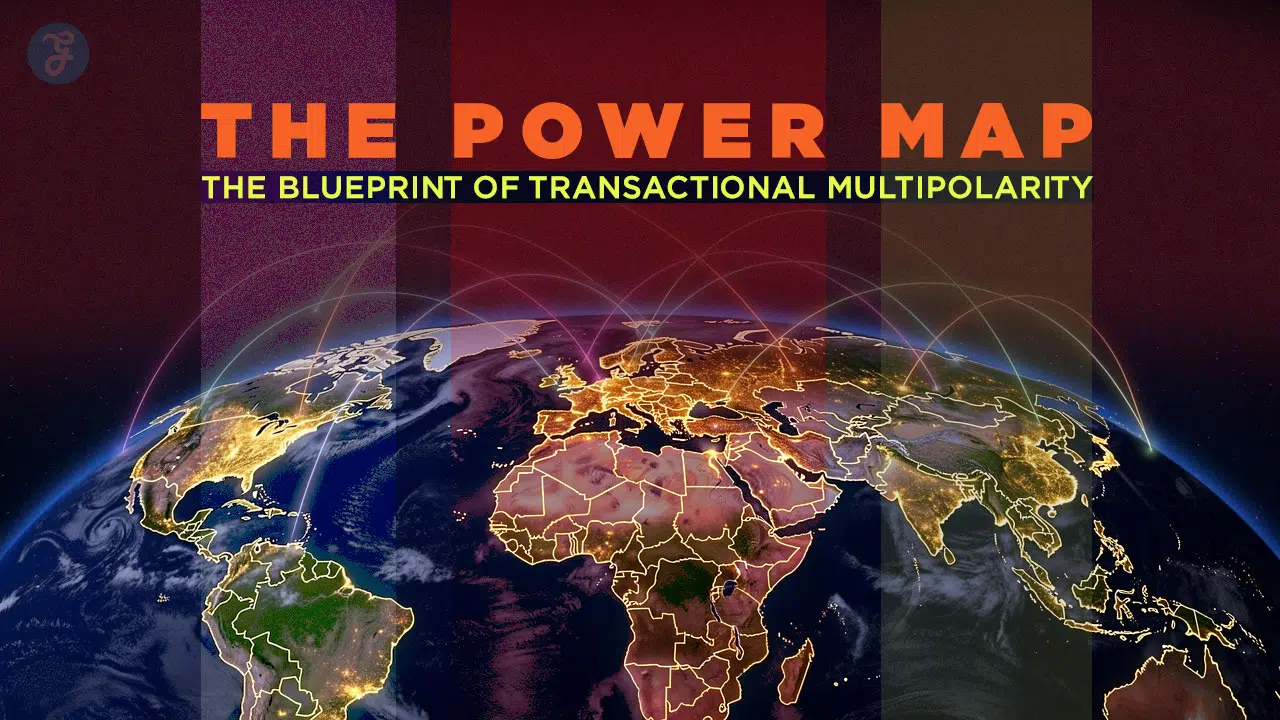
The world changed at 2:01 AM on 3 January 2026. Operation Absolute Resolve did not just extract Nicolás Maduro from his palace in Caracas; it unplugged the life support of the old liberal international order. As 150 US aircraft swarmed over Venezuela, the message was clear: the era of the “rules-based order” is over. This act of decisive force was not merely a strategic intervention; it signalled the dawn of Transactional Multipolarity, where power is brokered through deals and leverage instead of shared norms.
This shift marks the official arrival of the Donroe Doctrine, the “Trump Corollary” to 19th-century regionalism. It represents a cold synthesis of Victorian-era spheres of influence and 21st-century “America First” transactionalism. In this new operating system, the objective is no longer the ideological defence of a hemisphere; it is the blunt pursuit of resource dominance.
When Maduro was flown to New York to face narco-terrorism charges, the rhetoric from Washington was tellingly devoid of “democracy building.” Instead, the discourse focused on the logistics of extraction, specifically, who would manage the pumps and which sovereign entities would settle the invoices. The “Crude-for-Compute” swap has replaced the diplomatic communiqué. Under this new framework, a nation’s value is measured not by its governance, but by its contribution to the American energy and AI hardware stacks.
The Global Response and Silent Calculus
The global response was a chilling display of the new silence. An emergency UN Security Council meeting saw a draft resolution condemning the move. The US, UK, and France vetoed it with clinical efficiency, the latter two having already secured their own carve-outs in the Orinoco Belt. Beijing and Moscow, usually vocal in their outrage, were curiously muted. They were busy calculating their own price for looking the other way.
Loyalty as Commodity in a Strategic Free Market
This is the geopolitical interlude. We are in the gap between the world that was and the world that is becoming. In this space, loyalty is no longer a shield. You cannot hide behind a treaty or a historical friendship. Loyalty has been commoditised. It is now something to be traded, project by project, for a seat at the table.
The “default ally” is a ghost. In 2026, the world does not run on shared values. It runs on a new, high-stakes operating system where every nation is a strategic free agent. If you want a partner, you have to buy one. If you want to keep them, you have to keep paying. The old safety net has been cut. We are all operating in the open air now.
Transactional Multipolarity: Sovereign AI and the Compute Energy Trilemma
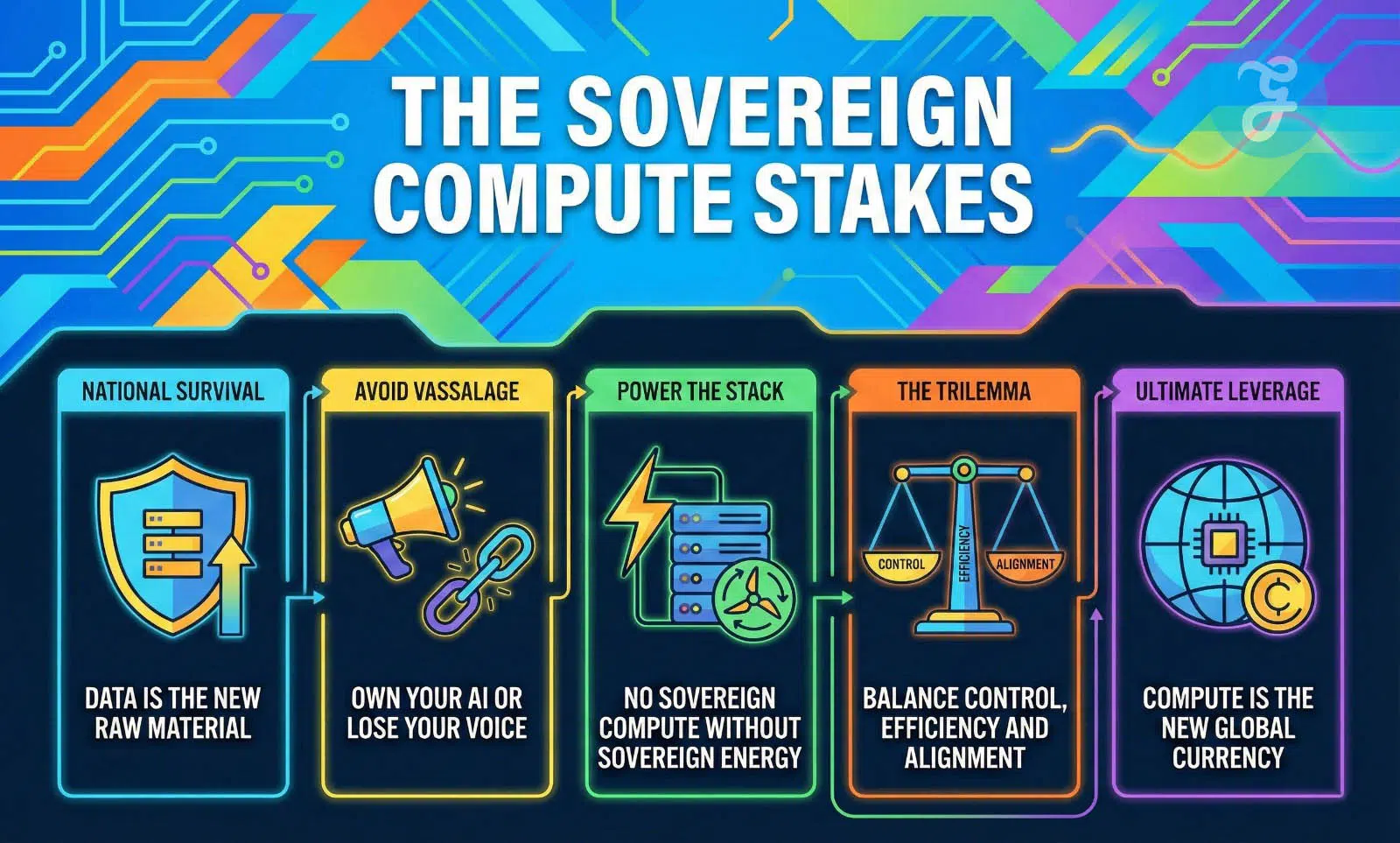
If oil was the black gold of the 20th century, computers are the silicon currency of 2026. Data is no longer just information. It is the raw material for national survival. We have entered a world where transactional multipolarity dictates who gets to think at scale and who is left behind in the digital dark.
The Tony Blair Institute recently warned of a new class of data vassals. These are nations that failed to build their own frontier models. By relying on foreign AI, they have effectively outsourced their national intelligence. They are digital colonies. Their policies, their economy and even their cultural narratives are now filtered through code written in Silicon Valley or Beijing. To have no Sovereign AI is to have no voice in the coming decade.
The infrastructure race has split the world into two distinct models. While the United States doubles down on being a high-tech petrostate via its Venezuelan interests, while simultaneously squeezing Copenhagen for “preferential access” to Greenland’s rare earth deposits, China has pivoted. If the January intervention in Caracas secured the fuel for the American AI engine, the quiet pressure on Greenland aims to secure its spark, targeting the world’s largest undeveloped deposits of heavy rare earths to decouple the hardware stack from the East. Beijing, meanwhile, has become the world’s first true Electrostate. They are not just building chips; they are building the Electric Stack, a total integration of renewable energy, massive battery storage, and localised data centres. They have realised that you cannot have Sovereign AI without sovereign power.
This brings every leader to the Compute Energy Trilemma. It is a brutal three way choice that offers no easy wins. Governments must balance three distinct pillars: sovereign control, economic efficiency and superpower alignment. You can choose two, but you can never have all three.
If you want total control, it will cost you billions in inefficiency. If you want the cheapest, fastest AI, you must surrender your data to a foreign cloud. If you try to stay neutral, you might find yourself disconnected from the very hardware you need to compete. In this landscape, the ‘Golden Share’ isn’t just a corporate provision; it’s a national survival strategy where the state owns the logic and the private sector provides the scale.
In this era of transactional multipolarity, compute is the ultimate bargaining chip. A nation might trade its lithium for access to an American LLM. Another might trade military basing rights for Chinese server farms. There are no permanent tech partners anymore. There are only those who have the compute and those who are desperate to rent it. The Electric Stack is the new border. Cross it at your own peril.
The Law of the Jungle in the Global Commons
If the January intervention in Caracas was a seismic shock, the erosion of the global commons is the slow, grinding sound of the old world falling apart. We are entering an era where geography is destiny and diplomacy is a loaded weapon. International law is no longer a referee. It is a casualty of transactional multipolarity.
The most chilling example is the collapse of the Indus Waters Treaty. Since April 2025, India has held this foundational agreement in abeyance, citing “security imperatives” over the Western Rivers. The completion of the Shahpur Kandi Dam in March 2026 served as the final “plug” for the Ravi, but the real escalation lies upstream. By fast-tracking the Pakal Dul and Ratle projects, New Delhi has converted the Chenab into a series of “hydro-batteries,” giving the state a strategic chokehold over Pakistan’s primary water artery without a single joint commission meeting. There was no negotiation; there were no joint commissions. There was only the physical reality of the Marwah Valley infrastructure. This is the new Law of the Jungle: if you sit upstream, you own the future. If you are downstream, you are a hostage to your neighbour’s domestic politics.
We see the same script playing out in the Nile Basin. Ethiopia’s Grand Ethiopian Renaissance Dam is now fully operational without a single binding treaty for Egypt or Sudan. Cairo calls it an existential threat. Addis Ababa calls it a sovereign right to development. In a world of transactional multipolarity, both are right, and neither cares about the other’s definition of “harm.” The common heritage of mankind has been partitioned into private reservoirs.
The Power Matrix: Winners and Losers in the New Economy
To understand who truly holds the cards in 2026, we have to look past the official press releases. The gap between declared success and actual power has never been wider.
| Sector | Declared Winner/Loser | Actual Winner/Loser | The 2026 Reality |
| Energy | Winner: Green Tech Startups | Winner: The “Electrostate” (China) | Small firms lack the “Electric Stack” scale to survive without state backing. |
| Finance | Winner: Global Fintech | Winner: Sovereign Wealth Funds | Private capital is being sidelined by state owned funds with political agendas. |
| Manufacturing | Loser: High Cost Western Plants | Winner: The “Golden Share” Facilities | Strategic factories are now protected by government vetoes regardless of cost. |
| Tech | Winner: Open Source AI | Loser: “Data Vassal” Nations | Without proprietary compute, open source tools still run on foreign clouds. |
| Geopolitics | Loser: The “Middle Power” | Winner: The Pragmatic Broker | Nations like India or Saudi Arabia win by refusing to pick a permanent side. |
Even trade has become a hostage negotiation. The World Trade Organisation is a ghost. In North America, we are living with the Zombie USMCA. The treaty has not been killed, but it is not truly alive either. It staggers on as a series of constant caveats. This “zombie” state allows Washington to bypass trilateral rules and squeeze Mexico and Canada for one on one concessions. Tariff exemptions are now rewards for political obedience. If you want access to the American market, you must align with American geoeconomics.
Critical minerals follow the same à la carte logic. A nation might partner with China for refining capacity while simultaneously begging the United States for “sovereign scale” security to protect the mines. There is no such thing as a “preferred partner” anymore. There are only projects, prices, and power plays. The global commons are being fenced off, and the only rule left is that the strongest gets to hold the gate key.
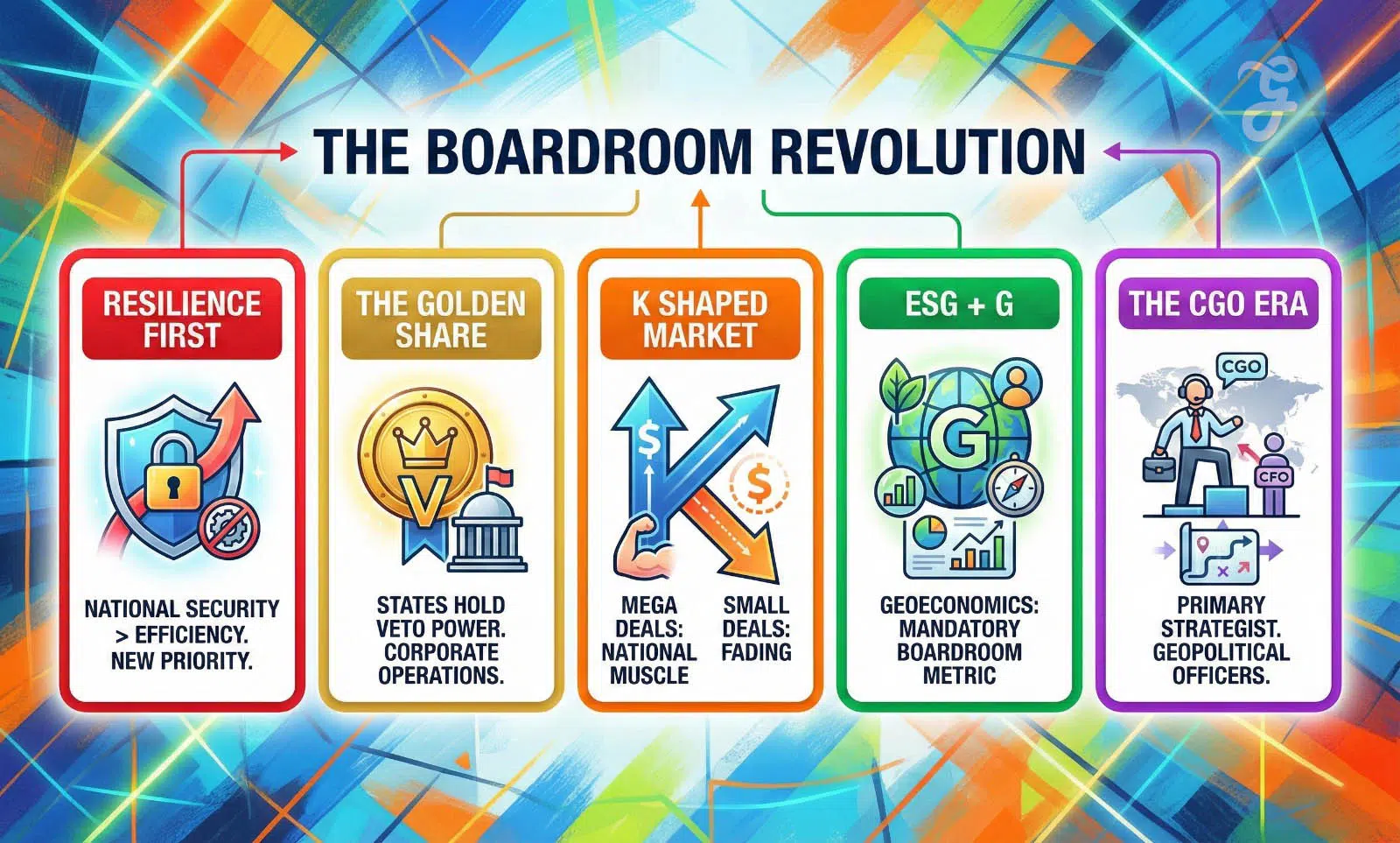
For decades, the global C-Suite worshipped at the altar of efficiency. The goal was simple: find the cheapest labour, the leanest supply chain, and the most frictionless path to market. In 2026, this metric has been replaced by resilience, driven by a boardroom pivot toward transactional multipolarity.
The most visible sign of this shift is the rise of the Golden Share. Look at the U.S. Steel–Nippon Steel merger. When the deal finally closed in June 2025, it carried a mandate that fundamentally altered the DNA of American capitalism. The transaction was not simply cleared; it was conditioned on a National Security Agreement (NSA) mandated by CFIUS. Crucially, this agreement required the issuance of a permanent Golden Share to the U.S. government, granting the President the legal authority to appoint a “National Security Sentinel” to the board. This director serves as more than an observer; they wield a direct veto over any material decision to shutter domestic blast furnaces or transfer labour and production across borders. The state is no longer a mere referee of markets; it is a controlling partner with a permanent “kill switch” over corporate strategy. This is State Capitalism with American Characteristics, where shareholder dividends are explicitly subordinated to the federal mandate of industrial resiliency.
This new reality has created a K-shaped M&A market. On one side, we see a surge in megadeals that serve the Sovereign Scale. These are massive consolidations in steel, chips, and energy that governments actively encourage because they build national muscle. On the other side, smaller cross border deals are dying on the vine. They are too risky, too exposed, and too difficult to defend in a world where every transaction is scrutinised for its geopolitical loyalty.
Governance itself is being rewritten. We used to talk about ESG: Environmental, Social, and Governance. Today, the smartest boards have added a second G for Geoeconomics. ESG + G is the new standard. It requires companies to treat political risk as a financial line item. If you have a factory in Mexico, you are no longer just managing a supply chain; you are managing a target of the Donroe Doctrine. If you have a plant in Europe, you are a pawn in Russia’s second front.
This is why the most valuable person in the building is no longer the CFO. It is the Chief Geopolitical Officer. These are the modern navigators who understand that a business decision in 2026 is always a political act. They don’t just read spreadsheets; they read the room in Washington, Brussels, and Beijing. They know that in an era of transactional multipolarity, the default ally is a myth. You are only as safe as your last negotiation.
The New C-Suite Mandate
To survive this boardroom revolution, companies are now forced to adopt a different set of survival traits:
- Prioritising Resilience Over Margin: Supply chains are being shortened and duplicated to ensure that a single political rift cannot shutter the entire company.
- The Rise of the CGO: The Chief Geopolitical Officer now holds equal or greater weight than the CFO, vetting every deal for its strategic alignment with host governments.
- Navigating the K-Curve: Leadership must decide early if they are playing for Sovereign Scale or if they will remain niche enough to avoid the regulatory crosshairs of state capitalism.
- Political Risk as Overhead: Boards now treat geopolitical instability as a fixed cost, akin to insurance or taxes, rather than an act of God that can be ignored.
- Veto Readiness: Executives are training for a future where major operational decisions require the explicit sign off of government Golden Share holders.
Foresight 2031: Surviving the Great Transition
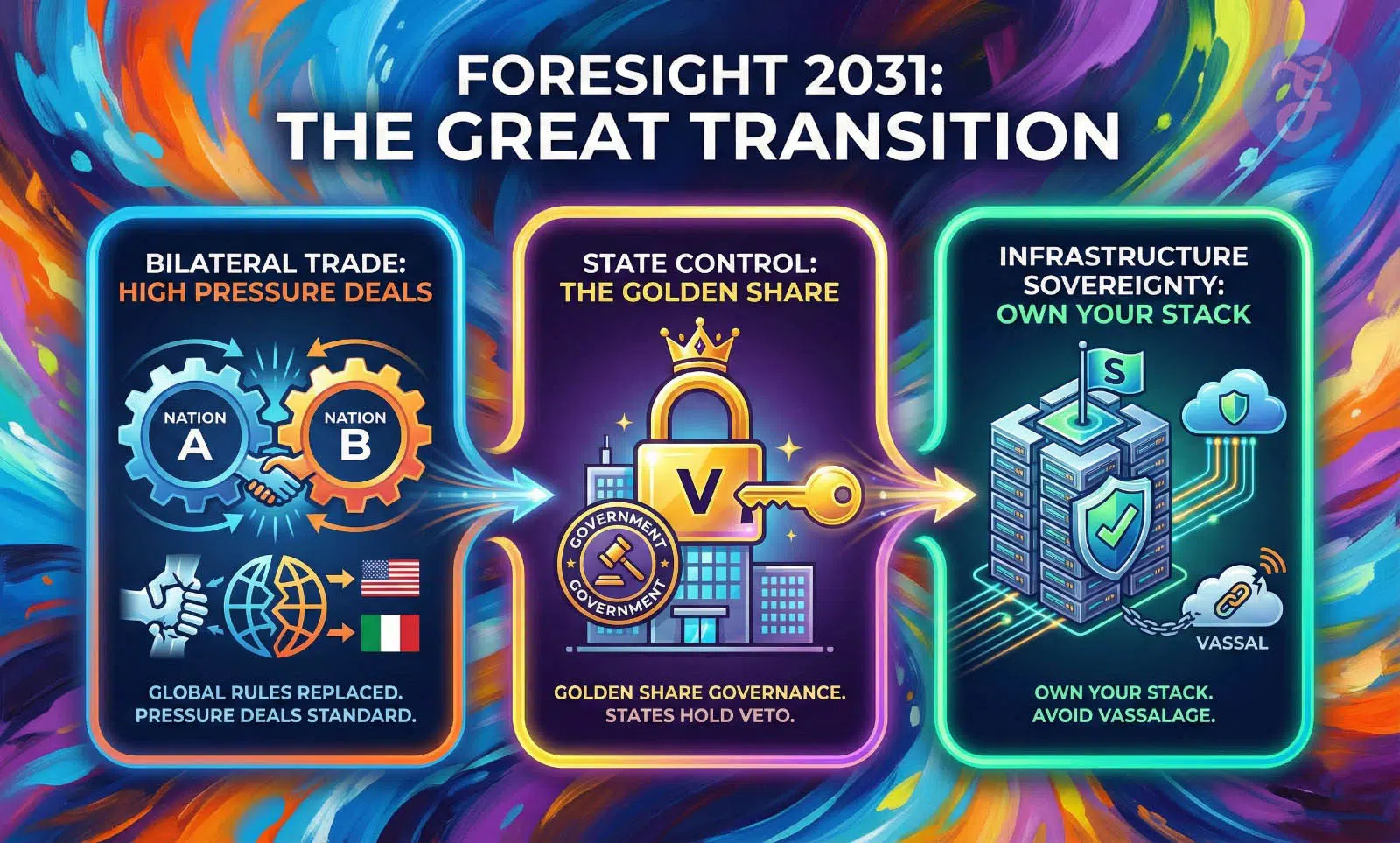
The next five years will be defined by a shift from global trade rules to a patchwork of high pressure bilateral deals. By 2030, the “Golden Share” will be standard practice in most developed economies. Governments will no longer wait for market failures to act. They will bake national security directly into the corporate board structure from the start. This means businesses must prepare for a future where profit is perpetually balanced against the state’s strategic needs.
The race for Sovereign AI will also reach its peak by the end of the decade. Nations that fail to secure their own compute and energy stacks by 2031 will likely find themselves as permanent data vassals. They will be locked into the tech ecosystems of the dominant superpowers with no easy way out. For the global C-Suite, the next five years are not about finding the cheapest path. They are about building the most resilient one. You must own your infrastructure or someone else will own you.
The Survival Checklist for 2031
To navigate this Great Transition, the successful enterprise must focus on these non negotiable priorities:
- Infrastructure Ownership: Shift from renting cloud space to owning the physical “Electric Stack” and compute hardware to avoid being a data vassal.
- Geopolitical Vetting: Every major partnership must be audited for alignment with the Donroe Doctrine and potential trade friction.
- Energy Sovereignty: Secure direct contracts with power producers or build on site small modular reactors to keep the chips running regardless of the grid.
- Strategic Boardroom Seats: Accept that a “Golden Share” or government advisor is now a standard cost of doing business in critical sectors.
- Bilateral Agility: Build the legal and operational flexibility to swap supply chain partners as bilateral trade deals shift overnight.
The 2026 reality is cold-blooded. We are living through a global rupture where the old safety nets have been replaced by high-stakes, project-by-project negotiations. This new global operating system is defined by transactional multipolarity; it is a world that is volatile by design and transactional by necessity. In this environment, the most dangerous thing a leader can do is rely on yesterday’s handshake. Whether you are a CEO or a Prime Minister, the strategy has shifted from picking a side to protecting your stack.
To “protect your stack” means building resilience at every level of your operation. It means securing your energy supply, owning your compute, and ensuring your supply chains are modular enough to survive a sudden tariff spike or a Donroe Doctrine intervention. You cannot wait for a multilateral body to save you. You must be your own anchor. Middle powers like India and Saudi Arabia are already showing the way, acting as pragmatic brokers who bridge the gap between competing superpowers to secure their own national interests.
Ultimately, the map of 2026 looks very different from the one we grew up with. Borders are no longer just lines on a map defined by ideology; they are defined by the flow of electrons, the mining of lithium, and the strategic placement of Golden Shares. This Great Transition is a period of high risk, but also of immense opportunity for those who can navigate its complexity.
The era of the passenger is over. In the age of transactional multipolarity, everyone is a pilot. You must watch the weather, check your fuel, and be ready to change course at a moment’s notice. The rules have been rewritten. It is time to start playing by them.