The financial landscape of 2025 will be recorded in history as the year artificial intelligence matured from a speculative buzzword into the definitive engine of global capital. An unprecedented stock market rally, fueled almost exclusively by the “AI Gold Rush,” lifted major indices to record highs, adding over $550 billion to the collective wealth of America’s top tech titans in just 12 months.
As the world heads into 2026, the combined net worth of the top 10 US technology leaders has soared to nearly $2.5 trillion, a figure that now rivals the GDP of entire G7 nations like France.
The 2025 Ledger: A $600 Billion Wealth Injection
According to data compiled by Bloomberg, the collective net worth of the top 10 US technology leaders didn’t just grow—it exploded. The group’s combined fortune surged from $1.9 trillion at the start of the year to nearly $2.5 trillion by Christmas Eve. This $600 billion increase in a single calendar year exceeds the market capitalization of most S&P 500 companies.
While the broader market benefited from the AI rally, the gains were heavily concentrated among the founders building the infrastructure for the next decade:
-
The Google Duo: Larry Page and Sergey Brin were arguably the year’s most efficient earners, collectively adding approximately $194 billion to their net worth as Alphabet’s AI investments finally matured.
-
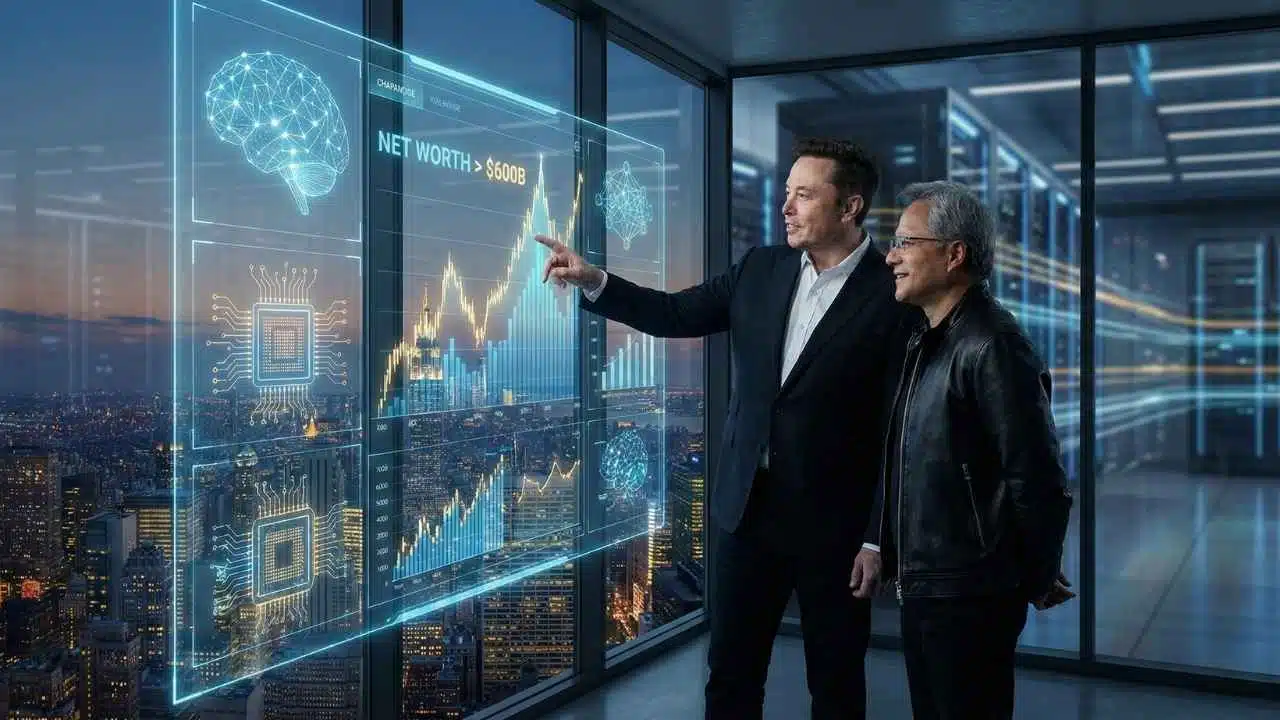
The Nvidia Effect: Jensen Huang, the face of the hardware boom, saw his personal fortune climb by $41.8 billion, a staggering rise for a non-founder CEO—driven by Nvidia’s march to a $5 trillion valuation.
-
Musk’s Momentum: Elon Musk, already the world’s richest person, widened the gap significantly. His fortune climbed by nearly 50%, adding over $200 billion in value.
Elon Musk: The Half-Trillion Dollar Milestone
Elon Musk remains the undisputed protagonist of this financial era. In October 2025, he shattered historical ceilings to become the first person ever to surpass a net worth of $500 billion. By Christmas Eve, his fortune had climbed even further to $638 billion.
-
The “Trillionaire” Trajectory: Analysts now predict Musk could become the world’s first trillionaire by 2027 if current trends hold.
-
Key Wealth Drivers:
-
SpaceX: The primary catalyst. A massive secondary market transaction in late 2025 valued the company at nearly $800 billion ahead of its rumored 2026 IPO.
-
xAI: His AI venture has aggressively expanded its compute infrastructure, positioning itself as the primary rival to OpenAI and boosting Musk’s valuation outside of Tesla.
-
Tesla: Renewed investor confidence following the launch of the dedicated Robotaxi fleet in Q4 2025.
-
The Infrastructure Kings: Chips and Cloud
While Musk captured the headlines, the “picks and shovels” of the AI revolution generated the most explosive value for shareholders.
Nvidia’s $5 Trillion Moment
No figure symbolizes the 2025 boom more than Jensen Huang. The Nvidia CEO saw his personal fortune rocket to $158 billion. In October, Nvidia made history as the first company to touch a $5 trillion market capitalization, solidifying its role as the “toll booth” of the AI economy.
Larry Ellison’s Oracle Resurgence
Larry Ellison (Rank #4) was a standout performer, seeing his wealth surge to $252 billion. This growth was driven largely by Oracle’s strategic pivot to becoming the premier data center provider for AI training, including a massive $100B+ partnership to host OpenAI’s next-generation models.
Silicon Valley Giants: The $200 Billion Club
The “old guard” of Silicon Valley has effectively transitioned into the new AI nobility.
-
Larry Page & Sergey Brin: The Google co-founders added nearly $200 billion combined to their fortunes. Markets rewarded Google’s successful deployment of its custom Tensor Processing Units (TPUs) and the Gemini 2.0 model.
-
Jeff Bezos: Amazon’s aggressive push into AI services via AWS kept Bezos firmly in the top 3, with a net worth of $255 billion.
-
Mark Zuckerberg: The Meta CEO remains a titan with $234 billion, banking on the long-term play of open-sourcing AGI (Artificial General Intelligence) through the Llama 4 release.
Top 10 Richest People 2026:The New Wealth Rankings
Data courtesy of the Bloomberg Billionaires Index (Dec 24, 2025).
| Rank | Name | Role | Net Worth (USD) | Net Worth (KSh) |
| 1 | Elon Musk | CEO, Tesla/SpaceX | $638B | 82.24t |
| 2 | Larry Page | Co-founder, Google | $270B | 34.80t |
| 3 | Jeff Bezos | Founder, Amazon | $255B | 32.87t |
| 4 | Larry Ellison | Founder, Oracle | $252B | 32.48t |
| 5 | Sergey Brin | Co-founder, Google | $251B | 32.35t |
| 6 | Mark Zuckerberg | CEO, Meta | $234B | 30.16t |
| 7 | Bernard Arnault | CEO, LVMH | $205B | 26.42t |
| 8 | Steve Ballmer | Ex-CEO, Microsoft | $170B | 21.91t |
| 9 | Jensen Huang | CEO, Nvidia | $158B | 20.37t |
| 10 | Warren Buffett | CEO, Berkshire Hathaway | $150B | 19.34t |
The “Silicon Shield” vs The State: 2026 Regulatory Outlook
While 2025 was the year of unbridled growth, analysts warn that 2026 will be the year of the “Regulatory Reckoning.” The concentration of $2.5 trillion in the hands of just ten individuals has triggered alarm bells in Washington and Brussels.
-
California’s AI Safety Act (Jan 1, 2026): The wealth of leaders like Musk and Zuckerberg faces an immediate stress test with the enactment of California’s rigorous new AI safety laws. The law mandates “kill switches” for large-scale models, which could increase compliance spending by up to 15%.
-
Antitrust “Toll Booth” Probes: The DOJ has signaled it will investigate the “AI infrastructure monopoly”, specifically scrutinizing the symbiotic relationship between chipmakers (Nvidia) and cloud providers (Amazon/Oracle).
Beyond Tech: The Energy & Biotech Rotation
While software and chips dominated 2025, smart money is moving toward the physical constraints of the AI era.
-
The Energy Crisis: AI data centers now consume more power than some G7 nations. This has created a secondary boom for “Green Grid” billionaires—investors pouring capital into nuclear fusion startups and Small Modular Reactors (SMRs).
-
Biotech & Longevity: With the oldest members of the rich list (Buffett, Ellison) entering their late 80s and 90s, a massive capital rotation is underway into “Longevity Science.” 2026 is expected to see the first major IPOs of biotech firms funded by these billionaires, aiming to treat aging as a curable condition.
The 2026 Horizon: The Dawn of the Trillionaire Era
The wealth concentration of 2025 underscores a definitive shift: AI is no longer just a sector; it is the global economy’s primary growth engine. As we enter 2026, the gap between AI-native companies and the rest of the market is expected to widen. The question for the coming year is no longer if we will see the world’s first trillionaire, but whether regulation or recession will be the only forces capable of slowing the ascent of the architects of the future.