Ever feel like the news on your screen doesn’t quite match the reality outside your window? You might wonder if the opinions you hold are truly your own or if they were shaped by someone else. You are not alone in asking these questions.
Millions of people struggle to understand why U.S. foreign policy often contradicts American values or why economic inequality keeps growing despite hard work. We all want to know who really pulls the strings.
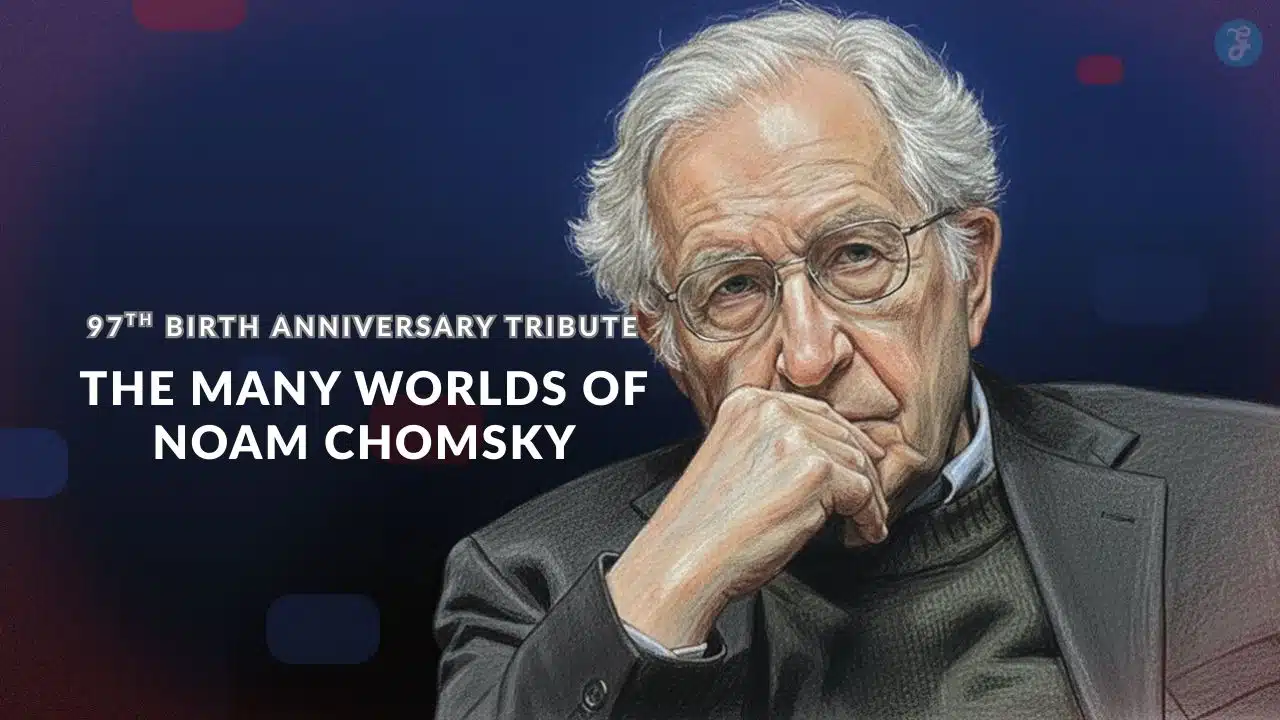
Here is a fact that might surprise you: Noam Chomsky wrote his first article about the rise of fascism when he was just ten years old. Today, he is known as “the father of modern linguistics,” but his impact goes far beyond grammar. Today is his 97th birth anniversary. Happy birthday to Noam Chomsky.
In “The Many Worlds Of Noam Chomsky,” we will explore his revolutionary ideas on language science and his fierce critique of mass media like Amazon.com and mainstream news. We will look at his protests against the Vietnam War and the Iraq War and his deep dive into wealth gaps in books like The Prosperous Few and the Restless Many.
I’m going to walk you through his most powerful ideas, from how we learn words to how we fight for human rights. So, grab a cup of coffee, and let’s go through it together.
Key Takeaways
- Noam Chomsky, “the father of modern linguistics,” wrote his first article about fascism in Europe at age ten and changed language study with Universal Grammar and Generative Grammar in the 1950s.
- In 1959, Chomsky strongly criticized behaviorism by showing that children use built-in mental rules to learn grammar, not just copying adults or getting rewards; his book “Syntactic Structures” (1957) started a new way to look at language like science.
- With Edward Herman, Chomsky created the “propaganda model” in “Manufacturing Consent,” revealing how mainstream media protects powerful interests through selective reporting and shapes public opinion for wars, as seen during Vietnam, Iraq, Gaza, and Afghanistan.
- Chomsky’s books, such as “What Uncle Sam Really Wants” and “The Prosperous Few and The Restless Many,” highlight U.S. foreign policy actions, including overthrowing leaders in Iran (Mohammad Mossadegh) and Guatemala (Jacobo Árbenz).
- He shows big banks and corporations use money to sway lawmakers through lobbying; financial systems help keep wealth with the rich few while making it difficult for regular people to have power or fair democracy.

Chomsky’s Linguistic Revolution
Noam Chomsky didn’t just tweak the way we study language; he completely rebuilt the foundation. Before him, most experts believed we learned to speak the same way a dog learns to sit—by repetition and reward. Chomsky proved that the human brain is actually hardwired for language from birth.
He introduced the concept of the “Language Acquisition Device” (LAD). This is a theoretical tool in our brains that allows children to pick up complex grammar rules almost instantly, even with very little instruction. It explains why a toddler in Tokyo and a toddler in Toronto both start putting sentences together at roughly the same age.
The “Colorless Green Ideas” Experiment
To prove that grammar is separate from meaning, Chomsky created a famous sentence in his 1957 book, Syntactic Structures. He wanted to show that we all have an internal rulebook for structure that works even when the words make no sense.
“Colorless green ideas sleep furiously.”
If you read that sentence, you know it is grammatically correct. You know, “colorless” describes “green,” and “furiously” describes “sleep.” But the sentence means absolutely nothing. This simple example destroyed the idea that we only learn language by understanding the meaning of words.
Chomsky vs. Skinner: The Battle for the Mind
In the 1950s, the dominant theory was “Behaviorism,” led by B.F. Skinner. Skinner argued that language was just a habit we learned through training. If you said “milk” and got milk, you learned the word.
Chomsky challenged this in a 1959 review of Skinner’s work that changed psychology forever. He pointed out a simple fact: children say things they have never heard before. A child might say, “I goed to the park” instead of “I went.”
No adult taught them that mistake. The child applied a grammar rule (add “-ed” for past tense) that they figured out on their own. This proved that humans are born with a creative power to generate infinite sentences, a concept now known as generative grammar.
Chomsky as a Political Dissident
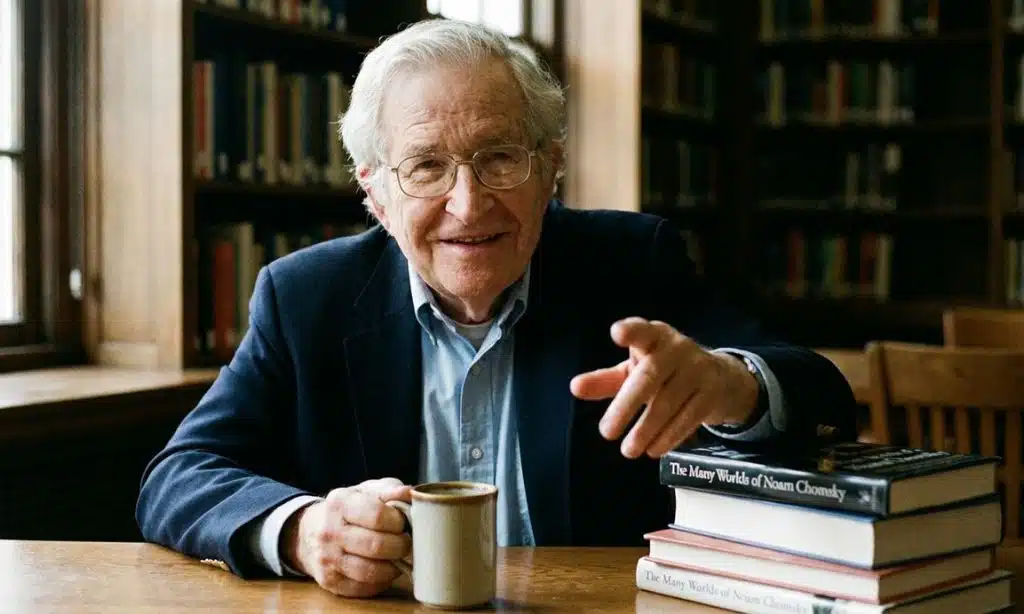
Chomsky applies the same rigorous logic to politics that he uses for linguistics. He challenges the U.S. government to live up to its own ideals. His famous 1967 essay, “The Responsibility of Intellectuals,” argued that writers and scholars have a duty to speak the truth and expose lies, no matter how unpopular it makes them.
The “Worthy” vs. “Unworthy” Victims
One of Chomsky’s most powerful tools for analyzing foreign policy is the comparison of “worthy” and “unworthy” victims. He argues that the U.S. media cares deeply about victims of enemy states but ignores victims of U.S. allies.
In Manufacturing Consent, he and Edward Herman compared the media coverage of two specific events to prove this bias:
| Victim Type | Example Event | Perpetrator | Media Coverage |
|---|---|---|---|
| “Worthy” Victim | Jerzy Popiełuszko (Polish Priest) | Poland (Soviet Enemy) | Massive front-page outrage; detailed investigation. |
| “Unworthy” Victim | 100 religious figures in Latin America | U.S. Client States | Minimal coverage; often buried in back pages. |
This data reveals a stark double standard. When an enemy commits a crime, it is proof of their evil. When an ally commits a crime, it is often called an “unfortunate error” or simply ignored. Chomsky points to the silence surrounding the U.S.-backed invasion of East Timor as a prime example of this selective blindness.
Critiques of U.S. Imperialism
Chomsky documents the history of U.S. intervention with brutal precision. He details how the CIA helped overthrow democratic leaders like Mohammad Mossadegh in Iran (1953) and Jacobo Árbenz in Guatemala (1954) because they threatened corporate interests.
He argues that these actions are not about spreading democracy. Instead, they are about maintaining control. In books like What Uncle Sam Really Wants, he explains that the U.S. acts like a global mafia don. The goal is to ensure that no country can successfully defy U.S. orders, serving as a warning to others.
Media and the Propaganda Model
You might think of propaganda as something that only happens in dictatorships. Chomsky disagrees. He and Edward Herman developed the “Propaganda Model” to explain how free press in democratic societies still ends up serving the powerful elite.
They argue that the news doesn’t need to be censored by a government official to be biased. Instead, market forces do the work for them.
The 5 Filters of Editorial Bias
According to their research, news must pass through five specific “filters” before it reaches your screen. These filters strip away stories that challenge the status quo.
- Ownership: Massive corporations own the media outlets. Their primary goal is profit, not truth, and they will not run stories that hurt their own financial interests.
- Advertising: Media sells your attention to advertisers. TV stations and newspapers fear losing ad revenue, so they avoid content that might upset big sponsors.
- Sourcing: Journalists rely on “official” sources like the White House or police departments for easy news. This gives the government immense control over the narrative.
- Flak: This refers to negative feedback. If a reporter criticizes a powerful group, they get attacked with lawsuits, angry letters, and threats. This “flak” scares others into silence.
- The Common Enemy: To keep people frightened and obedient, the media focuses on a terrifying outsider. In the Cold War, it was Communism. Today, it is often terrorism or immigrants.
These filters create a system where mainstream media acts as a cheerleader for U.S. foreign policy and corporate power. It explains why you rarely see deep questions about class warfare or economic exploitation on the nightly news.
Economic Critiques and Wealth Inequality
Chomsky’s analysis of the economy is just as sharp as his view on media. He argues that the modern capitalist system is rigged to concentrate wealth at the very top. He often cites the “Plutonomy Memos” from Citigroup, leaked in 2005.
In these memos, the bank told its wealthiest investors that the world was dividing into two blocks: the “Plutonomy” (the super-rich who drive the economy) and the “rest.” They advised ignoring the “rest” because their spending power no longer mattered. This cynical view confirms what Chomsky has warned about for decades.
The Disconnect Between Productivity and Pay
Chomsky points to hard data to show that the “American Dream” has broken down. For decades, when American workers produced more, they got paid more. That link snapped in the late 1970s.

According to the Economic Policy Institute, between 1979 and 2023, productivity in the U.S. grew by roughly 65%. However, hourly pay for the typical worker grew by only about 15% during that same period. Workers are creating massive value, but the rewards are going almost entirely to CEOs and shareholders.
How Money Buys Policy
This concentration of wealth leads to a concentration of political power. Chomsky explains this as a “vicious cycle.” The rich use their money to lobby the government. Politicians then write laws that cut taxes for the rich and deregulate banks. This makes the rich even richer, giving them more money to buy more influence.
The result is a democracy in name only. As he outlines in The Prosperous Few and the Restless Many, the preferences of the average voter have almost zero impact on public policy. Whether you want better healthcare or lower tuition, your voice is drowned out by the roar of corporate lobbying.
Takeaways
Noam Chomsky shows us that words have power, whether we are talking about the grammar in our heads or the headlines in our newspapers. His work pulls back the curtain on government and media, asking sharp questions that many powerful people would rather avoid.
The man from Philadelphia did more than just revolutionize the study of linguistics; he gave us a toolkit to defend ourselves against manipulation. He taught us to spot the lies in the news, to question the motives of our leaders, and to fight for the rights of the “unworthy” victims the world tries to forget.
Standing up to authority is never easy, but Chomsky proves it is necessary. His voice echoes far beyond the classroom, right into the lives of people like you and me who are hungry for the truth.
FAQs on Noam Chomsky
1. Who is Noam Chomsky, and why do people talk about him so much?
Avram Noam Chomsky is a legendary linguist and political activist who completely reshaped our understanding of the human mind and authority. He wrote essential books like How the World Works and Manufacturing Consent to expose the hidden mechanics of power and economic inequality.
2. How does Chomsky explain the role of mass media in society?
He argues that mainstream media functions through a propaganda model where news is filtered to serve the political elite rather than inform the public. This system manufactures consent for U.S. government actions like the Cold War or the invasion of Iraq by framing them as necessary for defense.
3. What are some key topics Chomsky discusses when talking about U.S. foreign policy?
Chomsky challenges the myth of American idealism by dissecting how the U.S. empire really operates in regions like French Indochina or during the bombing of Afghanistan. He argues that what Uncle Sam really wants is to secure resources and markets rather than protect populations under the South Vietnamese government.
He sees class warfare and economic exploitation as global forces that keep the prosperous few wealthy at the expense of the restless many in third-world countries. Whether discussing the Vietnamese independence movement or the need for a Palestinian state, he insists that human rights must apply to everyone equally.
5. Has Chomsky written anything on war crimes or controversial figures?
He frequently compares U.S. actions to the brutality of figures like Saddam Hussein or the Gestapo to demonstrate that international standards of justice should apply to all nations.
6. Does Chomsky only focus on politics? Or does he study other things too?
He is actually the father of modern linguistics and revolutionized the field with concepts like Universal Grammar and the Minimalist Program. While he is famous for political analysis on the global economy or the Oslo Accords, his scientific work on language remains his primary academic legacy.