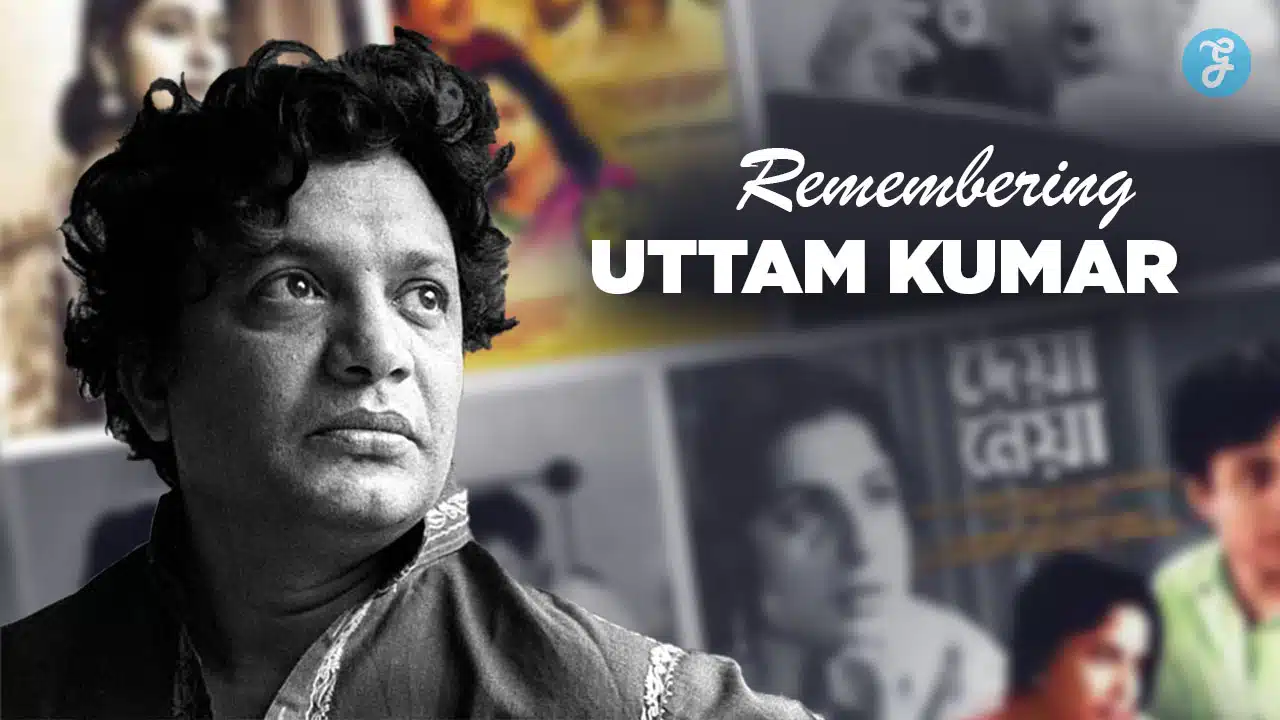
Many fans feel stuck. They see Uttam Kumar’s long list of films and wonder where to start. They miss the real spark behind Bengali cinema’s charm. Today, 24th July, 2025, is Uttam Kumar’s 45th death anniversary.
Uttam Kumar won the first National Film Award for Best Actor in 1967. We will list the films you should watch first. We will share his top roles and his ties with Satyajit Ray. We will explain the legacy of Uttam Kumar and his lasting impact on Indian film.
Keep reading.
Key Takeaways
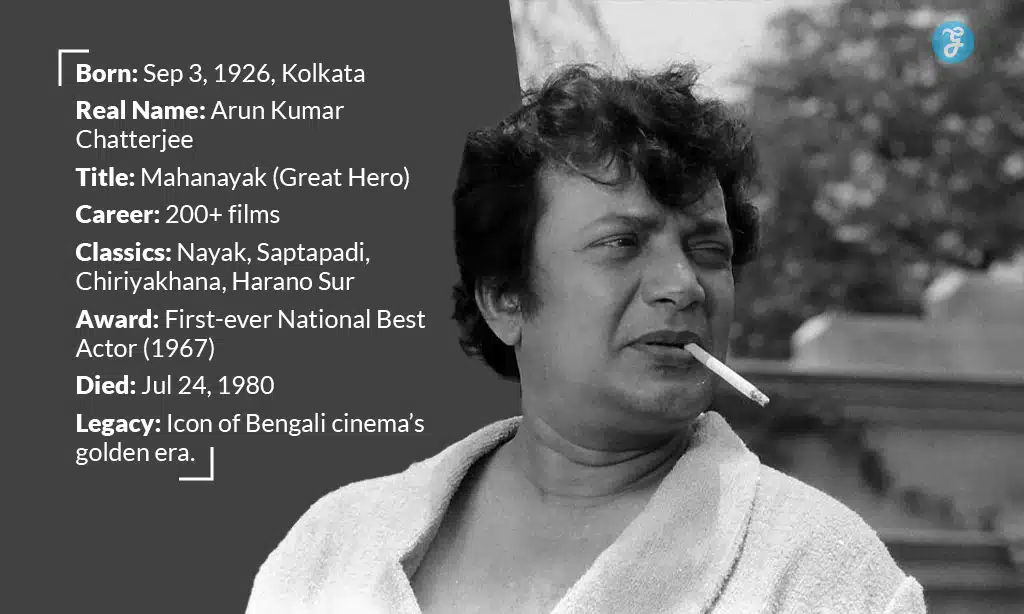
- Uttam Kumar was born on September 3, 1926, in Calcutta. He starred in over 250 films after his 1948 debut as Arun Kumar Chattopadhyay.
- He won the first National Film Award for Best Actor in 1967 for Antony Firingee and Chiriyakhana. He also won eight BFJA Best Actor Awards (1955–1976).
- His big break came in Saptapadi (1961) with Suchitra Sen. He also starred in Satyajit Ray’s Abhijan (1962), Kanchenjungha (1962), and Nayak (1966).
- He directed Shudhu Ekti Bachhar (1966) and Bon Palashir Padabali (1973). He sang a duet with Asha Bhosle in 1968.
- He died on July 24, 1980, of a heart attack. In 2010, Kolkata named the Tollygunge metro station “Mahanayak Uttam Kumar Metro Station.”
Early Life and Beginnings

Uttam Kumar grew up in a modest home in Kolkata, where he chased media reels like a kid chasing candy. He learned early that a simple recording device could capture big dreams and that an audition could change a life.
Birth and upbringing
On September 3, 1926, a baby boy named Uttam Kumar Chatterjee arrived in Calcutta, Bengal Presidency, British India. His father, Satkari Chatterjee, worked nearby in the bengali film industry, and his younger brother, Tarun Kumar Chatterjee, grew up by his side.
Family life pulsed around them in a busy Calcutta neighborhood near theaters showing bengali cinema. Street scenes, school lessons, and modest celebrations taught the future icon his first lessons.
Entry into the film industry
Uttam Kumar stood tall at 5 foot 11, he caught the eye of Calcutta producers. He left college drama to seek a film role. His first screen part in 1948 used his birth name, Arun Kumar Chattopadhyay.
Drishtidan gave him a small role. The film failed at the box office. He did not quit his dream, he picked a new screen name, Uttam Kumar.
He joined a small studio as an assistant. There he learned camera moves and dialogue delivery. He met Hemanta Mukherjee and Shyamal Mitra, they backed his early work. Producers saw his charm, they offered larger parts.
He stepped into the bengali film industry with hope. He aimed to become Mahanayak of bengali cinema.
Early Film Career
He left his mark in small roles on dusty studio floors and in noisy editing rooms, as he lugged film cans, held reflectors, and learned lines late into the night. His early work in regional cinema set the tone for his later awards and shaped his filmography.
Struggles and initial setbacks
Uttam Kumar moved to Calcutta, West Bengal, in 1947 with hopes of starring in bengali cinema. Casting directors rejected him in seven auditions within six months. Staying in a tiny room near Park Street, he took odd jobs as a stagehand and read script pages by lantern light.
Early films flopped, and Gauri Ganguli, his wife from 1948 to 1963, felt the strain as they cared for one child.
Falling numbers in his bank account forced him to borrow a 35mm camera and master lighting techniques at home. Producers offered only background roles, but each tool and trial sharpened his craft.
He did not know he would act in over 250 films someday, yet he kept pushing through each setback.
Breakthrough roles
Saptapadi shot him into public view in 1961. The romantic drama earned a Certificate of Merit at the National Film Awards. He shared the screen with Suchitra Sen, and their chemistry lit up Bengali cinema.
Fans flocked to see the duo, and ticket sales soared.
The 1967 National Film Award for Best Actor made headlines. It came for roles in Antony Firingee and Chiriyakhana. Many praised how Uttam Kumar went from a fiery folk singer to a clever sleuth with equal flair.
That honor set a new bar for Indian actors.
Golden Era of Uttam Kumar’s Career
Uttam Kumar turned every frame into a live painting of emotion and charm, lighting up Bengal’s cinema with his magnetic presence. He teamed up with a celebrated director, delivering hit after hit and redefining the canvas of film with each new scene.
Iconic films from 1955–1965
The silver screen in Bengal glowed from 1955 to 1965. Kumar shone in dramas, romances, and thrillers.
- Saheb Biwi Aur Ghulam (1956), directed by Nitin Bose: he played the loyal servant with depth, critics lauded his range opposite Suchitra Sen.
- Bicharak (1959), courtroom drama: he portrayed a lawyer torn by duty, audiences felt every pulse of his conflict.
- Khokababur Protyabarton (1960), thriller adaptation: he brought Tagore’s tale to life, his intense gaze gripped every viewer.
- Jatugriha (1964), family saga: he starred as a husband facing a broken home, raw emotion struck a chord with many.
- Thana Theke Aschi (1965), crime mystery: Uttam Kumar chased a killer with grit, his voice still echoes in old theaters.
Collaboration with Satyajit Ray
Uttam Kumar starred in Abhijan, Kanchenjungha, and Nayak with Satyajit Ray. He brought depth to each part. Ray filmed him with a cinema camera that used film. People in Calcutta talked about that magic.
Ray stated that Kumar’s death marked the loss of a significant figure in Bengali cinema.
Abhijan tested both their skills in script and lens work. They met daily to shape each scene. Kumar’s charm and Ray’s direction clicked on set. These films still stir the heart of Bengali cinema fans.
National Award and Later Works
He claimed the National Film Award for Best Actor, dazzling cinematographers and camera operators with his natural flair on every frame. He followed that triumph with powerful 1970s turns in dramas, thrilling theater buffs and filmgoers alike, and setting a high bar for his later legacy.
Winning the National Award
Uttam Kumar stood under the camera lens at the National Film Award ceremony. Critics leaped to praise his work in Antony Firingee and Chiriyakhana, two bengali films that year. The jury gave him the Best Actor nod for 1967.
He became the first to ever claim this honor.
That trophy sat tall in his display case, next to his bfja best actor award. A simple film script boosted his craft early. The camera lens caught his grin at the award night. The cutting room team hailed his role.
Fans still flock to watch his filmography on screen. His win flicked a new switch in indian actor lore within bengali cinema.
Memorable performances in the 1970s
Mahanayak Uttam Kumar lit up screens in Amanush in 1975. That drama made him a star as an Indian actor in Bengali cinema and Bollywood. He played a flawed hero, alongside Amjad Khan in the Hindi version.
Next, he led Anand Ashram in 1977, with Vidya Sinha. Fans hail his range in regional films and Hindi hits.
Amanush earned him the BFJA Best Actor Award. Dui Prithibi in 1980 got a 7.1 rating. Samadhan in 1980 got a 5.9 score on IMDb. Kitaab from 1977 still draws praise for its honest dialogue.
Contributions Beyond Acting
Uttam Kumar shaped films from the director’s chair and steered projects as a producer, from editing to lighting. He lent his voice in playback singing, led audio mixing in the studio and coached his theater troupe, lighting every scene with a spark.
As a producer and director
In his hands, Uttam Kumar shaped bengali cinema from both sides of the camera. His movies included Chhoti Si Mulaqat (Rating 6.9), Grihadaha (8.2) and Do Dil (6.2). Each project brought fresh energy to the bengali film industry.
He oversaw casting, budgeting and soundtrack choices with ease.
That vision drove his direction on Shudhu Ekti Bachhar, 1966. Bon Palashir Padabali came in 1973, and Kalankini Kankabati followed in 1981. He fine tuned screenplay elements and guided camera work.
That indian actor staged a smooth shift behind the lens.
Music and playback singing
Uttam Kumar composed tunes for Banpalashir Padabali. He led sessions in a recording studio, sat at a piano, and tweaked tracks on an audio mixer. The indian actor grabbed the vintage microphone and sang.
He quipped, “Music lives inside me.” The tune runs through Bengali cinema history.
His voice reached ears as a playback singer in a few regional pictures. He recorded a duet with the veteran singer Asha Bhosle in 1968. His smooth baritone gave depth to on-screen drama.
Listeners still hum those lines from Ghare Baire. He showed his talent went beyond acting.
On-Screen Partnerships
Uttam’s chemistry with Suchitra Sen flashes through every line of their sparkling dialogue, and a wide-angle lens captures each subtle glance. They steal scenes with an effortless grip, thanks to a smooth tracking shot that locks on their every move, leaving us craving more.
Collaboration with Suchitra Sen
Uttam Kumar and Suchitra Sen lit up Bengali cinema screens with their first hit, Sharey Chuattor in 1953. Agni Pariksha in 1954 cemented their status as a top screen pair. Fans cheered every scene in Harano Sur and Sagarika.
Saptapadi earned them wide acclaim in 1961.
Their chemistry set a high bar in on-screen partnerships. Directors picked them for key roles across decades. Their joint entries fill the key pages of Uttam Kumar filmography. Their work still thrills viewers in West Bengal, India.
Other prominent co-stars
Fans saw Uttam Kumar, a top Indian actor, spark magic with Soumitra Chatterjee in films like Nayak and Chiriyakhana. They shaped Bengali cinema with sharp minds in mystery and drama.
He paired with Madhabi Mukherjee in Jatugriha and Khokababur Protyabarton, blending emotion with grit.
Audiences loved his scenes with Supriya Devi in Thana Theke Aschi. That tandem showed raw power on screen. Collaborations with Bikash Roy in Bicharak and Vidya Sinha in Ekhane Pinjar added depth to the Bengali film industry.
Philanthropy and Public Image
He backed a small foundation that ran health camps in dusty villages. He even joined a crowdfunding drive to revive old film reels for fans.
Charitable work and activism
On November 25, 1975, the government of India gave Uttam Kumar the Mahanayak award, worth 500,000 rupees. He handed over every rupee to a Calcutta orphanage and paid their expenses for a year.
Friends from bengali cinema, including Suchitra Sen and Soumitra Chatterjee, joined his charity shows. He opened a free clinic near Basu Paribar road, and locals still talk about his 1974 flood relief drive.
People saw the indian actor use his star power to speak up on public health. He stood beside Mamata Banerjee at vaccine rallies and urged viewers on All India Radio to help rural schools.
Amjad Khan recorded a support message at Uttam’s request. His activism left a mark on bengali film industry and bengal society.
Influence on Bengali society
Uttam Kumar held a firm place in Bengali culture. This Indian actor shaped images of heroes in Bengali cinema. He shared screens with Suchitra Sen and Soumitra Chatterjee in Basu Paribar and Jhinder Bandi.
People copied his style, from the tilt of his hat to his quiet grin. Youth looked up to him as a symbol of hope. He earned the National Film Award in 1961 and won BFJA Best Actor Awards multiple times.
Kolkata honored his memory by renaming the Tollygunge metro station Mahanayak Uttam Kumar after his death in 1980.
Cinema halls filled fast when his films opened. His value spanned art and social change. He served charities and helped small theater groups in Calcutta. His voice echoed in music halls, and crowds cheered at each song.
Fans still visit the station that bears his name to exchange tales about Antony Firingee or great hits like Saheb Bibi Golam. That stop stands as a living tribute to the spirit of Bengali film.
Illness and Death
He battled a stubborn cardiac ailment in his final years, yet he lit up theaters and screens with the same spark. He died in 1980 and left a void in Bengal; explore his final bow and the heartfelt tributes from veteran actor Soumitra Chatterjee and filmmaker Srijit Mukherjee.
Final years and legacy
Uttam Kumar led a busy life in late 1970s. The actor shot scenes for Ogo Bodhu Sundari in Calcutta, Bengal. Crew members noted his energy on location, even as he dealt with health issues.
He died of a heart attack on July 24, 1980, in Calcutta, West Bengal, India. Fans filled theatres to watch his last films.
Modern film fairs sometimes screen his hits with Suchitra Sen and Soumitra Chatterjee. Critics praise his range from drama to comedy, in Anthony Firingee and Bhranti Bilash. Srijit Mukherjee and Rituparno Ghosh cited him in interviews.
Award bodies still count his BFJA Best Actor Award and National Film Award wins. Prosenjit Chatterjee calls him a north star in Bengali cinema.
Artistry and Legacy
He rewrote narrative structure and sparked fresh camera techniques in Bengali films. Explore his performance style and film restoration tips in upcoming posts.
Influence on Indian cinema
Indian actor Uttam Kumar changed the way people saw mood and depth on regional screens. His work lifted bengali cinema to new heights. Actors across India borrowed his gentle gestures and sharp glances.
Camera work in Mumbai and Chennai films learned from his moves. Satyajit Ray stated that Kumar’s death marked the loss of a significant figure in bengali cinema.
His aura still guides young stars. Editors watch him to pick up timing tricks on a motion picture camera. Students at film schools in kolkata, bengal, and new delhi study his dialogue delivery to find fresh heart.
His legacy lives in studios far beyond the bengali film industry.
Tributes and honors
He ruled the screen and earned his place in hearts. His memory shines in awards and street signs across Calcutta.
- He won five BFJA Best Actor awards between 1954 and 1972, each trophy marking his stride in bengali films.
- Officials gave him the Padma Shri in 1970, a clear salute from the national stage to his craft.
- A National Film Award for Best Actor in 1968 honored his turn in Antony Firingee, sealing his status.
- Calcutta’s Tollygunge metro station was renamed Mahanayak Uttam Kumar in 2010, so each ride recalls his legend.
Takeaways
Uttam Kumar carved a lasting place in Bengali cinema. Warm acting still wins hearts today. Every shot glows through a film camera. He bagged top awards, like the National Film Award and Padma Shri.
Students and fans study his film ideas like a guide star.
FAQs on the Legacy of Uttam Kumar
1. Why is Uttam Kumar called Bengali Cinema’s Greatest Icon?
He starred in more than 200 bengali films, broke box office records, charmed fans with his warm eyes, and even worked with Satyajit Ray.
2. How did Uttam Kumar shape the bengali film industry?
He brought a fresh style to the bengali film industry. He led hits like Basu Paribar and Antony Firingee, named for Firhad Hakim. His duo scenes with Soumitra Chatterjee felt alive, like old pals trading wise cracks.
3. What top awards did Uttam Kumar receive?
He earned the BFJA Best Actor Award and a National Film Award. He also won nods from critics for his work with Suchitra Sen.
4. Who were Uttam Kumar’s famous co-stars?
He shared the stage with the actress, he clicked with Vidya Sinha, and he even met Rajesh Khanna and Amjad Khan in crossover shows.