
After hours of heated debate and procedural delays, the Texas House of Representatives passed a mid-decade congressional redistricting plan strongly backed by Republicans and former President Donald Trump. The plan, approved late Wednesday evening, is designed to give the GOP a significant advantage heading into the 2026 midterm elections by reshaping several Democratic districts in major urban centers and making two Rio Grande Valley districts more competitive.
Analysts have highlighted that the newly approved congressional map could potentially flip as many as five Democratic-held seats to Republican control. Districts represented by Democrats Al Green, Marc Veasey, Julie Johnson, Greg Casar, and Lloyd Doggett are among those most vulnerable under the new lines. The revised map does not significantly endanger any current Republican incumbents, instead focusing entirely on consolidating GOP power while weakening Democratic-leaning areas in Houston, Dallas–Fort Worth, and Austin.
The Republican majority pushed the plan through as part of a broader mid-decade redistricting effort, a highly unusual move outside the traditional ten-year cycle. Critics, including legal scholars and civil rights groups, have argued that this strategy represents a blatant example of partisan gerrymandering designed to entrench Republican dominance in Texas’ congressional delegation.
Democratic Walkout, Quorum Crisis, and GOP Countermoves
The path to Wednesday’s vote was turbulent. In early summer, House Democrats staged a dramatic walkout to deny the legislature the quorum needed to move the maps forward. For more than two weeks, Republicans were unable to proceed with the session, prompting Governor Greg Abbott and GOP leaders to threaten arrest warrants and fines for absent lawmakers. Eventually, enough Democrats returned to restore quorum, enabling Republicans to force the redistricting bill onto the floor.
During Wednesday’s session, Democrats attempted to stall deliberations with numerous amendments. Some lawmakers introduced long-shot procedural motions to table or delay the bill, while others attempted to draw attention to what they saw as the undemocratic nature of the process. Ultimately, every Democratic amendment failed as Republicans held firm. The final vote broke sharply along party lines, with all 88 Republicans in favor and 52 of the 62 Democrats opposed.
In the aftermath of the walkout, Abbott announced plans to introduce legislation that would punish lawmakers for future quorum-denying tactics, reflecting the high level of political tension surrounding the redistricting process.
Minority Representation and Legal Challenges Expected
Civil rights advocates have raised concerns that the GOP’s plan dilutes the voting power of minority communities, particularly Hispanic and Black voters in urban and border regions. Experts have warned that the map may violate provisions of the Voting Rights Act by minimizing opportunities for communities of color to elect representatives of their choice.
Democratic lawmakers have already indicated that they plan to challenge the new congressional map in court once Governor Abbott signs it into law. Legal experts expect lawsuits to focus on whether the maps unlawfully discriminate against minority groups or represent unconstitutional partisan gerrymandering.
Abbott, Trump, and the GOP National Strategy
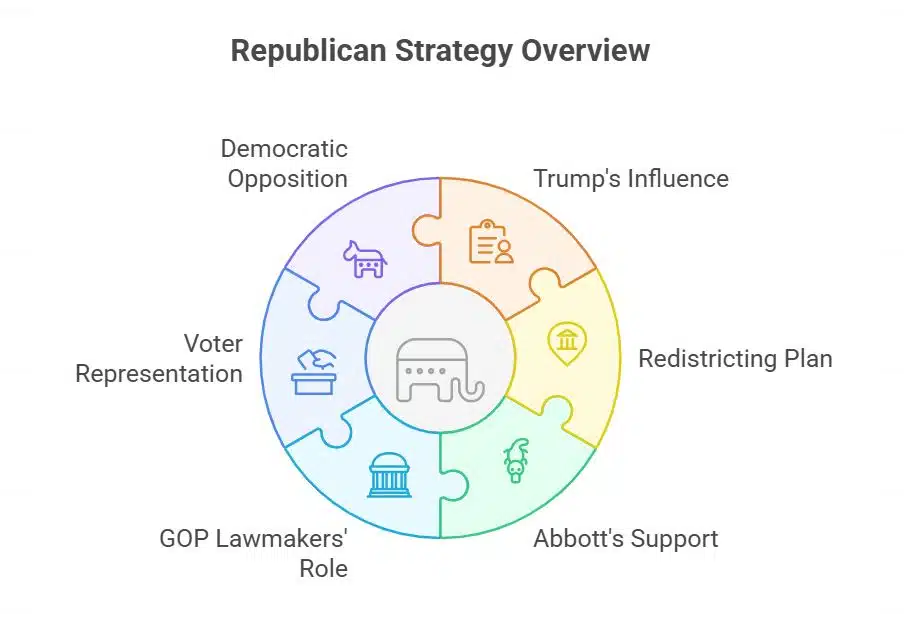
The redistricting plan is closely tied to Donald Trump’s broader national push to secure Republican dominance in the House of Representatives. Trump personally pressured Texas Republicans to pursue the mid-decade map changes, framing the move as essential for protecting GOP control of Congress in 2026.
Governor Abbott has strongly aligned himself with the effort, praising Republican lawmakers for pushing the maps through despite fierce opposition. He has portrayed the legislation as reflecting the will of Texas voters, while dismissing Democrats’ objections as obstructionist tactics.
Democratic Resistance and Acts of Defiance
Despite ultimately losing the vote, Texas Democrats used Wednesday’s floor session to mount vocal resistance. Lawmakers accused Republicans of manipulating the political process for partisan gain, while also condemning Trump’s influence on the state legislature.
Some Democrats demonstrated acts of defiance that drew attention nationwide. Representative Nicole Collier refused to sign a law enforcement “permission slip” meant to prevent members from leaving the Capitol, choosing instead to spend the night inside the House chamber in solidarity with colleagues. She and others described the fight as far from over, framing the redistricting battle as one piece of a broader struggle for fair representation.
Protests also spilled outside the statehouse. Democratic members including Greg Casar and Lloyd Doggett joined activists in denouncing the maps as a threat to democratic institutions.
National Fallout: California and New York Respond
The controversy in Texas has not gone unnoticed in other states. California Governor Gavin Newsom and New York Governor Kathy Hochul have both indicated that their states may redraw congressional maps in response, a move that could counterbalance Republican gerrymandering efforts. Newsom has accused Texas Republicans of undermining democratic principles, while Hochul has declared that New York is prepared to fight back in the national redistricting battle.
California lawmakers are already preparing to take up legislation to create new maps, while in New York, officials have said the earliest revised districts could take effect is 2028.
What Comes Next
The Texas Senate is expected to approve the redistricting bill within days, sending it to Governor Abbott’s desk for signature. If enacted, legal challenges from Democrats and civil rights groups are almost certain to follow. Courts may ultimately decide whether the maps can be used in the 2026 elections.
For now, Republicans are celebrating what they view as a major victory in their effort to secure long-term congressional dominance. Democrats, meanwhile, are regrouping for the next stage of the fight, both in court and at the ballot box.