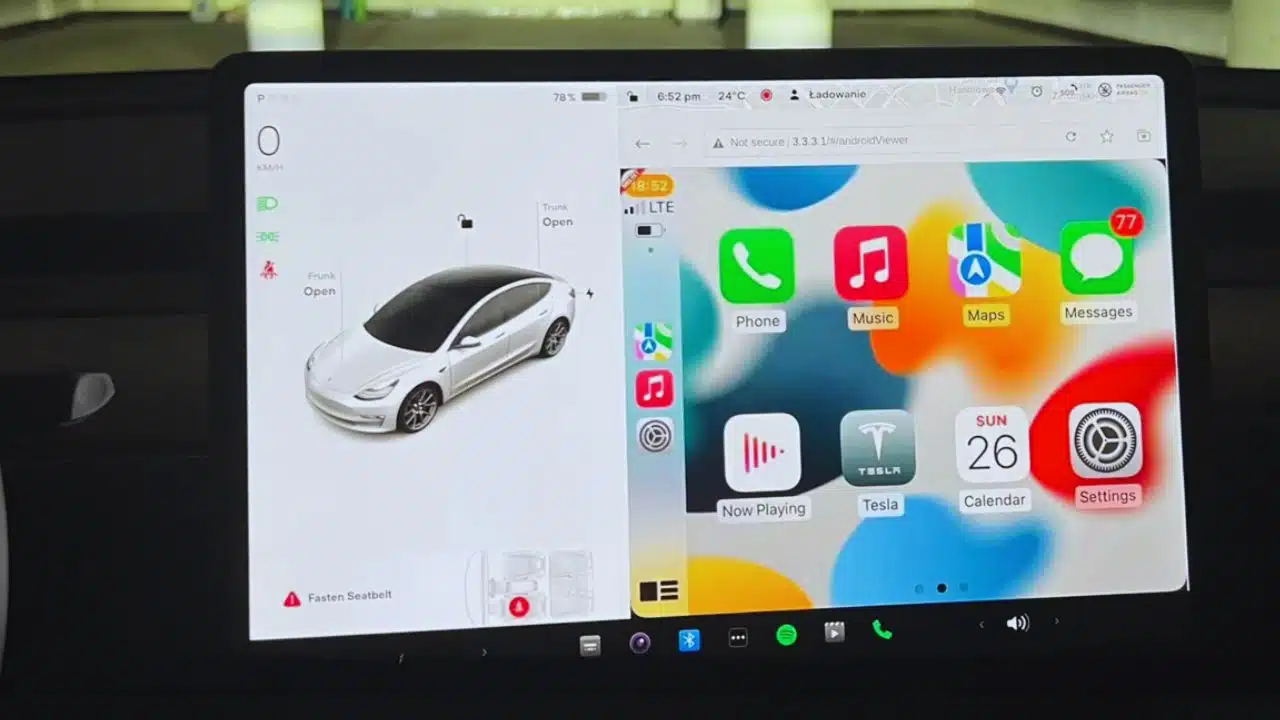
Tesla is reportedly taking a major step that many iPhone users have been waiting years to see: the company is said to be internally testing the integration of Apple CarPlay inside its electric vehicles. According to multiple reports, this feature is now in active development and undergoing internal trials, indicating that Tesla is seriously considering adding Apple’s popular in-car interface to its software ecosystem. While Tesla has not officially confirmed this shift, the fact that internal testing has begun suggests that the company may finally be re-evaluating its long-standing resistance to smartphone-based infotainment systems.
This development is surprising because Tesla has spent years building, refining, and defending its own proprietary infotainment platform. From the earliest Model S to the latest vehicles, Tesla has emphasized a closed ecosystem where the user experience is controlled entirely by the company. Unlike most automakers—who commonly offer both Apple CarPlay and Android Auto—Tesla chose to exclude both, arguing its built-in apps and software experience were superior and eliminated the need for mobile-mirroring solutions. For years, this strategy created a clear divide: iPhone users in most brands enjoyed seamless CarPlay integration, while Tesla owners relied fully on Tesla’s own system.
What makes this new testing even more notable is the history between Tesla and Apple. Elon Musk has previously described a “frosty” relationship with Apple’s leadership, even revealing that he once attempted to pitch the sale of Tesla to Apple during a difficult period in the Model 3 program. Musk says the offer was dismissed without a meeting. Over the years, Apple and Tesla have occasionally competed for talent, with Apple once hiring several Tesla engineers for its long-running and ultimately abandoned “Apple Car” project. These past frictions make the idea of CarPlay arriving inside a Tesla even more unexpected and strategically interesting.
According to reports, Tesla is not planning to replace its interface with CarPlay; instead, the feature would appear as a separate window inside Tesla’s existing software. That means Tesla maintains full control of its system while giving iPhone users an additional layer of convenience. Importantly, the version being tested is said to be the standard CarPlay experience—not the newer CarPlay Ultra, which integrates more deeply into areas like the instrument cluster and vehicle controls. This suggests Tesla wants to maintain tight control over core driving-related functions while still addressing a major customer demand.
If Tesla launches CarPlay support, the integration would give drivers access to familiar tools such as Apple Maps, Music, Podcasts, and Messages, all in a format they already know. This could be particularly attractive to drivers who rely on the Apple ecosystem and prefer continuity between their phone and car. For years, many Tesla owners have expressed frustration about not having CarPlay—especially when navigating areas where Apple Maps excels or when wanting to use apps not available within Tesla’s environment.
Interestingly, Tesla is considering CarPlay at a moment when some automakers appear to be moving in the opposite direction. GM has announced plans to remove CarPlay and Android Auto from its future electric vehicles, focusing instead on an AI-driven infotainment system built around Google technologies. Ford’s leadership has also publicly criticized Apple’s latest version of CarPlay for limiting automakers’ ability to control the in-car experience. In this broader industry context, Tesla’s potential adoption of CarPlay reflects shifting dynamics: customers continue to demand open connectivity, even as some manufacturers try to push users into proprietary ecosystems.
Despite the excitement around this news, it’s important to remember that internal testing does not guarantee a public release. Tesla frequently prototypes features that never reach production. Software upgrades and new integrations go through long validation processes, and Tesla could still decide that CarPlay conflicts with its broader software strategy. The company has not responded to requests for comment, and Elon Musk has not addressed the reports publicly, leaving room for speculation.
If Tesla does move forward, this decision could signal a strategic recalibration. Allowing CarPlay—even in a limited windowed format—would acknowledge that customer expectations have changed. Smartphone-based ecosystems continue to be a high priority for many buyers, and offering CarPlay could help Tesla stay competitive as more EV brands enter the market. It could also improve user satisfaction, reduce friction for iPhone-heavy households, and support broader adoption among consumers who consider CarPlay essential.
At the same time, Tesla must balance openness with the control it has always prioritized. A windowed approach gives the company flexibility: it can satisfy user demand without compromising the design and functionality that differentiate Tesla’s interface from other brands. Whether Tesla ultimately pushes this feature to the public will depend on internal testing outcomes, customer feedback, and larger strategic goals related to software, partnerships, and market positioning.
For now, the possibility of Tesla enabling Apple CarPlay marks one of the most interesting developments in the automotive software space. If released, it would represent a noteworthy shift for a company long known for going its own way—and for millions of iPhone-using Tesla owners, it could finally bring the experience they’ve been asking for.