Do your games stutter on Linux? You tweak the Nvidia or AMD driver and still get low fps. You hit anti-cheat errors on Steam. You want a smooth gaming experience.
One fact: over 80% of Steam games run on Linux with Proton GE. In this post, you get Tech Hacks Pblinuxgaming to boost fps, tune VKBasalt shaders, and fix controller compatibility quirks.
We show you how to use GameMode, kernel tweaks, and Ubuntu settings for top performance. We guide you through easy anti-cheat solutions and swap tricks. Keep reading.
Key Takeaways
- Tech Hacks Pblinuxgaming notes that over 80% of Steam games run on Linux with Proton GE. You can cut crashes by 10–30% in titles like Witcher 3 when you add the Glorious Eggroll build under ~/.steam/steam/compatibilitytools.d.
- Use Feral’s GameMode to lock your CPU governor on high and kill background tasks. Pair it with MangoHud to display real-time FPS, GPU/CPU load, and RAM use on every frame.
- Apply simple kernel tweaks: set vm.swappiness=10, allocate 2048 huge pages via sudo sysctl, install a low-latency kernel build, and add a file-system sync patch. These steps cut input lag and boost frame rates.
- Add vkBasalt for bloom, FXAA, and HDR effects through easy ini profiles. It works on Vulkan, Mesa, OpenGL, and Proton GE games with minimal FPS impact.
- Fix anti-cheat snags by running the Proton GE BattleEye build, creating separate Wine prefixes per title, and echoing lower kernel security flags to avoid rootkit errors and false bans.
Essential Tools for Enhancing Tech Hacks Pblinuxgaming Performance

GameMode jumps in and locks your operating system core on full throttle, so your graphics card can breathe easy and pump up the frames. You can pair that with Proton GE to run Windows titles right inside your distro and dodge those pesky stutters.
GameMode and Feral GameMode
Feral Interactive made a resource tuner called GameMode, kind of like a pit crew for your rig. It hijacks CPU threads, shifts your governor into high mode, and dials down background chores.
You fire it up with gamemode-run in your terminal or drop it into Steam launch options. This trick lifts frame rate on a PC, tames stutter on a Steam Deck, and saves you from spending cash on a new GPU.
MangoHud joins the party as a stats overlay, showing FPS, GPU load, CPU load, and even random-access memory usage right on top of your match. You adjust its options in a text file on GitHub and pick colors, font size, and placement.
This monitor flags latency spikes or thermal throttling, so you can alter kernel patches or fiddle with BIOS switches before your next raid. Linux gamers grab vital data, and they reclaim control over their Tech Hacks Pblinuxgaming experience, one hack at a time.
Wine and Proton GE for Windows Compatibility
Wine software runs Windows games on Linux distributions. It maps Win32 calls to open-source libraries. You install it from your distro’s package archive or use WineHQ scripts for the newest release.
Then you set up a prefix per title. Each prefix acts as a virtual C drive for files and registry entries. Many gamers tweak GPU settings or Nvidia driver flags to reach higher frame rates.
Proton GE comes from the Glorious Eggroll project. It packs enhanced patches for anti-cheats and extra codecs for better cutscene playback. Users report 10 to 30 percent fewer crashes on titles like Witcher 3.
You make a compatibilitytools.d folder under ~/.steam/steam and then copy the downloaded files. Steam picks it up on restart, so you can launch games with Proton GE like a native Linux port.
Tech Hacks Pblinuxgaming: Performance Optimization Hacks
Tech Hacks Pblinuxgaming patches the system core to cut input lag and boost clock rates, so you get smoother play. Try a Vulkan filter layer for crisp colors and softer edges, then spot every detail.
Kernel Tweaks for Gaming
Tech Hacks Pblinuxgaming rigs thrive on a tuned kernel. Small hacks push frame counts higher.
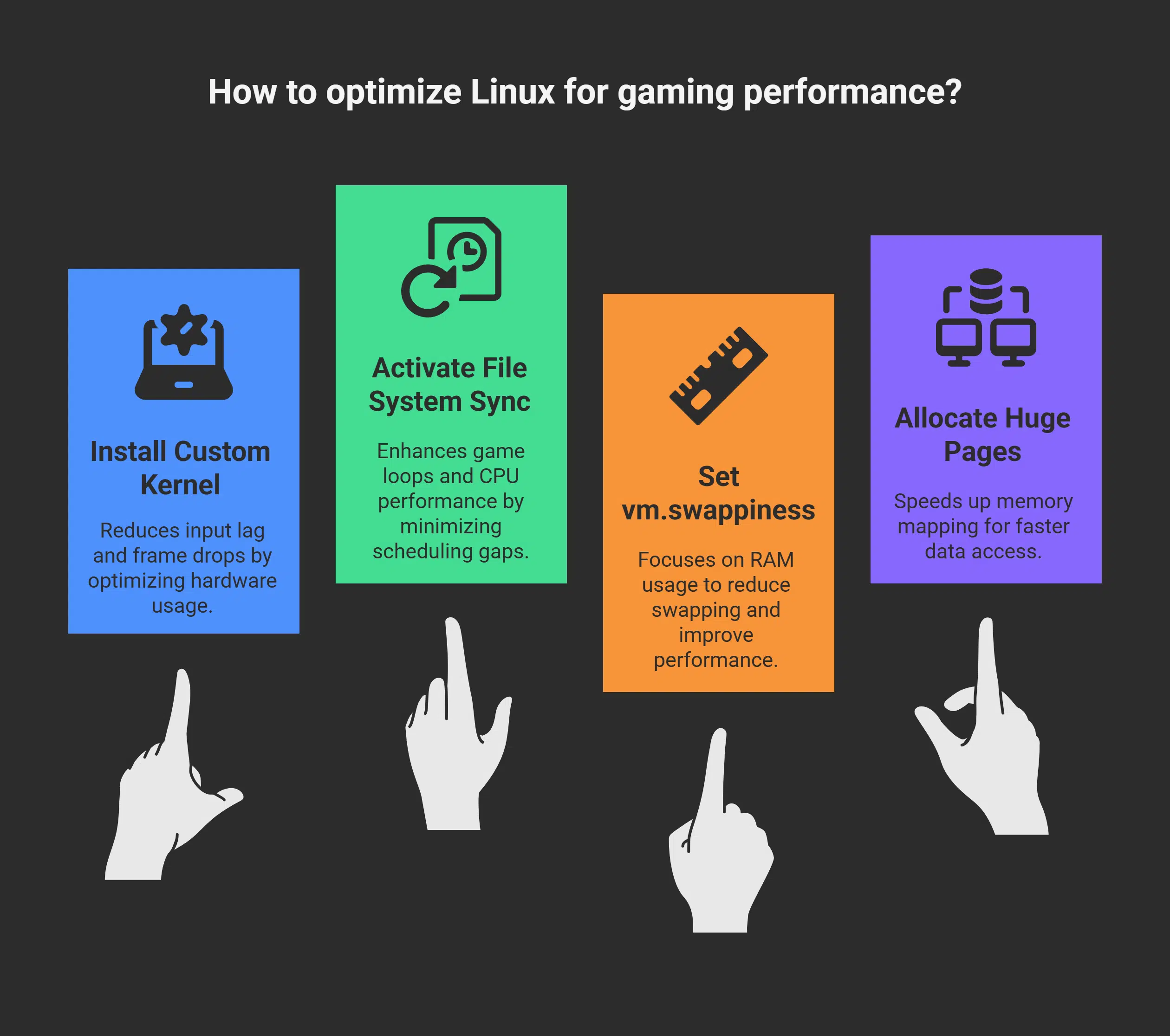
- Install a custom low-latency build to cut input lag and frame drops, pulling extra juice from your hardware.
- Activate a file system sync patch to boost game loops and trim scheduling gaps in CPU performance.
- Set vm.swappiness to 10 with sudo sysctl vm.swappiness=10 for more RAM focus and fewer swaps.
- Allocate 2048 huge pages with sudo sysctl vm.nr_hugepages=2048 to speed memory mapping.
Using vkBasalt for Visual Enhancements
vkBasalt boosts graphics with Vulkan shaders, adding bloom, FXAA, and HDR effects, all without a major FPS hit. This tool works on Steam games, Mesa and OpenGL apps, and even Proton GE titles.
Gamers enjoy deep customization via ini files; they adjust contrast, color, and brightness. They can set up custom profiles per game in seconds.
Setup takes minutes on any distro with Vulkan support and makes gaming on Linux pop. Users can back up their .vkbasalt.d folder to keep profiles safe. vkBasalt runs alongside GameMode and Feral GameMode or custom kernel tweaks, so it stays light.
People get sharper textures and clear shadows on AMD or Intel graphics processing units.
Tech Hacks Pblinuxgaming: Game Compatibility Fixes
Proton GE and Wine run Windows-only titles and sidestep anti-cheat software with simple flag tweaks. You can map your Xbox pad in the controller API and kill input lag with tweaks to the open-source graphics stack.
Fixing Anti-Cheat Issues
Multiplayer titles hit snags on Tech Hacks Pblinuxgaming. Updates can break League of Legends with Trail Guard.
- Use a GE build of Proton on Steam. This build packs BattleEye fixes and lets Linux load the anti-cheat module without rootkit errors.
- Create a new Wine prefix for each Windows title. Load Trail Guard in that box to stop false unauthorized access errors and bans.
- Adjust kernel-level flags in system settings. Echo a lower security number to allow module loads without a hitch.
- Lock updates in Steam for League of Legends. Stop patches from breaking play with Trail Guard and avoid new bans.
- Run a community patch script on your server. It wraps BattleEye in a shim, cuts Spectre checks, and trims latency spikes.
Optimizing Controller and Peripheral Support
Controllers can spark joy in any Linux gaming rig. Smooth inputs feel great.
- Use the Steam Input service to map gamepad buttons for Steam and non-Steam apps, adjust dead zones, override presets, and let Video games and Linux fans on Reddit share your configs.
- Install the xboxdrv driver, set the USB polling rate in the Linux kernel to cut gamepad latency, overclock the input frequency on your computer hardware for smooth play, and avoid stick drift.
- Configure the evdev input driver, add udev rules for out-of-the-box Linux support across this family of operating systems, grant user-level access, stop sudo prompts, and boost hotplug.
- Create bash scripts to disable the touchpad and keyboard on controller hotplug, block ghost clicks, protect your cursor, and prevent invasive inputs.
- Test each controller with the jstest tool, record axis values via command line, find dead spots, and then override defaults in your config file for lag-free runs.
- Map Sony gamepad via ds4drv, route inputs in video game console emulators like Dolphin or RetroArch, tune rumble strength, and cut odd stick jitter.
- Pair Bluetooth controllers with Bluetoothctl commands, trust and connect your pad, enable low energy mode, and avoid random disconnects.
- Calibrate devices in anti-cheat titles running under Proton GE or Wine, apply kernel patches for Microsoft Windows driver quirks, and stop your account from getting banned by Battleye.
Takeaways
Tech Hacks Pblinuxgaming uses Proton or Wine to run Windows titles with low latency. Tweak your kernel and open source driver settings to sharpen texture mapping and cut GPU lag. Add vkBasalt to boost color and shine up visuals with easy filters.
Tune controllers on Steam or set your PS2 emulator and console emulator without fuss. Guard your build from malware; lock down server security with a few simple antivirus moves.
FAQs on Tech Hacks Pblinuxgaming
1. How do I run Windows games on Linux?
Use the Proton layer in Steam or install Wine; they act like a bridge, so your games run perfectly on this platform.
2. How do I cut latency and boost FPS on my Linux gaming PC?
Pick a low-latency kernel, host your match on a remote server to drop lag, overclock your CPU carefully, and then tweak Mesa graphics and texture mapping for extra speed.
3. What can I do to stop malware, spyware, and hackers?
Install antivirus software, scan for spyware and adware, patch Spectre flaws right away, lock down your server ports, use a safe browser, and follow hacker news for tips from the white hat community.
4. Can I play console games like Wii or PlayStation on Linux?
Yes, you can use an emulator for Wii titles and PCSX2 for PlayStation games, just follow Pblinuxgaming on YouTube, set each option, and tailor the settings so your titles run smoothly.
5. How do I protect my game data and avoid data loss?
Sync your save files with cloud computing services, back up often, and keep extra copies on a USB stick; that way you never lose progress if your drive fails.
6. Where can I find more tips and help?
Join the Pblinuxgaming subreddit, chat with other developers on YouTube, share hacks, swap money-saving tricks, and learn new tweaks every week.