Your smartphone has been your constant companion for years. You check it first thing in the morning, scroll through it during lunch, and keep it by your side before bed. Yet lately, something feels off. The new models look almost identical to last year’s version. The battery still dies by evening. The screen time keeps climbing, but the innovation has stalled. You are not alone in feeling this way. Millions of people are experiencing the same fatigue with phones that simply do not change much anymore.
Tech giants envision future beyond smartphones, and they are building something completely different. Apple, Google, Meta, and Samsung have all shifted their focus away from phones and toward new technologies that will reshape how we interact with the digital world.
These companies recognize that smartphone sales have plateaued, hardware improvements have slowed to a crawl, and consumers are hungry for fresh experiences. The post-smartphone era is coming, and it will transform personal computing in ways that feel almost like science fiction.
This article walks you through what comes next. You will discover why smartphones are losing their grip on the tech world. You will learn about augmented reality glasses, spatial computing, and AI assistants that work without screens.
You will see exactly what Apple, Google, and other giants are building right now. By the end, you will understand the technologies reshaping your future. The next computing revolution starts here.
Why the Smartphone Era Is Shifting

Smartphones have dominated our lives for nearly two decades, yet the market for new phones has hit a wall. Hardware makers struggle to pack meaningful upgrades into each generation, leaving millions of users asking what comes next.
Wearables and ambient devices now grab our attention in ways phones never could. Smart glasses, smartwatches, and AI-powered assistants work quietly in the background, reshaping how we interact with technology without demanding our constant focus.
Plateau in Hardware Innovation
Your phone’s camera got a little better this year. The processor runs a touch faster. The battery lasts maybe one more hour. Sound familiar? That’s the reality of today’s hardware innovation in smartphones.
For over a decade, these devices ruled our pockets and our lives. Now, the improvements feel thin and tired. Samsung, Apple, and Google keep releasing new models, but the jumps between generations have shrunk dramatically.
Consumers notice this stagnation. Many skip annual upgrade cycles because the new phone doesn’t feel meaningfully different from last year’s model. The market has hit a ceiling, and everyone knows it.
This slowdown has real consequences for the tech industry. Foldable and rollable display innovations emerged as potential game-changers, yet they remain transitional technologies rather than revolutionary breakthroughs.
Samsung, Huawei, Oppo, and Google invested heavily in foldable formats to test hybrid designs and expand screen real estate. These experiments merge tablet functionality with smartphone portability, but they don’t fundamentally shift how we interact with our devices.
The insights from foldable technology will inform future AR glasses and spatial interface designs, pointing the industry toward new form factors beyond the traditional flat screen.
Hardware plateaus force companies to look elsewhere, and that’s exactly where the next era of computing begins.
Rise of Wearables and Ambient Devices
Your wrist now does what your phone used to do. Smartwatches like the Apple Watch handle calls, texts, and payments without pulling out your pocket device. Google and Samsung are building smart ecosystems where wearables talk to home assistants and other gadgets, creating a connected web around you.
These wearable computers transform how you interact with technology. Smart rings and wristbands track your heart rate variability, skin temperature, and sleep patterns in ways phones never could.
Your living space becomes a tech hub when voice assistants like Amazon Alexa, Apple Siri, and Google Assistant sit in your home, listening for commands. Ambient computing, promoted by Google, lets technology blend into your everyday life without demanding your attention.
You don’t hunt for your phone; the tech finds you instead.
Wearable sensors and AR-assisted devices are shaking up entire industries. Healthcare workers use smart glasses to see patient data overlaid on their vision. Construction crews access real-time information through headsets, keeping both hands free for work.
Battery limitations and data privacy remain real challenges, though. Companies are racing to solve these problems before 2025. The wearable tech market will expand significantly between 2025 and 2030, with early adoption of AR glasses and AI assistants accelerating this shift.
Your personal assistant now lives on your wrist, in your glasses, and throughout your home, redefining what a computing device actually means.
Key Technologies Shaping the Post-Smartphone Future
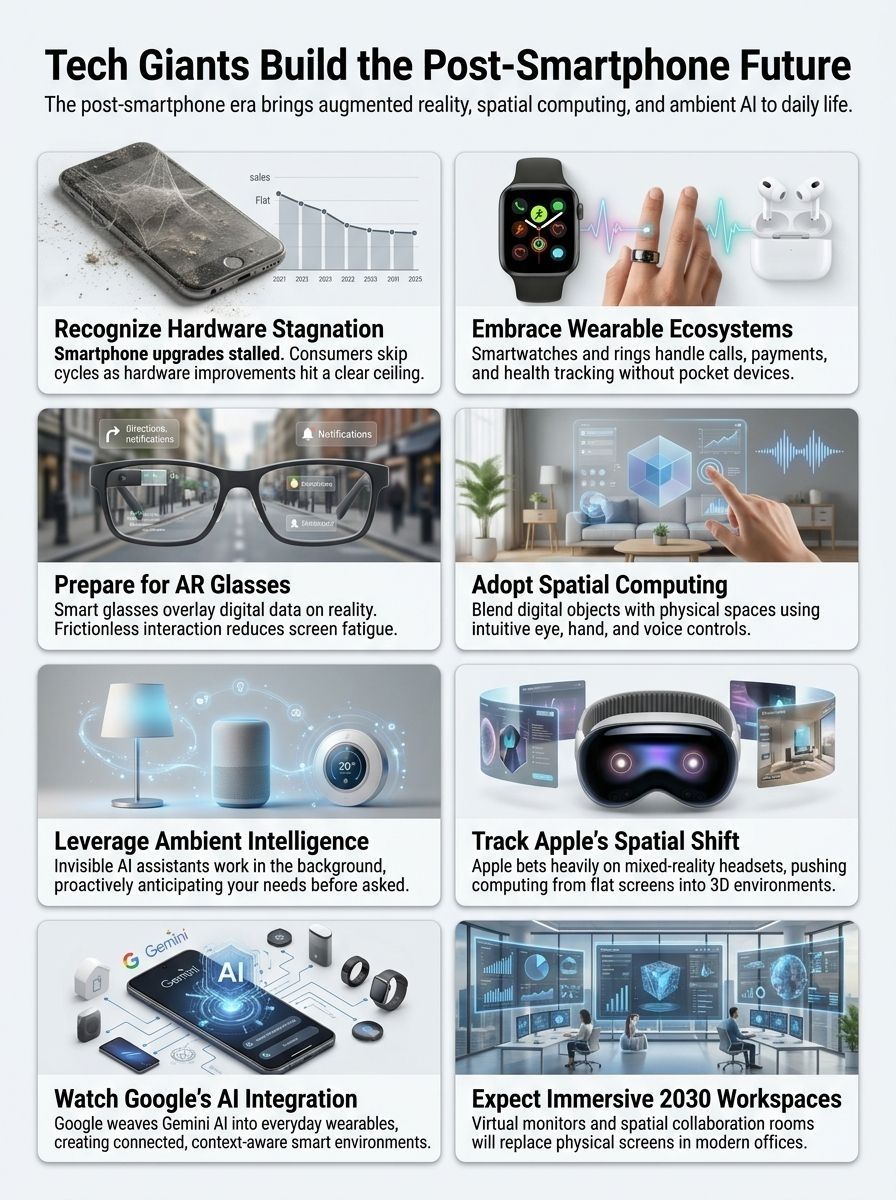
AR glasses, spatial computing, and AI assistants are reshaping how we interact with digital information around us. These technologies move beyond the screen and place intelligence directly into our everyday world.
Augmented Reality (AR) Glasses
AR glasses overlay digital information right onto your field of vision, and they’re shaping up to be the next platform after smartphones. Imagine walking down a street and seeing navigation arrows float above the sidewalk, or getting real-time translation of a foreign menu without pulling out your phone.
Apple, Meta with Ray-Ban, and Google are all racing to make this happen. These smart glasses offer something smartphones can’t: passive, frictionless interaction that reduces digital fatigue. You get the information you need without constantly staring at a screen in your hand.
The tech giants envision future beyond smartphones where AR glasses become as normal as wearing regular eyeglasses. Market expectations point to lighter, more stylish prototypes arriving in the next two to five years, with better battery life than what we see today.
Battery longevity remains a major hurdle, though, since keeping glasses powered all day is no small feat. Social acceptance and privacy concerns also stand out, especially regarding discreet content projection that others can’t see.
Companies like Apple with Vision Pro are already making major investments in wearable technology, signaling that this shift is real and happening now.
Spatial Computing and Immersive Interfaces
Spatial computing blends digital content with the physical world around you. Your eyes, hands, gestures, and voice become the tools that make this happen. Apple popularized this technology with Vision Pro, creating smaller and lighter devices that feel natural to wear.
You don’t need bulky equipment anymore. Instead, you interact with digital objects as if they sit right in front of you. Microsoft’s HoloLens already helps engineers and healthcare workers do their jobs better.
These mixed reality headsets let professionals see virtual information overlaid on real environments. Samsung and Google are teaming up to build a premium XR platform that pushes this technology further.
The shift toward spatial computing represents a major move away from traditional screens and flat displays.
Immersive interfaces transform how you work and create. Gesture recognition lets you manipulate 3D design interfaces with hand movements in spatial environments. Virtual monitors replace physical screens in future workspaces.
Immersive collaboration rooms let teams work together as if they’re in the same space, even when miles apart. Voice user interfaces add another layer of control, letting you command digital objects through speech.
Current challenges include high costs, bulkiness, and comfort issues for all-day wear. Tech companies are solving these problems fast. By 2030 to 2035, immersive spatial workspaces will become mainstream in offices and creative studios.
This shift changes everything about how people work, design, and communicate with each other.
AI Assistants and Ambient Intelligence
AI assistants are getting smarter and more invisible. Apple is revamping Siri into an intelligence hub that understands your needs without you asking. Google is testing a new Assistant powered by Gemini AI, which handles complex tasks across your devices.
Meta is putting AI inside glasses for real-time interactions, while Amazon advances Alexa for home and productivity management. These tools no longer sit in apps waiting for you to tap them; they work in the background, watching for what you need next.
AI advancements are changing what people expect from their devices, pushing for hands-free interactions and instant help.
Ambient intelligence makes technology disappear into your surroundings. Your devices will soon offer context-driven suggestions, not ones based on old tracking methods like cookies.
Advanced AI will provide real-time meeting summaries and personalized assistance by 2026, handling tasks you didn’t even know were possible. Imagine walking into a room where your glasses show you exactly what you need, your watch alerts you to important information, and your home adjusts itself without a single voice command.
This shift from apps to proactive, invisible interfaces represents a fundamental change in how we interact with technology. AI-driven systems will span across devices, making the smartphone less central to your daily life.
Multimodal AI tools combine voice control, visual recognition, and contextual awareness to serve you better, faster, and smarter than ever before.
Strategies of Leading Tech Giants

Apple pushes spatial computing with the Vision Pro, a mixed-reality headset that layers digital information over the real world. Google weaves artificial intelligence into everyday devices, making ambient computing the backbone of how people interact with technology.
Apple’s Focus on Spatial Computing
Apple is betting big on spatial computing to reshape how we interact with technology. The company introduced Vision Pro, a high-end headset that marks their first major push into wearable spatial technology.
This device signals Apple’s serious investment in moving beyond smartphones. Vision Pro lets users interact through eyes, hands, gestures, and voice instead of tapping screens. The company is revamping Siri into a proactive intelligence hub, making it smarter and more helpful for seamless device interaction.
Apple anticipates a future where AR glasses replace iPhones as the main interface. Voice, gesture, and eye-tracking technologies will become standard, pushing touchscreens to the background.
The tech giant is also investigating neural input for accessibility, showing interest in brain-computer interfaces that could transform how people control devices.
Tech giants envision the future beyond smartphones, and Apple leads this charge with spatial computing. Their strategy moves computing from flat screens into three-dimensional spaces around you.
Generative artificial intelligence powers these interactions, making devices understand what you want without you saying much. The company’s mixed-reality approach blends digital content with the real world seamlessly.
By investing in future computing through spatial interfaces, Apple is building the next generation of personal computing. This shift represents a fundamental change in how technology fits into our daily lives, moving from devices we hold to environments we inhabit.
Google’s Integration of AI and Ambient Computing
Google is building a future where AI and ambient computing work together seamlessly. The company promotes ambient computing, a concept where technology fades into the background of your daily life.
Google’s investments span proactive AI assistants, wearables, smart home devices, and AR software that learn what you need before you ask. The tech giant is testing a new Assistant integrated with Gemini AI, which powers context-aware help that understands your situation and offers information without interruption.
Google targets mainstream adoption of these ambient and spatial technologies between 2025 and 2030, making this shift from smartphones happen sooner than you might think.
Google and Samsung are collaborating on a joint XR platform for premium mixed-reality experiences that go beyond what phones can do. The companies are building smart ecosystems with wearables and home assistants that talk to each other, creating a connected world around you.
Google is developing lightweight AR wearables for mainstream adoption, bringing augmented reality overlays into everyday moments. This partnership shows how tech giants are building infrastructure that replaces the smartphone as your main device.
By combining Gemini AI with spatial computing capabilities, Google creates an environment where your devices anticipate your needs and respond instantly, shaping the future of personal technology in ways that feel natural and effortless.
Final Words
Tech giants are betting big on a future where smartphones fade into the background. Apple, Meta, and Samsung are racing to perfect AR glasses, spatial computing, and AI assistants that work without screens.
The shift won’t happen overnight; expect smartphones to play supporting roles by 2035 as these new devices take center stage. Privacy concerns and software readiness remain hurdles, but the momentum is real.
Your next computing device might sit on your face, respond to your voice, and blend the digital world with reality in ways we’re only beginning to imagine.
FAQs on Tech Giants Envision Future Beyond Smartphones
1. What do tech giants believe will replace smartphones in the future?
Big Tech companies like Apple Inc., Meta Platforms, and Google are betting on devices such as smartglasses, virtual reality headsets, and brain–computer interfaces to redefine how we connect without smartphones.
2. How might AI chatbots change life after smartphones?
AI chatbots could become our main way to communicate, answer questions, and manage daily tasks; they may even handle things now done by mobile apps or personal computers.
3. Are there any real products showing this shift beyond smartphones?
Yes, gadgets like Apple Vision Pro, Samsung Galaxy foldable phones with flexible displays, Pixel Watch wearables, and Meta’s virtual reality headset all point toward a future optimized for spatial computing rather than just screens in your pocket.
4. What role does the Metaverse play in this vision of technology’s next step?
The Metaverse lets people interact inside digital universes using avatars; it blends social media with virtual reality so you can work or play together from anywhere—no smartphone needed.
5. Could brain–computer interface technology really replace the smartphone experience?
Companies like Neuralink are working on ways for brains to talk directly to computers; if successful, you might control devices or surf YouTube just by thinking about it instead of tapping a screen.
6. Why do tech giants keep investing billions into these new technologies in 2024?
They see advancements in AI and electric battery power making old-school phones less important; their goal is to discover what’s next so they stay ahead when everyone moves toward life without smartphones.