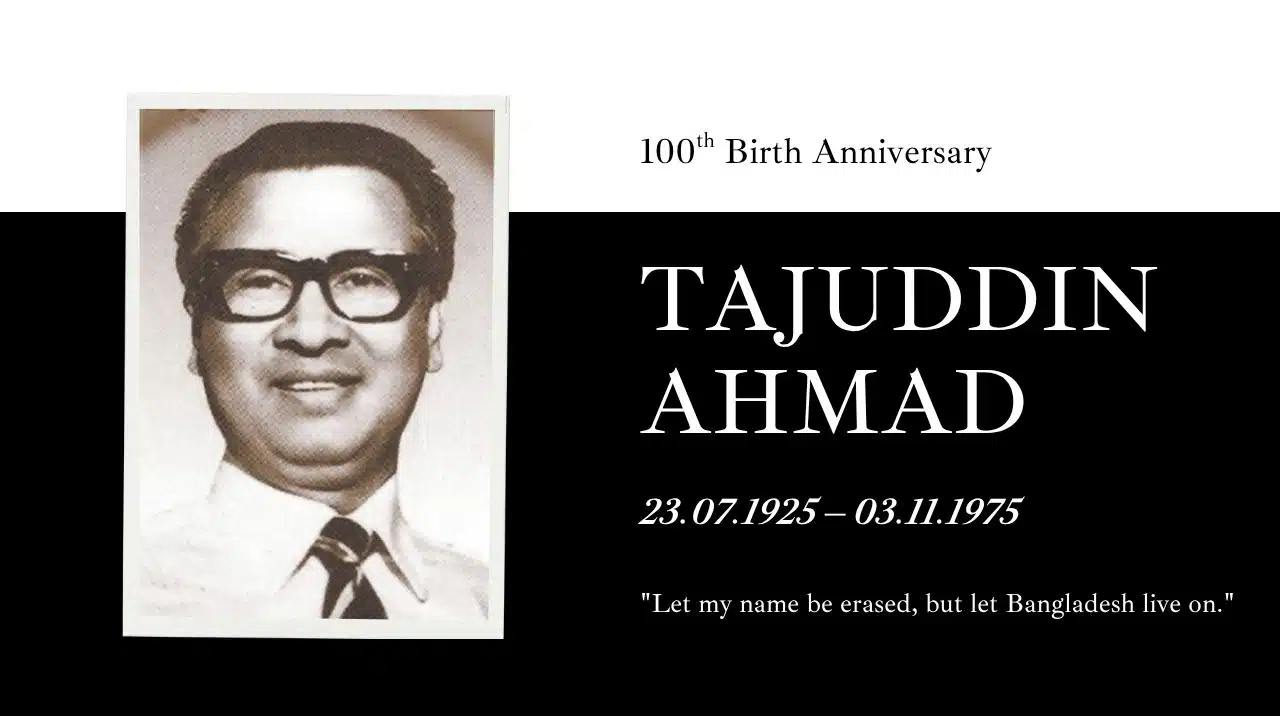
Today marks the 100th birth anniversary of Tajuddin Ahmad, the first Prime Minister of independent Bangladesh and a towering figure in the country’s liberation and early governance. Born on July 23, 1925, in the village of Dardariya in Kapasia, Gazipur, Tajuddin Ahmad is hailed as one of the most integral architects of Bangladesh’s independence and nation-building.
Tajuddin’s political career spanned decades, beginning with his involvement in the Muslim League youth activities during British India. He was a committed participant in the 1952 Language Movement and later the key proponent of the Awami League’s secular, democratic agenda. As General Secretary of the Awami League from 1966, he played a vital role in the historic 1970 general election victory and led the provisional government during the Bangladesh Liberation War in 1971, serving as its Prime Minister in exile.
His leadership was instrumental in coordinating the independence movement, rallying international support, and drafting the first budget and five-year development plan for the nascent nation. Despite succeeding against enormous challenges, Tajuddin remained a humble, self-effacing patriot who consistently prioritized Bangladesh’s welfare.
Namesake institutions like the Shahid Tajuddin Ahmad Medical College commemorate his legacy, while documentaries such as Tajuddin Ahmad: An Unsung Hero help keep his memory alive. Prominent figures and government officials gathered throughout the day at various ceremonies, paying tribute to his unwavering commitment to justice, democracy, and the liberation of Bangladesh.
His tragic assassination inside Dhaka Central Jail on November 3, 1975, alongside other national leaders, marked a dark chapter in the country’s history, but it only cemented his status as a martyr and symbol of sacrifice.
As Bangladesh celebrates 100 years since his birth, citizens and leaders alike remember Tajuddin Ahmad as a visionary leader, a principled statesman, and a founding father whose patriotism and dedication continue to inspire the nation’s progress.