Sustainability in retail has officially left the warehouse. In the past, “going green” meant efficient LED lighting in distribution centers or optimized shipping routes, vital changes, but invisible to the average shopper. In 2026, the game has changed. Sustainable retail practices in the UK are now front-and-center, tangible, and often participatory.
With the “Simpler Recycling” reforms kicking in by March 2026 and the cost-of-living pressure evolving into a hunt for “value-for-money durability,” customers are voting with their wallets. They aren’t just looking for eco-friendly badges; they are looking for services that extend the life of their products and technology that proves ethical claims instantly.
Key Takeaways
-
Sustainability is Service: Repair labs and refill stations turn passive shopping into active engagement.
-
Transparency is Tech-Driven: QR codes and Digital Passports are becoming the standard for trust.
-
Resale is Mainstream: Second-hand sections are no longer hidden; they are prime retail real estate.
-
Logistics are Visible: Electric vans and cargo bikes are part of the brand image.
From “Greenwashing” to Green Acting: The Consumer Shift
Why the sudden change? For years, there was a disconnect known as the “value-action gap”—shoppers said they wanted to be sustainable, but often didn’t follow through at the till. In 2026, that gap is closing, and it is being driven by trust.
After a decade of vague “eco-friendly” claims and “greenwashing” scandals, the UK public has become skeptical. They no longer trust a green leaf printed on a package; they trust action they can see and verify. Sustainable retail practices in the UK have had to evolve from marketing slogans into tangible services.
Today’s consumer isn’t just asking “Is this product green?” They are asking, “Can I fix it when it breaks?” “Can I resell it when I’m done?” and “Can you prove where it came from?”
The retailers winning market share in 2026 are the ones answering “Yes” to these questions. They have realized that sustainability isn’t just about saving the planet—it is about providing a better, more honest customer experience. The following 15 moves represent the gold standard of this new, transparent era of retail.
Here are the 15 sustainable retail moves that are reshaping the UK high street and online baskets in 2026.
The “Circular Economy” on the High Street
The most visible shift in 2026 is the move from “take-make-waste” to “keep-it-in-use.” Retailers are finding that helping customers repair and resell is a powerful loyalty engine.
1. In-Store Repair “Labs” & AI Diagnostics
The “Right to Repair” movement has graduated from policy papers to the shop floor. Major electronics retailers like Currys have expanded their “Long Live Your Tech” initiative into visible, glass-walled “Repair Labs” in prime locations.
-
What customers see: Instead of a sales desk, they see technicians actively fixing laptops and phones.
-
The 2026 Twist: Before you even leave home, AI-driven diagnostic tools on retailer apps can listen to a washing machine’s spin cycle or analyze a photo of a broken device to order the exact part needed, turning a “broken” item into a weekend project.
2. Branded “Pre-Loved” & Resale Sections
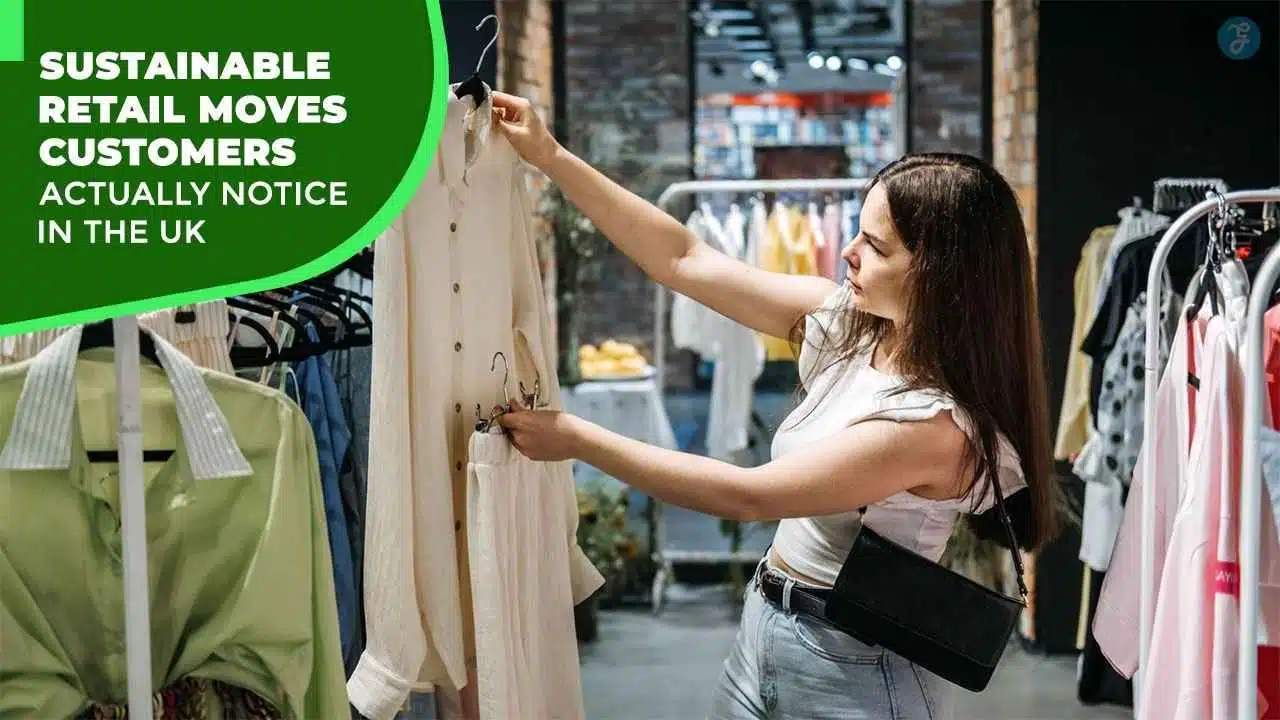
Walking into a flagship store on Oxford Street or a local High Street branch, you are now just as likely to see a “Vintage” or “Pre-Loved” rail as you are new arrivals. Brands like Zara, Primark, and River Island have integrated resale directly into their floor plans.
-
Why it works: It removes the stigma of second-hand. By placing used items next to new ones, retailers validate the quality and longevity of their own goods.
3. Rental Services for Occasion Wear
The “ownership” model is fading for items worn only once. Department stores and fashion giants have fully integrated rental platforms (like Hurr or Hirestreet) into their physical spaces.
-
The Shift: It’s no longer just luxury handbags. In 2026, we are seeing rental options for ski wear, camping gear, and even DIY power tools in mainstream hardware stores, allowing customers access without the clutter of ownership.
4. Instant “Buy-Back” Kiosks
Trade-in schemes have become frictionless. Retailers like IKEA and tech giants have introduced automated or express “Buy-Back” desks. You bring in your old bookshelf or tablet, get an instant quote based on its condition, and receive store credit immediately. It turns a customer’s old clutter into their next purchase’s down payment.
Visible Waste Reduction & Packaging
Shoppers are tired of the “bin guilt” associated with overflowing recycling boxes. Sustainable retail practices in the UK now focus on helping customers reduce waste before they leave the store.
5. “Refill & Reuse” 2.0
The early experiments with gravity dispensers for pasta have matured. Supermarkets like Asda and M&S now offer “Refill Zones” that are cleaner, faster, and integrated into the main aisles rather than tucked away in a corner.
-
The Tech Upgrade: Smart dispensers now recognize reusable containers (via RFID tags) and automatically tare the weight, making the checkout process as fast as buying a packaged item.
6. Reverse Vending Machines (RVMs)
With deposit return schemes gaining traction, RVMs have become a fixture in store entrances for Sainsbury’s, Lidl, and Co-op.
-
The Incentive: It’s not just about recycling; it’s about instant rewards. Customers feed in plastic bottles and cans to receive 5p–10p coupons or donate directly to local charities via the machine’s touchscreen.
7. Hard-to-Recycle Drop-Off Points
Curbside recycling still rejects many items, and retailers have stepped in to fill the gap.
-
Beauty & Health: Stores like Boots and Superdrug host prominent collection bins for blister packs, toothpaste tubes, and makeup compacts.
-
The Impact: Customers actively save these items for their weekly shop, driving footfall and associating the retailer with responsible disposal.
8. “Naked” Produce & Plastic-Free Aisles
The sea of plastic wrapping on fruit and veg is receding. “Naked” produce is the standard for many items, with retailers utilizing misting technology to keep unwrapped greens fresh. Where packaging is necessary, plastic rings on cans have been entirely replaced by cardboard “snap packs” or compostable alternatives.
Tech-Enabled Transparency & Trust
In 2026, vague green labels are out. Data-backed proof is in. Customers want to know the story behind the product, and technology is providing the script.
9. Digital Product Passports (DPP)
Ahead of full EU/UK mandates, forward-thinking fashion and electronics brands have rolled out Digital Product Passports.
-
How it works: A simple QR code on a clothing label reveals the item’s full journey—from the cotton farm to the factory floor.
-
Customer Value: It proves authenticity (crucial for resale value) and allows shoppers to verify ethical labor claims instantly.
10. Carbon Footprint Labelling
Traffic-light systems for nutrition are now being applied to the planet. Food brands like Quorn and Oatly, alongside supermarket own-brands, are printing CO2e (carbon dioxide equivalent) footprints on the front of packs.
-
Comparison: A sandwich with a “Low Carbon” green label sits next to a higher-impact option, nudging customers toward the sustainable choice at the point of decision.
11. AI-Powered “True Fit” Technology
Returns are a massive sustainability black hole (fueling transport emissions and waste). Fashion retailers are combating this with AI virtual try-on tools.
-
The Experience: “Find My Size” algorithms use a customer’s previous purchase history and smartphone camera scans to predict fit with 90%+ accuracy, drastically reducing the “buy three sizes, return two” behavior.
12. Paperless “Smart” Receipts
The “Beat the Receipt” campaign has won. The question “Do you want a receipt?” is disappearing, replaced by automatic digital receipts sent to banking apps or loyalty accounts. It eliminates non-recyclable thermal paper and provides customers with a searchable digital record for warranties.
| Feature | Old Retail Model (2020) | New Sustainable Model (2026) |
| Receipts | Paper thermal rolls | Digital/App-integrated |
| Sizing | Size charts | AI Virtual Try-On |
| Supply Chain | “Made in China” label | Digital Product Passport (QR) |
Green Operations & Logistics
While some logistics are hidden, the “Last Mile” is highly visible. Sustainable retail practices in the UK are turning delivery fleets into mobile billboards for green values.
13. Zero-Emission Last-Mile Delivery
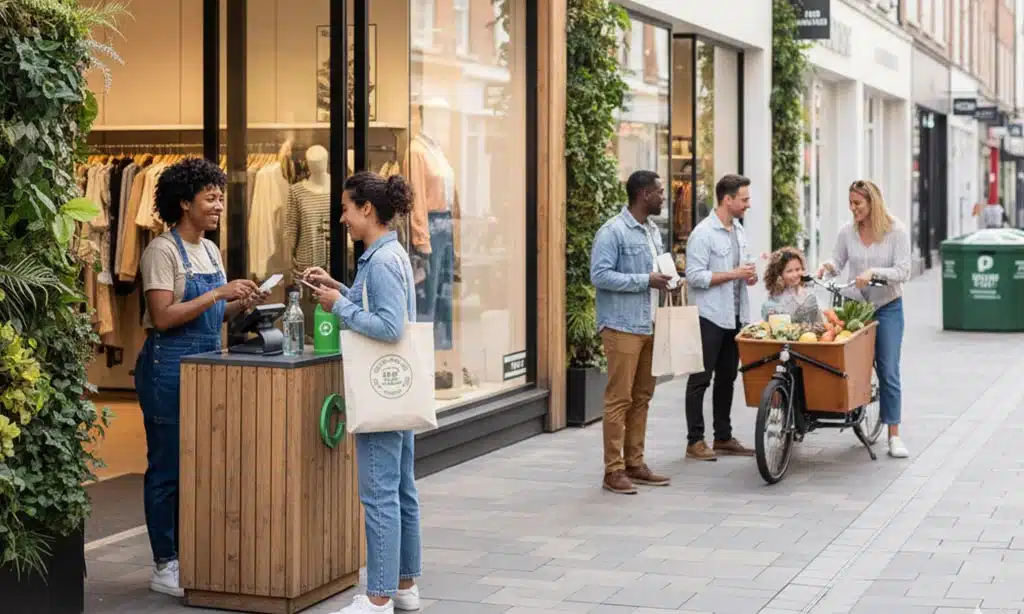
Seeing a diesel van idle outside a home is becoming a brand risk. Retailers like IKEA and Ocado have heavily invested in electric fleets. In urban centers, branded cargo bikes are replacing vans entirely for small drops, signaling speed and eco-consciousness to the entire neighborhood.
14. “Regenified” Farming Badges
Agriculture is moving beyond “Organic.” Retailers like Waitrose and M&S are championing “Regenerative Agriculture”—farming that heals the soil.
-
The Label: Customers are starting to see “Regenified” badges on bread, meat, and produce. It tells a story of biodiversity and soil health that resonates with eco-aware foodies.
15. Sustainable Loyalty Perks
Loyalty programs have evolved from “buy more” to “do good.”
-
Gamification: M&S Sparks and other schemes reward customers not just for spending, but for sustainable behaviors—like bringing a reusable cup, opting for a slower “green” delivery slot, or donating old clothes.
Why These Moves Matter
The shift to these sustainable retail practices in the UK isn’t just about saving the polar bears; it’s about business survival. 2026 data indicates that while price remains king, value is queen. A product that can be repaired (Move #1), resold (Move #2), or verified (Move #9) is inherently more valuable to a consumer than a disposable alternative.
Retailers who treat sustainability as a “customer service” feature rather than a compliance headache are the ones winning loyalty in a crowded market.
The Regulatory & Quality Shift: Why Now?
In 2026, sustainable retail isn’t just about good vibes; it is being driven by hard legislation and a smarter consumer mindset. Two major factors are forcing these changes:
1. The “EPR” Effect (January 2026)
As of January 2026, the UK’s Extended Producer Responsibility (EPR) regulations have come into full force. This legislation shifts the full cost of dealing with packaging waste from the taxpayer to the retailer.
-
The Impact: Retailers are now financially penalized for every gram of hard-to-recycle plastic they sell. This is the direct driver behind the sudden explosion of “naked” produce and refill stations—it is now cheaper for shops to sell loose pasta than packaged pasta.
2. The “Investment Shopper” Mindset
Post-2025 data reveals a fascinating shift: while budgets are still tight, the “buy cheap, buy twice” era is ending. UK shoppers are increasingly viewing clothing and tech as investments.
-
The Trend: There has been a surge in demand for natural fibers (like cotton and wool) and modular electronics. Customers are willing to pay 10-15% more upfront for a product if it comes with a “Right to Repair” guarantee or a guaranteed resale value.
Frequently Asked Questions (FAQ)
1. What are the most impactful sustainable retail practices in the UK for 2026?
The most impactful practices are those involving the circular economy—specifically in-store repair services, branded resale platforms, and extensive refill stations. These moves directly reduce waste and extend product lifecycles, which customers value highly.
2. How does the “Right to Repair” affect UK shoppers?
The “Right to Repair” regulations mandate that manufacturers make spare parts and repair manuals available to professionals and consumers. For shoppers, this means products purchased in 2026 are designed to be fixed rather than thrown away, often supported by retailer “Repair Labs.”
3. What is a Digital Product Passport (DPP)?
A Digital Product Passport is a digital record (usually accessed via a QR code on the product) that provides comprehensive data about a product’s sustainability. It includes information on materials, supply chain origin, recyclability, and repair instructions.
4. Are sustainable products more expensive in 2026?
Not necessarily. While some “premium” sustainable goods exist, the rise of “Pre-Loved” sections and “Refill” stations often allows customers to save money. Additionally, buying durable, repairable goods is cheaper in the long run compared to replacing disposable items.
5. Which UK supermarkets are leading in sustainability?
While rankings fluctuate, Waitrose (for regenerative farming), M&S (for “Plan A” and refill initiatives), and Co-op (for community recycling and ethics) are consistently recognized leaders. However, discounters like Lidl are also making massive strides with deposit return schemes and plastic reduction.
Final Thought: The High Street Has Changed for Good
If there is one lesson to take from the retail landscape of 2026, it is that sustainability is no longer a “nice-to-have” add-on; it is the new baseline for quality.
The days of the “take-make-waste” model are numbered. Today, sustainable retail practices in the UK are defined by connection rather than consumption. When a retailer offers to repair your laptop, refill your pasta jar, or buy back your old coat, they are building a relationship that lasts far longer than a single transaction.
For the British shopper, this is a win-win. We have moved past the era of “eco-guilt” and into an era of empowerment. We now have the tools, the technology, and the shops to make choices that are good for our wallets and the planet simultaneously. The High Street hasn’t just gone green—it has grown up.