Eco-friendly smartphones are no longer a niche idea for a small group of environmentally conscious buyers. They are becoming a practical choice for people who want a phone that lasts longer, costs less to keep over time, and creates less waste. The smartphone industry sits at the center of a major sustainability problem. Phones are replaced quickly, repaired less often than they should be, and shipped through global supply chains that rely on mining, complex manufacturing, and energy-heavy logistics.
That is why sustainable phone brands are gaining attention. They are trying to solve the hardest parts of the smartphone lifecycle, not just the marketing story. This includes repairability, battery replacement, long software support, recycled materials, ethical sourcing, lower packaging waste, and take-back programs that keep devices in circulation.
Still, sustainability is not a simple label. A phone can contain recycled materials and still be hard to repair. A brand can run a trade-in program and still push rapid upgrades. A device can be “eco” on paper but have weak software support that forces early replacement.
This guide explains what makes a smartphone truly more sustainable, what signals to trust, and which sustainable phone brands are worth watching in 2026 based on the direction of their product strategies. It also gives you a practical framework to pick a phone that matches your needs without falling for greenwashing.
What Makes A Smartphone Sustainable In Real Life
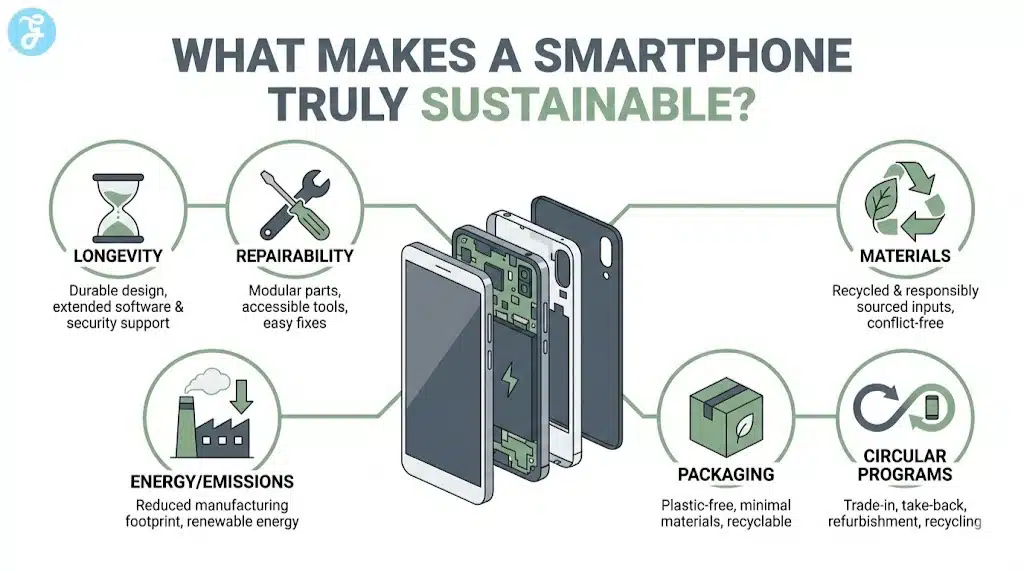
A smartphone becomes more sustainable when it stays useful longer and creates less waste throughout its life. This sounds obvious, but it changes how you evaluate brands. The greenest phone is often the one you do not replace.
There are six practical pillars that define eco-friendly smartphones for most buyers.
The Six Pillars Of Eco-Friendly Smartphones
-
Longevity: the phone remains fast and secure for years
-
Repairability: key components can be replaced at fair cost
-
Materials: recycled and responsibly sourced inputs reduce extraction pressure
-
Energy and emissions: manufacturing and logistics are measured and reduced
-
Packaging and accessories: less waste and fewer unnecessary items
-
Circular programs: trade-in, take-back, and refurbished resale keep devices in use
If a brand is strong in at least four of these pillars and improving on the rest, it is usually worth attention.
A Quick Sustainability Scoring Table
| Pillar | What To Look For | Why It Matters |
|---|---|---|
| Longevity | Long software and security support | Prevents early replacement |
| Repairability | Easy battery and screen replacement | Cuts e-waste and cost |
| Materials | Recycled metals, plastics, fair sourcing | Reduces mining pressure |
| Emissions | Transparent reporting and reduction targets | Aligns claims with data |
| Packaging | Minimal packaging, fewer extras | Lowers waste immediately |
| Circular programs | Take-back, refurb resale, parts recovery | Keeps devices in circulation |
This table is also the best way to compare sustainable phone brands without getting distracted by slogans.
Why “2026” Matters For Eco-Friendly Smartphones
The smartphone market is entering a phase where sustainability moves from optional to expected. Three trends are pushing this.
First, many consumers are tired of small yearly upgrades. They want value, durability, and reliability.
Second, repair and e-waste policy pressure is growing. This encourages design changes, parts availability, and better support.
Third, supply chain scrutiny is increasing. Brands are being asked to explain sourcing, labor, and environmental impact more clearly.
In 2026, buyers will pay more attention to how long a phone stays supported and how easily it can be fixed. This is exactly where sustainable phone brands can stand out.
How To Spot Greenwashing In Eco-Friendly Smartphones
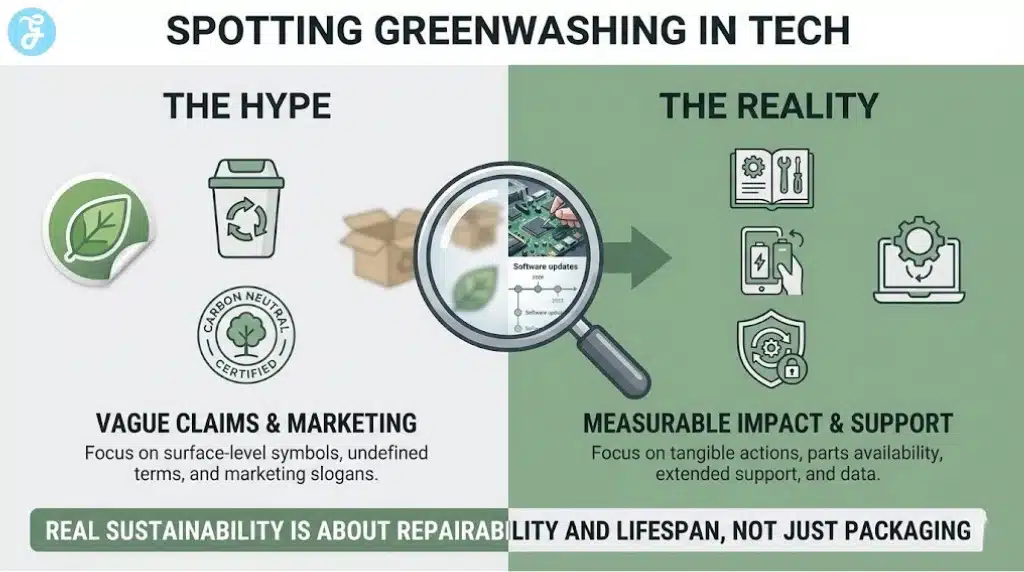
Greenwashing is common in consumer electronics because sustainability is hard to measure quickly. A brand can highlight one good feature and ignore the rest.
Here are the most common patterns.
Common Greenwashing Patterns
-
Recycled packaging is marketed as major sustainability progress
-
“Trade-in” is emphasized without showing reuse or refurbishment outcomes
-
Recycled materials are added, but repairability remains poor
-
Carbon claims rely heavily on offsets without operational reductions
-
Phones remove chargers “for the planet” while selling accessories aggressively
-
Software support remains short, forcing early upgrades
A Greenwashing Reality Table
| Claim | What It Could Mean | What You Should Ask |
|---|---|---|
| “Eco materials” | Small recycled percentage | How much, and where? |
| “Carbon neutral” | Offset-heavy strategy | What was reduced, not offset? |
| “Recyclable phone” | Recycling is possible in theory | Is take-back easy and real? |
| “Less packaging” | Small improvement | Does the phone last longer? |
| “Trade-in program” | Upgrade funnel | How many devices are refurbished? |
Sustainable phone brands that deserve attention usually publish clearer data, support repairs, and extend software support. That is where real sustainability lives.
The Five Sustainable Phone Brands To Watch In 2026
This list is not about which brand is “perfect.” No brand is perfect. It is about which brands are shaping the direction of eco-friendly smartphones through repairability, longevity, materials choices, and circular systems.
The five brands below represent different approaches. Some focus on radical repairability. Some focus on scale and supply chain influence. Some focus on ethical sourcing.
1) Fairphone
Fairphone is often the reference point for eco-friendly smartphones because it built its identity around longevity, repairability, and fairer sourcing. Its modular approach makes repairs more accessible, and its long support strategy has pushed the market conversation forward.
Why Fairphone Stands Out
-
Repair-first design that encourages battery and screen replacement
-
Modular components that reduce the need for full-device replacement
-
Strong focus on sourcing and supply chain improvement
-
A brand narrative built around longevity rather than yearly upgrades
Where Fairphone Still Faces Challenges
-
Availability can be limited in some regions
-
Hardware performance can lag top flagship devices
-
Pricing can be higher than expected for mid-range specs
-
Some components still rely on standard industry supply chains
Best Fit For Buyers
Fairphone is best for buyers who value repairability and long-term use over having the most powerful camera or the fastest processor. It is also a strong choice for people who want a phone that aligns with a sustainability-first story in a direct, visible way.
2) Apple
Apple is not typically framed as a “sustainable niche” brand, but it is one of the most important sustainable phone brands to watch because of scale. When Apple changes materials, packaging, repair policies, or energy sourcing, it moves the entire supply chain.
Apple’s sustainability story is strongest when it focuses on materials recovery, recycled inputs, and operational emissions reductions. It has also invested in trade-in and refurbished resale.
Why Apple Matters For Eco-Friendly Smartphones
-
Massive supply chain influence
-
Increased use of recycled materials in components
-
Strong device longevity in terms of performance and resale value
-
A large trade-in ecosystem and refurbished device market
Where Apple Gets Criticized
-
Repairs can be expensive and restricted depending on region and model
-
Parts pairing and repair complexity can limit independent repairs
-
Accessory ecosystem can drive additional consumption
-
Sustainability claims can be hard for consumers to verify without deep reading
Best Fit For Buyers
Apple is best for buyers who want a phone that holds value, receives long software support, and fits into a strong resale and refurbishment market. If repair accessibility continues improving, Apple’s role in eco-friendly smartphones could grow significantly.
3) Samsung
Samsung’s importance comes from market reach and manufacturing capability. Like Apple, it can shift suppliers and standards at scale. Samsung also plays a major role in Android longevity and trade-in behavior.
Samsung’s sustainability efforts are most visible in packaging, materials initiatives, and circular programs. The biggest sustainability improvement area to watch is repairability and long-term software support consistency across models.
Why Samsung Is Worth Watching In 2026
-
Scale across mid-range and flagship devices
-
Strong trade-in culture in many markets
-
Growing focus on recycled materials and packaging reduction
-
Expanding software support timelines in recent years
Where Samsung Needs To Improve
-
Repair cost and ease varies by model and region
-
Parts availability and independent repair support can be inconsistent
-
Accessory and upgrade marketing still encourages frequent replacement
Best Fit For Buyers
Samsung fits buyers who want Android flexibility and broad device choices, but still want a brand moving toward more sustainability. In 2026, the most meaningful signal will be whether repair and parts access becomes easier across more models.
4) Google (Pixel)
Google is not the biggest phone maker, but it is a major platform company. Pixel devices matter because they often shape Android software practices, update policies, and AI features that influence the whole ecosystem.
For sustainability, Pixel’s biggest lever is software longevity. When Google extends support and makes updates more predictable, it keeps phones useful longer.
Why Pixel Is A Sustainable Brand To Watch
-
Strong software integration and optimized performance over time
-
Update policies that can extend device usefulness
-
A pathway to stronger repair ecosystems if parts access improves
-
Influence on Android standards that affect many manufacturers
Key Sustainability Watchpoints
-
Repairability and parts access still need improvement in many regions
-
Trade-in and refurbishment outcomes are not always clear
-
Hardware durability varies by generation
Best Fit For Buyers
Pixel works for buyers who want a phone that stays smooth through software optimization and consistent updates. In the eco-friendly smartphone context, Pixel’s long-term value depends on repair accessibility and the quality of its refurbished channel.
5) Nokia / HMD (Repair-Focused Models)
Nokia-branded devices under HMD have explored more repair-friendly approaches in certain models and have targeted durability and affordability. This category is important because sustainability is not only for premium phones. If repairability reaches budget and mid-range markets, impact grows.
Why This Segment Matters
-
Repair-friendly approaches can make sustainability accessible
-
Durability focus can extend device life in practical ways
-
Affordable repair models reduce the “replace it” mindset
Where The Challenge Lies
-
Not all models are repair-oriented
-
Software support length and consistency vary
-
The sustainability story depends heavily on execution and availability
Best Fit For Buyers
This is a practical category for users who want durability and basic performance with a better repair pathway. The main thing to watch in 2026 is whether repair-friendly designs become standard across more models rather than isolated examples.
A Side-By-Side Comparison Of The Top 5 Brands
| Brand | Strength In Sustainability | Biggest Risk | Best For |
|---|---|---|---|
| Fairphone | Repairability and longevity | Performance and availability | Repair-first buyers |
| Apple | Longevity and resale ecosystem | Repair restrictions and cost | Long-use premium users |
| Samsung | Scale and trade-in culture | Inconsistent repair access | Android variety seekers |
| Google Pixel | Software longevity influence | Repair and parts access | Update-focused users |
| Nokia/HMD | Repair-friendly direction in some models | Support inconsistency | Budget durability buyers |
This table helps readers quickly see the sustainability logic without needing brand loyalty.
How To Choose Eco-Friendly Smartphones Without Overthinking
A sustainable phone choice is not about finding a perfect device. It is about reducing replacement frequency and improving end-of-life outcomes.
The Most Practical Buying Rules
-
Prioritize long software support
-
Choose a model with affordable battery replacement
-
Avoid storage limits that force early upgrades
-
Buy refurbished when performance needs allow
-
Use a case and screen protection to extend life
-
Choose brands with transparent take-back programs
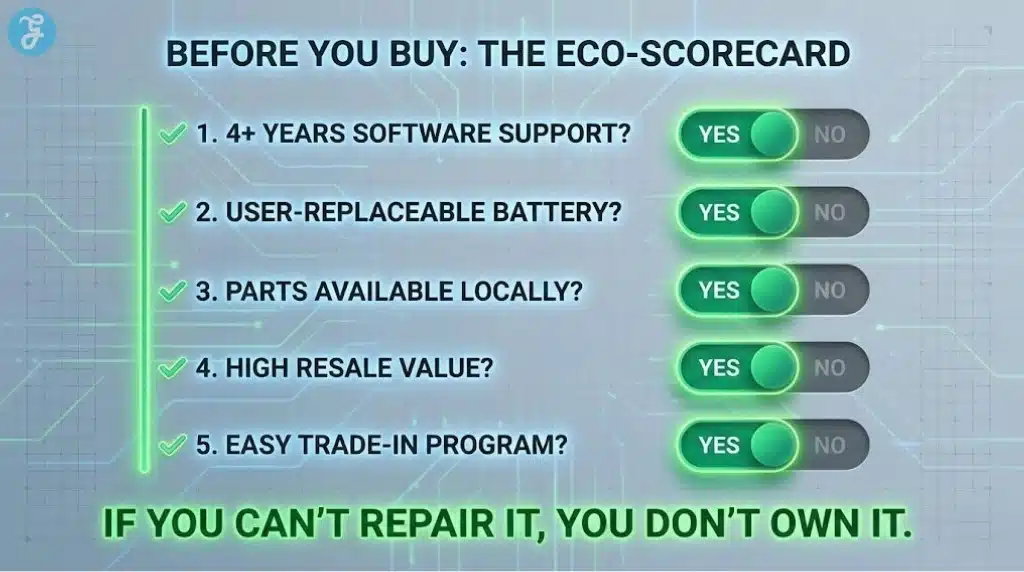
A Simple Decision Checklist
-
Can you realistically use the phone for four to six years?
-
Does the brand offer battery replacement at fair cost?
-
Are parts and repairs available in your region?
-
Does the phone hold resale value if you eventually sell it?
-
Is there an easy trade-in or take-back option?
If most answers are yes, you are likely buying one of the better eco-friendly smartphones available to you.
Refurbished Phones: The Sustainability Shortcut Most People Ignore
One of the easiest ways to reduce smartphone footprint is to buy refurbished rather than new. Manufacturing is typically the highest-impact stage for electronics. Reusing an existing device avoids much of that.
A good refurbished purchase includes:
-
Verified battery health or battery replacement
-
Clear cosmetic grading
-
Warranty coverage
-
Return policy
-
Verified data wipe and resets
Refurbished Buying Table
| What To Check | Why It Matters |
|---|---|
| Battery health | Determines daily usability |
| Warranty | Protects against hidden defects |
| Grading | Aligns expectations with reality |
| Return policy | Reduces purchase risk |
| Seller credibility | Reduces fraud and low-quality units |
Sustainable phone brands that operate strong refurbished programs contribute more to circularity than brands that only promote recycling.
How Sustainability Features Should Affect Price Decisions
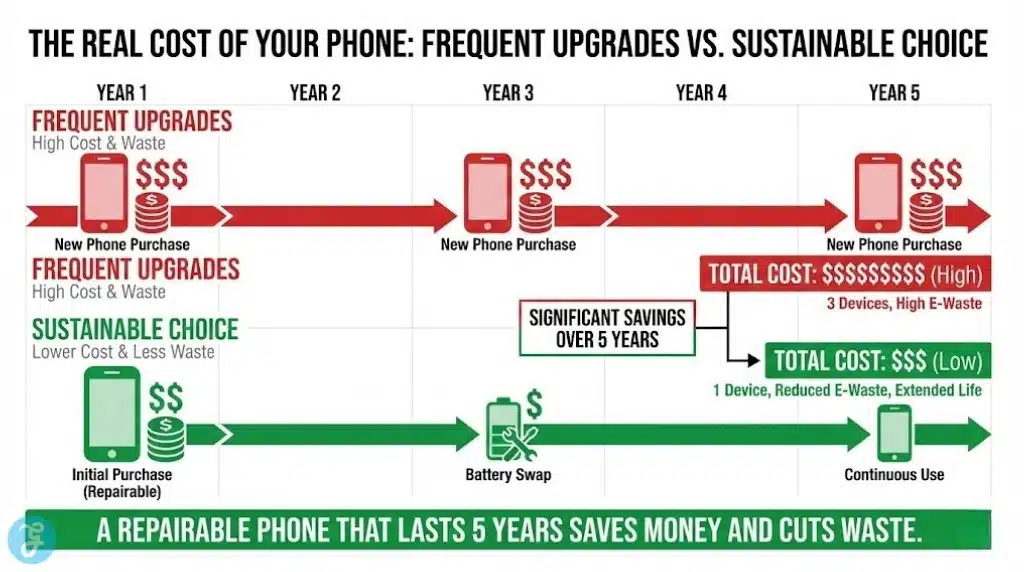
Many people assume sustainable phones cost more. Sometimes they do. But the real cost is total cost over years, not purchase price.
A phone that lasts five years with one battery replacement can be cheaper than a phone replaced every two years. The same logic applies to refurbished phones, which often deliver high value.
Total Cost Of Ownership Table
| Choice | Typical Pattern | Long-Term Outcome |
|---|---|---|
| Frequent upgrades | Buy new every 1–2 years | High cost and high waste |
| Long-term use | Keep phone 4–6 years | Lower cost and lower footprint |
| Refurbished route | Buy refurbished and maintain | Lowest footprint for many users |
| Repair-first | Replace battery/screen | Extends value and reduces waste |
Eco-friendly smartphones become an economic strategy as much as an ethical one.
The Role Of Batteries In Smartphone Sustainability
Batteries often decide when phones get replaced. A degraded battery makes a phone feel old even if the processor is fine. If batteries are easy to replace, phone lifespans extend.
A sustainability-focused battery strategy includes:
-
Batteries designed for replacement
-
Battery health transparency
-
Affordable service options
-
Safe recycling for old battery modules
In 2026, one of the most meaningful sustainability improvements would be making battery replacement easier across more models, not just niche brands.
Software Support: The Most Important Sustainability Feature
Hardware can last, but software support often ends too early. When security updates stop, phones become risky to use. When apps stop supporting older versions, phones become frustrating.
Sustainable phone brands are increasingly judged by support length.
What To Look For In Support Policies
-
Clear minimum years of security updates
-
Predictable OS upgrade pathways
-
Repair support aligned with software support
-
Replacement parts available for the support window
If a brand offers long support but does not offer repair access, sustainability weakens. The best ecosystem aligns both.
At this stage, the focus keyword should appear naturally again. Sustainable phone brands are those that combine long software support with real repair access and a functioning circular pathway.
Carrier Policies And Network Longevity Matter More Than Most Buyers Realize
Eco-friendly smartphones can lose sustainability value if carrier policies shorten their usable life. Some devices remain physically functional and software-supported but become less practical due to network changes, limited band support, or carrier restrictions. When phones stop receiving reliable connectivity, users are pushed toward replacement even if the device itself is fine.
Sustainable phone brands to watch in 2026 will be those that:
-
Support a wide range of network bands for long-term compatibility
-
Maintain certification across carriers for multiple years
-
Avoid artificial feature limits tied to specific networks
Network longevity is an overlooked sustainability factor because a phone that cannot connect reliably becomes obsolete regardless of its materials or repairability.
What To Expect From Eco-Friendly Smartphones In 2026
The next wave of eco-friendly smartphones will likely focus on:
-
Longer software support becoming standard
-
More repair-friendly designs in mainstream phones
-
Stronger refurbished markets and certified resale channels
-
Better material recovery through improved take-back systems
-
More transparency around emissions and sourcing
Consumers will increasingly demand proof. Brands that publish clear metrics and make repair simple will gain trust.
In the End
Eco-friendly smartphones are becoming a realistic option because sustainability is shifting from marketing to product design. The most sustainable phone is usually the one you keep longer, repair when needed, and return responsibly when it is done.
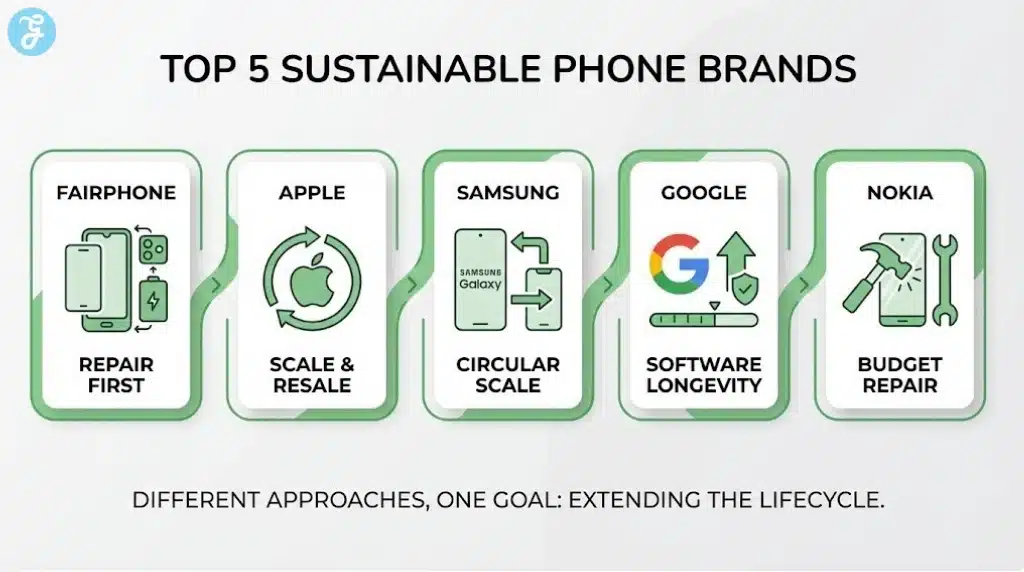
The sustainable phone brands to watch in 2026 are those pushing repairability, long support, and circular systems. Fairphone stands out for repair-first design. Apple and Samsung matter because of scale and resale ecosystems. Google matters because software policy can extend phone lifespans across Android. Nokia and HMD matter because repair-friendly ideas must reach affordable markets to create real impact.
If you want to make a sustainable choice, focus on longevity, repairability, and resale pathways. When those align, eco-friendly smartphones become more than a label. They become a practical way to reduce waste without giving up modern performance.