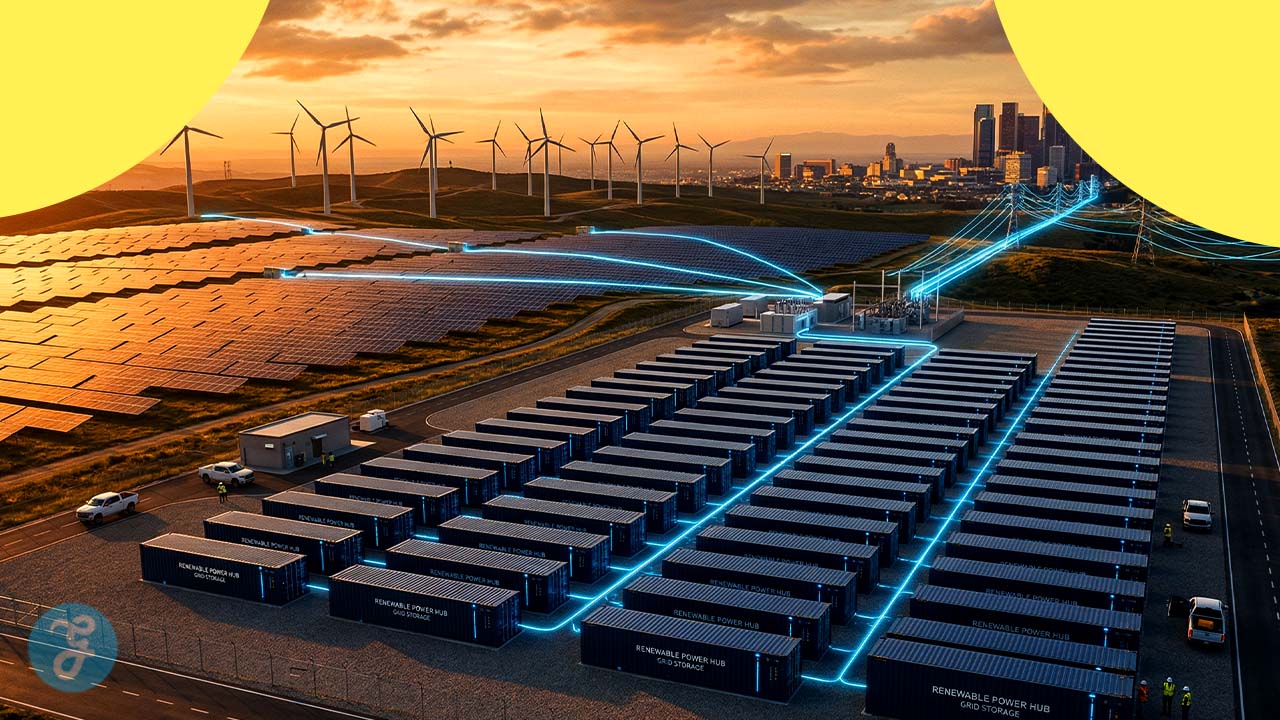
Energy Transition is no longer a distant vision. It is the practical work of rebuilding how the world generates, moves, stores, and uses electricity between now and 2030. This guide walks you through what is changing, why it matters, and what to watch if you want a clear, real-world understanding of the sustainable energy shift.
The next five years will feel fast because multiple forces are hitting at once. Electricity demand is rising, clean generation is scaling, and grids are straining under new load and new complexity. That combination creates a simple truth. The winners of 2025–2030 will be the places that can build clean power and modern infrastructure at the same time.
Key Takeaways
- The sustainable energy transition is mostly a power system transition, not just a generation story.
- Solar and wind will keep leading new capacity additions, but grids and flexibility determine how far they can go.
- “Flexibility” is the word of the decade, meaning storage, demand response, smarter pricing, and faster grid connections.
- Hydrogen matters, but mainly where direct electrification struggles, like steel, chemicals, shipping fuels, and some seasonal storage pilots.
- Microgrids and distributed energy resources are becoming mainstream for resilience, reliability, and local independence.
- Policy and financing do not just “support” the transition. They often decide the pace.
- Developing nations will see some of the biggest quality-of-life gains from off-grid and mini-grid solutions when financing and reliability align.
- The biggest risks are not only technology. They include permitting, interconnection queues, mineral constraints, and local acceptance.
What The Sustainable Energy Transition Actually Means
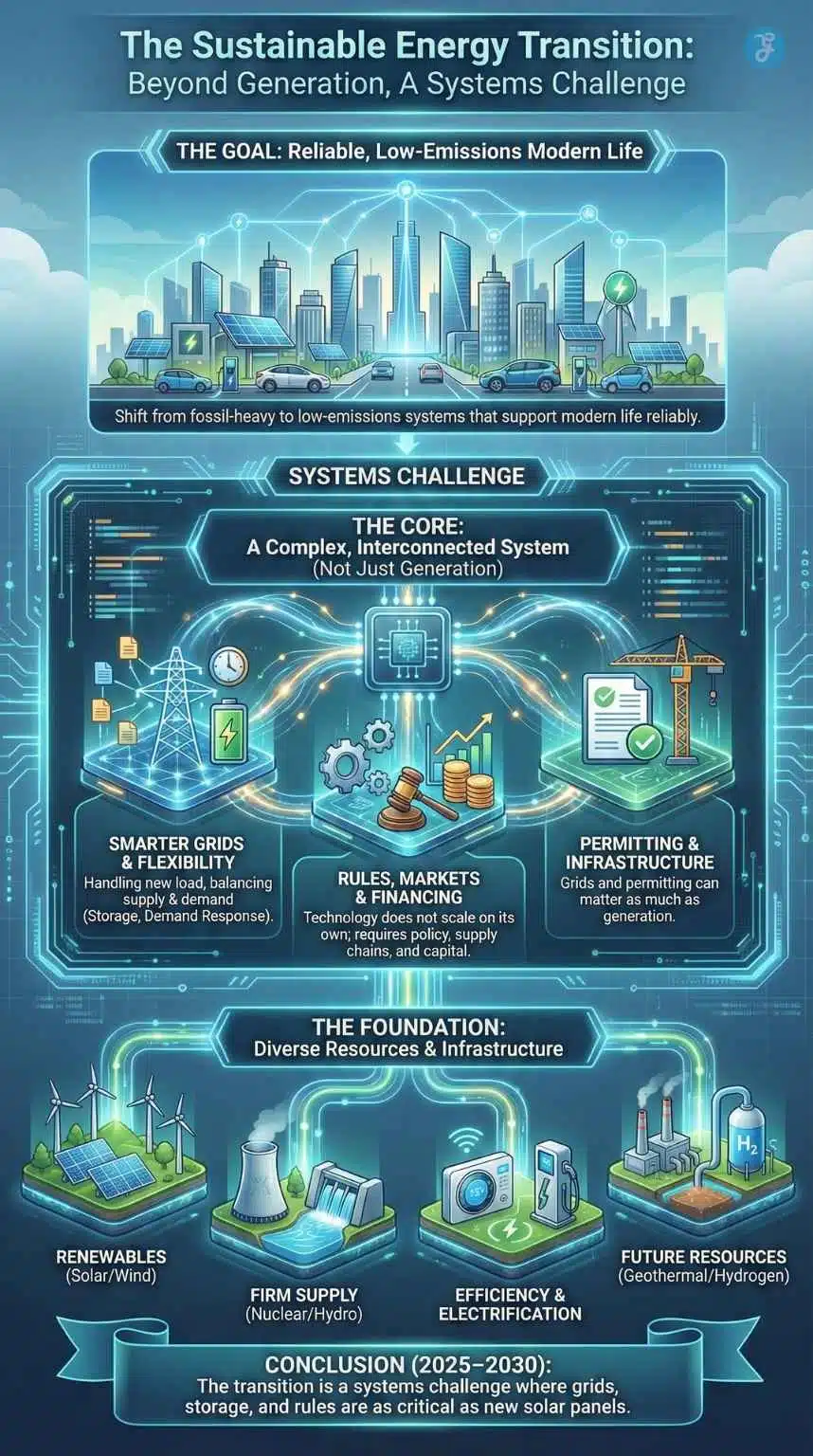
The sustainable energy transition is the shift from fossil-heavy energy systems to low-emissions systems that can support modern life reliably. It includes renewables, nuclear, storage, efficiency, electrification, and smarter grids. It also includes rules, markets, financing, and supply chains, because technology does not scale on its own.
Many people think the transition is mostly about building more solar and wind. That is part of it, but it is not the whole game anymore. The transition from 2025 to 2030 becomes a systems challenge, where grids, storage, flexibility, and permitting can matter as much as generation.
Energy Transition Vs Decarbonization Vs Electrification
Energy transition is the broad umbrella. It covers changes to power, transportation, buildings, and industry, plus the infrastructure and markets behind them. Decarbonization is the goal, meaning fewer greenhouse gas emissions across the economy.
Electrification is one of the main methods. It means moving end uses from direct fuel burning to electricity, like replacing gasoline cars with EVs or gas furnaces with heat pumps. When electrification grows, the power sector becomes the backbone, because electricity must become cleaner while also serving more demand.
Why The Power Sector Leads
The power sector leads for one practical reason. Electricity can be produced with many technologies, and it can then power many sectors. If you decarbonize electricity, you create a cleaner input for cars, homes, offices, and parts of industry.
This does not mean every sector can electrify quickly. It means electricity is the fastest lever, and it shapes what comes next. From 2025 to 2030, the most visible change will be a power grid that must handle more load, more variable generation, and more distributed resources than ever before.
The 2025–2030 Milestones That Matter
The decade has plenty of goals, but not all goals shape real-world outcomes. The milestones that matter in 2025–2030 fall into four buckets. They are clean generation scale, grid buildout, flexibility scale, and efficiency improvements.
If you track these four, you can predict a region’s progress with surprising accuracy. If one of these lags, the whole system slows, even if the others surge.
2025–2030 Sustainable Energy Transition “Scoreboard”
| What To Track (2025–2030) | Why It Matters | What “Good Progress” Looks Like |
| Renewable Build Rate (Solar/Wind) | Drives clean electricity supply growth | Annual additions rising without major curtailment bottlenecks |
| Grid Interconnection Speed | Determines whether projects actually get built | Shorter queue times; transparent, predictable timelines |
| Transmission + Substation Expansion | Enables moving power to load centers and balancing regions | More line miles, upgraded substations, fewer congestion events |
| Distribution Upgrades | Supports EV charging, heat pumps, rooftop solar exports | Fewer local overloads; faster service upgrades |
| Storage Deployment Mix | Ensures reliability with variable renewables | Growth in both short-duration and long-duration storage where needed |
| Demand Response + VPP Adoption | Cheapest “virtual capacity” during peaks | Large participation; measurable peak reduction and load shifting |
| Electrification Growth (EVs/Heat Pumps) | Shifts demand onto cleaner power | Managed charging and winter/summer peak planning built in |
| Efficiency Improvements | Reduces total system build required | Building retrofits, efficient cooling, industrial efficiency rising |
| Supply Chain + Critical Minerals | Prevents cost spikes and delays | Diversified sourcing; recycling scale-up; stable procurement |
| Reliability Under Extreme Weather | Proves grid resilience | Stable outages/SAIDI metrics and strong recovery performance |
Milestone 1: Scaling Clean Power Without Breaking Reliability
In the real world, the transition succeeds when electricity remains affordable and reliable. That means clean generation must scale while the system keeps frequency stable, handles peaks, and manages extreme weather.
The key challenge is variability. Solar output follows daylight and clouds, and wind output follows weather patterns. Variability is not a flaw, but it changes how you plan and operate a grid. The grid needs tools that balance supply and demand at every moment.
Milestone 2: Grid Buildout, Not Just Grid Talk
From 2025 to 2030, grid modernization becomes the central bottleneck. New generation and new demand both depend on it. If projects cannot connect, they do not count, no matter how cheap the technology is.
Grid buildout includes transmission lines, substations, transformers, and distribution upgrades. It also includes interconnection reform, because queues and slow studies can freeze progress for years. In many markets, the limiting factor is no longer the cost of solar panels. It is the time it takes to connect projects.
Milestone 3: Flexibility At Scale
Flexibility is the ability to keep the grid balanced when conditions change. It comes from multiple sources.
- Batteries and pumped hydro shift energy across hours and, sometimes, days
- Demand response shifts consumption to cheaper, cleaner hours
- Flexible generation can ramp up when wind drops
- Smarter pricing shapes when people charge EVs or run appliances
A grid with high renewables does not rely on one magic technology. It uses a portfolio of flexibility tools.
Milestone 4: Efficiency That Actually Shows Up In Bills
Efficiency does not always get exciting headlines, but it is one of the fastest ways to reduce emissions and costs. When efficiency improves, the system needs less generation and less infrastructure to deliver the same services.
From 2025 to 2030, efficiency improvements in buildings, cooling, motors, and industrial processes will decide how hard the grid must work. If demand grows faster than supply and grids, reliability issues become more likely. That’s why it’s essential to understand solar tax credits.
The New Power Mix: Solar, Wind, Nuclear, Hydro, And What Comes Next
The future power mix is not a single answer. It depends on geography, policy, existing infrastructure, and local priorities. Still, you can identify common patterns that show up across most regions.
Solar and wind are the main growth engines because costs have fallen and deployment has scaled. Hydro and nuclear often play the role of firm supply where they already exist. Geothermal is growing in attention as drilling innovation improves. Emerging resources like tidal and wave remain niche, but they may become strategic in specific locations.
Solar Power: The Volume Leader
Solar keeps growing because it is modular, fast to deploy, and widely applicable. Utility-scale solar can deliver large capacity in open areas, while rooftops can turn buildings into generators.
Solar’s challenge is timing. It produces most at midday, often when demand is not at its peak. That creates the famous “duck curve” in some markets, where net demand dips at midday and ramps sharply in the evening. The solution is not to stop building solar. The solution is to pair solar with storage, demand shifting, and grid upgrades.
To solve this, the grid requires flexible storage and balancing solutions to ensure reliability, which is the most critical step in achieving a successful Sustainable Energy Transition that functions even when the sun isn’t shining.
Wind Power: The Complement That Stabilizes
Wind often complements solar because it can produce at night and during different seasons. Onshore wind tends to be cheaper, while offshore wind can deliver strong output near coastal load centers.
Wind’s biggest challenges include permitting, grid interconnection, and supply chain constraints for turbines and components. In some places, local acceptance has become a deciding factor, especially for onshore wind. Offshore wind can face higher costs and longer timelines, but it can also provide large, steady output once built.
Hydropower: A Giant Base With Climate Risk
Hydropower remains a major source of low-emissions electricity in many countries. It provides both energy and flexibility, because reservoirs can often adjust output quickly.
The main constraint is geography and climate variability. Drought risk can reduce hydro output just when it is needed most. From 2025 to 2030, hydro planning increasingly includes climate adaptation, reservoir management, and diversified flexibility so grids are not over-dependent on rainfall patterns.
Nuclear Power: Firm Supply With Long Timelines
Nuclear provides firm, low-emissions electricity, and it can support grid stability. Its role differs widely by country. Some nations are extending plant lifetimes, while others are pursuing new builds.
New nuclear construction typically has long lead times and high upfront costs. That makes it hard to scale quickly in the 2025–2030 window, unless projects are already far along. Still, life extensions and improved operations can provide meaningful low-carbon supply during this period.
Geothermal: From Niche To Strategic
Conventional geothermal is location-limited, but it offers firm power. Next-generation geothermal approaches aim to expand the resource by drilling deeper and working with different rock types, often borrowing techniques from oil and gas drilling.
If next-generation geothermal scales, it could become a strong “always-on” clean source that reduces the need for fossil backup. Between 2025 and 2030, geothermal is likely to grow in pilot projects and early commercial deployments in selected regions.
Bioenergy: Useful, But Sensitive
Bioenergy can provide dispatchable power and can use existing infrastructure. The challenge is sustainability. Not all biomass is climate-friendly, and land use impacts can be serious.
From 2025 to 2030, bioenergy makes the most sense when it uses waste streams, supports grid reliability, and fits strong sustainability rules. It is not a blanket solution.
Emerging Generation: What Might Break Through
Some technologies draw attention because they promise major efficiency or cost improvements. Others matter because they can produce in places where solar and wind struggle.
- Perovskite solar may increase efficiency and reduce costs if durability and manufacturing scale are solved
- Tidal and wave energy may become useful in coastal regions with predictable ocean patterns
- Nuclear Fusion remains a longer-term bet, with research progress but limited commercial readiness before 2030
Storage And Flexibility: The Real Enablers Of High-Renewables Grids
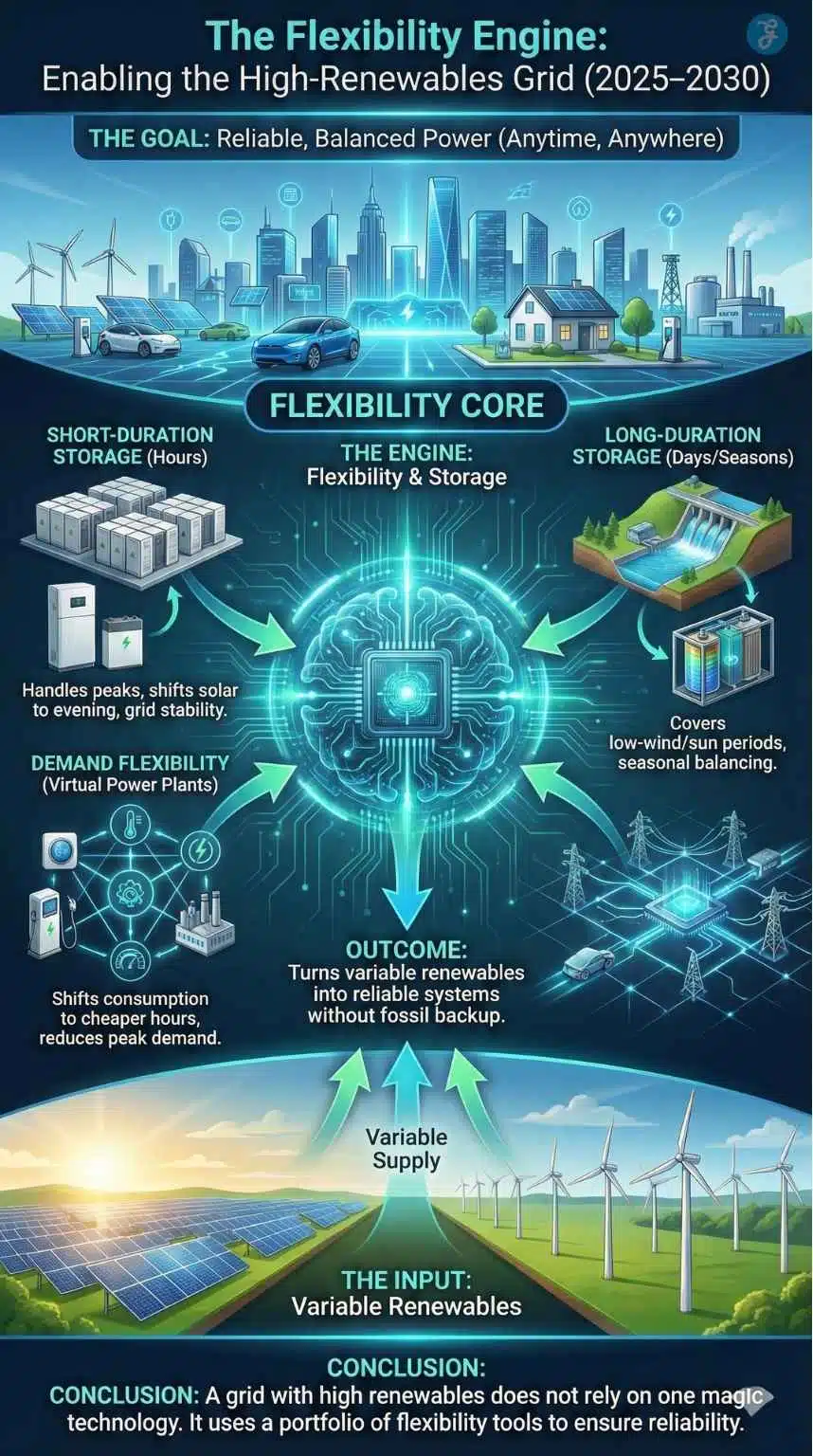
If you want a single concept that explains the 2025–2030 power transition, it is flexibility. Flexibility turns variable renewables into reliable systems, without relying on fossil fuels for every gap.
Storage is only one form of flexibility, but it gets the most attention because it is tangible. People can see battery projects and understand the idea of saving energy for later. Still, the best systems use multiple tools together, and that mix changes by region.
Short-Duration Storage: The Workhorse
Most deployed battery storage today is designed for hours, not days. That is enough to handle many challenges, including evening ramps, short peaks, and shifting midday solar into evening demand.
Short-duration storage also supports grid stability services, like frequency regulation. That helps grids run smoother, especially as rotating fossil generation declines.
Long-Duration Storage: The Next Frontier
Long-duration energy storage aims to shift energy across many hours or even days. This becomes important when a region experiences long low-wind periods, extended cloudy spells, or major seasonal mismatches.
Multiple approaches compete here. Pumped hydro remains the largest form of long-duration storage in many regions, but it depends on geography. Other concepts include flow batteries, compressed air, thermal storage, and emerging chemical pathways.
From 2025 to 2030, you will likely see more long-duration pilots, targeted deployments, and policy support. The winners will be solutions that prove cost-effective at scale, not just impressive in a lab.
Demand Response And Virtual Power Plants
The cleanest kilowatt-hour is often the one you do not need at the worst time. Demand response shifts electricity use away from peaks or toward times of abundant renewables.
Virtual power plants combine many small resources, like home batteries, EV chargers, smart thermostats, and flexible industrial loads. Together, they can behave like a power plant, ramping up or down based on grid needs.
Demand-side flexibility becomes more valuable as EV adoption rises. If millions of cars charge at the same time, grids strain. If charging shifts to off-peak hours, grids become more stable and customers can save money.
Smarter Pricing: The Quiet Game-Changer
Electricity prices often fail to reflect real-time system conditions for many customers. Time-of-use pricing and dynamic pricing can align customer behavior with grid needs, especially when paired with automation.
The future is not about asking people to think about electricity every hour. It is about devices that respond automatically, while still keeping comfort and convenience. That shift reduces peak demand and helps integrate renewables.
The Hidden Costs: Mining, Recycling, And Local Impacts
Storage technologies have environmental impacts and social tradeoffs. Battery supply chains rely on minerals that can come with land disruption, water use, and labor risks. Manufacturing has emissions impacts, and end-of-life disposal can be harmful if recycling systems lag.
This does not mean storage is “bad.” It means storage must be built with responsible sourcing, better recycling, and lifecycle planning. By 2030, recycling and second-life battery pathways will matter more, especially as early EV packs retire.
While storage provides the flexibility needed for the grid, it introduces environmental costs through mining and waste. We must address these tradeoffs with responsible sourcing and recycling. Taking this systems-level view is the only way to ensure the Sustainable Energy Transition solves problems without creating new ones.
The Grid Revolution: From Centralized Power To Microgrids And Distributed Energy
The grid is changing in two directions at once. It must expand and strengthen at the top, through transmission and large infrastructure. At the same time, it must become smarter at the edges, because distributed energy resources are growing.
This creates a new model. The grid becomes a platform that coordinates many resources, rather than a one-way delivery system from a few big power plants.
Why Grids Became The Bottleneck
Grid infrastructure is hard to build. Transmission lines face complex permitting, land rights issues, and local opposition. Transformers and substation equipment can have long lead times. Interconnection processes can take years.
As clean generation and electrification accelerate, old planning assumptions break. Distribution grids designed for one-way power flow now must handle rooftop solar exports, EV charging clusters, and localized peaks. Without upgrades, reliability risks rise.
Microgrids: Local Reliability And Independence
Microgrids are small networks that can operate connected to the main grid or independently during outages. They often combine solar, storage, and backup generation, plus smart controls.
Microgrids are growing because they solve real problems. They support hospitals, data centers, military bases, factories, campuses, and neighborhoods that face outage risk. They also support community resilience in storms and heatwaves.
The big shift from 2025 to 2030 is that microgrids will move from niche to standard in many resilience-focused projects. Costs are improving, controls are better, and the business models are maturing.
Distributed Energy Resources: The Rise Of The Grid Edge
Distributed energy resources include rooftop solar, home batteries, EV chargers, smart thermostats, and flexible commercial loads. When coordinated, they reduce peak demand, provide local voltage support, and improve resilience.
The challenge is orchestration. Utilities and markets need rules and platforms that can integrate millions of devices securely and fairly. This is where data, cybersecurity, standards, and regulation meet power engineering.
The “Energy Internet” And Blockchain: What Is Real
The idea of an “Energy Internet” is that energy can become more decentralized, with peer-to-peer trading, transparent verification, and automated settlement. Blockchain is often mentioned because it can record transactions and automate contracts.
In practice, blockchain is not required for most grid modernization. Many benefits come from standard databases, modern market design, and better interoperability. Still, blockchain can fit specific use cases like renewable certificate tracking, settlement automation, and microgrid communities where transparency matters.
From 2025 to 2030, the realistic story is not a full peer-to-peer revolution. It is a selective adoption where it reduces friction, improves trust, or cuts administrative costs.
Green Hydrogen And Clean Molecules: Where Electrification Stops
Hydrogen is one of the most debated topics in clean energy. Some people treat it as the missing piece that solves everything. Others dismiss it as an expensive distraction. The truth sits in the middle, and it becomes clearer when you use a simple decision framework.
Hydrogen makes the most sense when you cannot easily replace fossil fuels with direct electricity. That happens in certain industrial processes, some forms of long-distance transport, and potentially some forms of long-duration storage.
Where Hydrogen Wins
Hydrogen and hydrogen-derived fuels have stronger use cases in:
- Chemicals, especially ammonia and fertilizer production
- Refining processes that already use hydrogen today
- Steel pathways that use hydrogen as a reducing agent
- Shipping fuels, often through ammonia or e-fuels
- Some high-temperature industrial heat cases where electrification is difficult
Hydrogen can also support energy storage in theory, especially for seasonal needs. Still, the economics are tough, and the infrastructure is limited.
Why Hydrogen Is Hard And Expensive
Hydrogen is not an energy source. It is an energy carrier. You must make it, move it, and use it, and each step loses energy and adds cost.
Green hydrogen uses electrolysis powered by clean electricity. That ties its cost to electricity prices, electrolyzer costs, and utilization rates. Transport and storage can be challenging because hydrogen is low-density and can be hard on materials. Converting hydrogen into ammonia or e-fuels adds more steps and more cost, even if it improves transport practicality.
Hydrogen Vs Direct Electrification: A Simple Rule
If you can electrify directly, it is often cheaper and more efficient. That includes passenger vehicles, many building heating use cases, and many industrial motor-driven processes. If you cannot electrify easily, hydrogen may be a better tool, especially when the alternative is fossil fuels with no viable low-carbon substitute. The goal is not to use hydrogen everywhere. The goal is to use it where it has a clear advantage.
Direct electrification is often the most efficient choice for transportation and heating, but hard-to-abate sectors require hydrogen where plugging in isn’t feasible. Strategically balancing these “electrons” and “molecules” to target the right use cases is essential for a cost-effective Sustainable Energy Transition.
The 2030 outlook for Green Hydrogen and Solar reveals that we aren’t facing a winner-takes-all competition, but rather building a complex, multi-layered energy ecosystem where both play vital roles.
“Choose the Right Tool” Framework [Electrification vs Hydrogen vs Storage]
| Energy Need / Use Case | Best-Fit Solution (Most Often) | Why | Notes / Watch-outs |
| Passenger cars, 2–3 wheelers, city buses | Direct Electrification (EVs) | Highest efficiency, lower operating costs | Charging infrastructure + peak load planning matters |
| Home heating/cooling (many climates) | Heat Pumps + Efficiency | Efficient, scalable, and reduces bills | Grid winter peaks in cold regions need planning |
| Industrial motors, low/medium heat | Direct Electrification | Mature tech, good economics | May need process redesign and power-quality upgrades |
| Steel (some pathways), chemicals, refining | Green Hydrogen | Enables hard-to-electrify chemistry and high heat | Needs low-cost clean power + infrastructure |
| Long-haul shipping fuels | Hydrogen Derivatives (Ammonia/E-fuels) | Better storage/transport than pure H₂ | Cost and safety standards are critical |
| Aviation (most commercial routes) | Sustainable Aviation Fuels (near-term) | Energy density constraints for batteries | Electric/hybrid more likely for short routes first |
| Evening peak after solar-heavy midday | Short-Duration Storage + Demand Shifting | Moves cheap midday solar into evening | Battery lifecycle + recycling planning needed |
| Multi-day low-wind/low-solar events | Long-Duration Storage + Firm Low-Carbon | Covers extended gaps | LDES still scaling; geography matters (pumped hydro, etc.) |
| Neighborhood resilience during outages | Microgrids (Solar + Storage + Controls) | Local reliability + islanding | Requires good control systems + maintenance model |
Hard Sectors: Transport, Industry, Buildings, And The Power They Need
The power transition does not stop at the grid. It changes how people move, heat, cool, and manufacture. From 2025 to 2030, electrification spreads, but at different speeds across sectors.
This matters because electrification shifts demand onto the grid. That creates a feedback loop. More electrification requires more clean electricity and stronger grids, which then enable even more electrification.
Transport: EV Growth And Charging Reality
EV adoption changes power demand patterns. Fast charging hubs can create local peaks similar to small factories. Residential charging can create evening peaks if unmanaged.
The best outcome is not to restrict EVs. It is to make charging smart. Workplace charging can absorb midday solar. Overnight charging can use off-peak capacity. Time-based pricing and managed charging programs can reduce grid stress while saving drivers money.
Fleet electrification is especially important. Delivery vans, buses, and commercial fleets have predictable routes and centralized depots, making charging planning easier. By 2030, fleet electrification can be a major lever for both emissions and grid planning.
Buildings: Heat Pumps, Cooling, And Efficiency
Buildings are where efficiency meets electrification. Heat pumps can replace gas heating in many climates, and they can also cool efficiently.
Cooling demand is rising globally. That means the grid must handle summer peaks, especially in hotter regions. Building standards, insulation, efficient appliances, and smart thermostats reduce peak load and lower bills. These measures often produce benefits faster than large infrastructure builds.
Industry: The Tougher Frontier
Industry includes a wide range of processes. Some electrify easily, such as motors, drives, and some low-to-medium temperature heat. Other processes require very high temperatures or specific chemical reactions, which makes electrification harder.
From 2025 to 2030, the industry will likely take a mixed path. You will see more efficiency upgrades, electrified equipment where feasible, and selective use of hydrogen or other clean fuels in difficult processes. Industrial clusters, where multiple factories share infrastructure, can accelerate progress through shared power upgrades and shared clean fuel supply.
Electric Aviation: The Timeline Reality
Aviation is hard to decarbonize because energy density matters. Batteries still struggle with the weight required for long flights. Electric aviation is more realistic first in short routes, regional planes, and hybrid concepts.
By 2030, you may see expanded short-range electric aircraft, but widespread carbon-neutral commercial aviation is likely to depend on a mix of efficiency, operational changes, and sustainable aviation fuels. Still, breakthroughs in batteries and propulsion can shift timelines, so aviation remains a “watch closely” area.
Policy And Money: The Transition Runs On Permitting, Incentives, And Capital
Technology does not scale just because it exists. It scales because regulations allow it, capital funds it, and markets reward it.
From 2025 to 2030, policy and finance will determine not only how much clean energy gets built, but also where, how fast, and who benefits.
Permitting And Interconnection: The Invisible Gatekeepers
Permitting can be the longest part of a clean energy project timeline. Interconnection studies can add years, even when the project itself could be built quickly.
Faster permitting does not mean careless permitting. It means clear rules, predictable timelines, better coordination between agencies, and smart planning that reduces conflict. Regions that modernize permitting and interconnection will move faster than regions that treat every project as a fresh battle.
Incentives And Market Mechanisms
Different countries use different tools. Some rely on tax credits and rebates. Others use auctions for renewable contracts. Some use feed-in tariffs or contracts for difference. Many use a combination.
The key is stability. Investors and developers need confidence that rules will not shift abruptly. Stable policy reduces risk, and lower risk reduces the cost of capital. That can be the difference between a project being profitable or not.
Power Purchase Agreements And Corporate Demand
Corporate power purchase agreements help scale renewables by offering long-term revenue certainty. Large buyers like data centers and manufacturers often want clean electricity for cost stability and climate goals.
From 2025 to 2030, corporate demand can be a major accelerator, especially in markets where policy is uncertain. Still, the grid must support it. A PPA does not solve the interconnection queue by itself.
The Cost Of Capital: The Underestimated Factor
Two regions can have the same solar resource and the same technology costs, yet build at very different speeds. The reason is often financing.
High interest rates and higher perceived risk raise the cost of capital. That increases the cost of energy. Policies that reduce risk, improve transparency, and support currency stability can unlock clean energy growth even without dramatic technology changes.
Just Transition: Keeping People In The Plan
The transition affects jobs, communities, and energy bills. A just transition means helping workers and regions adapt, not ignoring impacts until backlash grows.
From 2025 to 2030, public acceptance becomes a strategic asset. Projects that include community benefits, local job training, and fair pricing can move faster and last longer. Governments are now shifting their focus toward Domestic Content Requirements (DCR), grid stability, and energy storage integration.
Developing Nations And Off-Grid Solutions
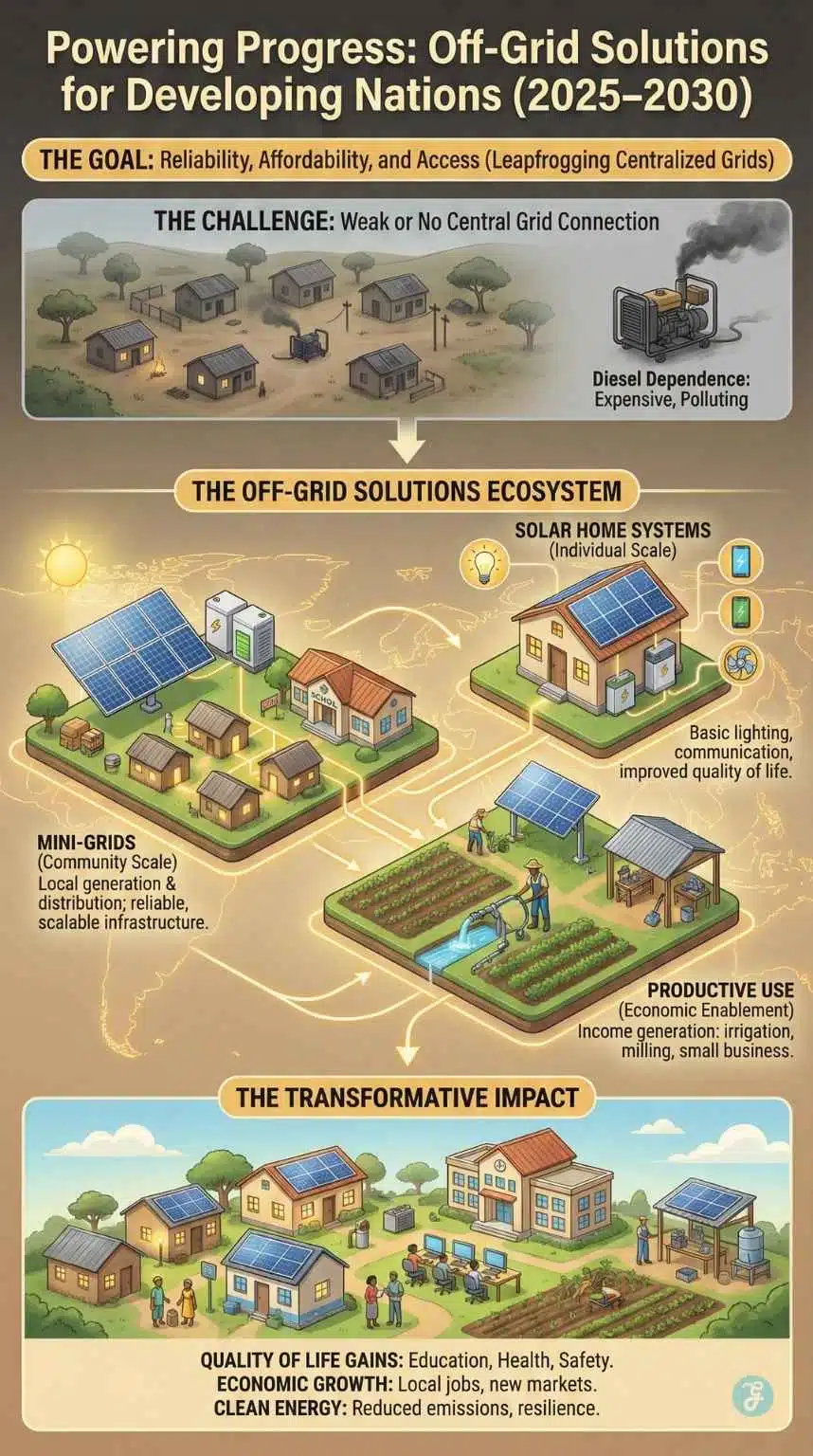
The sustainable energy transition looks different in developing nations. In many places, the goal is not only decarbonization. It is also reliability, affordability, and access.
Off-grid energy solutions can deliver major benefits quickly, especially where extending the central grid is slow or expensive. Mini-grids, solar home systems, and productive-use electrification can transform communities, businesses, and public services.
Mini-Grids: The Bridge Between Off-Grid And Grid
Mini-grids provide local electricity generation and distribution, often using solar plus storage, sometimes with backup generation. They can power villages, small towns, farms, and industrial sites.
The success factors include strong operations, fair tariffs, reliable maintenance, and financing that matches local income patterns. Mini-grids work best when they are treated as infrastructure, not as temporary experiments.
Solar Home Systems And Productive Use
Solar home systems can provide lighting, phone charging, and basic appliances. They improve quality of life quickly. Still, the biggest long-term impact comes when electricity supports productive uses, such as irrigation, refrigeration, milling, and small manufacturing.
Productive use creates income, which supports bill payment, which supports long-term system sustainability. From 2025 to 2030, the most effective energy access programs will focus on economic enablement, not only basic consumption.
Avoiding Diesel Lock-In
Diesel generators often fill gaps where the grid is weak. They can be expensive and polluting, but they are available. The transition opportunity is to replace diesel dependence with solar, storage, and smarter local grids.
The challenge is reliability. If clean systems do not meet real needs, people return to diesel. Success depends on good system design, strong maintenance, and realistic sizing.
What Could Derail 2025–2030 And How The System Adapts
The transition is not guaranteed. The biggest threats are not always technical failures. They are often practical constraints that slow deployment, increase costs, or trigger backlash.
The best way to think about risk is to separate it into supply chain risk, social acceptance risk, reliability risk, and hype risk. Then you can see how systems adapt.
Critical Minerals And Supply Chains
Clean energy technologies require materials, and supply chains can tighten quickly. Solar panels, batteries, wind turbines, and grid equipment all depend on complex manufacturing networks.
The response is not to panic. It is to diversify supply, expand recycling, improve materials efficiency, and build resilient procurement strategies. By 2030, regions that invest in responsible supply chains will have more stable deployment than regions that treat materials as an afterthought.
Land Use And Community Acceptance
Even clean projects can face opposition. People care about land, views, wildlife, and local identity. When communities feel ignored, projects stall.
A strong solution is to design projects that create local benefits and reduce conflict. Agrivoltaics is one example. It combines solar with farming, helping the land produce food and electricity simultaneously. Community ownership models and local revenue sharing can also improve acceptance.
Reliability Scares And The Reality Of Transitioning Grids
As fossil plants retire, some regions worry about reliability. Those fears can be used politically, and they can also reflect real planning challenges.
The answer is system planning that treats reliability as non-negotiable. That means a portfolio of resources, improved forecasting, grid upgrades, flexible demand, storage, and appropriate firm low-carbon supply where needed. Reliability is not a reason to stop the transition. It is a reason to do it with competence.
Hype Cycles: Hydrogen, Fusion, And The “Overnight Breakthrough” Problem
Hype can derail progress by misdirecting attention and capital. If decision-makers expect a miracle breakthrough, they may delay proven solutions.
Hydrogen and fusion both matter, but timelines and use cases must stay realistic. From 2025 to 2030, the core work is scaling what works now while funding R&D responsibly. The future arrives faster when the present is executed well.
Navigating these hype cycles requires a disciplined focus on tangible progress rather than speculative promises. By balancing immediate deployment with long-term innovation, stakeholders can minimize the risk of stagnation and ensure that the Sustainable Energy Transition proceeds on a realistic, resilient trajectory rather than waiting for miracles that may arrive too late.
2030 Scenarios: What “Success” Looks Like By The End Of The Decade
It helps to think in scenarios, not predictions. The world is complex, and the transition varies by region. Still, you can define what success looks like by tracking practical indicators.
Below are three simplified 2030 scenarios. Real outcomes may fall between them.
Scenario 1: Accelerated Transition
In an accelerated scenario, policy stays stable, grids expand, and flexibility scales quickly. Renewables continue strong growth, and storage and demand response grow alongside. Electrification progresses without causing major reliability crises.
In this world, electricity becomes cleaner while supporting more demand. Many regions see lower long-term system costs because cheap renewables and smarter operations reduce dependence on volatile fuel prices.
Scenario 2: Uneven Transition
In an uneven scenario, some regions modernize grids and build fast, while others stall. Interconnection and permitting reforms happen slowly in some markets. Supply chains tighten in waves, causing delays and price spikes.
The result is a patchwork. Some regions approach high-renewables reliability and affordability. Others remain dependent on fossil backup and face higher costs. This scenario is common when policy shifts frequently.
Scenario 3: Constrained Transition
In a constrained scenario, grids fail to expand fast enough, local opposition grows, financing costs stay high, and supply chains remain fragile. Renewables still grow because they are competitive, but not at the pace needed for broad decarbonization goals.
Reliability concerns cause some regions to prolong fossil generation or build new fossil capacity. Emissions fall more slowly, and energy bills can remain volatile. The main lesson here is that slow infrastructure and unstable policy can outweigh technology progress.
The 2030 Success Scoreboard
If you want a simple way to judge progress in any country or region, track these indicators:
- Interconnection queue times and project completion rates
- Transmission and distribution investment trends
- Storage deployment by duration, not just total megawatts
- Demand response and flexible load participation
- EV charging infrastructure growth paired with managed charging programs
- Heat pump adoption and building efficiency improvements
- Clean industrial pilots and scale plans in steel, chemicals, and cement
- Renewable capacity additions that translate into delivered energy, not only announcements
- Reliability performance during extreme weather events
- Public acceptance indicators, including project approval timelines and community benefit programs
This scoreboard keeps you grounded. It shows whether the transition is real, not just promised.
Wrapping Up: The Future Of Power Is A System, Not A Single Technology
The Energy Transition through 2030 won’t be won by one breakthrough. It will be won by building a power system that can scale clean generation, expand and modernize grids, and add enough flexibility, storage, demand response, and smarter pricing to keep electricity reliable and affordable.
The real differentiator is execution: faster interconnection, better permitting, resilient supply chains, and policies that stay stable long enough for capital to move. Places that treat clean power like core infrastructure will move faster, cut emissions sooner, and handle rising demand with fewer reliability shocks.