Hey there, are you struggling to keep up with supply chain issues in Vietnam? Maybe your business faces delays, high logistics costs, or just can’t predict demand right. It’s a real headache, I know, and it feels like you’re stuck in a maze with no way out.
Here’s a quick fact to chew on: Vietnam plans to invest a whopping $13.8 billion in expanding its seaport systems by 2030. That’s a big step to boost the Vietnam supply chain and help with economic growth.
In this blog, we’ll break down six major supply chain challenges, from infrastructure hiccups to global trade shifts, and hand you practical solutions to tackle them. Stick around, we’ve got fixes for you!
Key Takeaways
- Vietnam plans to invest $13.8 billion in seaport systems by 2030 to handle 1.1 to 1.4 billion tons of cargo.
- Infrastructure needs $500 billion, with $300 billion from public-private partnerships, to fix logistics issues.
- About 7,000 new transport businesses started in 2022, but labor shortages slow down growth.
- E-commerce in Vietnam hit $20.5 billion in 2023 and is expected to reach $45 billion by 2025, making demand forecasting vital.
- Vietnam aims to phase out fossil fuel vehicles by 2050 with incentives like waived registration fees for electric vehicles.
Infrastructure Limitations
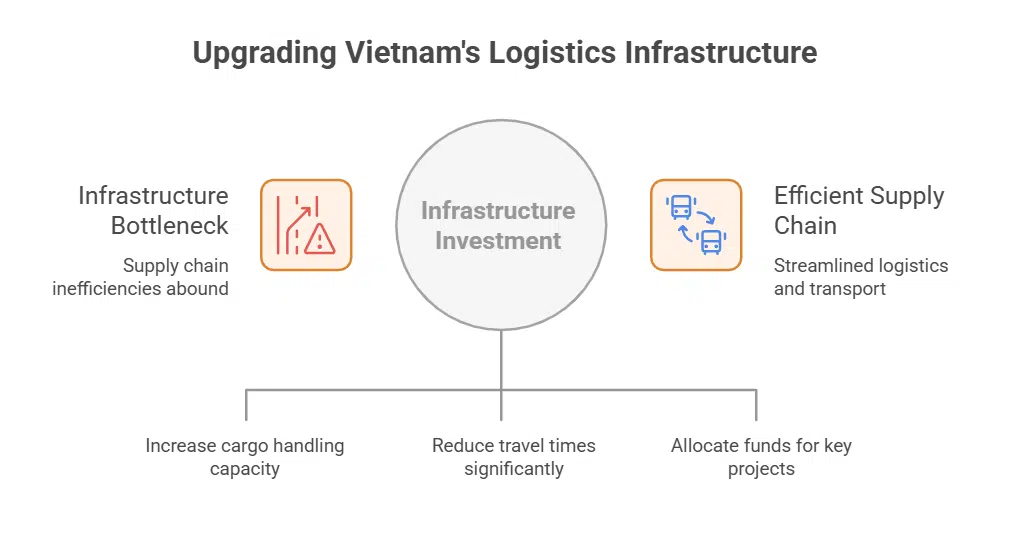
Infrastructure in Vietnam has some big hurdles to jump, folks. Let’s chat about the transportation infrastructure holding back the supply chain in this growing nation. Vietnam dedicates 6% of its GDP to logistics infrastructure development, which sounds impressive, right? But, the country still needs a whopping $500 billion to fix these challenges, with $300 billion expected from public-private partnerships.
Think of it like trying to build a sturdy bridge with only half the bricks; progress is slow.
Now, consider the seaports, a vital piece of the Vietnam supply chain puzzle. The nation has 44 seaports handling 470 to 500 million tons yearly, and plans to invest $13.8 billion to boost capacity to 1.1 to 1.4 billion tons by 2030.
That’s a huge goal! Yet, congestion at places like Ho Chi Minh City slows down logistics. On a brighter note, upgrades in the Mekong Delta cut travel times in Can Tho City from four hours to just two and a half.
Plus, the transport master plan for 2021 to 2030 sets aside $65 billion for projects. Still, building better roads, deepwater ports, and warehouses remains a tough climb for this manufacturing hub.
Labor Shortages
Hey there, folks, let’s chat about a big hurdle in Vietnam’s supply chain, labor shortages. It’s a real headache for many businesses trying to keep up with growth. Workforce skill gaps stand out as a major issue in this fast-growing manufacturing hub.
Many workers lack the training needed for modern supply chain management tasks. Think of it as trying to run a race with one shoe missing, tough, right? This gap slows down efficiency in the logistics sector and industrial parks.
The demand for skilled hands is soaring, but the supply just isn’t there yet.
Now, dig into this, around 7,000 new businesses jumped into the transport sector in 2022 alone. That’s a lot of new jobs needing people, isn’t it? But here’s the catch, finding trained workers to fill these roles is like hunting for a needle in a haystack.
Government initiatives are stepping up to help, though. Plans like the National E-Commerce Development Plan aim to boost skills for cross-border trade. On top of that, companies are turning to tools like advanced inventory management systems for help.
Take JUSDA, for instance, using eVMI and Juslink for real-time tracking to cut down on labor needs. It’s a smart move to build supply chain resilience in places like Hai Phong and Da Nang.
Dependence on Foreign Suppliers
Vietnam’s supply chain often leans heavily on foreign suppliers for raw materials. This setup can be a real headache, folks, like depending on a neighbor for your daily bread. If they’re late, you’re stuck hungry.
Many manufacturers in Vietnam pull in goods from abroad, especially from nearby giants like China. But, ouch, any hiccup in those global supply chains, say a delay or a price spike, hits hard right here at home.
Relying on outsiders also means less control over costs and timing in the Vietnam supply chain. Think of it as playing a game where someone else rolls the dice for you. Trade agreements like CPTPP and RCEP help by cutting tariffs and easing customs, sure, but they don’t fully shield us from disruptions.
The ASEAN Economic Community boosts ties with places like South Korea, yet we still feel the pinch when foreign supplies falter. Let’s chat about how this shakes up local businesses, shall we?
Demand Forecasting Challenges
Facing demand forecasting hurdles in Vietnam’s supply chain can feel like trying to predict a storm with just a hunch. Many businesses struggle to guess how much product they’ll need, especially in fast-growing sectors like e-commerce.
With Vietnam’s e-commerce market hitting $20.5 billion in 2023 and expected to soar to $45 billion by 2025, getting forecasts right is a big deal. Mess up, and you’re stuck with too much inventory, or worse, empty shelves that frustrate customers.
Now, toss in fragmented production, like in agriculture, and the challenge grows. Outdated tools and uneven quality make it tough to plan ahead, as noted by CASS Ltd. in their push for better market forecasting.
Add supply chain disruptions from events like the COVID-19 pandemic, and it’s clear why nailing demand forecasting is vital for staying competitive. Tools like data analytics and Internet of Things (IoT) gadgets can help track trends and boost accuracy in this tricky game.
Environmental Sustainability Concerns
Hey there, readers, let’s chat about a big issue in Vietnam’s supply chain, environmental sustainability. It’s no secret that the country faces some tough challenges with pollution.
Major ports pump out high CO2 emissions every day, and the heavy reliance on road transportation just adds fuel to the fire. According to the Environmental Performance Index, Vietnam struggles with PM2.5 exposure and losing tree cover fast.
That’s a real problem for the air we breathe and the land we live on. Imagine a future where smog chokes every city street; we can’t let that happen, right?
Now, here’s the good news, folks. Vietnam aims to switch to green energy and phase out fossil fuel vehicles by 2050. They’re even offering sweet deals like waiving first-time registration fees for electric vehicles and cutting excise taxes.
On top of that, ideas like digital transformation and green practices are gaining ground in the logistics sector. Think about using tech like AI and IoT to cut waste in the supply chain network.
Plus, focusing on renewable energy could be the key to sustainable growth. Isn’t it exciting to picture a cleaner, greener Vietnam?
Adaptation to Global Trade Shifts
Adapting to global trade shifts is a big deal for Vietnam’s supply chain, folks. Trade agreements like the CPTPP and RCEP are game-changers, cutting tariffs and smoothing out customs hassles.
This means more goods flow in and out with less friction. It’s like greasing the wheels of a rusty bike, making the ride faster and easier. Vietnam, as a growing manufacturing hub, grabs a competitive advantage from these deals.
On top of that, projects like the Long Thanh International Airport, set to handle 100 million passengers yearly, boost Vietnam logistics big time. Add to that the North-South Expressway and port expansions, and you’ve got better transport efficiency and cargo space.
These upgrades help tackle global supply chain shifts head-on. Plus, with e-commerce in Vietnam projected to hit $45 billion by 2025, and cross-border online retail growing at 28.5% each year, staying ahead in digital transformation is key.
Let’s keep the momentum going, shall we?
Takeaways
Hey there, let’s wrap up this chat about Vietnam’s supply chain hurdles and fixes. It’s clear that with big investments in roads, ports, and digital tools like blockchain technology, the country is pushing hard to boost its logistics game.
Gotta love the grit, right, as they tackle everything from labor gaps to green goals with a can-do vibe. So, stick around, because Vietnam’s journey to becoming a manufacturing hub is just getting started!
FAQs on Supply Chain Challenges and Solutions in Vietnam
1. What are the big hurdles in Vietnam’s supply chain scene?
Hey, let’s chat about the Vietnam supply chain, which faces some real head-scratchers. Think of supply chain challenges like a bumpy road in the logistics sector, with high logistics costs and shaky transportation infrastructure slowing things down. On top of that, inventory management can be a beast when demand forecasting goes off track.
2. How does Vietnam fit into the global supply chain puzzle?
Vietnam’s a rising star as a manufacturing hub in the global supply chain. It’s tied tight to ASEAN nations and deals like the Trans-Pacific Partnership, boosting economic growth. But, gosh, keeping supply chain resilience up with foreign investment pouring in ain’t always a walk in the park.
3. What’s messing with raw materials and supplier relationships in Vietnam?
Raw materials can be a real pain for small and medium-sized enterprises here. Non-compliance with safety regulations, plus weak supplier relationships, often throws a wrench in the works.
4. Can digital transformation save the day for Vietnam logistics?
Oh, you bet digital transformation is shaking things up in Vietnam logistics! Tools like blockchain technology and big data are helping streamline supply chain management, cutting down errors. It’s like giving the logistics infrastructure a shiny new toolbox to build competitive advantage.
5. How does infrastructure investment impact industrial parks in central Vietnam?
Infrastructure investment is the secret sauce for industrial parks, especially in central Vietnam. It boosts reliability in transportation infrastructure and supports business continuity for industries like construction and renewable energy. Without it, well, it’s like trying to cook without a stove, just frustrating.
6. Are innovations like mobile commerce helping with environmental sustainability?
Hey, guess what, innovations such as mobile commerce and mobile money are stepping up! They’re linking ecommerce platforms to lean manufacturing, reducing waste for environmental sustainability. Even wind energy and energy efficiency play a part in greening the value chain, making the whole supply chain in Vietnam a bit more earth-friendly.