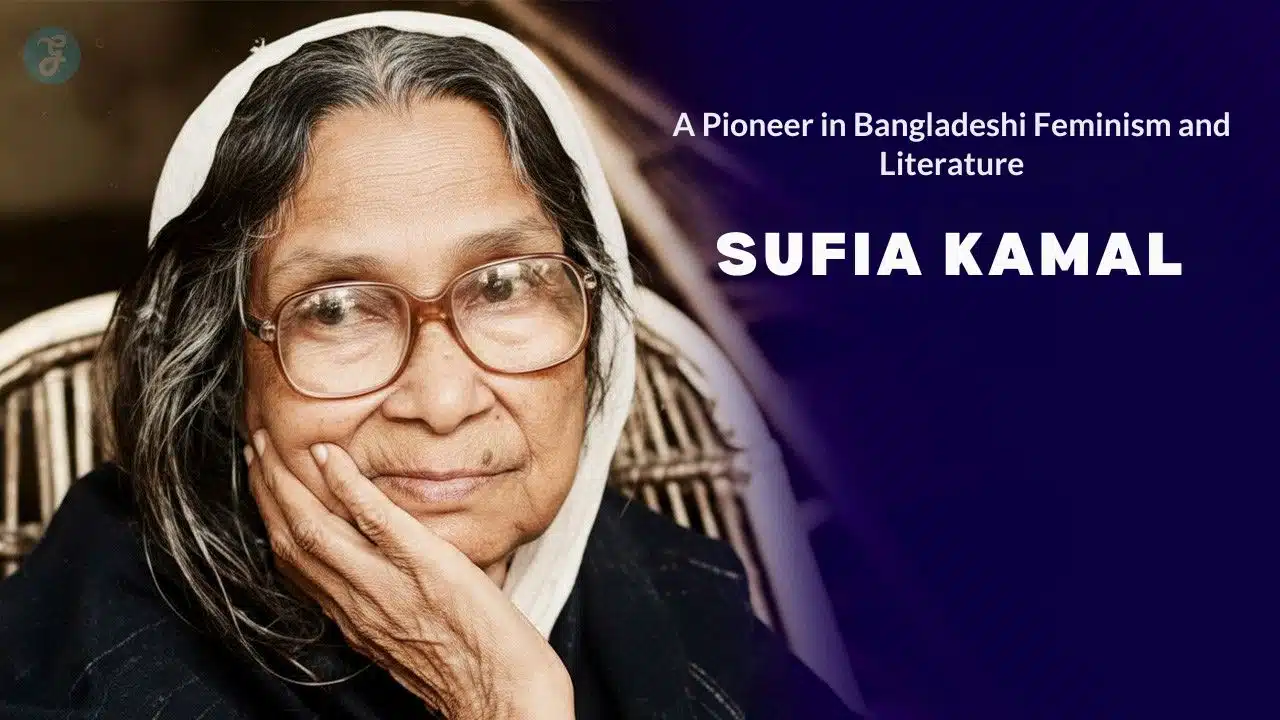
You know how some figures in history seem to stand at every crucial moment when change happens? That’s Sufia Kamal. She wasn’t just present at the birth of Bangladesh as a nation; she helped shape what it meant to be a woman in that nation. Today marks the 26th death anniversary of Sufia Kamal.
Born in 1911 in what’s now Bangladesh, Sufia Kamal became one of the most important Bangladeshi poets and activists for women’s rights.
She grew up when girls were routinely denied formal education. Yet she became a voice for freedom, equality, and culture that still echoes today.
This post will share her journey from eastern Bengal to national icon. You’ll see how she used words to change minds, supported freedom fighters during the Liberation War, and founded powerful movements like Bangladesh Mahila Parishad on April 4, 1970. Her life shows what one determined person can achieve when they refuse to accept injustice.
Key Takeaways
- Sufia Kamal was born in 1911 in Barisal and became a leading poet and activist for women’s rights in Bangladesh.
- She founded Bangladesh Mahila Parishad on April 4, 1970, which now has over 134,000 registered members, making it the country’s largest women’s organization.
- Her debut poetry collection, “Sanjher Maya” (1938), earned praise from both Rabindranath Tagore and Kazi Nazrul Islam, with Nazrul calling her “a new star on the horizon of Bangla poetry.
- During the 1971 Liberation War, her home became a supply hub where freedom fighters collected medicine and food, and she personally connected with fighters like Shafi Imam Rumi and Masud Sadek Chullu.
- She became the first woman in Bangladesh to receive a state funeral in 1999, with over 10,000 people attending to honor her legacy.
Sufia Kamal: Early Life and Education
Sufia Kamal was born into a respected Bengali family in what was then East Pakistan. Her mother played a critical role in her education, as girls faced massive barriers to schooling during her childhood.
What was Sufia Kamal’s childhood and family background?
Born on June 20, 1911, Begum Sufia Kamal grew up in Barisal, in the Backergunge District of Eastern Bengal and Assam. She was the only daughter in her family.
Her father, Syed Abdul Bari, worked as an eminent lawyer. But when Sufia was just seven months old, he left his practice to become a Sufi ascetic and never returned home.
She was raised by her mother, Sabera Begum, at their maternal home called Rahat Manzil in Shayestabad. Her paternal family were zamindars of Shilaur in Brahmanbaria.
At age 11, she married her cousin Syed Nehal Hossain, who was then studying law. He was a liberal man who encouraged her literary pursuits and social welfare work. With Syed Nehal Hossain, she had one daughter named Amena Kahnar.
After his death from tuberculosis in 1932, Begum Sufia remarried in 1937 to Kamaluddin Ahmed, a writer and translator who was a leading member of the Bulbul literary group. Together with Kamaluddin, she had two more daughters, Sultana Kamal and Saida Kamal, and three sons: Shahed Kamal, Shoeb Kamal (who went missing in 1971), and Sajed Kamal.
How did Sufia Kamal overcome barriers to education?
Sufia Kamal faced strict social customs that prevented her from attending formal school. This was common for girls in early 1900s Bengal, especially in aristocratic Muslim families.
She learned at home instead. House tutors taught her Urdu, Arabic, and Persian. But Bengali, the language of her people, was considered inappropriate for nawab families to learn.
Here’s where her determination showed. She taught herself Bengali in secret, getting lessons from her mother and maternal uncle, Syed Mohammad Hossain. She used her uncle’s library to read extensively on her own.
In 1918, when she was seven years old, Sufia went to Kolkata with her mother. There she met Begum Rokeya Sakhawat Hossain, the celebrated feminist writer and social reformer. That meeting changed everything. The inspiration from Begum Rokeya shaped Sufia’s entire future path.
By age 14, she had her first story published. Despite society limiting girls like her to learning only Arabic and some Persian, she kept studying. Her drive for knowledge helped shape her as both a Bangladeshi poet and an activist for women’s rights during key moments like the Language Movement and later national struggles.
Literary Career of Sufia Kamal
Sufia Kamal shaped Bangla literature through her poetry, short stories, and editorial work. She worked closely with Mohammad Nasiruddin on Begum Magazine and drew inspiration from literary giants like Kazi Nazrul Islam and Rabindranath Tagore to highlight women’s issues and Bengali identity.
What are the key works and themes of Sufia Kamal’s literature?
Her first short story, “Shainik Badhu” (The Soldier Bride), was published in 1923 when she was just 14. Her first poem, “Bashanti” (Of Spring), appeared in Saogat magazine in 1926.
Her literary career truly took off with “Sanjher Maya” (Evening Enchantment), published in 1938. This debut poetry collection came with a powerful endorsement. Kazi Nazrul Islam wrote the foreword and praised the young poet as “a new star on the horizon of Bangla poetry.” Rabindranath Tagore read the book and wrote to her, “You have a high place in Bangla literature, as constant and fixed as the Pole Star.”
In 1937, she published her first collection of short stories, “Keyar Kanta” (Thorns of the Keya Tree). Her poetry book “Sanjher Maya” was translated into Russian in 1984, showing her international reach.
“Ekattorer Diary” (Diary of ’71), written during the Bangladesh War of Independence, documented the atrocities she witnessed and called upon freedom fighters to liberate their country.
Strong themes run through her writing:
- Support for the Language Movement of 1952
- Deep respect for Bengali culture and identity
- Sharp criticism of injustice toward women
- Opposition to religious communalism, superstition, and fundamentalism
- Hope in Bangladesh’s freedom fighters and democracy
Many of her poems appeared in Begum Magazine. Her works supported democracy, human rights, and women’s emancipation. Poems reflected personal grief yet inspired collective strength. Translations exist in Chinese, English, German, Italian, Polish, Russian, Vietnamese, Hindi, and Urdu.
How did Sufia Kamal contribute to Bengali literature?
Sufia Kamal became a leading Bangladeshi poet by breaking every barrier in her path. She wrote poems, short stories, and essays focused on women’s rights, social justice, and the struggles facing her people.
Her work spread hope during the hardest times. During the Language Movement, when Pakistan tried to suppress Bengali culture, her words rallied people. During the mass uprising of 1969 and the Bangali nationalist movements, she gave voice to resistance.
In 1947, she became the inaugural editor of the weekly magazine Begum, which was published by Mohammad Nasiruddin and specialized in women’s issues. This platform amplified women’s voices across the region.
She broke cultural barriers by mastering Bengali to write for her people, despite it being forbidden in her family. Her style was influenced by Rabindranath Tagore and Kazi Nazrul Islam, but her voice remained distinctly her own.
She also founded the cultural organization Chhayanaut, which became an iconic center for promoting Bengali culture. Through decades of dedication, she helped shape modern Bangladeshi literature and proved that a self-taught woman could stand alongside the greatest literary figures of her time.
Activism and Feminism by Sufia Kamal
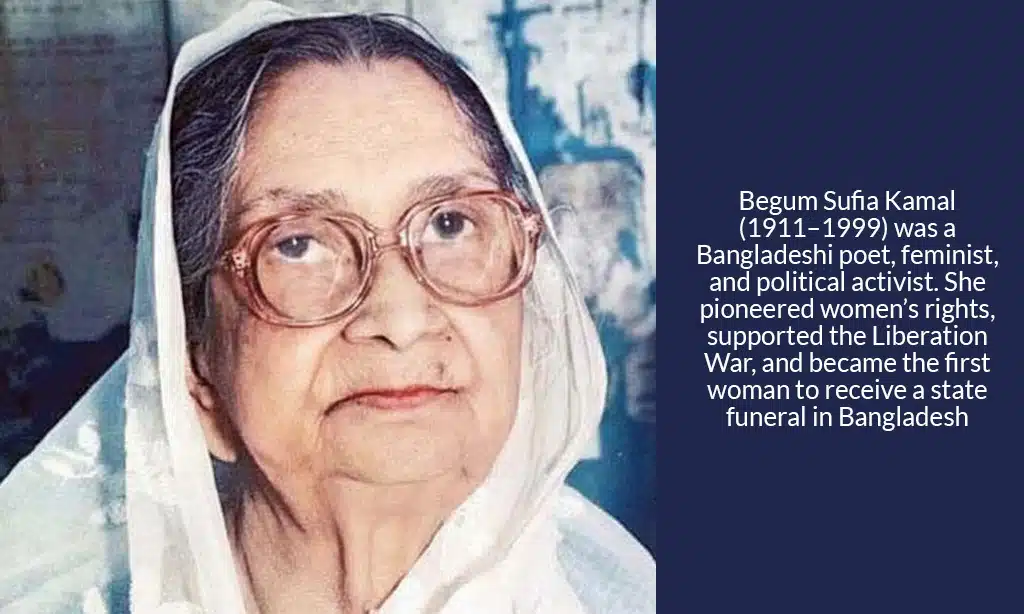
Sufia Kamal worked tirelessly for women’s rights. She helped form Bangladesh Mahila Parishad and spoke out forcefully for gender equality, often teaming up with leaders like Shamsunnahar Mahmud and citing Roquiah Sakhawat Hossain as her inspiration.
How did Sufia Kamal advocate for women’s rights?
She led Bangladesh Mahila Parishad, which she founded on April 4, 1970, during the politically charged atmosphere following the mass uprising of 1969. Today, the organization has over 134,000 registered members, making it the country’s largest women’s group.
She raised her voice for women from all backgrounds, not just the educated elite. She pushed for equal rights in education, work, and family matters starting as early as 1952.
Her advocacy was practical and bold:
- She demanded that the first women’s dormitory at Dhaka University be named Rokeya Hall, after Begum Rokeya, and she succeeded.
- She used her own life and writing to show others that girls could learn and lead.
- She campaigned for legal reforms, including the Family Courts Ordinance of 1985 and the Prevention of Women and Children Repression Act of 2000.
She spoke out against religious extremism. In 1993, the Islamic extremist group Harkatul Jihad placed her on a hit list and issued a death threat. She did not back down.
She worked with pioneering leaders to shape feminist ideas in Bangladesh and create safe spaces like Rokeya Sadan, a women’s shelter founded by Bangladesh Mahila Parishad in 1985.
What was her role in establishing feminist movements in Bangladesh?
Sufia Kamal played a leading part in shaping feminist movements across the nation. As the founding president of Bangladesh Mahila Parishad, she built an organization that reached women from all social classes.
Her work helped spread ideas about women’s rights and equality at every level of society. Under her leadership, campaigns for equal education, legal reforms, and health rights gained national attention.
She promoted unity among diverse groups. She brought together writers, activists, freedom fighters, and ordinary citizens through events linked with Begum magazine and organizations like Sanskritik Swadhikar Andolon. She worked alongside other major figures, including Mohammad Nasiruddin and Syed Abdul Bari.
Her clear demands helped set strong foundations for modern feminist advocacy across Bangladesh. She was also the first Chairperson of BRAC (Bangladesh Rural Advancement Committee) from 1972 to 1980, extending her influence into rural development and poverty alleviation.
In 1929, she joined Anjuman-i-Khawatin-i-Islam, an association of Muslim women founded by Roquiah Sakhawat Hossain. This forum allowed women to discuss relevant issues and promoted education and social reform. She also founded Kochi-Kachar Mela in 1956, a children’s organization focused on cultural and educational development.
Sufia Kamal’s Role in Bangladesh’s Liberation War
Sufia Kamal stood with the freedom fighters during Bangladesh’s War of Independence in 1971. She supported cultural groups like Sanskritik Swadhikar Andolon and used her platform to protect Bengali identity while organizing relief efforts across the country.
How did Sufia Kamal participate in and influence the Liberation War?
Her home became a critical supply hub. In 1971, several people in Dhaka, including Professor Ghyasuddin Ahmed and writer Shahidullah Kaiser, collected medicine and food and delivered them to Sufia Kamal’s house. Freedom fighters picked up these supplies for their training outposts.
From July 1971, she went to hospitals with food and medicine for injured people. She used an ingenious system: she gave food and medicine to certain rickshaw pullers at the Science Laboratory in Dhaka, who then transported these items to the freedom fighters.
She established closer contact with freedom fighters like Abul Barak Alvi, Shafi Imam Rumi, Masud Sadek Chullu, and Jewel. The Pakistani army kept her under strong surveillance, but she continued helping in different ways, ignoring the risks. Tragically, except for Abul Barak Alvi, all the others died at the hands of the Pakistani Army.
Her daughters joined the Mukti Bahini (freedom fighters), setting up the first hospital for fighters at Agartala. Meanwhile, Sufia, her husband, and older son stayed in the country to provide moral support and a safe place where messages could be passed.
The Pakistani government tried to break her spirit. When false news of her killing was broadcast internationally on Akashbani radio in West Bengal, it drew criticism and diplomatic pressure from around the world. The Pakistani government was forced to broadcast an interview with her to prove she was still alive.
Zillur Rahman, the regional director of Radio East Pakistan, brought her a paper with the statement “In 1971 no massacre took place in Bangladesh.” When she refused to sign, he threatened her and her son-in-law, Abdul Quahhar Chowdhury. She told him she didn’t care for her life and said, “I would rather die than put my signature on the false statement.”
As president of Bangladesh Mahila Parishad, she raised her voice for justice and human rights. She spoke against violence and pushed for help for victims.
She used her role as a Bangladeshi poet and activist to protect Bengali culture under threat. She worked closely with groups like Sanskritik Swadhikar Andolon to defend language, literature, and arts during wartime.
During the war, she kept two diaries: “Ekatturer Diary” (Diary of ’71) and a poetic diary titled “Mor Jaduder Samadhi Pare” (Where My Darlings Lie Buried). These works recalled the atrocities committed by the Pakistani army and called upon freedom fighters to fight for liberation. In one poem, “Benibinyas Samay To Ar Nei” (No More Time for Braiding Your Hair), she reminded women that they too had a duty toward their motherland.
After the war ended, she sought advice from Mother Teresa on the vital issue of children born to captive women during the war. She stood up for their rights and worked relentlessly for their adoption and rehabilitation. Her leadership inspired many women to take part in protests and relief work during that critical time in history.
Legacy and Recognition
Sufia Kamal gained respect from both local and global organizations. Her poems and work in women’s rights continue to inspire freedom fighters, writers, and students interested in Bengali literature.
What awards and honors did Sufia Kamal receive?
Many awards marked the literary career of this Bangladeshi poet. The Bangladesh government gave her the Ekushey Padak in 1976, the second-highest civilian honor in the country. She was among the first recipients in the inaugural year of this prestigious award.
She received the first Begum Rokeya Padak in 1996 for her work in women’s rights. She also earned:
| Award | Year | Significance |
|---|---|---|
| Bangla Academy Literary Award | 1962 | For literature contributions |
| Lenin Centenary Jubilee Medal | 1970 | From the Soviet Union |
| Independence Day Award | 1997 | Highest national honor |
| Czechoslovakia Medal | 1986 | International recognition |
She had earlier received the Tamgha-i-Imtiaz in 1961 from the Pakistani government but returned it in 1969 in protest against their oppressive treatment of Bengali people.
Recognition came not only from medals but also from historic events. More than 10,000 people attended her funeral on November 20, 1999. The state gave full national honors at her burial in Dhaka. She became the first woman in Bangladesh to receive a state funeral, a distinction that reflected how much she meant to the nation.
The National Public Library in Dhaka is named the Sufia Kamal National Public Library in her honor. Bangladesh National Museum named one of its main auditoriums after her as well.
How has Sufia Kamal impacted future generations?
Sufia Kamal’s work shaped Bangladeshi feminism and literature for future generations in concrete, lasting ways.
Her founding of Bangladesh Mahila Parishad created a strong platform for women’s rights that continues today. The organization campaigns for legal reforms, provides medico-legal support and shelter to women victims of repression, and involves men and youth in the movement against women’s repression.
Her efforts inspired young women to lead and participate in social change. Through Begum Magazine, where she worked with Mohammad Nasiruddin, she encouraged more girls to pursue education and express their voices through the written word.
Her advocacy during the Language Movement influenced both cultural pride and national identity. Universities honored her legacy with institutions like Rokeya Hall at Dhaka University, named after pioneers who paved the way for women’s education.
Many literary prizes carry her name today to inspire writers who follow in her steps. The Bangladesh Mahila Parishad gives out the Poet Sufia Kamal Award annually to honor individuals and organizations making social impacts.
Leaders in modern feminist groups often mention Sufia Kamal as a guiding figure. They view her struggle for women’s rights as laying the foundation for continued progress across Bangladeshi society. Her work remains relevant because she addressed discrimination against all women, regardless of class, making her advocacy truly inclusive.
Cultural organizations like Chhayanaut, which she founded, continue to promote Bengali culture and celebrate her birth anniversary each year. Students study her poetry and life as examples of courage and commitment to justice. Affectionately known as “Khalamma” (Aunt), she remains a source of inspiration even decades after her death.
Takeaways
Sufia Kamal’s life marked a turning point for women’s rights in Bangladesh. Her poetry, activism, and leadership shaped both literature and social change in ways that still matter.
People today honor her courage through institutions like Rokeya Hall and Bangladesh Mahila Parishad. Many remember her as a fearless voice who stood alongside literary giants like Kazi Nazrul Islam and Rabindranath Tagore. When you study Bangladeshi poets like Sufia Kamal, you’re learning from someone who showed that one person can change a nation’s future through a firm commitment to justice and equality.
FAQs on Sufia Kamal
1. Who was Sufia Kamal?
Sufia Kamal (1911-1999) was a celebrated Bangladeshi poet and activist who became a pivotal figure in the country’s major political and cultural movements. She played an influential role in the 1952 Language Movement and the 1971 Liberation War, earning the title “Janani Sahasika,” or “Courageous Mother.” Her work inspired countless freedom fighters and advocates for women’s rights.
2. What was Begum magazine and how did Sufia Kamal contribute to it?
Founded in 1947 by Mohammad Nasiruddin, Begum was Bengal’s first illustrated weekly magazine focused on women, with Sufia Kamal serving as its inaugural editor. Through the magazine, she created a vital platform for female writers and promoted discussions on women’s emancipation and social reform across Bangladesh.
3. Which famous writers influenced Sufia Kamal’s work?
Her literary style was significantly shaped by the works of Nobel laureate Rabindranath Tagore and the revolutionary national poet Kazi Nazrul Islam.
4. What is Bangladesh Mahila Parishad and what was Sufia Kamal’s role?
Sufia Kamal was the founding president of Bangladesh Mahila Parishad, a leading women’s rights organization she helped establish in 1970. The organization works to achieve gender equality and prevent violence against women, playing a key role in social justice advocacy.
5. How is Sufia Kamal remembered in Bangladesh today?
Sufia Kamal is honored as a national icon, with her death anniversary officially observed and the national public library in Dhaka named after her. She received Bangladesh’s highest civilian honors, the Ekushey Padak and the Independence Day Award, for her contributions. Her academic legacy continues, with citations of her work appearing in formats like the Modern Language Association and APA styles.