

OpenAI, the company behind ChatGPT and one of the leading names in artificial intelligence, is making major strides in building the physical infrastructure needed for the future of AI. In its latest move, OpenAI has announced that it is expanding its highly ambitious “Stargate” project to Europe, marking a significant moment for the continent’s role in the global AI race.
The new data center, named Stargate Norway, will be built in Narvik, a town located in the Arctic Circle known for its clean, renewable energy and industrial legacy. OpenAI is partnering with Nscale Global Holdings, a specialized infrastructure developer, and Aker ASA, a Norwegian industrial investment company, to bring this $1 billion project to life.
This facility is expected to go live in 2026 and is being described by OpenAI as one of the most significant AI infrastructure projects ever undertaken in Europe.
A Response to Elon Musk’s Doubts on OpenAI’s Financial Power
This announcement carries added weight due to a recent public exchange between OpenAI CEO Sam Altman and tech mogul Elon Musk, who was a co-founder of OpenAI but later distanced himself from the company.
Earlier in January 2025, when OpenAI first revealed its $500 billion Stargate AI infrastructure initiative, Elon Musk was openly skeptical. He claimed that OpenAI and its partners didn’t actually have the capital required to execute such a massive plan. In a tweet, Musk said, “They don’t actually have the money. SoftBank has well under $10 billion secured. I have that on good authority.”
The remarks raised eyebrows and sparked debates about the feasibility of OpenAI’s plans. Sam Altman, in a composed response, praised Musk as “the most inspiring entrepreneur of our time” but maintained that OpenAI’s infrastructure push was real and well underway.
OpenAI’s follow-up action speaks louder than words: in May 2025, it announced its first Stargate facility in the United Arab Emirates, and now, just months later, it’s entering the European market with a high-profile facility in Norway.
Stargate Norway: What Makes This Facility Unique
According to OpenAI’s official blog post, the Stargate Norway project is being built with long-term AI sustainability and scalability in mind. Here’s what makes it stand out:
Powered Entirely by Renewable Energy
Narvik’s location gives it direct access to abundant hydropower, making it ideal for operating large-scale GPU servers sustainably. The entire facility will be powered by clean energy sources.
Optimized for Cooling Efficiency
Thanks to Norway’s naturally cool climate, Stargate Norway will use closed-loop, direct-to-chip liquid cooling systems, ensuring higher efficiency and minimizing environmental impact.
Recycling Excess Heat
The excess heat produced by the GPUs will be redirected to support low-carbon enterprises in the surrounding region, contributing to a circular energy economy.
Inside the Tech: 100,000 NVIDIA GPUs and Advanced Interconnects
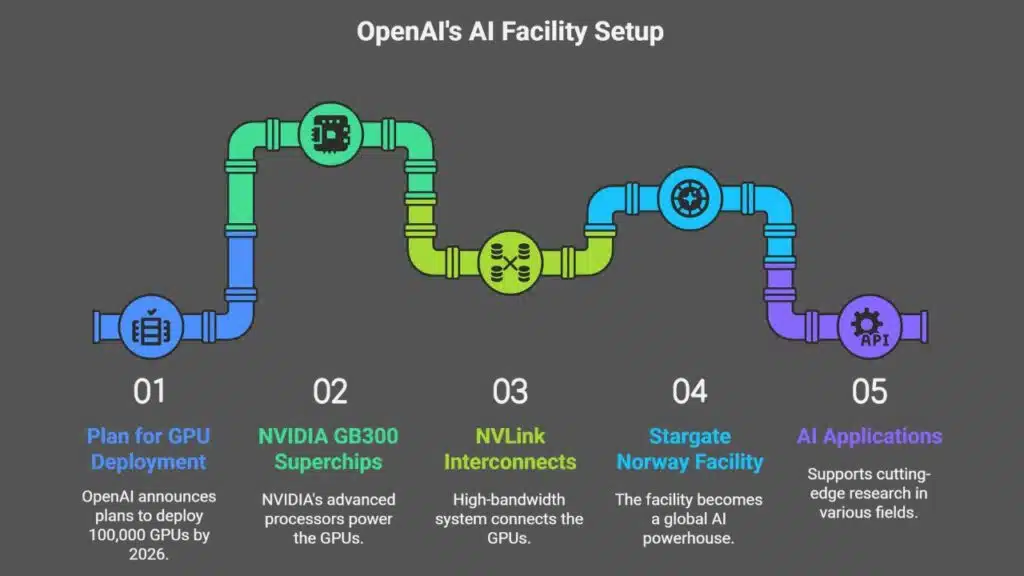
OpenAI plans to equip the facility with 100,000 NVIDIA GPUs by the end of 2026. These GPUs will be powered by NVIDIA’s GB300 Superchips, some of the most advanced processors designed for AI workloads. The chips will be connected via NVLink, a high-bandwidth interconnect system that boosts performance and enables efficient scaling of massive AI models.
This will make Stargate Norway one of the most powerful AI facilities in the world, capable of supporting cutting-edge applications in natural language processing, machine learning, robotics, and generative AI research.
Strategic Collaboration: Aker ASA and Nscale Global Holdings
The partnership structure is equally important. OpenAI is collaborating with:
- Aker ASA: A Norwegian conglomerate with strong expertise in energy, sustainability, and infrastructure development.
- Nscale Global Holdings: A developer of sovereign-scale AI data infrastructure.
The facility will be co-owned 50/50 by Aker and Nscale, ensuring local governance and alignment with European data sovereignty principles.
Aker has emphasized that Stargate Norway aligns with its commitment to green digital infrastructure, while Nscale stated the partnership aims to ensure “secure, high-performance compute resources that remain within regional governance structures.”
Part of a Larger Vision: OpenAI’s Global AI Infrastructure Push
OpenAI’s move into Norway is part of a broader global expansion strategy under its Stargate initiative, which was first unveiled earlier in 2025 as a visionary plan to deploy large-scale AI infrastructure around the world.
In May 2025, the company announced a similar-sized Stargate facility in the UAE. Now, with the addition of Stargate Norway, OpenAI is cementing its presence across continents.
These facilities are not just technical investments; they are meant to empower developers, researchers, startups, and governments with reliable access to AI compute capacity on their own soil, reducing dependence on centralized cloud platforms.
Beyond Infrastructure: OpenAI’s Government Partnerships in Europe
In parallel with the Stargate rollout, OpenAI has also been building relationships with European governments:
- United Kingdom: OpenAI has signed a Memorandum of Understanding (MoU) with the UK government to accelerate responsible AI adoption.
- Estonia: OpenAI is collaborating with Estonia’s Ministry of Education to integrate ChatGPT into secondary school education, potentially reshaping how students learn across the country.
- European Union: OpenAI has submitted proposals to join AI Gigafactories consortia aimed at creating large-scale, regional AI compute ecosystems.
These partnerships illustrate OpenAI’s broader commitment to AI sovereignty, safety, and education throughout Europe.
Economic Impact on Narvik and Beyond
Stargate Norway is expected to create hundreds of local jobs, both during the construction phase and later through facility operations, research collaborations, and adjacent businesses.
Given Narvik’s relatively small population and remote location, the arrival of such a massive tech investment is likely to bring long-term transformation, attracting talent, boosting property values, and supporting new industries such as green energy services and digital education.
Local leaders in Narvik have welcomed the project, calling it a “generational opportunity” to turn the city into one of Europe’s future digital capitals.
Stargate Norway at a Glance
| Feature | Details |
| Location | Narvik, Norway |
| Investment Value | ~$1 Billion (initial phase) |
| GPU Count | 100,000 NVIDIA GPUs by 2026 |
| Power Capacity | 230MW (initial) → scalable up to 520MW |
| Energy Source | 100% Renewable (Hydropower) |
| Cooling Tech | Closed-loop, direct-to-chip liquid cooling |
| Heat Recycling | Yes – for regional low-carbon enterprises |
| Ownership Structure | 50% Aker ASA, 50% Nscale Global Holdings |
| Launch Year | Expected by end of 2026 |
| Primary Tech | NVIDIA GB300 Superchip + NVLink interconnect |
| Regional Goals | Support AI sovereignty and sustainable digital development |
A Big Win for European AI Ecosystem
Despite skepticism from influential voices like Elon Musk, OpenAI is pushing ahead with full force. The launch of Stargate Norway confirms that OpenAI is serious about global AI infrastructure and is already turning vision into reality.
By choosing Norway, OpenAI is not just gaining a physical presence in Europe — it’s also aligning with the continent’s values around green energy, data sovereignty, and tech-for-good. Stargate Norway could become the blueprint for future AI infrastructure projects across the world.
As the AI race intensifies, OpenAI is positioning itself not just as a creator of models, but as a builder of the very infrastructure of intelligence.
The Information is Collected from Times of India and Reuters.































