Global music streaming giant Spotify has officially announced a price increase for its Premium Individual subscription, set to take effect in September 2025 across many countries. This strategic move reflects the company’s ongoing efforts to improve its profit margins while responding to global economic pressures and rising operational costs.
Let’s break down what this change means for users, artists, and the broader music industry.
Global Price Hike: What’s Changing and Where
Starting in September 2025, Spotify will raise the monthly cost of its Premium Individual plan from €10.99 to €11.99, equivalent to about $13.86 USD. This update will not be limited to one region; it will affect users in numerous territories worldwide, including:
-
Europe
-
South Asia
-
Middle East
-
Africa
-
Latin America
-
Asia-Pacific
Spotify has confirmed that all affected users will receive individual email notifications, clearly stating the new pricing and the effective date for their subscription. This gradual rollout is expected to start in late August and continue into September, ensuring transparency and advance notice for subscribers.
Why Is Spotify Increasing Its Prices?
The decision to increase prices is part of Spotify’s larger financial strategy to drive sustainable growth and profitability. Although the platform has gained millions of users across the globe, especially in emerging markets, the company is dealing with growing expenses.
Here are the key reasons behind the price hike:
1. Rising Employee-Related Costs
Spotify has reported significant increases in taxes tied to employee compensation, particularly in countries with higher social insurance and employment-related tax burdens. These rising costs have directly affected the company’s operating margins.
2. Operational and Content Licensing Costs
As the platform expands globally, it continues to invest in content licensing, regional data centers, and user experience upgrades. All of these improvements come with rising infrastructure costs.
3. Response to a Weak Financial Forecast
Just last month, Spotify issued a statement forecasting that its quarterly earnings might fall below Wall Street expectations. This was attributed mainly to higher tax obligations and general overhead costs, despite ongoing growth in user engagement.
Investor Reaction: Stock Price Gains
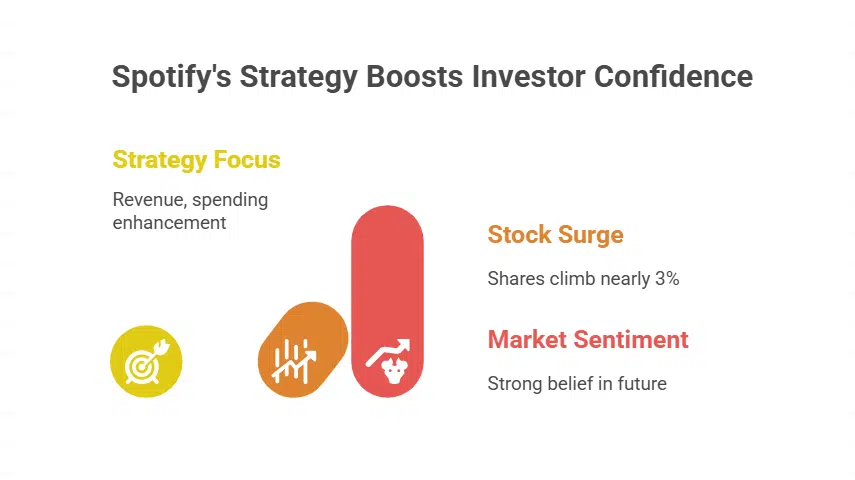
Interestingly, investors welcomed the announcement with optimism. Shortly after the news broke, Spotify’s shares climbed nearly 3% in premarket trading. This price hike appears to reinforce investor confidence in Spotify’s long-term business strategy, which focuses on enhancing revenue per user and reducing wasteful spending.
In fact, Spotify’s stock has surged about 40% year-to-date, underlining strong market sentiment around its future performance. The company’s ongoing efforts to streamline operations, cut unnecessary costs, and divest from underperforming areas—such as its scaled-back podcast investments—are seen as encouraging signs of discipline and focus.
Spotify’s Fight Against Artificial Streaming
In addition to the price update, Spotify has also intensified its campaign against artificial streaming, a growing problem that undermines the credibility and fairness of its platform.
What Is Artificial Streaming?
Artificial streaming involves fake plays of music tracks that are generated by bots, click farms, or manipulated algorithms, often purchased through third-party services that promise increased visibility or chart success.
Spotify revealed that this issue is affecting the entire global music ecosystem, and while some artists knowingly engage in such practices, others fall victim to shady marketing firms disguised as legitimate promotion services.
New Policy Changes and Penalties
Spotify has made it clear that any music track found to have significant levels of artificial streaming will face financial penalties. The cost of detection and removal will be charged directly to distributors or labels, and in many cases, these costs will be passed on to the artists themselves. In serious cases, royalties may be withheld altogether.
To tackle this, Spotify has increased its investment in AI-powered detection tools and hired specialized teams focused on fraud prevention. These systems can now detect suspicious activity much faster, ensuring that illegitimate plays are removed quickly and do not affect royalty calculations.
Protecting Real Artists and Fair Play
Streaming fraud doesn’t just hurt Spotify—it harms genuine artists by taking attention and revenue away from those who have built real audiences through organic growth and hard work. By clamping down on artificial streams, Spotify aims to protect the value of legitimate music and ensure that royalties go to the right creators.
Industry leaders are supporting this initiative. Music distributors such as TuneCore are also working to educate artists about the dangers of artificial streams and the importance of choosing verified, ethical promotion methods.
The goal is to create an ecosystem where authentic engagement is rewarded, and the industry can grow with integrity.
Massive Growth in Royalties for African Artists
Despite concerns around pricing and fraud, Spotify continues to be a major source of revenue for artists—especially in developing markets.
A recent report by Nairametrics showed that:
-
Nigerian artists earned over ₦58 billion (approx. $38 million USD) in royalties from Spotify in 2024.
-
This figure more than doubled the 2023 numbers, and is five times higher than in 2022.
This impressive growth highlights how Spotify is becoming an increasingly important income stream for African artists, as more fans across the continent turn to music streaming as their preferred way of listening.
It also shows that Spotify’s reach in emerging markets is having a real financial impact, helping independent and regional musicians earn sustainable incomes.
Spotify’s latest changes signal a pivotal moment for the company—and the broader music streaming industry. While the subscription price hike may put pressure on users, it also reflects the platform’s commitment to financial stability and quality service.
Meanwhile, its crackdown on artificial streaming is a necessary step to protect real artists and uphold the value of music in the digital era. The growing revenue among African creators is proof that, when managed fairly, music streaming can be a powerful force for creative growth and economic opportunity.
As Spotify moves into this next phase, it aims to balance business goals, artist empowerment, and user satisfaction—all while navigating a fast-evolving media landscape.