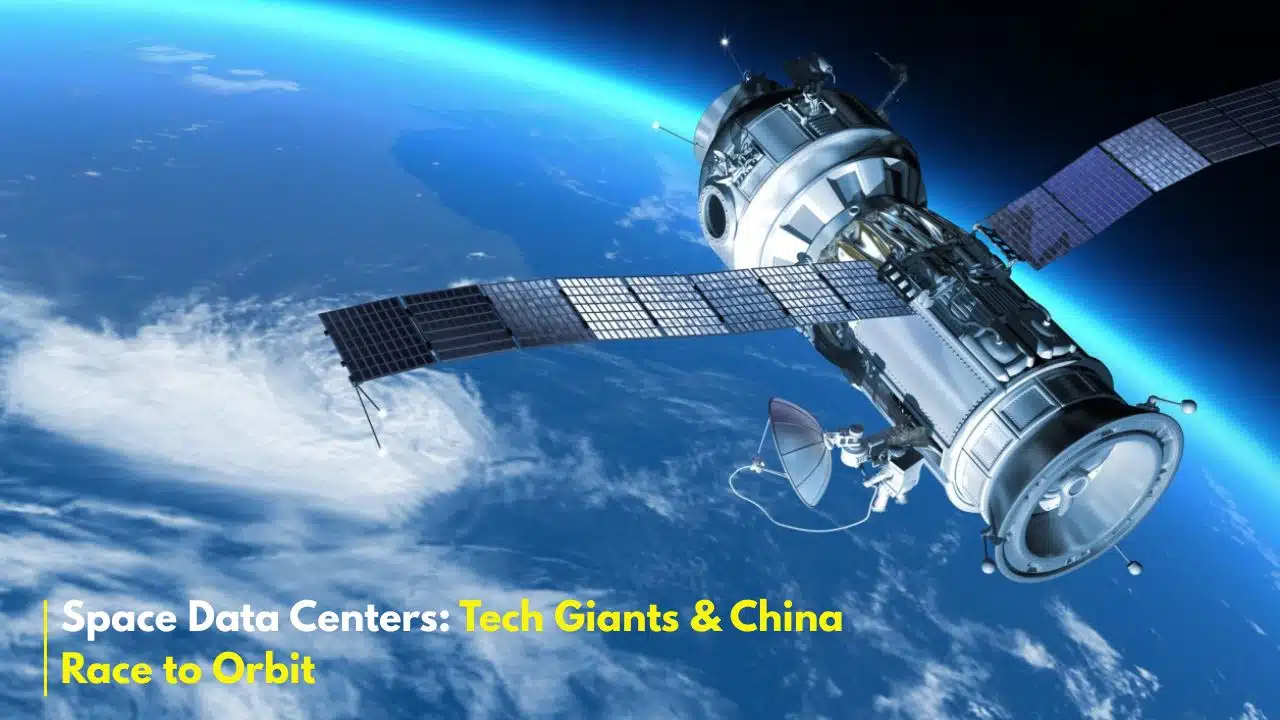
The race to dominate artificial intelligence (AI) is moving beyond Earth’s atmosphere, with tech giants and China pushing the boundaries of what’s possible by planning massive AI data centers in orbit. As the demand for computing power skyrockets, the constraints of terrestrial infrastructure—energy, space, and cooling—have led innovators to look skyward. This new frontier promises not only exponential growth in processing capability but also a paradigm shift in how humanity harnesses the power of AI.
The Rise of Space-Based AI Infrastructure
Artificial intelligence is no longer just a tool for automating tasks; it is becoming the backbone of scientific discovery, global communications, and real-time decision-making. However, the growth of AI has come at a cost. Ground-based data centers consume vast amounts of electricity and water for cooling, and their physical expansion is limited by land availability and environmental regulations.
To overcome these challenges, Google has launched Project Suncatcher, an ambitious initiative to deploy solar-powered satellite constellations equipped with Tensor Processing Units (TPUs) and interconnected by free-space optical links. These constellations would orbit in sun-synchronous low Earth orbit, maximizing exposure to solar energy and minimizing the need for heavy batteries. The goal is to create a scalable, environmentally friendly AI infrastructure that could one day rival the combined computing power of all ground-based data centers.
China is not far behind. In May 2025, the country launched the first batch of its “Three-Body Computing Constellation,” a network of 12 AI-enabled satellites designed to process data directly in orbit. This constellation, led by Zhejiang Laboratory and ADA Space, is just the beginning of a much larger plan to deploy thousands of satellites with a total computing capacity exceeding that of China’s entire current ground-based fleet.
How Space-Based Data Centers Work
The concept of space-based AI data centers revolves around three core principles: solar energy, distributed computing, and real-time data processing.
-
Solar Energy: In space, solar panels can be up to eight times more productive than on Earth due to near-constant sunlight and the absence of atmospheric interference. This means that space-based data centers could operate almost entirely on solar power, drastically reducing their carbon footprint.
-
Distributed Computing: Instead of relying on a single massive facility, space-based data centers use constellations of smaller, interconnected satellites. These satellites can distribute AI workloads across the network, enabling real-time processing of petabytes of data from remote sensing, astronomy, and global communications.
-
Real-Time Data Processing: By processing data directly in orbit, space-based AI systems can filter and analyze information before it is sent back to Earth. This reduces bandwidth requirements and allows for immediate insights, which is particularly valuable for applications such as climate monitoring, disaster response, and autonomous navigation.
China’s Three-Body Computing Constellation
China’s entry into the space-based AI race is marked by the Three-Body Computing Constellation, a project that aims to create a global network of thousands of satellites capable of real-time data processing. The first phase, launched in May 2025, involved 12 satellites equipped with high-performance GPUs and AI models. These satellites are designed to handle complex tasks such as analyzing satellite imagery, detecting gamma-ray bursts, and supporting intelligent remote sensing.
The ultimate goal is to deploy a constellation of 2,800 satellites, delivering a combined computing capacity of 1,000 peta operations per second (POPS). This would make the Three-Body Computing Constellation more powerful than any ground-based supercomputer, and it would be able to process vast amounts of data without relying on terrestrial infrastructure.
Chinese tech firms are also addressing the challenges of space-based computing, such as radiation-induced failures and thermal management. By implementing redundant designs, error correction protocols, and fluid-loop cooling systems, they are ensuring that their orbital computers can operate reliably in the harsh environment of space.
Google’s Project Suncatcher
Google’s Project Suncatcher is a moonshot initiative that aims to build a scalable AI infrastructure in space. The project envisions a constellation of solar-powered satellites equipped with TPUs and connected by high-bandwidth optical links. These satellites would operate in a dawn–dusk sun-synchronous orbit, maximizing solar energy collection and minimizing the need for batteries.
The technical challenges of Project Suncatcher are significant. The satellites must fly in a very close formation to achieve the high-bandwidth inter-satellite links required for distributed AI workloads. Google has developed numerical and analytic models to analyze the orbital dynamics of such a constellation, and initial tests have shown promising results.
Google is also addressing the issue of radiation tolerance in space. The company has tested its Trillium TPUs in a proton beam and found that they are surprisingly radiation-hard, with no hard failures observed at doses up to 15 krad(Si).
The first milestone for Project Suncatcher is a learning mission in partnership with Planet Labs, scheduled to launch two prototype satellites by early 2027. This experiment will test the hardware and optical links in orbit, laying the groundwork for a future era of massively-scaled computation in space.
Technical and Environmental Challenges
While the potential benefits of space-based AI data centers are immense, there are significant technical and environmental challenges that must be overcome.
-
Inter-Satellite Communication: Large-scale AI workloads require high-bandwidth, low-latency connections between satellites. Achieving this in space is difficult due to the vast distances and the need for precise orbital control. Both Google and China are developing multi-channel dense wavelength-division multiplexing (DWDM) transceivers and spatial multiplexing to overcome these challenges.
-
Radiation and Thermal Management: The space environment is harsh, with high levels of radiation and extreme temperatures. Components must be radiation-hardened, and thermal management systems must be designed to dissipate heat in the vacuum of space, where there is no air convection.
-
Launch Costs and Space Debris: Historically, high launch costs have been a barrier to large-scale space-based systems. However, with the advent of reusable rockets and falling launch prices, this barrier is rapidly diminishing. The risk of space debris is also a concern, as thousands of satellites in orbit could create a hazardous environment for future missions.
The Future of AI in Space
The race to build AI data centers in space is just beginning, but the implications are profound. By moving AI infrastructure into orbit, tech giants and China are not only overcoming the limitations of terrestrial infrastructure but also opening up new possibilities for global connectivity, real-time data processing, and scientific discovery.
As the technology matures, we can expect to see a new generation of AI-powered satellites that will revolutionize everything from climate monitoring to autonomous navigation. The final frontier is no longer just a destination for exploration; it is becoming the new frontier for artificial intelligence.
Final Words
The race to build AI data centers in space is a testament to the ingenuity and ambition of tech giants and China. By harnessing the power of solar energy and distributed computing, these projects promise to overcome the limitations of terrestrial infrastructure and unlock new possibilities for AI. As the technology advances, the final frontier will become an integral part of our digital future.