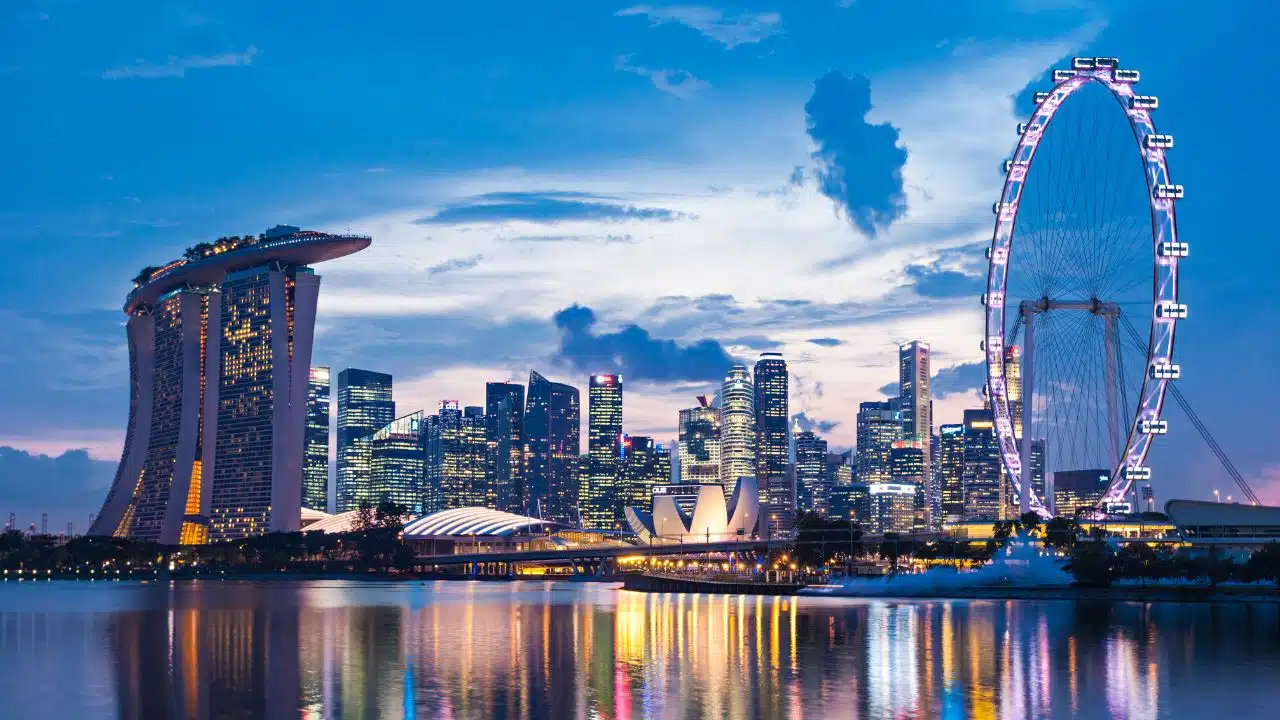
Singapore has once again been recognized as Asia’s most peaceful country in 2025, maintaining its reputation as one of the world’s safest and most stable nations. According to the Global Peace Index (GPI) 2025, compiled by the Institute for Economics and Peace (IEP) in Sydney, the city-state ranked 6th worldwide, ahead of several European countries traditionally associated with peace and stability.
The only Asian nations joining Singapore in the top 20 are Japan, ranked 12th, and Malaysia, ranked 13th. This underlines Singapore’s unique position in the region: a small yet highly organized country that consistently manages to provide safety, security, and stability in a volatile global environment.
Globally, the top five positions went to:
- Iceland – retaining the top spot for the 18th consecutive year.
- Ireland
- New Zealand
- Austria
- Switzerland
Singapore comes in immediately after this group, placing it firmly among the elite peaceful nations of the world.
Why Singapore Ranks So High
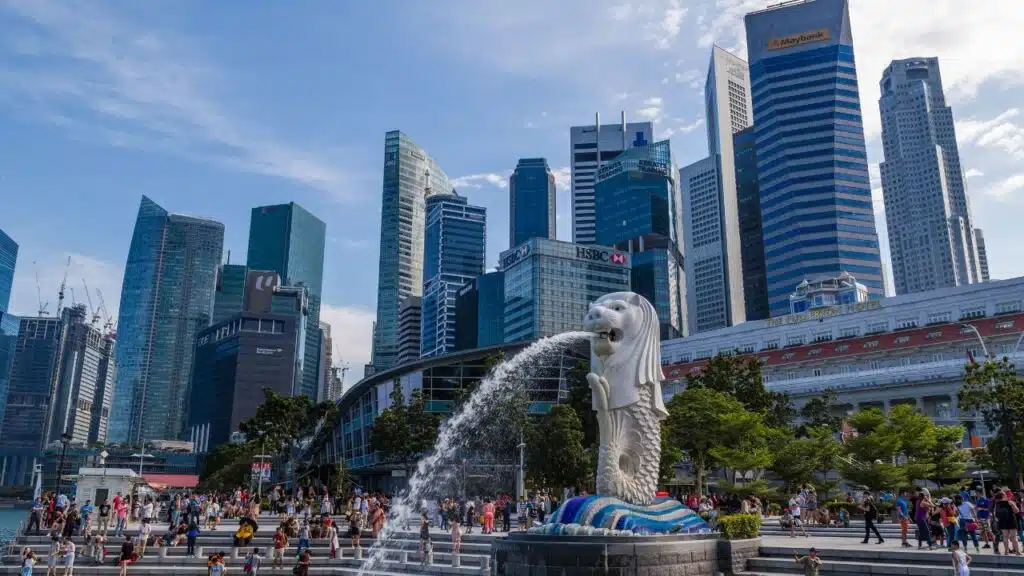
The GPI evaluates 163 countries and territories based on 23 qualitative and quantitative indicators grouped into three domains:
Societal Safety and Security
-
- Singapore consistently earns near-perfect scores here, with very low crime rates, a strong rule of law, and efficient policing.
- Violent crime, terrorism, and political instability are rare, making the city-state one of the safest places in the world for residents and visitors alike.
- Singapore consistently earns near-perfect scores here, with very low crime rates, a strong rule of law, and efficient policing.
Ongoing Domestic and International Conflict
-
- Unlike many nations, Singapore has no ongoing domestic conflicts or active participation in international wars.
- Its diplomacy emphasizes neutrality, trade stability, and regional cooperation through platforms like ASEAN.
- Unlike many nations, Singapore has no ongoing domestic conflicts or active participation in international wars.
Militarisation
-
- Singapore invests heavily in its military capabilities, particularly to protect vital sea trade routes through the Strait of Malacca and South China Sea.
- This high militarisation score, while necessary for national security and economic survival, prevents Singapore from ranking at the very top of the index.
- Singapore invests heavily in its military capabilities, particularly to protect vital sea trade routes through the Strait of Malacca and South China Sea.
Iceland: Still the World’s Most Peaceful Country
While Singapore leads in Asia, Iceland remains unmatched on the global scale. For the 18th consecutive year, the Nordic island nation ranked #1 in the world. Iceland’s peace stems from:
- Having no standing army, navy, or air force.
- Exceptionally low levels of violent crime.
- A political culture that emphasizes consensus and social welfare.
- Police officers who generally do not carry firearms.
Other European countries like Ireland, Austria, Switzerland, Denmark, and Slovenia also feature prominently in the top ten, reflecting Europe’s long tradition of peace and stable governance.
Singapore’s Climb Since 2008
Singapore’s journey to becoming one of the world’s most peaceful nations has been steady and deliberate.
- 2008 – When the Global Peace Index was first introduced, Singapore ranked 22nd globally.
- 2019 – It broke into the global top 10 for the first time, reflecting years of strong governance, economic resilience, and internal security.
- 2025 – It has now cemented its place in the top 10 for six consecutive years, underlining consistency rather than a one-off achievement.
This steady progress highlights Singapore’s ability to adapt to global challenges while prioritizing internal harmony and external neutrality.
Asia-Pacific Rankings
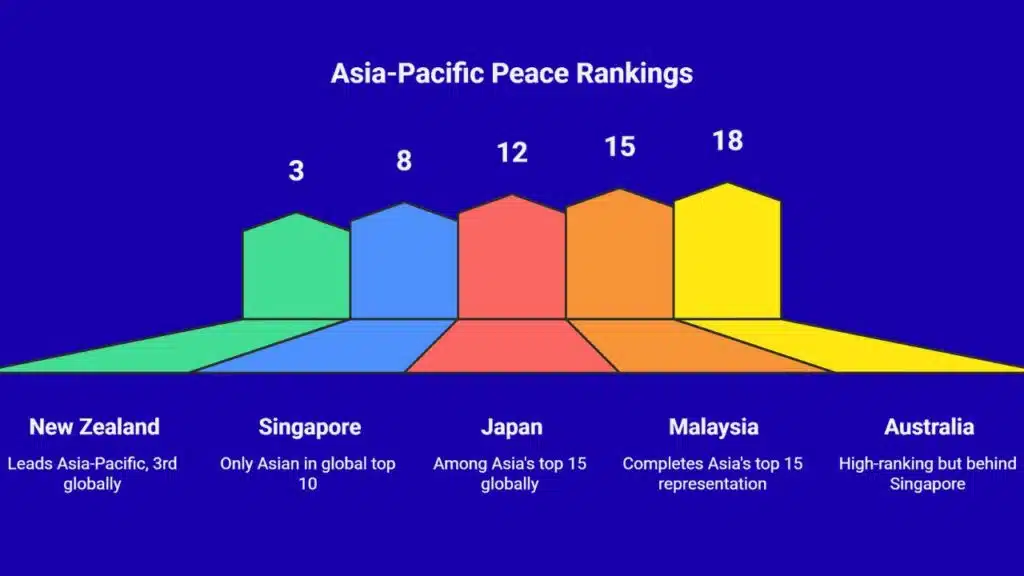
Within the Asia-Pacific region, the ranking paints a clear picture:
- New Zealand leads the region (and is 3rd globally).
- Singapore follows closely behind, the only Asian country in the global top 10.
- Japan and Malaysia complete Asia’s representation in the top 15.
- Australia also ranks high but lags behind Singapore and New Zealand.
This contrast shows how small, well-governed nations can often perform better on peace metrics compared to larger powers in the region, which face internal conflicts, security dilemmas, or geopolitical tensions.
Why Peace Matters for Singapore
Singapore’s peaceful reputation is more than symbolic—it has real-world benefits:
- Economic Competitiveness: A safe and stable environment attracts foreign investment and global businesses, reinforcing Singapore’s role as a financial hub.
- Tourism Growth: Tourists continue to see Singapore as a secure and welcoming destination.
- Talent Retention: Safety and quality of life make it attractive for global talent, expats, and international students.
- Diplomatic Strength: As a neutral and peaceful state, Singapore often serves as a venue for international summits and peace negotiations.
A Global Context of Declining Peace
While Singapore continues to rise, the broader global picture is less optimistic. The 2025 report notes that global peacefulness has declined for the sixth consecutive year, with worsening scores in militarisation and conflict outweighing gains in societal safety.
Factors behind this global decline include:
- Wars and instability in Ukraine, the Middle East, and parts of Africa.
- Rising militarisation and arms races in different regions.
- Geopolitical competition among major powers.
- Social unrest and inequality in several countries.
Against this backdrop, Singapore’s consistency stands out even more starkly.
In 2025, Singapore reaffirms its status as Asia’s most peaceful nation and a global leader in safety and stability, ranked 6th in the world. Its success comes from decades of investment in societal security, efficient governance, and economic resilience, even though its high militarisation rating prevents it from overtaking Iceland, Ireland, or New Zealand.
At a time when global peace is deteriorating, Singapore’s performance offers a model for other nations: peace is not just the absence of conflict—it is the result of long-term policies, strong institutions, and a deep commitment to security and harmony.
The Information is Collected from BBC and MSN.