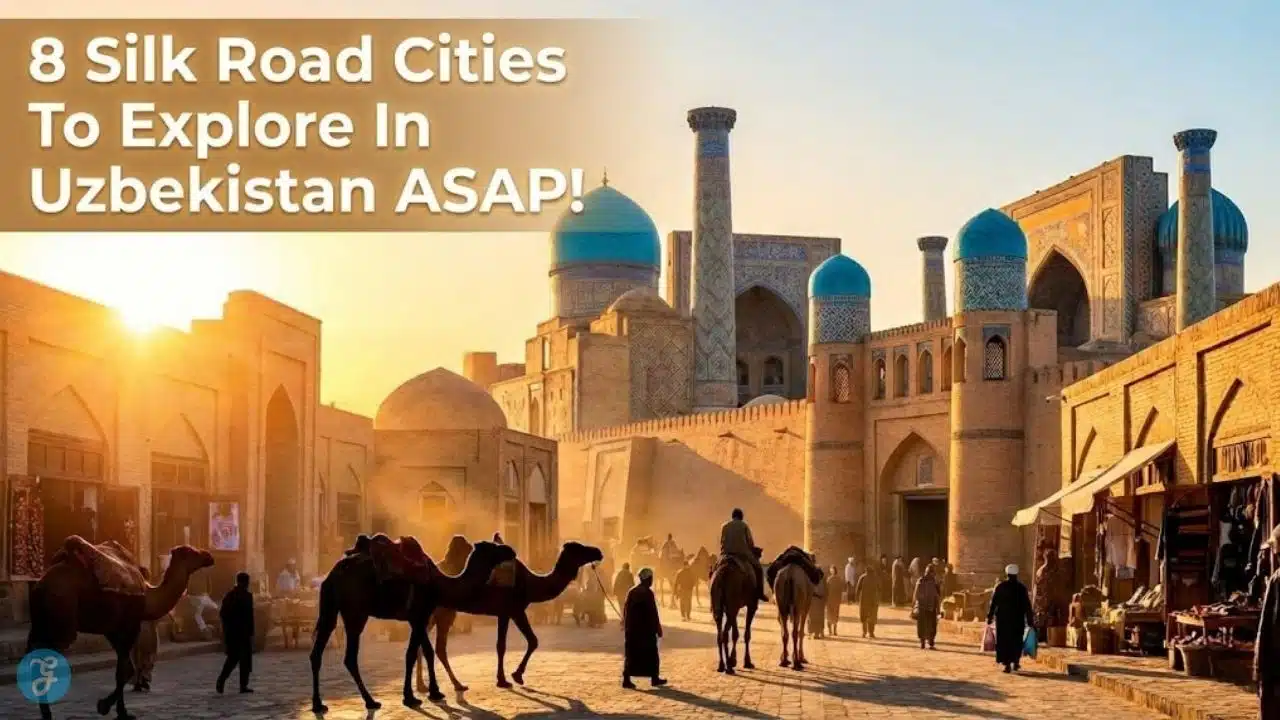
For centuries, the very mention of the Silk Road has conjured images of camel caravans, azure domes, and bustling bazaars laden with spices and textiles. Nowhere is this history more tangible than in Uzbekistan. This double-landlocked nation in the heart of Central Asia was once the beating heart of global trade, connecting China with the Mediterranean.
In 2025, Uzbekistan will have transformed from a niche destination for intrepid backpackers into one of the world’s most exciting travel hotspots. The country has successfully blended its ancient heritage with modern infrastructure. High-speed trains now whisk you across the desert where merchants once trudged for weeks. Visa-free policies have opened the doors to millions.
Despite the modernization, the magic remains. The tile work is still as blindingly blue as it was in the 14th century, and the hospitality of the Uzbek people is just as warm. If you are planning a journey through history, these are the 8 Silk Road cities to explore in Uzbekistan that you must include in your Uzbekistan bucket list.
What Is So Special About Silk Road Cities?
The Silk Road isn’t just a route—it’s a story of exchange: goods, ideas, architecture, religion, and technology moving across continents. Uzbekistan’s Silk Road cities feel special because they still carry that “crossroads energy” in a way that’s visible and walkable.
A living museum of global trade history
In places like Samarkand and Bukhara, you’re standing in cities that once connected empires. The monuments aren’t isolated ruins—they’re part of functioning urban spaces with bazaars, courtyards, and neighborhoods that still feel inhabited.
Architecture that doesn’t look real
The signature experience is the scale and detail: turquoise domes, geometric tilework, and monumental squares that make you stop mid-step. The design isn’t just decorative—it communicates power, knowledge, and identity in stone and color.
Each city has a different “Silk Road personality”
Even within one trip, the vibe shifts dramatically.
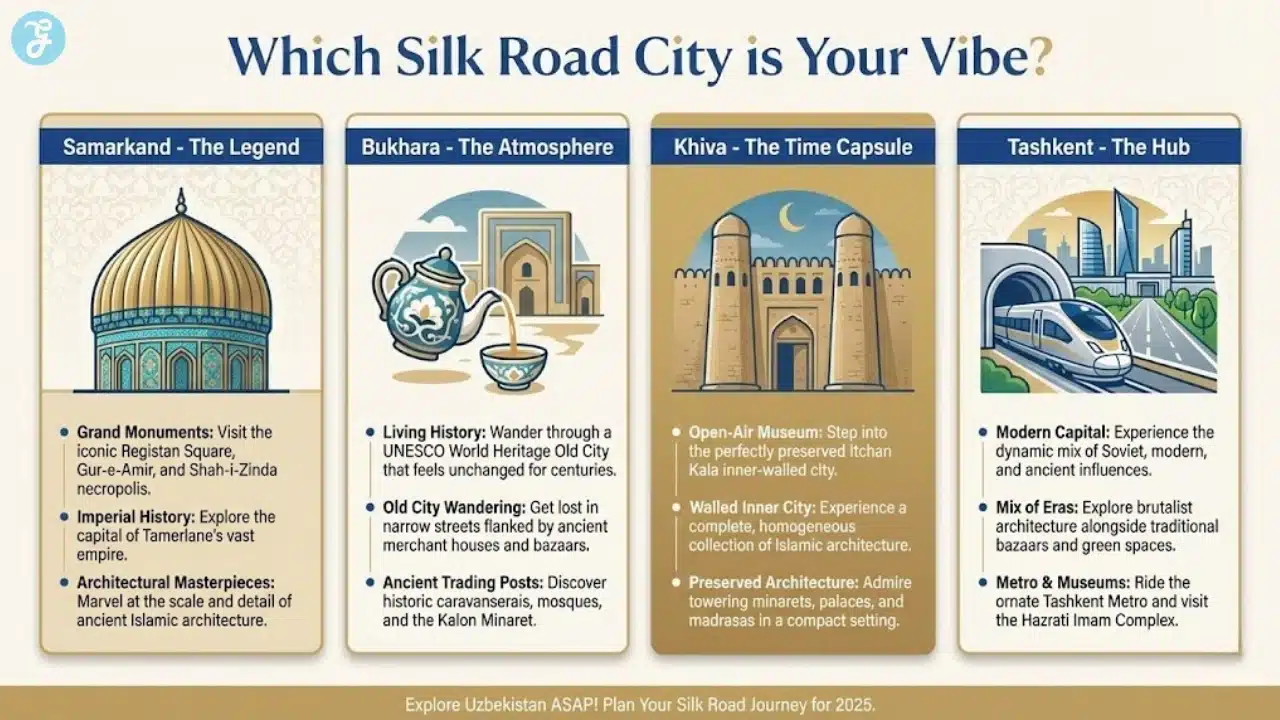
| City | What it feels like | Why it stands out |
| Samarkand | Grand, legendary | Iconic monumental architecture and imperial scale |
| Bukhara | Intimate, atmospheric | Old City wandering, living history, courtyards |
| Khiva | Time capsule | Walled inner city with a preserved, cinematic feel |
| Fergana Valley cities | Craft + tradition | Silk-making and a more local, less-touristed rhythm |
| Termez | Deep-history detour | Pre-Islamic layers, including Buddhist heritage |
Craft and culture aren’t “performances”
The Silk Road was built on craftsmanship—textiles, ceramics, metalwork, and trade goods. Cities like Margilan give you that tactile connection: you understand what “Silk Road” meant because you can see and feel the process, not just admire the end product in a souvenir shop.
8 Silk Road Cities To Explore In Uzbekistan in 2026
Here are the must watch cities to explore in Uzbekistan in 2026:
1. Samarkand: The Jewel of the East
Samarkand is the city of legends. It was the capital of Amir Timur’s vast empire and the cultural crossroads of the world. Alexander the Great was struck by its beauty, and poets have written about it for millennia. If you visit only one city in Uzbekistan, it must be Samarkand.
The scale of the monuments here is difficult to comprehend until you stand beneath them. The Registan Square is the centerpiece. It is framed on three sides by massive madrasas, each decorated with intricate mosaics that seem to shift color with the sun. It is arguably the most impressive public square in the Islamic world.
Top Sights in Samarkand
- Registan Square: Visit at sunrise for peace and at night to see it illuminated.
- Gur-e-Amir Mausoleum: The final resting place of Timur, featuring a stunning ribbed gold ceiling.
- Shah-i-Zinda: A necropolis of mausoleums covered in the finest tile work in the country.
- Bibi-Khanym Mosque: Once the largest mosque in the Islamic world, built by Timur for his favorite wife.
2. Bukhara: The Holy City
While Samarkand dazzles with its monumental grandeur, Bukhara charms with its atmosphere. Samarkand often feels like a museum, but Bukhara feels like a living, breathing city. The Old City is a UNESCO World Heritage site that has remained largely unchanged for two centuries.
The joy of Bukhara is getting lost. The streets are narrow and winding, flanked by ancient merchant houses and caravanserais that have been converted into boutique hotels and carpet shops. It is a city best explored on foot. You can walk from one end of the historic center to the other in about twenty minutes, passing dozens of mosques and madrasas along the way.
Top Sights in Bukhara
- The Kalon Minaret: A tower so beautiful that even Genghis Khan spared it when he destroyed the rest of the city.
- The Ark Fortress: A massive citadel that served as the residence of the Emirs of Bukhara.
- Lyabi-Hauz Complex: A plaza centered around a pool, shaded by ancient mulberry trees and perfect for tea.
- Chor Minor: A unique, small madrasa with four distinct turquoise towers.
3. Khiva: The Open-Air Museum
Khiva is located deep in the western desert and feels like a movie set. The inner-walled city, known as Itchan Kala, is the most homogeneous collection of Islamic architecture in the Islamic world. It is completely preserved. When you step through the gates, you leave the 21st century behind entirely.
Khiva was historically a brutal place. It was a hub of the slave trade and known for its harsh desert conditions. Today, it is a peaceful maze of mud-walled alleyways and towering minarets. The colors here are different from the rest of the country.
Instead of just blue, you see desert golds and deep greens. It is compact and intense. You can see everything in a day, but staying overnight allows you to wander the silent streets under the stars, which is a magical experience.
Top Sights in Khiva
- Kalta Minor Minaret: The iconic “unfinished” fat blue tower that dominates the skyline.
- Juma Mosque: A unique mosque supported by 213 wooden columns, some dating back to the 10th century.
- Islam Khodja Minaret: The tallest minaret in Uzbekistan, which you can climb for a view over the desert.
- Kuhna Ark: The old fortress offering the best sunset views over the city walls.
4. Tashkent: The Modern Hub
Many travelers skip Tashkent in their rush to get to the blue domes, but that is a mistake. The capital is the main entry point for international flights and offers a fascinating mix of history. It showcases the layers of Uzbekistan’s past, from the Silk Road to the Soviet era and finally to the modern independent republic.
Tashkent is a green city with wide avenues and massive parks. It is the best place to understand modern Uzbek life. You will see brutalist Soviet hotels standing next to 16th-century madrasas and gleaming glass skyscrapers. It also boasts the best food scene in the country, with access to international cuisine if you need a break from plov.
Top Sights in Tashkent
- Chorsu Bazaar: A massive market under a giant blue dome where locals buy everything from spices to bread.
- Hazrati Imam Complex: Home to the Uthman Quran, considered one of the oldest Qurans in the world.
- Tashkent Metro: Every station is designed like an underground palace with marble, chandeliers, and mosaics.
- Hotel Uzbekistan: A brutalist Soviet icon that looms over the central park.
5. Shahrisabz: The Green City
Shahrisabz is a small town south of Samarkand, but its historical significance is massive. It was the birthplace of Amir Timur. He intended for this city to be the crown jewel of his empire, even surpassing Samarkand. While time and history were not kind to Shahrisabz, the ruins that remain are a testament to grand ambitions.
The drive to Shahrisabz from Samarkand takes you over a stunning mountain pass, which is a highlight in itself. The atmosphere here is relaxed and provincial. You see fewer tourists and more locals enjoying the parks around the monuments. It makes for a perfect day trip or a quiet stopover on the way to the south.
Top Sights in Shahrisabz
- Ak-Saray Palace: Only the ruined entrance pylons remain, but they are colossal and covered in stunning blue tile.
- Dorut Tilavat Complex: A peaceful courtyard containing the Kok Gumbaz Mosque and the mausoleum of Timur’s father.
- Crypt of Timur: An underground bunker intended for the conqueror, though he was eventually buried in Samarkand.
6. Kokand: The Gateway to the Valley
Located in the fertile Fergana Valley, Kokand was once the capital of a powerful Khanate that ruled over much of modern-day Central Asia. The Fergana Valley is the agricultural heartland of Uzbekistan and feels culturally distinct from the desert cities of the west. It is more conservative, more traditional, and deeply hospitable.
Kokand sees a fraction of the tourists that Samarkand does. This means you often have the palaces and mosques to yourself. The architecture here features more wood and painted ceilings, reflecting the different resources available in the valley. It serves as the perfect entry point to exploring the wider Fergana region.
Top Sights in Kokand
- Palace of Khudayar Khan: A stunning 19th-century palace with a facade that rivals anything in Bukhara.
- Jami Mosque: A beautiful mosque featuring a 22-meter minaret and a hundred wooden columns.
- Norbutabiy Madrasah: An active religious school where you can sometimes see students studying.
7. Margilan: The City of Silk
You cannot have a Silk Road guide without mentioning the city that actually produces the silk. Margilan, located just a short drive from Kokand, has been the center of Central Asia’s silk industry for over a thousand years.
While other cities are famous for their buildings, Margilan is famous for its craft. This is a working city. The skyline is not dominated by domes but by mulberry trees and factory roofs.
A visit here is tactile. You come to hear the clack of the looms and feel the raw silk threads. It offers a necessary context to the rest of your trip. When you see the silk carpets in Bukhara or the robes in Khiva, you will understand the labor that went into them after visiting Margilan.
Top Sights in Margilan
- Yodgorlik Silk Factory: You can tour the entire production process from boiling cocoons to hand-weaving the ikat patterns.
- Kumtepa Bazaar: A massive market held on Thursdays and Sundays, where you can buy local textiles directly from the weavers.
8. Termez: The Southern Outpost
Termez is the outlier on this list. Located in the far south on the border with Afghanistan, it offers a completely different slice of history. Before Islam arrived in Central Asia, this region was a hub of Buddhism.
Termez is for the traveler who wants to go deeper. The landscape is drier and hotter. The history here spans from Alexander the Great to the Soviet invasion of Afghanistan. You will find ancient Buddhist stupas crumbling in the desert just miles from active military bases. It is a fascinating, layered place that feels like the edge of the world.
Top Sights in Termez
- Fayaz Tepe: An ancient Buddhist monastery complex dating back to the 1st century.
- Sultan Saodat Ensemble: A complex of mausoleums belonging to the Sayyid dynasty, spread out over a long courtyard.
- Archaeological Museum: One of the best museums in the country, housing unique Bactrian and Buddhist artifacts.
4 Practical Tips for Visiting Uzbekistan
Here are 4 things you should keep in mind:
Best Time to Visit Uzbekistan
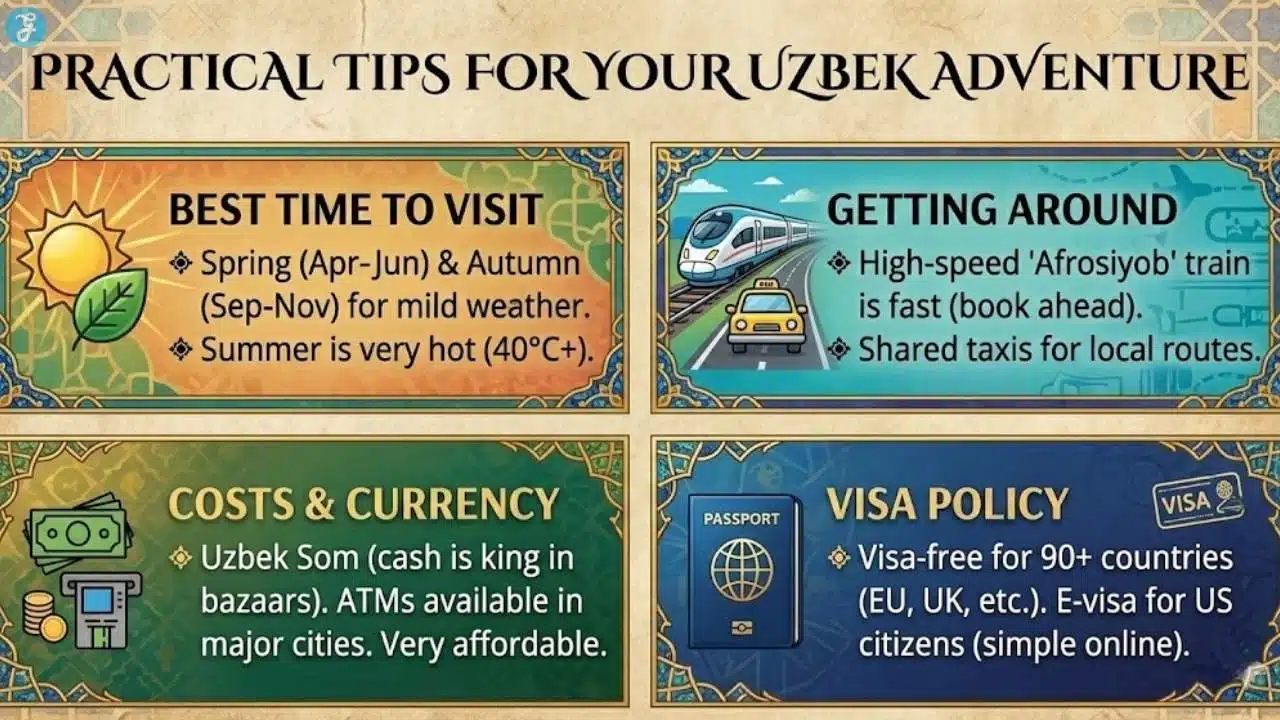
The climate in Uzbekistan is extreme. The best times to visit are spring (April to early June) and autumn (September to early November). During these months, the weather is mild and perfect for walking. Summer can see temperatures exceed 40°C (104°F), which makes sightseeing grueling. Winter is cold, but it offers the advantage of having the cities entirely to yourself.
Getting Around in Uzbekistan As Tourists
Uzbekistan has invested heavily in its railway network. The “Afrosiyob” high-speed train connects Tashkent, Samarkand, and Bukhara. It is fast, clean, and affordable. You must book tickets weeks in advance as they sell out quickly. For Khiva and Termez, you can take the slower sleeper trains or domestic flights. Shared taxis are the standard way to travel between smaller towns like Shahrisabz and the Fergana Valley cities.
Costs For Tourists in Uzbekistan
The currency is the Uzbek Som. You will likely carry large wads of cash as the exchange rate is high. ATMs are now common in all major cities and usually dispense both US Dollars and Som. Credit cards are accepted in major hotels and restaurants in Tashkent and Samarkand, but cash is king in bazaars and smaller towns. Uzbekistan is a very affordable destination by Western standards.
Visa Policy in Uzbekistan
Uzbekistan has a very open visa policy. Citizens of over 90 countries, including the EU, UK, Canada, and Australia, can enter visa-free for 30 days. US citizens need an e-visa, which is a simple online process. Always check the latest entry requirements before you fly.
Is It Worth It?
For most travelers who love culture, history, and visually stunning cities, Uzbekistan is absolutely worth it—especially if you want a trip that feels both epic and approachable.
Reasons it’s worth it
Uzbekistan delivers a rare combination:
- High “wow” factor (architecture and history are world-class)
- Strong value (you can often travel well without luxury budgets)
- Easy multi-city structure (a clear route with distinct highlights)
- Warm hospitality that makes the trip feel welcoming rather than intimidating
When it might not be your best match
It may be less ideal if you:
- struggle with long walks and uneven streets (many historic areas are pedestrian-heavy)
- need constant nightlife or beach downtime
- prefer trips with minimal planning across multiple stops
A simple way to decide
If you’re excited by the idea of wandering ancient lanes in Bukhara, seeing Samarkand’s Registan in perfect light, and spending an evening inside Khiva’s walls, then yes—it’s worth it. The experience is immersive and memorable, and the cities genuinely feel like chapters of a larger Silk Road story rather than separate tourist checklists.
Final Verdict
Uzbekistan is a country that exceeds expectations. The photos you see on social media, as beautiful as they are, cannot capture the scale of the architecture or the warmth of the people.
Whether you are haggling for spices in a Tashkent bazaar or watching the sunset over the walls of Khiva, you are walking in the footsteps of history. By visiting these eight cities, you will see the full spectrum of what the Silk Road was and what this incredible nation has become.
Frequently Asked Questions
Here are the most frequently asked questions people have about visiting Silk Road cities in Uzbekistan.
Is Uzbekistan safe for tourists?
Yes, Uzbekistan is considered one of the safest countries in the world for tourists. The government places a high priority on the safety of guests. Crime rates are very low, and there is a visible police presence in tourist areas, known as “Tourist Police,” who often speak English and are there to help. Solo female travelers generally report feeling very safe and welcomed, though standard precautions like dressing modestly in religious sites should be observed.
Do I need to hire a guide?
You do not strictly need a guide to get around, as logistics are relatively easy. However, hiring a guide for the major sites in Samarkand and Bukhara is highly recommended. A guide can unlock these stories for you. Without one, you might just be looking at beautiful buildings without understanding their significance.
What should I wear in Uzbekistan?
Uzbekistan is a secular country with a Muslim-majority population. It is not as strict as some of its neighbors, but conservative dress is respectful and appreciated. In Tashkent, you will see modern fashion. In the Fergana Valley and religious sites in Bukhara, it is best to cover your shoulders and knees.
For women, carrying a light scarf is useful for entering active mosques, though it is not always mandatory. Good walking shoes are the most important item to pack, as you will walk miles on uneven pavement.
Can I drink the tap water?
No, you should not drink the tap water in Uzbekistan. It is generally not safe for consumption by tourists. Stick to bottled water, which is cheap and widely available. Many hotels also provide filtered water dispensers where you can refill your reusable bottles to reduce plastic waste.
Is it easy to be a vegetarian in Uzbekistan?
Uzbek cuisine is very meat-heavy, with lamb and beef featuring in almost every dish. The national dish, Plov, is rice cooked with meat and animal fat. However, it is getting easier for vegetarians. In major cities like Tashkent, Samarkand, and Bukhara, tourist-focused restaurants now offer vegetarian Plov, grilled vegetables, salads, and pumpkin dumplings (manti).
You will never go hungry, as the bread and fresh fruit are incredible, but your variety of main courses might be limited outside the capital.