The allure of the “side hustle” has never been stronger, but in 2026, the landscape has shifted beneath our feet. We’ve moved past the era of easy wins. The barrier to entry for digital businesses has bottomed out, meaning that “popular” now often translates to “overcrowded.” If you are following a tutorial from 2022—or even 2024—you aren’t just late to the party; you’re likely walking into a trap where the only person making money is the one selling you the course.
In 2026, profitability isn’t about working harder; it’s about avoiding low-ROI (Return on Investment) traps that consume your most precious resource: time. Many of the most-searched side hustles today are “zombie hustles”—they look alive on social media, but they are functionally dead for the average newcomer.
This guide is designed to help you filter through the noise. We will identify the five most common time-wasters side hustles to avoid and, more importantly, offer high-leverage “pivots” that actually respect your schedule and your bank account.
How We Judged These Hustles:
To separate the gold from the glitter, we evaluated each hustle based on four key metrics: Time-to-first-dollar (how fast you get paid), Net Margin (what you keep after fees), Repeatability (can you do it twice?), and Platform Risk (can a single algorithm change wipe you out?).
Quick Reality Check: What Makes A Side Hustle A “Waste of Time”?

Before we dive into the specific list, we need to define the “Waste of Time” framework. A side hustle isn’t necessarily a failure because it makes zero dollars; it’s a failure when the opportunity cost outweighs the gain. If you spend 20 hours a week to make $100, you aren’t an entrepreneur—you’re working for less than minimum wage without the benefits.
The 5 Filters of a Low-Value Hustle
- Low Margin After “Hidden” Costs: You see the revenue, but you forget the Shopify subscription, the 15% marketplace fee, the returns, and the self-employment tax.
- High Competition + No Differentiation: If your business model is “copy and paste,” you are competing with millions of others doing the exact same thing. In 2026, AI can copy and paste faster than you.
- The Paid Traffic Trap: If the only way to get a customer is to pay Meta or Google $2 to make $1.50 in profit, the math will never work unless you have a massive bankroll to “buy” data.
- Platform Dependency: Building your house on rented land (like relying solely on a single TikTok shop or Amazon’s good graces) is a high-stakes gamble.
- Fake Passivity: Many “passive” hustles are actually operationally heavy. If you have to answer 50 customer service emails a day about lost packages, it isn’t passive income.
A Simple Self-Assessment
Before starting any venture, fill out this table to see if the hustle matches your reality:
| Metric | Low-ROI Trap | High-ROI Potential |
| Time/Week | 20+ hours for “maintenance” | 5–10 hours for “growth” |
| Budget | High burn on ads/software | Low overhead, high skill |
| Skill Advantage | None (anyone can do it) | Specific (you have a unique edge) |
| Patience Horizon | “Get rich next week” | 90–180 days to see real traction |
Waste of Time 1 — “Easy” Dropshipping General Stores
In 2026, the “General Store” model—where you sell everything from dog bowls to sunset lamps—is effectively dead. The promise of “zero inventory, zero risk” has been replaced by “zero trust, zero profit.”
Why it’s popular
It remains the #1 “get rich quick” hook on social media. The barrier to entry is almost non-existent; you can spin up a store in an afternoon using AI tools. YouTube gurus continue to flash “revenue” screenshots (conveniently hiding the 80% ad spend) to sell their coaching programs.
Why it wastes time in 2026
- The Trust Deficit: Consumers in 2026 are savvy. They recognize generic Shopify themes and 3-week shipping times instantly. With the rise of local, sustainable, and hyper-fast delivery, a “mystery box” from an unknown overseas warehouse is a hard sell.
- Margin Compression: Between rising customer acquisition costs (CAC) and the logistical nightmare of global shipping delays, your $10 margin disappears the moment a single customer requests a refund.
When it can work
Dropshipping only works in 2026 if you have a supply advantage (exclusive rights to a product) or a content engine (a massive, organic following that trusts your curation).
Do this instead: The “Affiliate-to-Brand” Pivot
Instead of building a store for a product you’ve never seen, start by being an affiliate for a high-quality, existing brand. Once you prove there is demand and you’ve mastered the content side, launch a branded, niche offer with a small amount of local inventory. Focus on a “micro-brand” rather than a “general store.”
Waste of Time 2 — Retail Arbitrage Without a Moat
Retail arbitrage (buying clearance items at Walmart to flip on Amazon) was a goldmine in 2018. In 2026, it is a recipe for burnout.
Why it’s popular
It feels tangible. There is a “hunter-gatherer” rush to finding a $5 toy you know sells for $20 online. It requires no digital marketing skills—just a car and a scanning app.
Why it wastes time
- The “Fee” Reality Check: Amazon FBA (Fulfillment by Amazon) fees, storage fees, and shipping costs eat roughly 30–50% of your sale price.
- Brand Gating: In 2026, most major brands have “gated” their products. You cannot sell Nike, Lego, or Apple without direct authorization, which a retail receipt won’t provide.
- Race to the Bottom: You and 500 other people found the same clearance item. The moment you all list it, the price crashes.
Do this instead: B2B Liquidation or Refurbished Niche
Instead of fighting over toys, look for B2B liquidation contracts where you buy bulk returns of a specific category (e.g., industrial espresso machines). Alternatively, specialize in a high-ticket refurb niche—buying broken high-end electronics, fixing them, and selling them with a warranty. This creates a “moat” because it requires a skill (repair) that others don’t have.
Waste of Time 3 — Print-on-Demand (POD) With Generic Designs
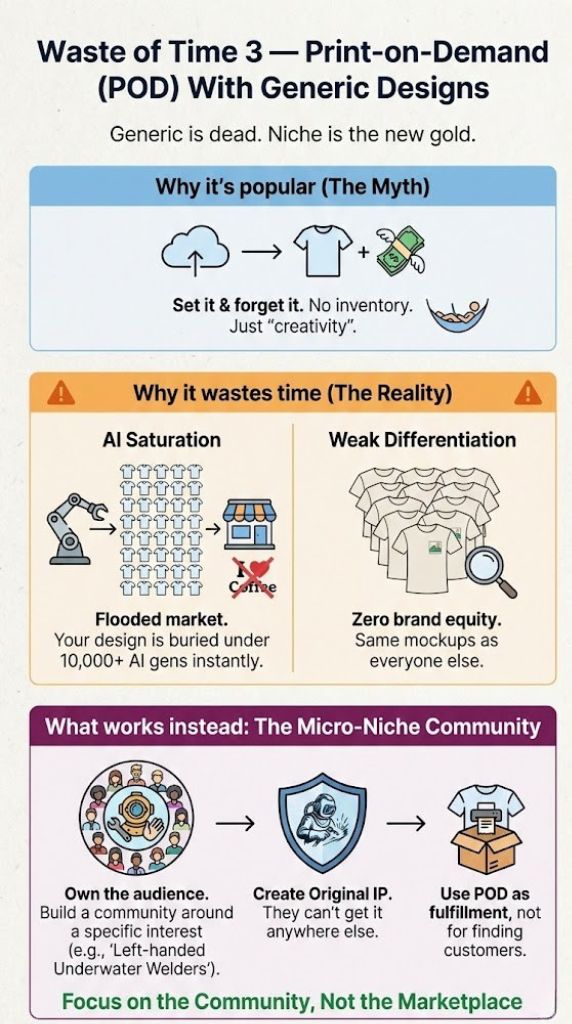
Uploading “I Heart Coffee” designs to Redbubble or Printful is no longer a business; it’s a hobby that pays pennies.
Why it’s popular
It is marketed as the ultimate “set it and forget it” business. No inventory, no shipping, just “creativity.”
Why it wastes time
- AI Saturation: The market is flooded with millions of AI-generated designs. Your “unique” design is buried under 10,000 similar ones within seconds.
- Weak Differentiation: If you are using the same basic T-shirt mockups as everyone else, you have no brand equity.
What works instead: The Micro-Niche Community
POD only works if you own the audience. Build a community around a very specific interest (e.g., “Left-handed Underwater Welders”) and create original IP (Intellectual Property) that they can’t get anywhere else. Use POD as a fulfillment method for your community, not as a way to find customers on a marketplace.
Waste of Time 4 — Paid Surveys As a “Side Hustle”
Let’s be blunt: Paid surveys are not a side hustle; they are a low-wage digital chore.
Why it wastes time
The “effective hourly rate” for most survey sites in 2026 hovers around $2–$4 per hour. You will frequently spend 15 minutes on a survey only to be “screened out” at the last second with zero compensation.
Better alternatives: User Testing & AI Training
If you have a phone and a voice, User Testing (testing websites and apps while speaking your thoughts aloud) typically pays $10 for 20 minutes. Better yet, look into AI-assisted micro-tasks or “Data Labeling” for specialized industries (legal, medical), which require a human eye and pay significantly more.
Waste of Time 5 — “Beginner” Affiliate Marketing (No Audience)
“Post your link in Pinterest comments and make $5,000 a month!” This is the lie that refuses to die.
Why it wastes time in 2026
In 2026, platforms have aggressive anti-spam filters. “Posting and praying” will get your accounts banned. Furthermore, the FTC (Federal Trade Commission) has strict disclosure requirements. If you aren’t building trust, you aren’t making sales.
Do this instead: The “Problem-Solver” Approach
Pick a narrow problem (e.g., “How to set up a home recording studio for under $500”). Create a “Best of” guide or a comparison video. Build an email list by offering a free checklist. Affiliate marketing is the reward for providing value; it is not the business itself.
What To Do Instead: 5 High-ROI Directions for 2026
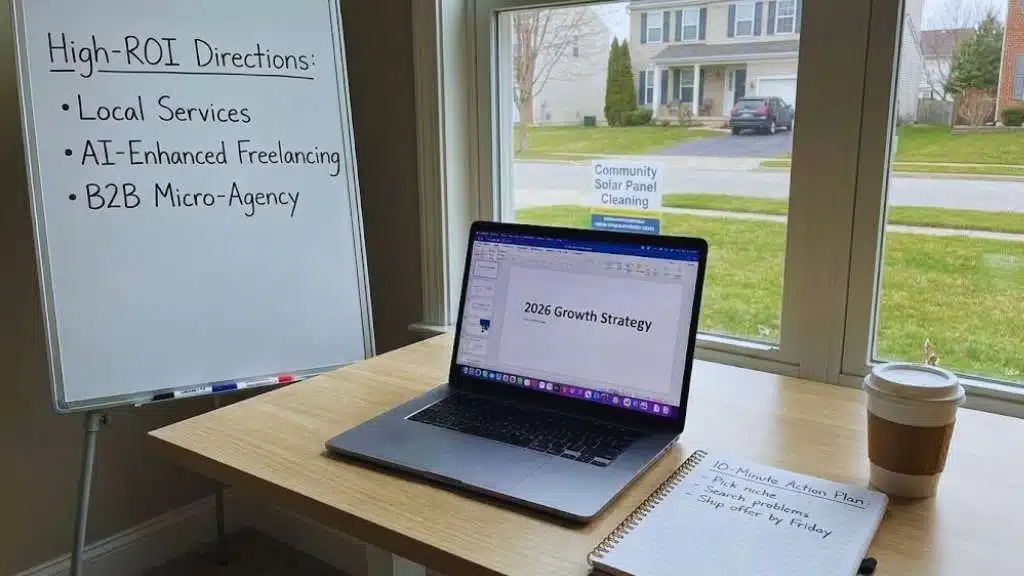
If the “easy” stuff is a waste of time, where should you put your energy? Focus on Skill-Stacking and Local Friction.
- Time-Saving Local Services: In a digital world, the person who can reliably show up and clean solar panels, set up smart-home security, or manage short-term rental turnovers is king.
- AI-Enhanced Freelancing: Don’t just “write articles.” Use AI to provide a Productized Service, like “I will turn your 1-hour podcast into 20 LinkedIn posts and 5 TikTok scripts.”
- B2B Micro-Agency: Businesses don’t want “marketing.” They want “Leads for HVAC companies.” Pick one offer for one specific type of business.
- Specialized Consulting: If you know how to use a specific software (like a niche CRM), companies will pay you $100+/hour to set it up for them.
- Digital Products with Distribution: Create a template, a kit, or a guide that solves a specific pain point and sell it on platforms where people are already looking for solutions (like Gumroad or specialized marketplaces).
Decision Checklist: Choose Your Next 30 Days
Choose one path based on your current needs:
- Cash-Fast Path: Focus on local services or high-skill freelancing.
- Skill-Build Path: Spend 30 days mastering a specific tool (AI, No-code, Video Editing).
- Scale Path: Start building a niche audience via a newsletter or video channel.
Your 10-Minute Action Plan:
- Pick one niche you actually understand.
- Search “problems with [niche]” on Reddit or X.
- Write down three ways you could solve those problems for money.
- Ship your first offer (even if it’s just an email to a local business) by Friday.
Final Thoughts
Not every “popular” side hustle is popular because it works. Most are popular because they’re easy to sell as a dream. In 2026, the biggest risk isn’t failing—it’s spending months on something that was structurally stacked against you from the start.
If a hustle depends on thin margins, platform loopholes, or blind competition with no differentiation, it’s usually not a hustle—it’s a treadmill. The smarter play is to choose something with at least one real advantage: a skill edge, a niche audience, a distribution channel, or a repeatable system.
The goal isn’t to find the easiest side hustle. It’s to find the one that still makes sense after you account for time, costs, competition, and sustainability—and then commit long enough to make it work.