

For centuries, nationality has been a concept rooted in land. You were born somewhere—on a specific piece of soil—and that soil decided your citizenship, rights, and sense of identity. Whether you inherited nationality through your parents’ bloodline or received it by birth within a country’s borders, the link between physical geography and national belonging was nearly unbreakable.
But that link is fraying.
In a hyper-connected, digital-first world, a new kind of identity is emerging: a shift from physical to digital nationality. One that isn’t anchored by borders or dictated by governments but shaped by decentralized networks, blockchain, online communities, and shared values rather than shared soil.
The question now isn’t just “Where are you from?” —it’s also “Where do you belong online?”
A Brief History of Nationality and the Nation-State
The modern nation-state system traces back to the Treaty of Westphalia in 1648, which formalized national borders and sovereignty. Since then, nationality has been legally tied to geography through two main principles:
-
Jus soli (“right of the soil”)—common in countries like the United States, where citizenship is granted based on birthplace.
-
Jus sanguinis (“right of blood”)—practiced in countries like Japan or Germany, where ancestry plays a central role in nationality.
These frameworks determined who could vote, own property, serve in government, or even exist legally in a country. A passport became a symbol of belonging—yet also exclusion, especially for stateless people, refugees, and migrants.
In the 20th century, globalization challenged these borders, but it is the 21st-century digital revolution that is now truly redefining them.
The Rise of Digital Identity and Virtual Belonging
In the age of cloud computing, artificial intelligence, and Web3, nationality is undergoing a digital transformation.
Governments like Estonia have introduced e-Residency, allowing anyone in the world to become a “digital resident” and launch a business in the EU without ever setting foot in Europe.
Meanwhile, blockchain-based projects like Bitnation, Proof of Humanity, and Worldcoin aim to provide self-sovereign digital identities and governance platforms, free from traditional state control.
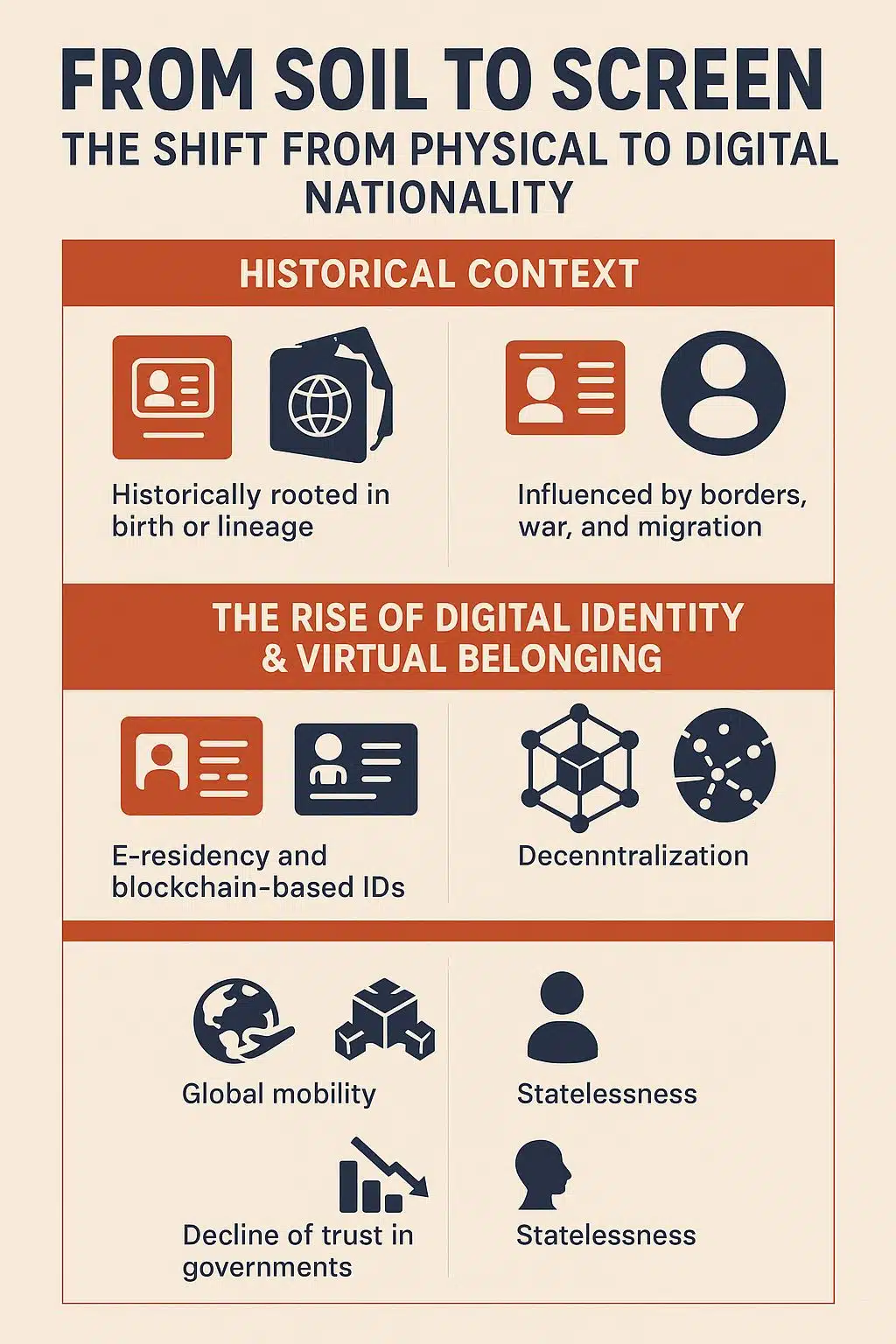
Online communities and DAOs (Decentralized Autonomous Organizations) are becoming new forms of digital nations—complete with voting, laws, currencies, and even “citizenship” models. These digital societies often share ideologies, interests, or missions, rather than geography or ethnicity.
In this new model, your identity is verified on-chain. Your reputation is your record. Your sense of belonging comes not from your passport but from your digital wallet.
Drivers Behind the Shift from Physical to Digital Nationality
Several key forces are fueling this seismic shift:
1. Global Mobility and Remote Work
The digital nomad movement has exploded. Millions now work across borders, choosing lifestyle over nationality. Traditional visas often can’t keep up—prompting countries to launch “digital nomad visas,” while others explore entirely virtual citizenship schemes.
2. The Decentralization Movement
Web3 advocates push for self-sovereign identity, where individuals control their data and governance is distributed. This challenges centralized national systems where identity is state-assigned and data is state-owned.
3. Declining Trust in Institutions
Political instability, corruption, and surveillance have pushed many to seek autonomy outside of national systems. For some, digital communities offer a more trustworthy alternative.
4. Statelessness and Inclusion
Over 10 million people globally are considered stateless, lacking the legal identity to access rights, healthcare, or education. Digital nationality offers a potential workaround—though it raises its own ethical questions.
5. Technological Readiness
Advanced digital ID systems (like India’s Aadhaar), blockchain wallets, and biometric verification have made it increasingly feasible to maintain secure identities online—separate from nation-states.
Legal and Ethical Questions Surrounding Digital Nationality
As this evolution unfolds, it brings difficult questions:
-
Can a DAO protect your human rights? Digital nations may offer identity and community, but can they guarantee legal protection, asylum, or due process?
-
What about taxation? Traditional citizens are taxed based on residency and nationality. But how do you tax someone with no permanent residence and multiple digital affiliations?
-
Is this movement inclusive? Most digital citizenship initiatives are tech-heavy. What about those in areas with poor internet access or low digital literacy?
-
Are we risking digital colonization? Big tech or blockchain conglomerates may start acting like “digital governments” without being elected—raising concerns about corporate control over virtual citizenship.
-
What’s real and what’s symbolic? Digital nationality may offer identity and belonging—but is it legally meaningful?
The transition demands new frameworks for rights, laws, and recognition.
Emerging Models and Real-World Examples
| Project | Description | Highlights |
|---|---|---|
| Estonia e-Residency | First government-issued digital identity for foreigners | Start EU-based business remotely |
| Bitnation (defunct) | A blockchain nation-state alternative | Enabled marriage, ID, and contracts on-chain |
| Worldcoin | Biometric global ID project using iris scans | Offers a form of universal digital identity |
| Nation3 DAO | A digital nation governed by a DAO | Uses crypto tokens for law and governance |
| UN-backed digital ID for refugees | Uses blockchain for legal identity | Helps displaced people access services |
The Future: Will Borders Matter Less?

If these trends accelerate, we may be headed toward a hybrid future where
-
People hold multiple digital and physical nationalities
-
Metaverses and virtual spaces offer jurisdiction, economy, and governance
-
New digital nations form based on ideology, not geography
-
Taxation and rights become detached from borders
Already, some visionaries propose “citizenship-as-a-service”—letting individuals choose digital identities like apps. For example, Satoshi Island aims to turn an island in Vanuatu into a crypto-based “blockchain democracy” where you apply for citizenship via NFT.
Digital nationality won’t fully replace traditional passports overnight—but it might become just as important.
Takeaways
From birth certificates to blockchain, the concept of nationality is shifting. Geography once decided everything—from your rights to your destiny. But in the digital age, that grip is loosening.
More people are choosing screen over soil, joining communities, building economies, and asserting identities in digital spaces that transcend maps.
Yet as we race toward a post-border future, the big question remains:
Can a digital nation protect its citizens as well as a physical one?
As the idea of digital nationality gains ground, we must ensure that it is not just an escape for the privileged but a tool for empowerment, inclusion, and freedom for all.































