Tonight, as the moon reaches its fullest phase, its light will spill over the rooftops of Dhaka or Delhi, casting a serene glow on city and village alike. This is no ordinary full moon. This is a celestial mandate, an astronomical event that commands the spiritual attention of millions across the world.
For tonight, this single lunar peak orchestrates two of the subcontinent’s most beautiful festivals of light: the Hindu celebration of Kojagari Laxmi Puja and the Buddhist observance of Prabarana Purnima.
The simultaneous celebration on October 6, 2025, is not a mere calendrical coincidence. It is a profound demonstration of how a singular astronomical phenomenon is interpreted through different yet convergent lenses of theology, symbolism, and cultural practice. This article dissects the astronomical data of this specific full moon, analyzes the core tenets of each festival, and explores the powerful thematic parallels that bind them under the same silver light.
The Prime Mover: Decoding the Ashwini Purnima of 2025
At the heart of this shared celebration is hard science. Both Hindu and Buddhist festive calendars are lunisolar, intricately weaving the moon’s phases with the solar year. This sophisticated system means that key events are anchored to specific lunar phenomena.
According to the Bengali Panjika, the Ashwini Purnima Tithi for 2025 is precise: the full moon phase begins at approximately 8:41 AM on October 6 and concludes at 10:27 AM on October 7. The peak of the full moon occurs tonight, making this evening the focal point for rituals that require its presence.
This alignment is by design, not chance. The Hindu month of Ashwin concludes with this Purnima, designated for the worship of Lakshmi. Simultaneously, the Buddhist three-month rains retreat, known as Vassa, which begins on the full moon of Asharh, is mandated to end on this very same full moon. It is the shared reliance on a common celestial clock that brings these two distinct traditions into this beautiful, unscripted synchronicity.
The Rhythm of the Land: Harvest, Moon, and Mythology
The shared reliance on a common celestial clock connects these traditions in a fundamental way. Furthermore, this timing links both spiritual cycles to the agrarian cycle of the land. The Ashwini Purnima arrives after the monsoon rains have subsided, a time of harvest and natural abundance.
It is a moment when the land itself offers its prosperity, creating a perfect backdrop for festivals centered on wealth and spiritual fruition. Both festivals, therefore, are not just observing the moon; they are observing a moment of climatic and agricultural completion, a theme central to both prosperity and reflection.
The First Stream of Light: Kojagari Laxmi Puja—A Vigil for Prosperity
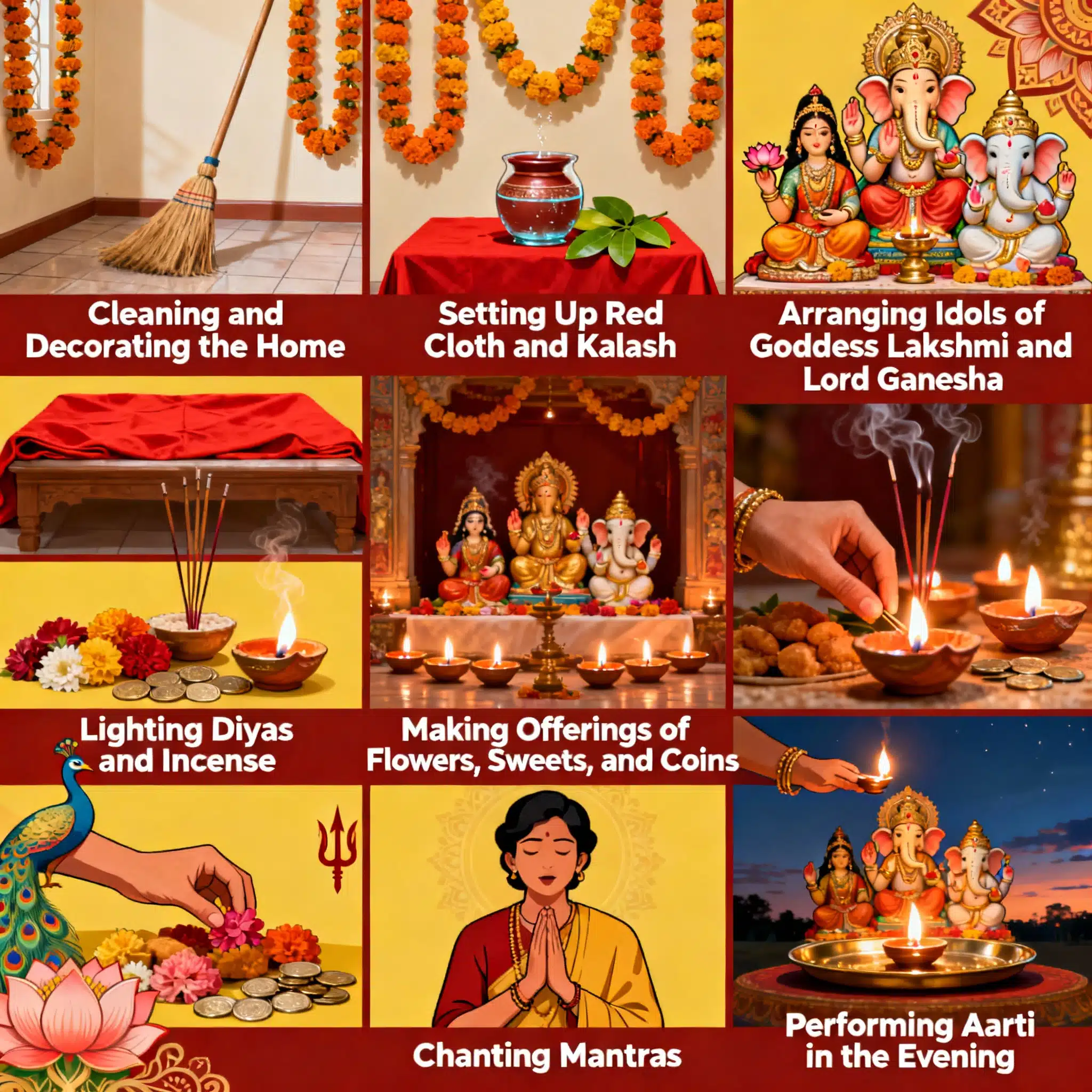
For the Hindu community, tonight is Kojagari Purnima. The name itself is a question and a challenge: “Ko Jagorti?” — “Who is awake?” According to the scriptures, Goddess Lakshmi, the purveyor of wealth, prosperity, and fortune, descends to earth on this night. She roams the mortal plane, seeking to bless the homes of those who are vigilant. The festival, therefore, is not an act of passive worship but a test of diligence.
The symbolism is deeply rooted in spiritual and economic wisdom:
- The Owl (Vahana): Lakshmi’s chosen vehicle is not a majestic eagle but the nocturnal owl. This represents the ability to see clearly in darkness—a potent metaphor for wisdom, prudent wealth management, and the foresight to navigate economic uncertainty.
- The Vigil: The act of staying awake through the night is a symbolic commitment. It signifies a household that is alert, hardworking, and ready to receive opportunity, embodying the principle that fortune does not favor the indolent.
- The Alpona: The intricate patterns painted on the floor are not mere decoration. They are sacred geometric maps, designed to guide the benevolent energy of the goddess into the heart of the home, creating an auspicious space for prosperity to dwell.
Kojagari Laxmi Puja is thus a sophisticated ritual that frames prosperity not as a lottery to be won, but as a condition to be earned through discipline, wisdom, and a prepared environment.
The Socio-Economic Pulse of Laxmi Puja
This theology has a direct socio-economic dimension. For many families, particularly those in business and trade, Laxmi Puja marks a pivotal moment in the financial year. It is a time for closing old ledgers, settling accounts, and invoking divine blessings for the new ventures that lie ahead.
The act of staying awake through the night becomes a metaphor for the constant vigilance required in commerce and enterprise. In this context, the worship of Lakshmi is an annual spiritual reaffirmation of the principles of sound financial conduct, where the intricate Alpona on the floor acts as a welcome mat for good fortune.
The Second Stream of Light: Prabarana Purnima—An Invitation to Purity
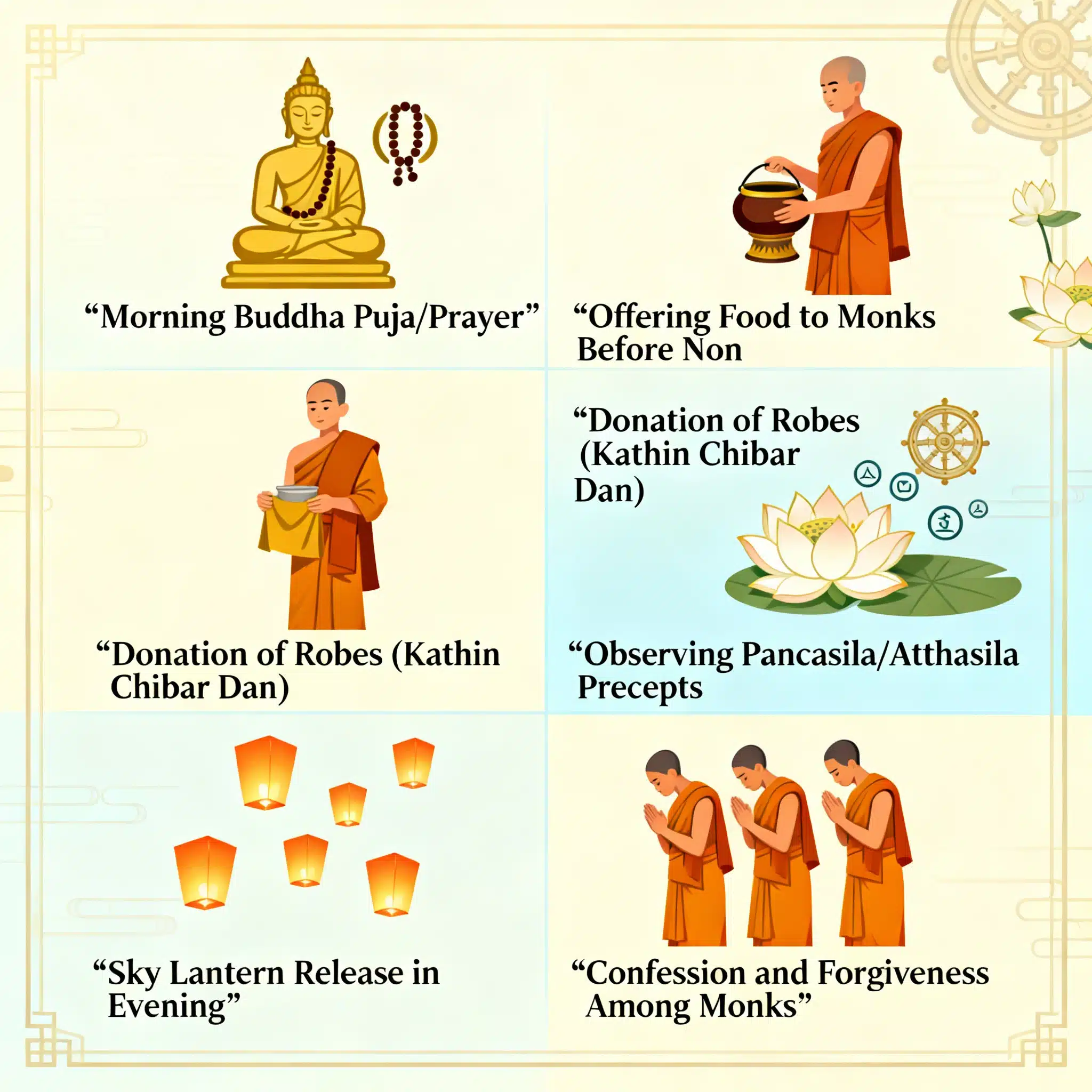
For the Buddhist community, this same full moon marks Prabarana Purnima, the culmination of the three-month Vassa. Its core is encapsulated in the word “Prabarana,” which translates to “invitation.” In a ceremony of radical humility, junior monks formally invite senior monks to admonish them for any transgressions committed during their long retreat. It is a communal act of spiritual purification and accountability, reinforcing the egolessness central to the faith.
The rituals of Prabarana are rich with analytical meaning:
- The Sky Lantern (Fanush): The breathtaking release of paper lanterns is a multi-layered symbolic act. It commemorates the Buddha’s return to Earth from the Tavatimsa heaven. On a personal level, it represents the releasing of one’s ego, sins, and worldly troubles, allowing them to float away into the ether. On a communal level, it symbolizes the light of the Dharma (the teachings) spreading out into the world to illuminate all beings.
- The End of Vassa: The three-month retreat is an intense period of study and meditation. The monks emerging tonight are spiritually “recharged,” ready to guide the lay community with renewed vigor and wisdom. The festival is not a holiday from discipline but a celebration of discipline’s fruits.
Symbolism of the Fanush and Civara
The rituals of Prabarana are rich with meaning. The breathtaking release of sky lanterns (Fanush) is a multi-layered symbolic act: a tribute to the Buddha, a personal release of one’s worries, and a representation of the Dharma’s light spreading throughout the world. Following Prabarana, the month is dedicated to the Kathina Civara Dana, the robe-offering ceremony.
This is a critical aspect of the festival’s aftermath, where the lay community engages in the meritorious act of offering new robes to the monks. This solidifies the symbiotic relationship where monks provide spiritual guidance, and the community provides material support.
Synthesis: Weaving the Convergent Beams of Light
While their narratives differ, the two festivals are thematically interwoven by the moonlight that bathes them both.
First is the shared theme of the vigil. The Hindu devotee stays physically awake to prove their diligence to Lakshmi, while the Buddhist monk emerges from a three-month period of heightened spiritual wakefulness. Both traditions elevate the principle that goodness—be it material or spiritual—is accessible only to the conscious and the vigilant.
Second is the shared prerequisite of purity. The Hindu household is meticulously cleaned to create a worthy space for the goddess. The Buddhist Sangha (community of monks) purifies itself through the Prabarana ceremony. Both acts recognize that creating a pure environment—one physical, one communal—is essential before positive energy can be welcomed or cultivated.
Finally, they offer two profound perspectives on the metaphor of light. In Laxmi Puja, the diya is a beacon, an invitation to attract divinity from the outside in. In Prabarana Purnima, the sky lantern is an emanation, a projection of inner learning and enlightenment from the inside out. One calls light in, the other sends light forth.
Takeaways: A Singular Moon, A Pluralistic Message
The convergence of Kojagari Laxmi Puja and Prabarana Purnima on October 6, 2025, is far more than a date on a calendar; it is a powerful, living illustration of the subcontinent’s philosophical depth.
Tonight’s moon over Bangladesh does not just illuminate a landscape; it illuminates the deep, syncretic soul of a nation where different paths towards prosperity and purity can, and do, share the same sky. It is a silent, celestial reminder that while our rituals may be distinct, our devotion to light is a shared human truth.