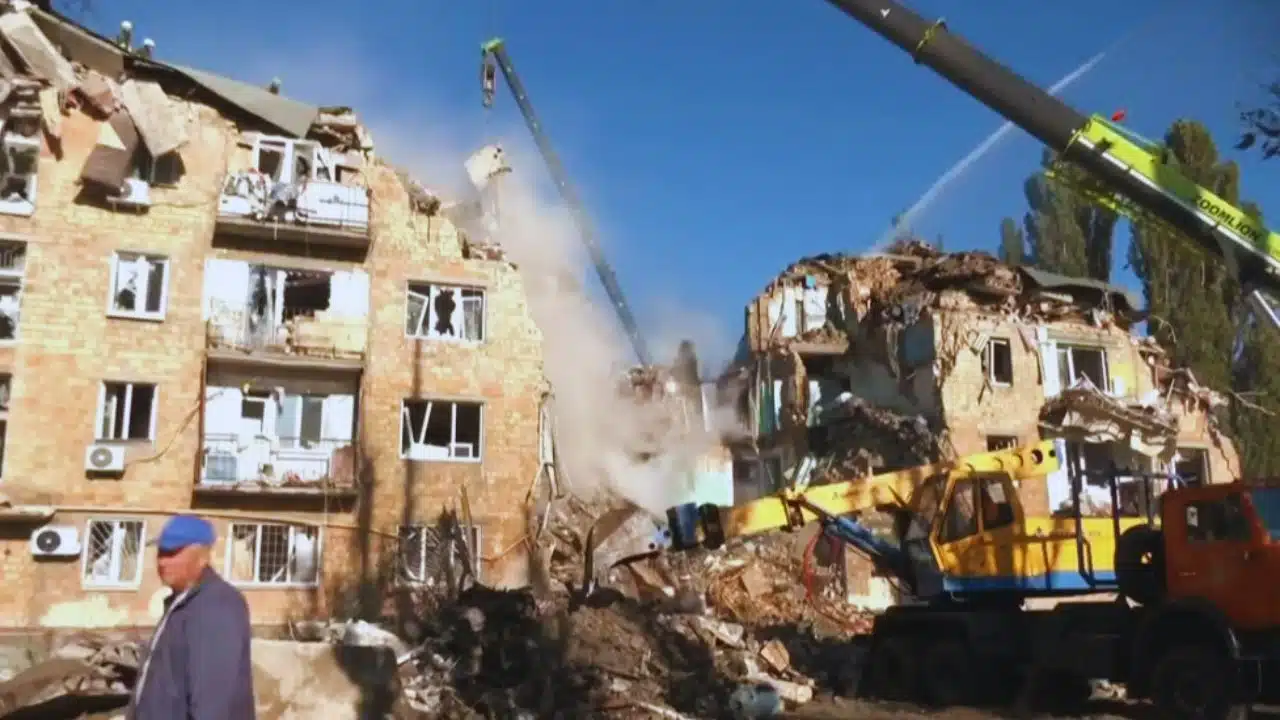
Ukraine experienced one of its deadliest nights in recent months when Russian missiles and drones rained down on Kyiv in the early hours of Thursday. Ukrainian officials confirmed that at least 23 people lost their lives, including four children, while dozens more were injured in the strikes.
The assault was described as the largest missile and drone barrage on the capital since July, with Ukrainian air defense units reporting that Russia had launched almost 600 drones alongside more than 30 ballistic and cruise missiles. Despite interceptions, many managed to hit residential and civilian areas.
One of the most devastating impacts occurred in the Darnytskyi district on Kyiv’s left bank, where a five-storey apartment building was struck directly at around 03:00 local time. The blast tore through the block of flats, causing a partial collapse that buried families beneath the rubble. Rescue workers spent hours combing through the smouldering debris in search of survivors, while diggers cleared large sections of destroyed concrete.
According to officials, three of the children killed were just two, 14, and 17 years old, while several other young victims were injured. The tragedy highlighted yet again how Russia’s ongoing war continues to claim innocent civilian lives.
EU Delegation and British Council Hit in the Strikes
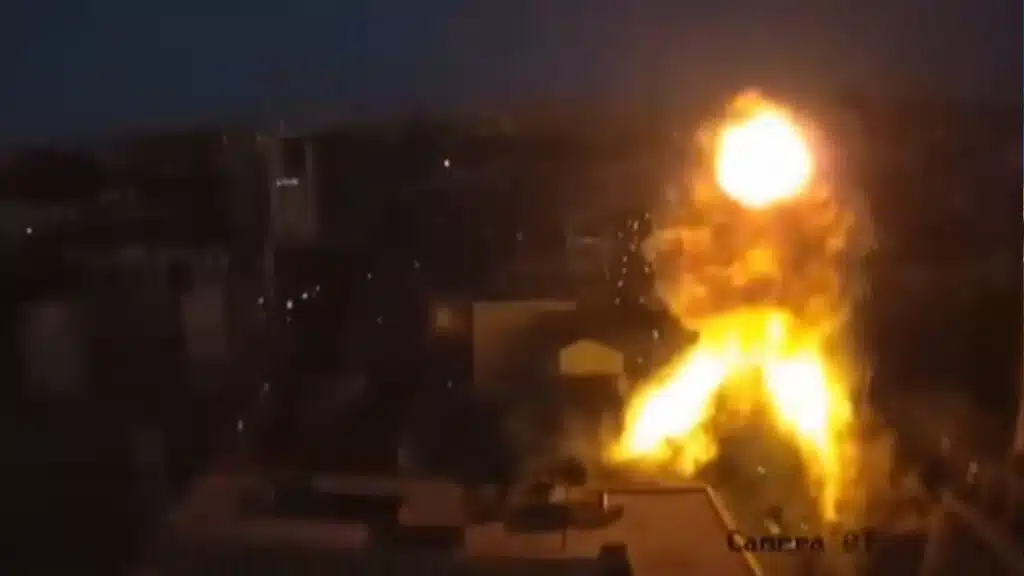
The overnight strikes did not only devastate residential neighborhoods but also damaged diplomatic and cultural institutions in Kyiv. The European Union’s delegation office suffered a near miss when missiles struck within 50 meters of the building, hitting twice within 20 seconds.
The British Council, which fosters cultural and educational cooperation, also sustained severe damage. Its offices are located in the same building block as the EU mission. The Council later announced that its Kyiv office would remain closed to visitors until further notice due to safety concerns.
Although no EU or British diplomatic staff were reported injured, the attacks were immediately condemned as a serious breach of international norms, raising fears that Russia was deliberately targeting symbols of European presence in Ukraine.
Outrage Across Europe and Beyond
The strikes provoked an immediate wave of anger from European leaders.
- Ursula von der Leyen, head of the European Commission, said she was “outraged” at what she described as Russia’s deadliest assault on Kyiv since July. She emphasized that Russia had once again chosen to terrorize civilians, destroy homes, and attack international institutions.
- Kaja Kallas, the EU’s foreign policy chief, declared that the strikes showed a “deliberate choice to escalate and mock peace efforts.”
- UK Prime Minister Sir Keir Starmer accused Russian President Vladimir Putin of “sabotaging hopes of peace,” underscoring that the attack came just days after a US-led diplomatic push for negotiations.
- German Chancellor Friedrich Merz warned that Russia had “shown its true face again,” saying the strikes were proof of Moscow’s increasing brazenness in the war.
- Leaders across France, Spain, Poland, and the Council of Europe echoed these condemnations, framing the attack as a direct challenge to diplomacy and international law.
The US special envoy on Ukraine, Keith Kellogg, also weighed in, saying that Russia’s “egregious attacks” on residential areas threatened the fragile peace initiatives that President Donald Trump had been pursuing.
Russia’s Message Amid Calls for Peace
Ukrainian President Volodymyr Zelensky said the wave of missiles was a clear signal from the Kremlin to those pushing for diplomacy. “Russia chose ballistics instead of the negotiating table,” he declared, calling once more for “new, tougher sanctions” against Moscow.
Although the Kremlin insisted it remained “interested” in negotiations, Western officials argued that the timing and scale of the attack made it clear that Russia was attempting to undermine peace efforts.
The strikes came just days after discussions in Washington where President Trump had met both Putin and Zelensky separately in an attempt to organize a broader peace summit. While Ukraine welcomed such efforts, Russia downplayed the likelihood of any meeting between Putin and Zelensky, further straining diplomatic channels.
Growing Humanitarian and Infrastructure Crisis
Beyond the immediate human toll, the strikes also worsened Ukraine’s energy crisis. The attack followed another Russian bombardment earlier in the week that had left over 100,000 Ukrainian homes without power. On Thursday, officials said an additional 60,000 consumers in Vinnytsia region were left without electricity after drones damaged energy facilities.
In a separate development, Russian forces targeted a Ukrainian naval reconnaissance ship named Simferopol near the River Danube. Moscow claimed it used an unmanned speedboat for the operation. Ukraine confirmed one sailor was killed and several others were injured but withheld further details.
The combined impact of these strikes left Ukrainians not only grieving their dead but also facing deepening energy shortages, damaged infrastructure, and a sense that no part of their daily lives was safe from Russia’s attacks.
Diplomatic Fallout: Sanctions and Summons
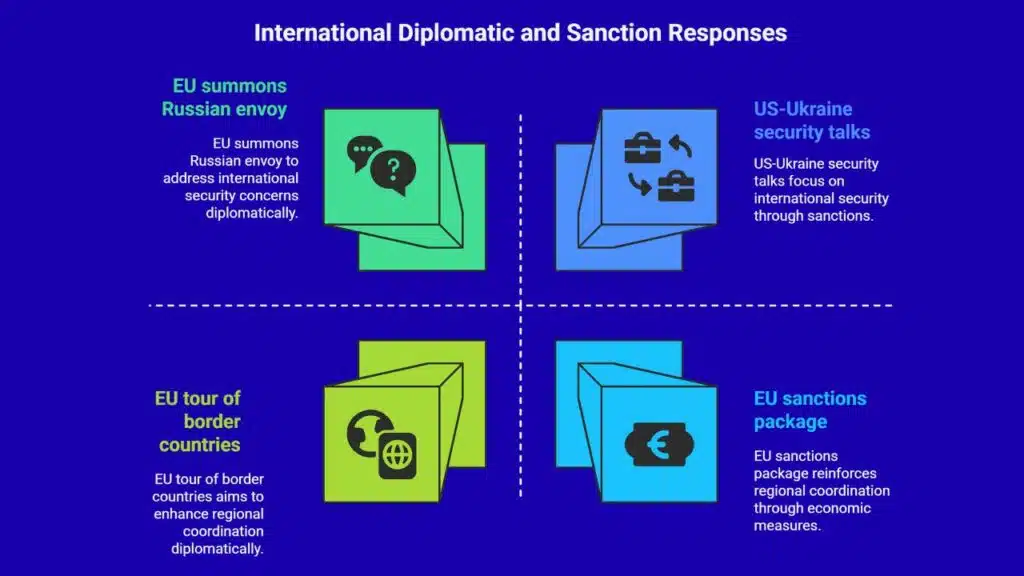
The EU responded swiftly. An EU spokeswoman said that no diplomatic mission should ever be targeted, and Brussels summoned the Russian charge d’affaires to demand explanations. Similarly, Russia’s ambassador to the UK, Andrei Kelin, was called to the British Foreign Office to answer for the damage to the British Council.
Von der Leyen announced that the EU was preparing a 19th package of sanctions against Russia, reinforcing Europe’s determination to hold Moscow accountable. She also revealed plans to tour seven EU countries bordering Russia and Belarus—including Latvia, Finland, Estonia, Poland, Bulgaria, Lithuania, and Romania—to coordinate regional responses.
The United States, meanwhile, confirmed that its diplomats would meet Ukrainian officials in New York on Friday to discuss long-term security guarantees for Ukraine, covering military, political, and economic support.
A War That Refuses to De-escalate
Thursday’s attack was a turning point in intensity, underscoring that Russia’s strategy is far from shifting toward compromise. By targeting both civilians and international missions, Moscow sent a dual message: it can still strike deeply inside Ukraine, and it is prepared to ignore global diplomatic norms.
For Kyiv, the devastation was not only physical but symbolic—Russia was striking at Ukraine’s neighborhoods while simultaneously undermining the presence of Europe itself in the capital. For Europe and its allies, it was a chilling reminder that Russia’s aggression extends beyond Ukraine’s borders into the very heart of the international system.
The attack on Kyiv that killed 23 people and damaged the EU headquarters and British Council offices is not just another episode in the war—it is a calculated move that intensifies the conflict at a time when the international community is still pushing for diplomacy.
For Ukrainians, it underscores the human cost of the war: lives lost, homes destroyed, and infrastructure crippled. For Europe, it represents a direct challenge to its presence and credibility in Ukraine. And for the wider world, it is a sobering reminder that despite ongoing peace initiatives, the war is escalating and risks spreading instability across the region.
The Information is Collected from BBC and Reuters.