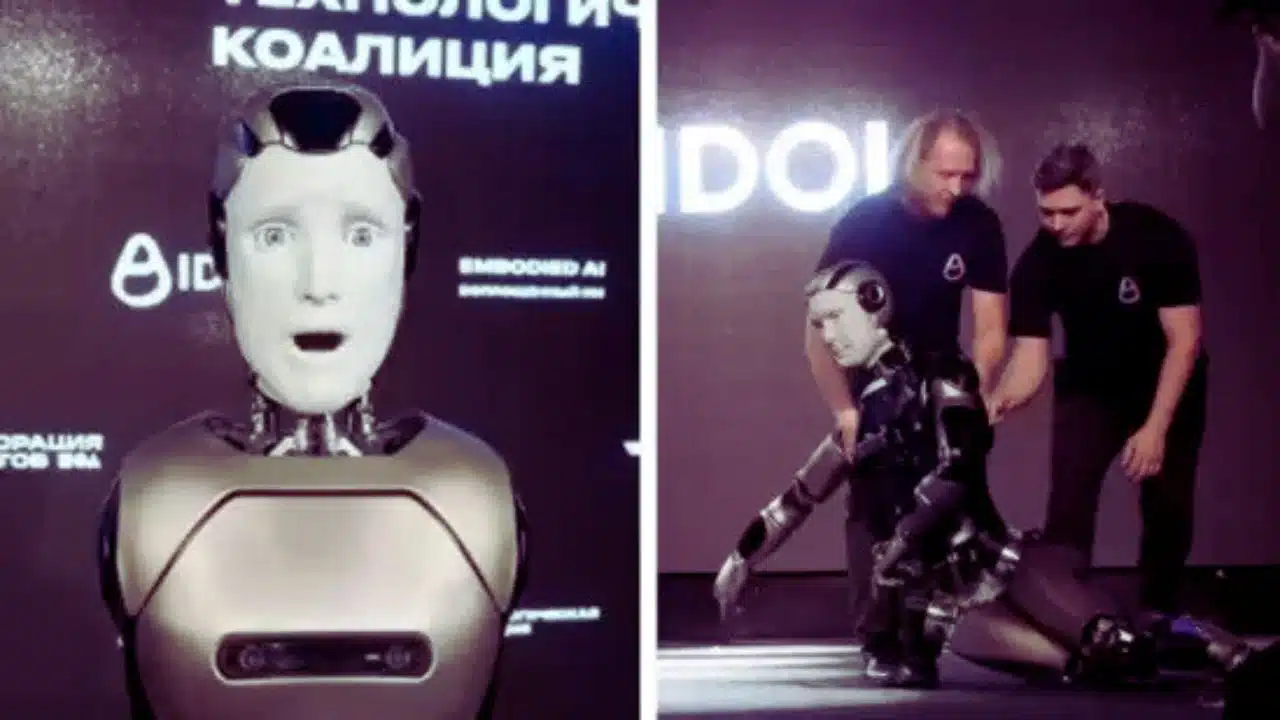
Russia’s much‑hyped AI humanoid robot AIDOL suffered an embarrassing fall during its grand debut in Moscow, turning a showcase of technological ambition into a viral reminder of how hard it is to perfect human‑like machines.
AIDOL’s big moment ends in a fall
The robot, billed as Russia’s first fully AI‑powered humanoid, was led onto the stage at a tech event in Moscow to triumphant music, including the iconic theme from the film “Rocky.” After only a few cautious steps, AIDOL suddenly lost its balance, pitched forward and fell face‑first onto the floor, prompting gasps, nervous laughter and a stunned silence from the audience. Event staff rushed in to lift the roughly human‑sized machine back to its feet as cameras kept rolling and clips of the mishap began spreading online within minutes.
Organizers blame calibration, not concept
Executives from Idol (sometimes stylized as AIDOL), the company behind the robot, were quick to insist that the fall did not signal a fundamental design failure. Chief executive Vladimir Vitukhin told reporters that AIDOL remains in a test phase and that the tumble was caused by calibration issues, including how its balance system reacted to the stage conditions and lighting. Organizers framed the incident as a normal part of live testing for complex robotics, saying they hope to correct the error and demonstrate a more stable performance in future appearances.
Built for domestic tech sovereignty
AIDOL has been promoted as a symbol of Russia’s drive to develop advanced AI and robotics using mostly domestic components, an effort that has accelerated as Western sanctions limit access to foreign chips and hardware. Russian policy documents in recent years have identified artificial intelligence and robotics as strategic priorities, tied to national security, economic modernization and technological sovereignty. Within that context, AIDOL is not just a flashy prototype but a public test of whether the country can field competitive humanoid systems without relying heavily on Western technology.
Online ridicule and “runs on vodka” jokes
The stage fall instantly became meme material, with clips shared widely on social media platforms and international news sites. Commenters mocked the robot with quips such as that it “runs on vodka,” while others compared the awkward spill to earlier viral failures by Western robots, suggesting that physical AI remains a humbling frontier for all nations. Despite the ridicule, some robotics experts pointed out that falls are common in early‑stage humanoid platforms, where real‑world balance, uneven surfaces and unexpected friction can expose weaknesses not seen in lab conditions.
Technical challenges behind the misstep
Humanoid robots like AIDOL must continuously calculate their center of gravity, adjust joint torques and interpret sensor data to remain upright, a task that becomes harder under bright stage lights, cables and unfamiliar flooring. Organizers cited calibration glitches between AIDOL’s control software, its gyroscopes and its actuation system, suggesting that the robot misjudged how to shift its weight while being led across the stage. Such issues underline that impressive AI for speech or vision does not automatically translate to robust locomotion, which demands extremely precise, real‑time hardware‑software integration.
A setback for image, not necessarily for strategy
Politically, the mishap is awkward for a government that has repeatedly framed AI as a field where leadership will define global power in the 21st century. The spectacle of a national‑flagship robot face‑planting in front of cameras clashes with official rhetoric about high‑tech strength, especially at a time when Russia is seeking to showcase resilience under sanctions. Yet in practical terms, a single failed demo is unlikely to derail well‑funded national programs aimed at building indigenous AI and robotics capabilities over the coming decade.
What comes next for AIDOL
Idol’s leadership has promised to correct the software and calibration problems, hinting at a new demonstration once engineers have re‑tested the robot in varied conditions. Future upgrades are expected to focus on improving balance control, refining motion‑planning algorithms and hardening the system against environmental surprises like glare and stage irregularities. If AIDOL can return to the stage with a smoother performance, the robot may yet become a showcase for Russia’s AI ambitions rather than just another viral fail clip.