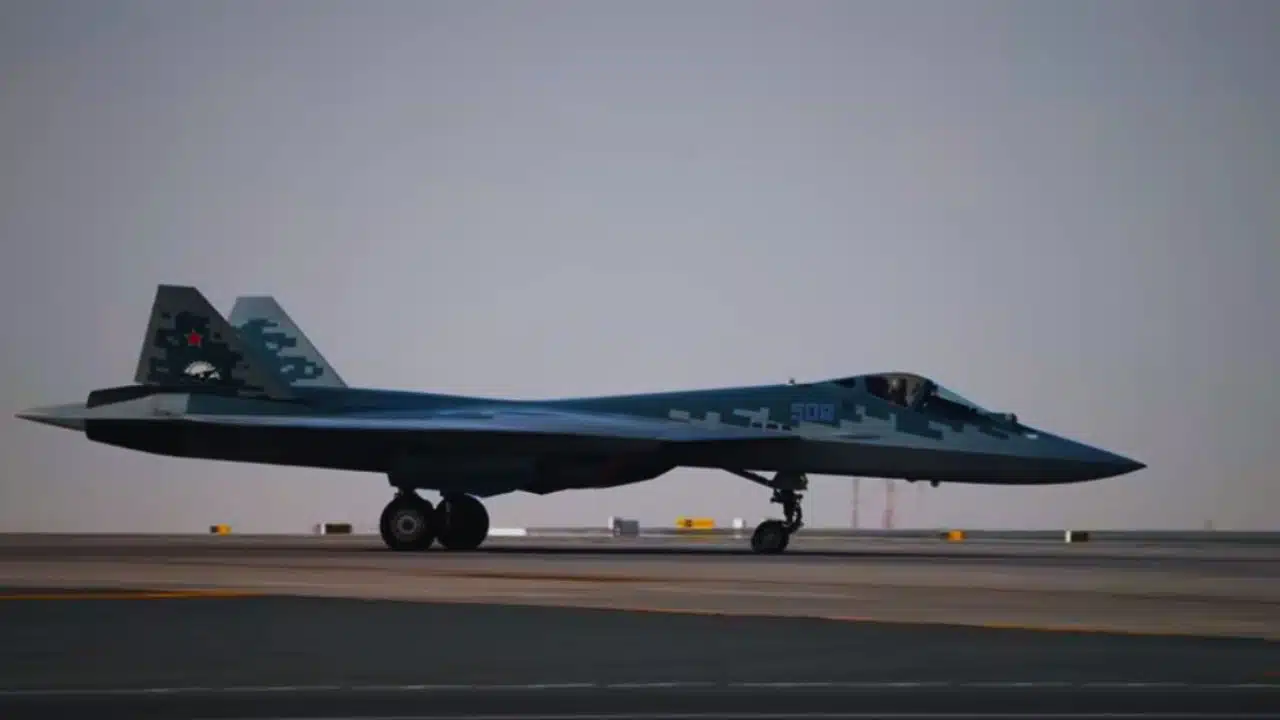
Russia has made a sweeping and highly consequential defence proposal to India just weeks before President Vladimir Putin’s scheduled visit to New Delhi. In what experts are calling one of the most generous military-technology offers ever extended to India, Moscow has expressed its readiness to provide full access to the ecosystem behind its fifth-generation stealth fighter jet, the Su-57, along with a pathway for joint production and long-term industrial cooperation.
This proposal, if accepted, could reshape India’s air-power trajectory for decades, close the gap in its fifth-generation fighter capability, and open the door to deeper technological autonomy at a time when geopolitical tensions and military modernization are accelerating globally. Russia’s willingness to share sensitive technologies—including engines, sensors, avionics, stealth materials, and artificial-intelligence-enabled systems—signals a strong intent to reinforce its long-standing partnership with India.
The offer was publicized by Sergey Chemezov, CEO of Russia’s state-owned defence conglomerate Rostec, during the Dubai Air Show 2025. Chemezov reiterated that the relationship between India and Russia is rooted in decades of dependable cooperation, including during periods when India faced sanctions and limited international defence support. According to him, Russia remains ready to supply any military capability India requires, without restrictions. His statement emphasized trust, mutual strategic interest, and a readiness to support India’s defence ecosystem with the highest levels of access ever offered.
Chemezov detailed that Russia’s proposal includes the supply of Su-57 aircraft directly from Russian production lines in the initial phase, followed by a gradual transfer of manufacturing capability to India. This would include engine production, stealth-material fabrication, radar technology, advanced optics, low-observable airframe manufacturing, and even elements of next-generation artificial intelligence integration in aircraft systems. Essentially, India would not only fly the aircraft—it would gain the capability to build and further develop them domestically.
In parallel to the Su-57, Russia has also signaled readiness to offer the Su-75 Checkmate, a single-engine stealth fighter designed to be lighter, more affordable, and more export-friendly than the Su-57. For India, this addition is significant. While the Su-57 is a twin-engine heavy fighter designed for air superiority and multi-role missions, the Su-75 occupies a lighter tactical segment. Indian defence analysts have already noted that the Su-75 would not compete with India’s ongoing Advanced Medium Combat Aircraft (AMCA) programme but would complement it, filling a different operational need and accelerating the modernization of the Indian Air Force (IAF).
Retired Indian Air Force Squadron Leader Vijainder K. Thakur highlighted that Russia has consistently shown willingness to base Su-75 production in a partner nation. Given India’s industrial base, defence experience, and strategic relationship with Moscow, India remains the strongest and most logical candidate for becoming the manufacturing hub. Were this to happen, India could potentially export Su-75 aircraft in the future, repeating the success enjoyed with the Indo-Russian BrahMos missile, which has become a major export-ready asset.
Another compelling aspect of Russia’s renewed outreach is the promise of full-scale “technology transfer” and “technological learning.” This means India would gain not just production rights but an understanding of the science, engineering, and systems integration behind next-generation air-combat platforms. Such access has been denied repeatedly by Western powers, including the United States and European defence leaders, who typically maintain strict limits on sharing core technologies like engines, stealth coatings, and radar systems. Russia’s willingness to offer this level of access marks a major strategic opportunity for India’s long-term self-reliance in aviation and defence manufacturing.
Officials from Rosoboronexport, Russia’s state arms exporter, echoed Chemezov’s statements, emphasizing that Russia is prepared to support India with both current and future-generation aircraft technologies. They highlighted the possibility of integrating Indian-origin weapons systems into Russian aircraft and establishing production lines inside India for air-launched weapons, sensors, and advanced avionics. Such collaboration could significantly strengthen India’s defence-industrial base, as well as reduce dependence on external suppliers.
All of this comes just ahead of Russian President Vladimir Putin’s expected visit to India in December for the 23rd India-Russia Annual Summit. This will be Putin’s first visit to India since 2021, a gap marked by the COVID-19 pandemic, the Russia-Ukraine conflict, and shifting global geopolitical dynamics. Preparations for the summit have been underway at the highest levels. Earlier this week, Putin’s close aide Nikolai Patrushev met Prime Minister Narendra Modi, signaling deepening strategic coordination. Their discussions included maritime cooperation, security collaboration, and progress on defence agreements expected to be unveiled during Putin’s visit.
Patrushev’s meeting and the Russian side’s public outreach underscore that both nations are carefully preparing for major announcements—likely covering defence modernization, technology sharing, maritime capabilities, and long-term industrial partnerships. For India, which is urgently trying to modernize its ageing fighter fleet and balance competition from regional rivals, this offer may arrive at the most strategically advantageous moment.
If India chooses to move forward, the Su-57 and Su-75 proposals could significantly alter its air-force structure, accelerate indigenization, and narrow the capability gap with global air-power leaders. The deal could also give India the ability to develop future stealth platforms on its own, strengthen its position in the Indo-Pacific, and reinforce its long-standing doctrine of strategic autonomy.
Russia’s message is clear: “Whatever India requires, we are here to support.” And as Putin’s visit approaches, the world will be closely watching whether New Delhi chooses to embrace a transformational new chapter in India-Russia defence cooperation.