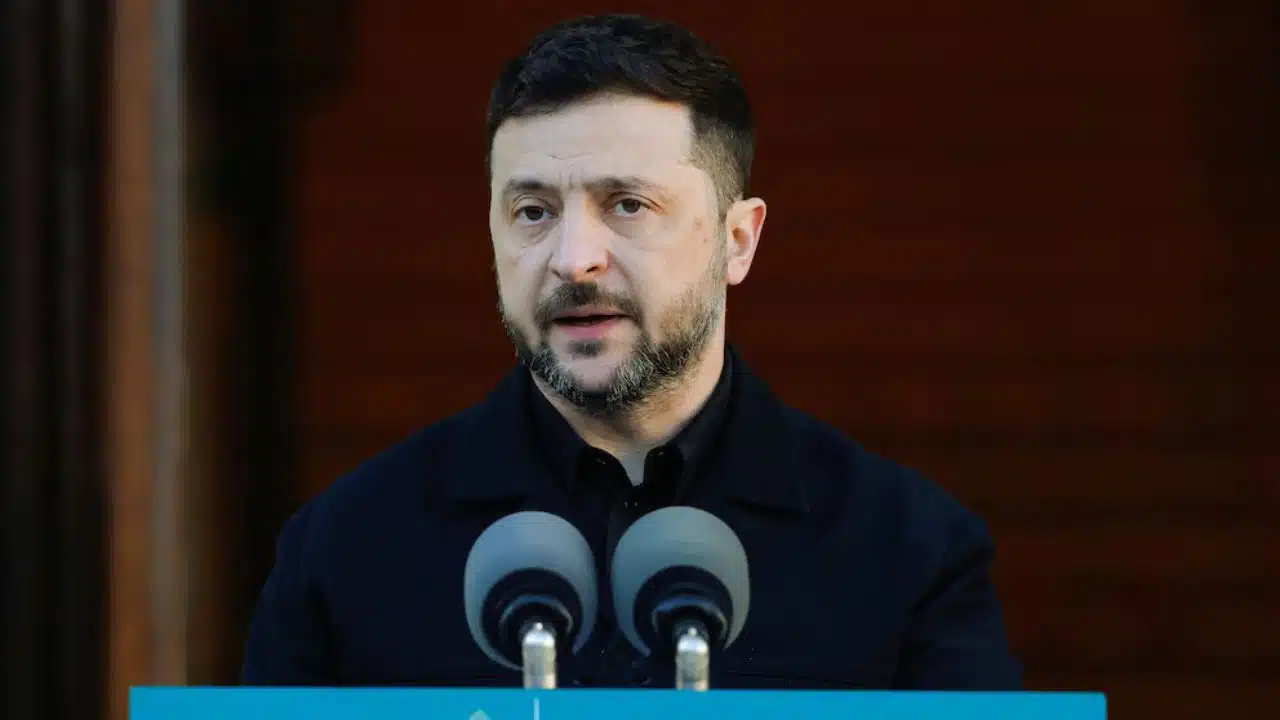
Ukraine’s President Volodymyr Zelenskyy says Russia is preparing to undermine the credibility of any future national vote, while Kyiv insists elections can only happen once security conditions allow a safe, inclusive ballot.
Russia discrediting Ukraine elections has become a growing political battlefield alongside the front lines, as Moscow questions Zelenskyy’s legitimacy and Kyiv points to wartime law and security risks as barriers to voting.
Election debate in wartime
Ukraine’s scheduled presidential election in 2024 was postponed because the country remains under martial law after Russia’s full-scale invasion that began in February 2022. Ukrainian law explicitly prohibits holding presidential, parliamentary, and local elections during martial law, placing the election question in a legal as well as political frame. Zelenskyy has said elections would be possible only if partners help create security conditions that protect voters, candidates, and election infrastructure from ongoing strikes.
Pressure has also built externally and internally around democratic continuity, voter representation, and how a vote could be run with millions displaced and parts of the country occupied. Civil society groups and election experts have argued that equal access, safe campaigning, and credible observation are hard to guarantee while missile and drone attacks remain a threat. Kyiv’s position has been that democratic legitimacy depends on conditions that allow broad participation, including for soldiers, internally displaced people, refugees abroad, and residents of frontline regions.
Key election constraints (wartime)
| Issue | Why it matters for legitimacy | What Ukrainian institutions/civil society cite |
| Security risks nationwide | A nationwide vote requires safe travel, safe polling sites, and protection from attacks. | Ongoing strike threats and safety requirements for a “safe sky” and secure territory. |
| Displaced and overseas voters | Millions may need accessible voting mechanisms to avoid disenfranchisement. | Equal and universal suffrage risks if large groups cannot vote. |
| Occupied territories | Voting cannot be credibly administered under occupation or coercion. | Concerns about inclusiveness and manipulation narratives tied to occupied areas. |
| Legal prohibition under martial law | The law bars elections while martial law is in force. | Article 19 bans presidential/parliamentary/local elections during martial law. |
| Observation and campaigning | Free media access, open campaigning, and monitoring are core election standards. | Shelling risks and constraints could undermine free competition and oversight. |
Zelenskyy’s warning on “discrediting” elections
Zelenskyy has warned that Russia is preparing to interfere in Ukraine’s future elections by turning the vote itself into a tool for delegitimization. He has argued that without comprehensive security guarantees, it would be impossible to ensure a legitimate and inclusive electoral process during active hostilities. In the same context, he emphasized that a safe environment across the country—at least for the election period—would be necessary before Ukrainians could vote.
Zelenskyy has also signaled conditional openness to a fast election timeline if security conditions can be guaranteed, suggesting Ukraine could be ready to hold elections within 60 to 90 days under the right protections. That linkage reframes the election debate as a negotiation over security guarantees rather than a simple domestic political timetable. It also positions election readiness as dependent on air defense, territorial security, and the practical ability to administer a nationwide ballot without intimidation or mass exclusion.
Timeline of key developments
| Date | Event / statement | Why it mattered |
| Feb 2022 | Martial law introduced after Russia’s full-scale invasion. | Martial law triggers the legal environment that suspends elections. |
| 2024 (scheduled) | Presidential election planned for spring 2024 but postponed. | The delay became central to competing legitimacy narratives. |
| Jan 2025 | Zelenskyy said elections could happen if the “hot phase” ends and martial law is lifted. | Linked elections to ending or de-escalating war conditions. |
| Dec 2025 | Zelenskyy warned Russia is preparing to discredit future elections and said security is essential. | Put “election interference-by-delegitimization” at the center of Kyiv’s message. |
| Dec 2025 | Zelenskyy suggested elections could be held within 60–90 days if security support is provided. | Presented a conditional pathway to elections tied to partner-backed security. |
How Moscow could challenge legitimacy
Zelenskyy’s warning points to a strategy where Russia uses procedural and voter-access disputes to claim any Ukrainian election outcome is invalid. He said Ukrainian intelligence warned that Moscow may demand voting access for Ukrainians located in Russia and in temporarily occupied territories, then use disputes about access to reject the results. This approach mirrors a broader pattern in which the Kremlin repeatedly labels Zelenskyy illegitimate after the end of his scheduled term while Kyiv argues continuity is grounded in wartime law.
European monitoring and policy reports have documented pro-Russian information manipulation tactics, including the use of networks of channels and websites, emotional manipulation, and the creation of fake media outlets and AI-generated visuals to spread false narratives. European Parliament analysis has also warned that generative AI is accelerating the scale and speed of manipulation, making it easier to fabricate convincing content and target audiences. In practice, that raises the risk of election-period disinformation such as fabricated “fraud evidence,” fake election commission statements, or synthetic videos designed to undermine trust in institutions.
What Ukrainian law allows—and blocks
Ukraine’s “On Legal Regime of Martial Law” law explicitly prohibits changing the constitution, holding presidential or parliamentary elections, holding local elections, and conducting national or local referenda during martial law. The same law describes martial law as a special legal regime introduced in cases of aggression or threat, allowing temporary restrictions on rights and expanded state powers for defense and security. Ukrainian national security officials have publicly emphasized that elections cannot be held during martial law and that authorities rely on the constitution and laws to govern continuity during wartime.
Policy analysis has also noted that elections would likely require not only improved security but also workable administrative solutions for voter participation across displacement and combat conditions. Civil society groups have argued that election preparation would need clear mechanisms for military voting, overseas voting, and safe campaigning—none of which are easily guaranteed under continued strikes and security threats. These constraints help explain why Kyiv frames the issue as “conditions first,” while warning that Russia will try to turn the unavoidable wartime delay into a permanent legitimacy weapon.
Final thoughts
Zelenskyy’s message combines two tracks: a warning that Russia is preparing to discredit future elections and a conditional offer that Ukraine could move quickly if robust security guarantees make a nationwide vote safe. The immediate practical question is whether partners can help create election-grade security—especially air defense and protection for election administration—while the war continues. The political question is whether Ukraine can protect trust in democratic institutions during a prolonged election delay, as information manipulation and AI-enabled disinformation raise the cost of any perceived procedural weakness.