
Today marks the birth anniversary of Dr. Muhammad Qudrat-e-Khuda, one of the most influential scientists, educationists, and writers in the history of Bangladesh. He was born on December 1, 1900, in the quiet village of Margram in Birbhum district, located in present-day West Bengal, India. Growing up in a rural setting, he showed exceptional academic promise from an early age.
Qudrat-e-Khuda began his primary education at Margram ME School and later continued at Calcutta’s Woodburn School. His outstanding performance soon set him apart from other students of his time. In 1918, he passed his matriculation examination from Calcutta Madrasa in First Division—an early indication of the brilliance that would define his later achievements.
Academic Excellence and Higher Studies Abroad
After completing school, he pursued higher education at the prestigious Presidency College in Calcutta. There, he studied Chemistry and earned his MSc degree in 1924, securing First Class First position and receiving a Gold Medal for his academic distinction. His exceptional results earned him the Premchand–Raichand Scholarship from Calcutta University, allowing him to continue advanced research in Chemistry.
Driven by ambition and scientific curiosity, he traveled to the United Kingdom for doctoral studies. In 1929, Qudrat-e-Khuda obtained his DSc (Doctor of Science) degree from the University of London. His doctoral dissertation, titled “Stainless Configuration of Multiplanmet Ring,” reflected his deep interest in organic chemistry and structural research. His achievement at an international institution marked him as one of the earliest South Asian scientists to gain recognition in global scientific circles.
Scientific Contributions and Groundbreaking Research
Dr. Qudrat-e-Khuda made remarkable contributions to organic chemistry, industrial chemistry, and applied scientific innovation. Over the course of his career, he conducted research on indigenous raw materials such as jute, molasses, charcoal, soil minerals, and local plant extracts. His research was not limited to academic theory—he constantly sought practical ways to apply scientific knowledge for industrial and agricultural development.
Among his many innovations, his work on converting jute-sticks into Partex-type board, producing malt vinegar from sugarcane by-products, and developing techniques for rayon and paper production became widely discussed for their industrial potential. He secured numerous patents for his inventions, highlighting his unique position as both an academic researcher and a visionary innovator.
Beyond laboratory research, Dr. Qudrat-e-Khuda played an essential role in establishing scientific institutions. At various points, he served as Scientific Adviser, Director of Public Instruction, and later as Director of the East Regional Laboratories under the national scientific research council. His work laid the foundation for what would eventually become Bangladesh’s modern scientific research infrastructure.
Leadership in National Education Reform
Following Bangladesh’s independence in 1971, the newly formed government entrusted him with an important national responsibility. In 1972, he was appointed as the Chairman of the National Education Commission, tasked with developing a modern and inclusive education system for the country.
Under his leadership, the Commission prepared a comprehensive education policy emphasizing science education, practical skills, mother-tongue instruction, modern curriculum development, and equal access to education. The final policy, formally published in 1974, came to be widely known as the “Kudrat-e-Khuda Education Commission Report.”
This landmark report influenced national education planning for decades, especially in promoting scientific thinking, technical learning, and the use of Bengali as an academic language. His recommendations continue to be studied in discussions on education reform in Bangladesh.
Popularizing Science Through Bengali Literature
One of Dr. Qudrat-e-Khuda’s most enduring contributions was his dedication to popularizing science in the Bengali language. At a time when science was largely restricted to English-medium texts, he worked tirelessly to make complex subjects accessible to students and general readers.
He authored numerous books aimed at introducing science in an engaging, simple, and accurate way. Among them, works such as Juicy Stories of Science, Strange Stories of Science, Introduction to Science, Biochemistry, Industrial Prospects of East Pakistan, Introduction to Nuclear Science, and First Words of Science became widely read and appreciated.
Through these writings, he helped create a culture of scientific curiosity among young readers and played a pivotal role in shaping Bengali scientific literature. His efforts encouraged thousands of students to pursue studies in science and technology at a time when such opportunities were scarce.
Honors, National Recognition, and Lasting Legacy
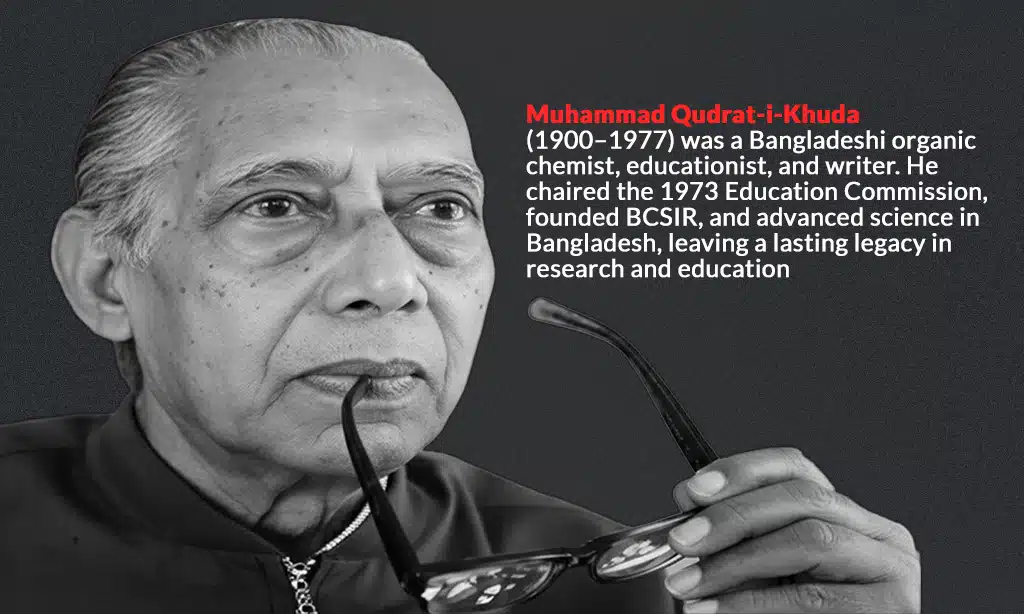
In recognition of his lifelong contributions to science, education, and nation-building, the Government of Bangladesh awarded him several of the country’s highest honors. He received the Ekushey Padak in 1976, one of the most prestigious civilian awards in Bangladesh. Later, he was honored with the Independence Day Award in 1984, posthumously acknowledging his profound impact on national progress.
Additionally, the University of Dhaka conferred upon him an honorary doctorate for his distinguished service to science and education. His leadership, publications, policy work, and scientific research collectively shaped the intellectual and academic landscape of the nation.
Dr. Qudrat-e-Khuda passed away on November 3, 1977, in Dhaka, leaving behind a rich legacy that continues to inspire researchers, educators, and students. His birth anniversary serves as a reminder of his lifelong dedication to innovation, enlightenment, and national development.
A Tribute to a Visionary Scholar
As Bangladesh reflects on the birth anniversary of Muhammad Qudrat-e-Khuda, his contributions remain invaluable. He was not just a scientist or writer—he was a visionary who connected academic excellence with national progress. Through his research, policy work, and commitment to mother-tongue science education, he laid the foundation for a more informed, scientifically aware, and forward-thinking society.
Today, readers are encouraged to learn more about his life and achievements, especially the ways in which his work continues to influence education, scientific development, and cultural identity in Bangladesh.