
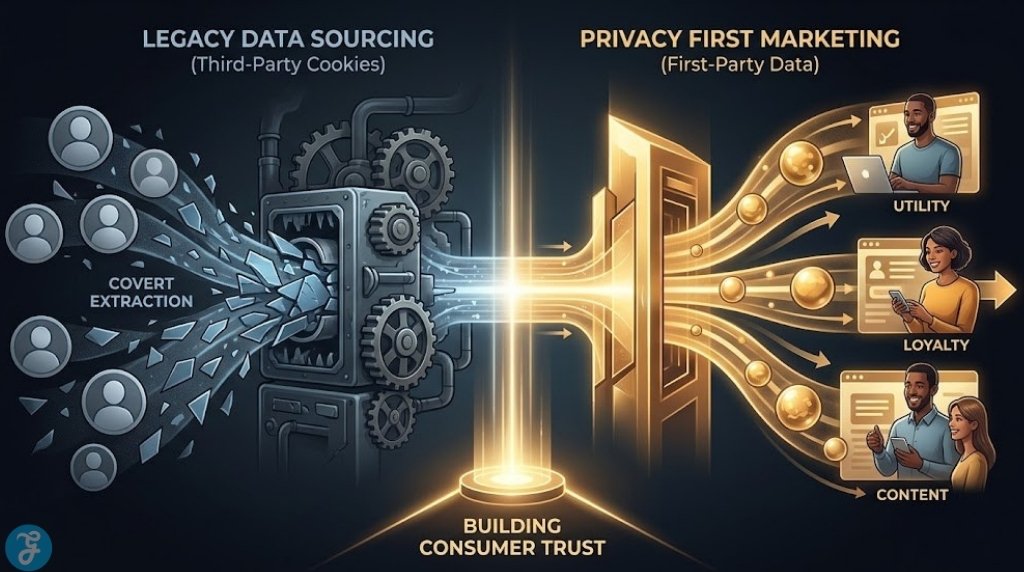
For the better part of the last fifteen years, the digital advertising industry has been operating under a state of collective, highly profitable delusion. We convinced ourselves that we had cracked the ultimate code of human commerce, achieving unprecedented levels of targeted persuasion. Entire massive corporate empires, billion-dollar agency networks, and a sprawling, opaque ecosystem of data brokers were built on the premise that if you simply tracked a consumer relentlessly enough across the internet, you could force them to buy your product. We did not call it what it actually was: mass digital surveillance. Instead, we sanitized it. We called it “retargeting,” “performance marketing,” and “programmatic optimization.” But strip away the Silicon Valley jargon, and the reality was stark. The modern marketing industry had essentially devolved into a global cartel of digital stalkers, addicted to the cheap, covert extraction of consumer data via the third-party cookie.
Now, that entire house of cards is collapsing. As regulatory bodies awaken from their technological slumber and platform gatekeepers shift control directly to the user, such as Apple’s strict App Tracking Transparency and Google’s pivot to an informed-choice model in Chrome, the era of default, invisible tracking is ending. The reaction from the digital marketing establishment has been a spectacle of apocalyptic panic. Agencies are frantically warning of plummeting conversion rates, destroyed return-on-ad-spend metrics, and the impending death of small e-commerce.
But this panic is not a tragedy; it is a long-overdue, forced rehabilitation. The death of covert tracking is the single best thing to happen to the advertising industry in a generation. It is systematically forcing brands to abandon intellectual laziness and return to the fundamental, difficult work of actually earning consumer attention.
As we navigate this massive transition, the adoption of Privacy First Marketing is no longer a niche compliance strategy relegated to the legal department. It is the absolute, uncompromising baseline for corporate survival. Brands that complain about the loss of their surveillance tools will rapidly bleed out and die. Brands that recognize this as an opportunity to fundamentally rebuild consumer trust from the ground up will forge unshakeable, highly profitable empires.
To fully grasp the magnitude of this shift, we must relentlessly critique the era we are leaving behind, analyze the financial mechanics of audience ownership, and map the strict, consent-based architecture of the digital economy that is taking its place.
The Surveillance Capitalism Hangover
To understand why the death of default tracking is a necessary market correction, we must first admit how intellectually bankrupt the previous era of digital marketing had become. The availability of frictionless, invisible third-party tracking created an industry completely addicted to a highly toxic drug: unearned data.
Because it was so incredibly cheap and easy to purchase a digital profile of a consumer: knowing what articles they read, what shoes they browsed, and what conditions they secretly researched, marketers entirely abandoned the art of the value proposition. Why do the hard work of building a compelling brand narrative, crafting exceptional creative copy, or fostering genuine community loyalty when you could simply pay an ad network to aggressively hound a consumer across the internet with a dynamic banner ad for the exact pair of sneakers they looked at three days ago?
This reliance on third-party cookies created the “Attribution Illusion.” Brands believed their marketing was highly effective because they could draw a direct, algorithmic line between a stalker-esque ad impression and a final purchase. But this approach profoundly alienated the global consumer base. It transformed the internet from a frontier of discovery into a claustrophobic, heavily monitored shopping mall where every click was commodified and sold to the highest bidder without explicit consent. Consumers did not feel marketed to; they felt hunted. The trust deficit between brands and buyers expanded into a massive, unbridgeable chasm.
The data grid below exposes the structural and psychological differences between the toxic era of covert extraction and the necessary future of overt exchange.
| Marketing Paradigm | The Era of Covert Extraction (Legacy) | The Era of Overt Exchange (Current) |
| Primary Data Source | Third-party cookies, invisible pixels, and opaque data brokers trading packaged identities. | Zero-party and first-party data, explicitly provided by the consumer with full knowledge. |
| Consumer Relationship | Adversarial: The consumer is a target to be tracked, manipulated, and algorithmically cornered. | Collaborative: The consumer is a partner engaged in a mutual, transparent value exchange. |
| The Core Metric | Creepy hyper-targeting, relentless frequency capping, and click-through attribution. | Contextual relevance, genuine brand affinity, customer lifetime value, and transparent engagement. |
| Brand Differentiator | Who possesses the most aggressive, omnipresent retargeting algorithm and the largest media budget. | Who commands the highest level of explicit, un-coerced consumer trust and offers the best organic experience. |
Moving beyond the psychological damage inflicted by surveillance marketing, we must examine the harsh financial realities that are now crushing the companies who relied upon it.

The Panic is a Confession: Why Lazy Marketers Will Die
When you observe a brand or a digital agency loudly complaining about mass consumer opt-outs, or lamenting the strict enforcement of modern data privacy regulations like the GDPR or CCPA, you must understand exactly what you are witnessing. You are not witnessing a victim of technological unfairness; you are witnessing a confession of corporate incompetence.
When a Chief Marketing Officer complains that they can no longer achieve their sales targets without invasive tracking, they are publicly admitting that their brand has absolutely zero inherent gravitational pull. They are confessing that their product is so commoditized, their creative messaging so entirely unremarkable, and their customer experience so thoroughly forgettable, that the only possible way they can generate a sale is by covertly stalking someone across the internet until they click an ad out of sheer algorithmic exhaustion.
The shift to consumer privacy exposes the nakedness of these brands. For a decade, heavily funded direct-to-consumer startups masqueraded as brilliant marketing innovators, when in reality, they were simply engaged in highly optimized digital arbitrage on massive tech platforms. They did not know how to build a brand; they only knew how to hack a tracking pixel. When Apple introduced App Tracking Transparency in iOS 14.5, blocking hidden data flows on mobile devices by default, social media giants reported nearly $10 billion in lost advertising revenue in a single year. The brands reliant on those platforms suffered equally, proving that they never actually owned their customers.
The new reality is unforgiving: if you cannot convince a consumer to voluntarily hand over their email address, their phone number, or their product preferences in exchange for the value your brand provides, your business model is structurally defective. The transition away from surveillance forces a brutal, necessary culling of the corporate herd, separating the brands that build equity from the brands that merely rent algorithms.
The comparative breakdown below highlights the harsh financial transition from renting an audience via surveillance to the difficult, necessary work of owning a legitimate audience.
| Business Metric | The “Rented Audience” Trap (Surveillance) | The “Owned Audience” Reality (Consent) |
| Customer Acquisition Cost | Highly volatile, constantly rising, completely dictated by the whims of Big Tech algorithms and bidding wars. | Stabilized and significantly lower over time, driven by direct, owned communication channels and organic referrals. |
| Data Ownership | Zero. The brand merely leases access to the platform’s proprietary, temporary surveillance data. | Absolute. The brand physically owns the CRM data, entirely insulated from external platform policy changes. |
| Engagement Strategy | Interruption-based advertising, forcing unsolicited messaging into unrelated content streams to disrupt the user. | Permission-based engagement, communicating only when the consumer has explicitly asked to be contacted with relevant updates. |
| Corporate Valuation | Lower multipliers, as the customer base is highly fragile, legally risky, and algorithm-dependent. | Massive enterprise value multipliers, backed by a portable, explicitly consented database of fiercely loyal buyers. |
To survive this culling, brands must abandon extraction and master the architecture of explicit exchange.

First-Party Data as the Ultimate Value Test
The solution to the end of default tracking is not to find a sneakier, more advanced technological loophole. Device fingerprinting and server-side tracking without consent are simply desperate attempts to prolong a dying paradigm. The only sustainable solution is to fundamentally redesign the architecture of how a brand interacts with a human being. The privacy-first digital economy is governed entirely by the acquisition of First-Party and Zero-Party data.
First-party data is the behavioral information a brand collects directly from its own digital properties, such as what a customer clicks on their specific website, their authenticated purchase history, and their engagement with an owned mobile application. Zero-party data is an even more potent asset; it is the qualitative information a customer intentionally, proactively shares with a brand. It is the style quiz they fill out, the specific communication preferences they actively select, and the explicit purchasing intentions they volunteer.
But modern consumers are heavily fatigued and highly cynical. They will not simply hand over this precious asset for nothing. This introduces the ultimate crucible for modern brands: the Value Exchange Architecture. If you want a consumer’s data in the post-surveillance economy, you must offer something of tangible, undeniable value in return. It cannot be a generic, uninspired newsletter prompt. It must be a bespoke digital experience, an exclusive gated community, a highly personalized utility, or a significant, ongoing financial incentive.
This requires a profound shift in marketing psychology. Marketers must stop asking, “How can we covertly capture this user’s data?” and start aggressively asking, “What can we build that is so incredibly valuable that this user will gladly, explicitly volunteer their data to access it?” When a consumer willingly provides their data, they are not just giving you an email address; they are giving you a mandate. They are expressing a desire for a relationship based on mutual respect.
This structural overview maps the necessary operational evolution from extracting data to actively earning it through a structured, highly visible value exchange.
| The Old Tactic (Covert Extraction) | The New Tactic (Transparent Value Exchange) | The Consumer Motivation (Why They Opt-In) |
| Invisible Website Pixels | Interactive diagnostic tools, augmented reality try-ons, or complex product matching quizzes. | “I want a personalized recommendation that actually saves me time and solves my specific, immediate problem.” |
| Scraping Browsing History | Developing robust, tiered loyalty programs that offer exclusive, gated benefits, early access, and voting rights. | “I want to be rewarded with VIP access and tangible financial perks for my continued, proven brand loyalty.” |
| Buying Opaque Email Lists | Creating premium, gated content, proprietary industry reports, or highly entertaining, brand-owned media networks. | “I want access to high-quality information or entertainment that I absolutely cannot find anywhere else on the open web.” |
| Covert Location Tracking | Offering a deeply integrated mobile application that requires location purely for core, user-requested functionality. | “I am willing to share my location because this specific app fundamentally improves my physical retail experience in real-time.” |
While building robust first-party databases takes time, brands still need to reach new audiences today. This requires a return to one of the oldest, most reliable methodologies in advertising history.
The Renaissance of Contextual and Semantic Targeting
Because marketers spent the last decade obsessed with who they were targeting, they completely forgot to analyze where they were targeting them. With behavioral surveillance facing regulatory and consumer backlash, the industry is experiencing a massive, highly lucrative renaissance in contextual and semantic advertising.
Contextual targeting does not care who the user is, what their search history contains, or what their demographics are. It only cares about the specific content the user is consuming at that exact moment. If an individual is reading an in-depth article about the intricacies of home coffee roasting, a contextual ad platform places an advertisement for high-end espresso machines directly adjacent to that text. The targeting is based on the inherent semantic meaning of the media, not the secret identity of the reader.

This is how advertising operated for a century before the digital era: you placed ads for golf clubs in golf magazines, not by stalking golfers into grocery stores. Modern AI has supercharged this approach. Advanced semantic engines can now analyze the tone, sentiment, and deep context of a webpage or video in milliseconds, placing hyper-relevant advertisements without ever dropping a single tracking pixel onto the user’s browser. It respects the user’s privacy completely while delivering messaging at the exact moment of highest psychological relevance.
The analytical grid below illustrates why contextual targeting is not a step backward, but a superior, privacy-safe leap forward in audience acquisition.
| Targeting Metric | Behavioral Targeting (The Dying Model) | Contextual Semantic Targeting (The Future) |
| Targeting Basis | The user’s historical, cross-site web browsing activity and inferred demographic profile. | The real-time, highly specific subject matter and semantic tone of the active webpage or video. |
| Privacy Impact | Highly invasive; relies on maintaining detailed, persistent profiles of individual citizens. | Zero privacy impact; the advertisement targets the active content, completely ignoring the user’s identity. |
| Psychological Relevance | Often jarring and creepy, such as seeing an ad for shoes while reading a serious news article about politics. | Seamless and additive, such as seeing an ad for running shoes while reading a marathon training guide. |
| Regulatory Risk | Massive and compounding; heavily targeted by GDPR, CCPA, and emerging global privacy frameworks. | Non-existent; requires absolutely no user consent banners because no personal data is collected or processed. |
Ultimately, whether relying on contextual acquisition or first-party retention, the entire system must be governed by a rigorous adherence to consumer choice.
The Architecture of Consent-Based Engagement
Building an ecosystem around explicit consent is not merely a legal requirement designed to avoid massive regulatory fines from European or Californian authorities; it is the most powerful brand differentiator available in the modern digital landscape. In an era where consumers are profoundly cynical about how their digital identities are exploited, leaked, and monetized, radical transparency is a devastatingly effective marketing strategy.
When a brand operates with absolute clarity: explicitly stating what data they are collecting, exactly why they need it, and precisely how it will be used to tangibly benefit the consumer, they instantly elevate themselves above the murky, untrustworthy swamp of their competitors. Trust is the ultimate, uncopyable capital moat. You can reverse-engineer a competitor’s global supply chain, you can perfectly clone their website user interface, and you can mimic their aggressive pricing strategy, but you absolutely cannot steal the genuine trust they have spent years meticulously building with their customer base.
To achieve this, the literal architecture of digital marketing must fundamentally change. Consent can no longer be buried in a forty-page, legally impenetrable terms of service document. It must be brought to the forefront of the user experience. Preference centers must evolve from static, hidden web pages into robust, dynamic dashboards where consumers can easily dial their brand engagement up or down.
If a consumer wants to hear from a brand once a month regarding specific product drops, but completely opt-out of all SMS marketing and third-party data sharing, the brand must honor that micro-preference instantly, flawlessly, and without friction. By treating data privacy not as a compliance hurdle, but as a premium core product feature, brands signal a deep, fundamental respect for their audience.
This structural index outlines the operational realities of shifting your organization from a panicked compliance mindset to a highly profitable, trust-as-a-feature mindset.
| Operational Mindset | The Compliance-Driven Approach (Failing) | The Trust-Driven Approach (Winning) |
| Data Collection Philosophy | “Collect absolutely everything we legally can, store it indefinitely, just in case we figure out how to monetize it later.” | “Collect only the specific, minimal data points required to immediately and tangibly improve the customer’s experience today.” |
| Consent Mechanisms | Confusing, pre-checked boxes hidden behind dense legal jargon and deceptive UX patterns designed to trick the user. | Clear, plain-language, un-checked opt-in toggles integrated seamlessly and honestly into the onboarding experience. |
| Consumer Control | Making it intentionally difficult to unsubscribe, delete accounts, remove data, or modify communication frequency. | Providing a centralized, intuitive dashboard where consumers can instantly revoke access or tailor their exact engagement levels. |
| Corporate Perspective | Privacy laws are an annoying bureaucratic obstacle that must be creatively bypassed, minimized, or lobbied against. | Privacy is a fundamental human right, and respecting it is the primary engine of long-term brand equity and customer lifetime value. |

Rebuilding the Digital Economy on the Bedrock of Trust
The transition we are currently enduring is painful, chaotic, and fiercely resisted by the entrenched powers of the legacy digital advertising complex. Entire business models that relied exclusively on the covert extraction of human behavior are actively collapsing in real-time. The executives who championed those surveillance models are desperately attempting to cling to the dying embers of a broken ecosystem. Let them fall.
The end of the default tracking era represents the necessary rebirth of legitimate, sustainable digital commerce. It forces a complete reset of the relationship between the modern corporation and the sovereign consumer. It dictates that you can no longer buy your way into a customer’s life through sheer financial force, endless banner ads, and algorithmic stalking. You must actively, continuously earn your place in their inbox, on their phone, and in their wallet.
The implementation of privacy-first frameworks is not about doing less marketing; it is about doing vastly superior marketing. It is about replacing the blunt, insulting instrument of mass surveillance with the surgical precision of explicit, consensual engagement and brilliant creative strategy. Brands that successfully navigate this transition will discover a profound, highly profitable truth: a highly engaged database of consumers who actively, explicitly want to hear from you is infinitely more valuable than a massive, rented list of individuals who are desperately trying to block your tracking pixels.
The era of digital stalking is officially over. We are entering a new, demanding era where absolute transparency is the ultimate currency, uncompromising consent is the only acceptable baseline, and deep consumer trust is the solitary foundation upon which any lasting global enterprise will be built. The marketing teams that understand this reality will not just survive the privacy revolution; they will inherit the entire digital economy. It will be born on a kitchen counter, built by a single entrepreneur armed with an internet connection, a visionary idea, and a suite of highly practical, everyday cognitive tools.