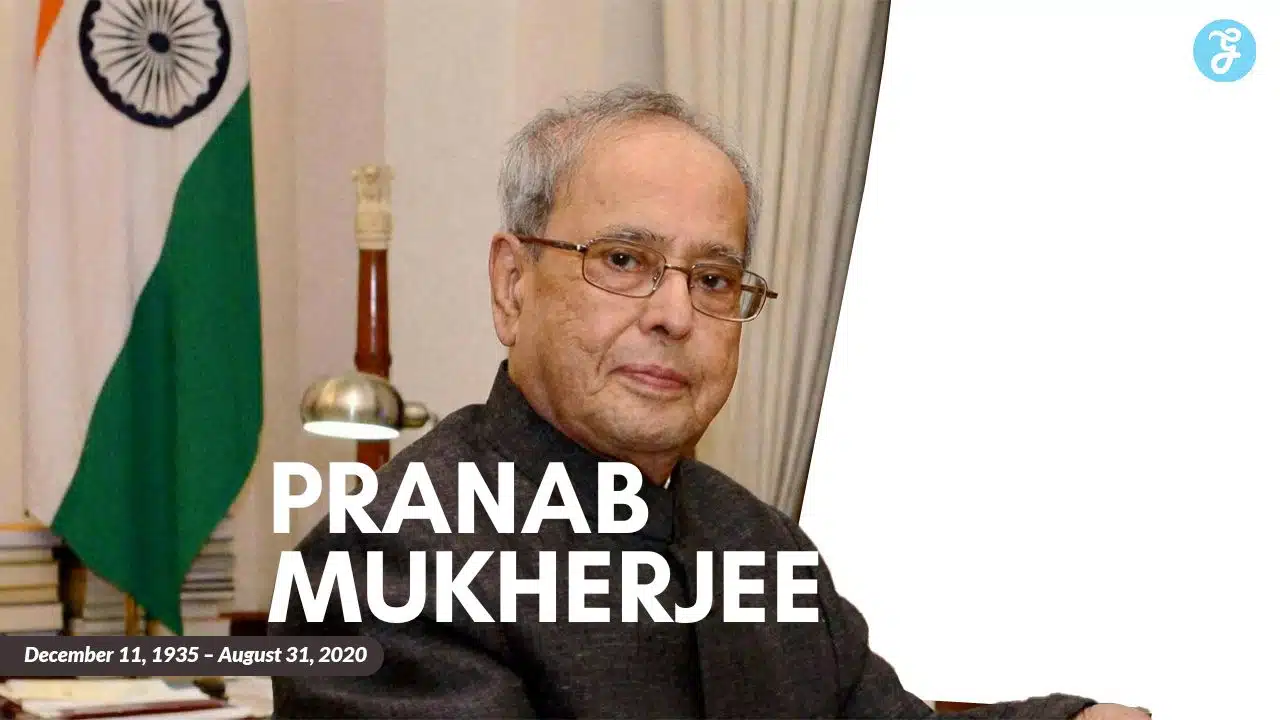
Did you know that the man who would become the 13th President of India was affectionately called “Poltu” by his family in the small village of Mirati? From walking barefoot to school in West Bengal to walking the red carpets of Rashtrapati Bhavan, Pranab Mukherjee’s journey is nothing short of a movie script. Today is his 90th birth anniversary.
Pranab Mukherjee wasn’t just a politician; he was the ultimate troubleshooter for the Congress party.
You might be wondering what made him such a giant in Indian politics. Was it his sharp memory, his ability to negotiate impossible deals, or his sheer longevity in power?
Here is the truth: Pranab Mukherjee shaped India’s destiny for over five decades. He held every major cabinet post—finance, defense, and external affairs—and served as President of India from 2012 to 2017. He was the man prime ministers turned to when they needed a solution.
In this guide, I will take you through the life of this “Master Negotiator.” We will look at his early struggles, his controversial decisions like the retrospective tax, and the tough calls he made as president.
So, grab a cup of tea, and let’s explore the legacy of Pranab Da.
Key Takeaways
- Landslide Victory: Pranab Mukherjee became the President of India in 2012 by securing 713,763 votes (69.3%), defeating P.A. Sangma by a massive margin.
- Versatile Leader: He is the only leader to have served as Foreign, Defense, Commerce, and Finance Minister.
- Key Deals: He played a central role in the Indo-US Civil Nuclear Agreement in 2008 and signed the Defense Framework in 2005.
- Tough President: Unlike some predecessors, he was decisive with mercy petitions, rejecting 24 pleas, including those of Ajmal Kasab and Afzal Guru.
- Top Honors: He received the Bharat Ratna on August 8, 2019, cementing his place in history.

What was Pranab Mukherjee’s Early Life and Education Like
Pranab Mukherjee was born on December 11, 1935, in Mirati, a village in the Birbhum district of West Bengal. His father, Kamada Kinkar Mukherjee, was a freedom fighter who spent over ten years in British jails. You could say politics was in his blood from day one.
His mother, Rajlakshmi Mukherjee, managed the household while his father was away fighting for India’s independence. He grew up with two siblings, Annapurna Banarjee and Piyush Mukherjee, in a home that valued education and sacrifice.
He attended the Suri Vidyasagar College, which was then affiliated with the University of Calcutta. He didn’t stop there. He went on to earn a Master’s degree in Political Science and History, and also an LL.B. law degree.
From Teacher to Politician
Before he entered the Lok Sabha or Rajya Sabha, Pranab Da had a regular job just like many of us. He started his career as an upper-division clerk in the Office of the Deputy Accountant-General in Calcutta (Post and Telegraph). In 1963, he became a lecturer at Vidyanagar College.
He even worked as a journalist for the Desher Dak newspaper. This background gave him a unique perspective. He understood the law, history, and the power of the press long before he drafted his first bill.
Insider Fact: One of his most famous habits was maintaining a daily diary. For decades, he wrote a page every single night. He once told his daughter Sharmistha that these diaries contained the “unvarnished truth” of Indian politics.
Political Career
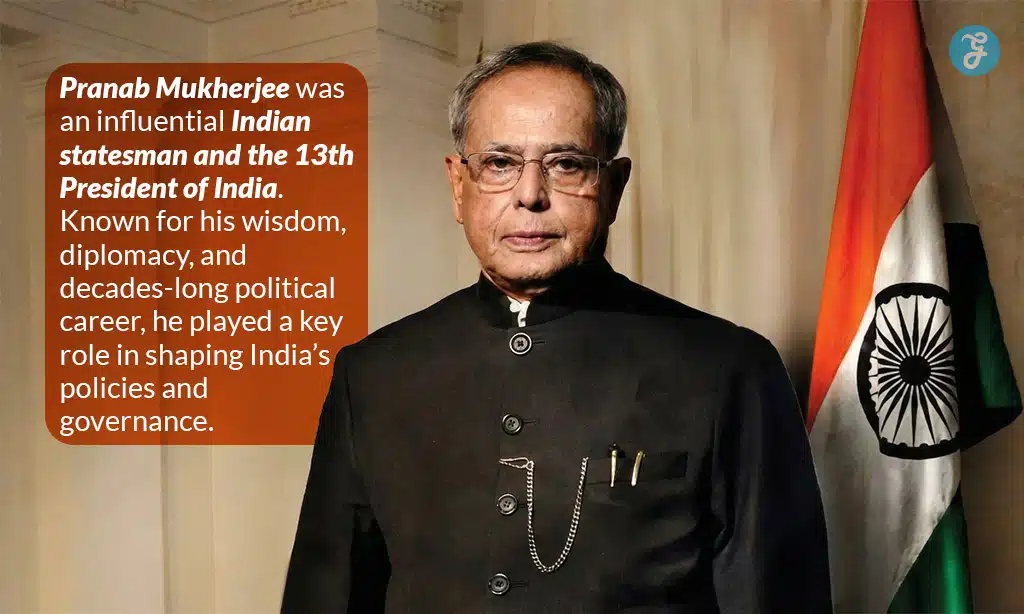
Pranab Mukherjee’s career in the Indian National Congress was a rollercoaster. He was a master tactician who knew exactly how to move pieces on the political chessboard.
What was Pranab Mukherjee’s role in the Indian National Congress?
His big break came in 1969 when V.K. Krishna Menon helped him get elected to the Rajya Sabha. Prime Minister Indira Gandhi quickly spotted his talent. She called him her “man for all seasons” because he could handle any crisis she threw at him.
By 1973, he was already a minister. From 1980 to 1985, he served as the Leader of the House in the Rajya Sabha. He wasn’t just participating in debates; he was guiding the entire party strategy.
The Wilderness Years (1986-1989)
It wasn’t always smooth sailing. After Indira Gandhi’s assassination in 1984, Pranab Mukherjee found himself sidelined by Rajiv Gandhi. This is a period many people forget.
He actually left the Congress party and formed his own group, the Rashtriya Samajwadi Congress (RSC), in 1986. However, by 1989, he realized that his true home was with the INC. He merged his party back into Congress and worked his way up again. This comeback showed his incredible resilience.
He later became a mentor to Sonia Gandhi, helping her navigate the tricky waters of Delhi politics when she took over as Congress President in 1998.
What were his key contributions as a Union Cabinet Minister?
Pranab Mukherjee was the definition of a heavyweight minister. He held the position of Finance Minister twice, separated by nearly 30 years (1982-1984 and 2009-2012). During his first term, he was rated as one of the best Finance Ministers in the world by Euromoney magazine.
He also served as the Deputy Chairman of the Planning Commission from 1991 to 1996. During the coalition era of Prime Minister Manmohan Singh, Pranab was the glue that held the United Progressive Alliance (UPA) together. He headed dozens of Group of Ministers (GoMs), resolving disputes on everything from fuel prices to land acquisition.
Leadership Roles
Few leaders in history have handled the diverse portfolios that Pranab Mukherjee did. He managed the nation’s money, its borders, and its diplomatic relationships.
What were Pranab Mukherjee’s achievements as Minister of Defense?
In 2004, he took charge as the Defense Minister of India. His biggest achievement here was shifting India’s strategic stance. In June 2005, he signed the 10-year Indo-US Defense Framework.
This was a game-changer. It opened the door for joint exercises and technology sharing with the US. But he didn’t abandon old allies. He maintained strong ties with Russia, even hosting joint anti-terror drills in October 2005. He proved that India could be friends with both superpowers at the same time.
How did he impact India’s foreign policy as Minister of External Affairs?
As the External Affairs Minister (1995-1996 and 2006-2009), he was the architect of India’s “Look East” policy. He pushed for stronger trade and security ties with Southeast Asian nations.
His crowning glory came in July 2008. He led the tense negotiations for the India-US Civil Nuclear Agreement (often called the 123 Agreement). He had to convince the Nuclear Suppliers Group (NSG) to give India a waiver, allowing us to trade nuclear fuel despite not signing the NPT. It was a diplomatic masterstroke that ended India’s nuclear apartheid.
What were his major initiatives as Minister of Finance?
His second stint as Finance Minister (2009-2012) was controversial. He steered the economy through the aftermath of the 2008 global financial crisis, but he also made some tough calls.

| Initiative | Impact on India |
|---|---|
| Retrospective Tax (2012) | He amended the Income Tax Act to tax deals like Vodafone retrospectively. This aimed to stop tax evasion but drew sharp criticism from foreign investors. |
| GST Groundwork | He laid the foundation for the Goods and Services Tax (GST), pushing for a constitutional amendment to unify India’s taxes. |
| Direct Benefits Transfer | He championed the use of Aadhaar for transferring subsidies directly to bank accounts, reducing corruption. |
While the retrospective tax amendment was a “pitfall” that spooked markets, his focus on banking expansion and rural credit through initiatives like NABARD (established during his first term) helped millions of farmers.
What Were the key Highlights of Pranab Mukherjee’s Presidency (2012-2017)
On July 25, 2012, Pranab Mukherjee took the oath as the 13th President of India. He didn’t just sit in the Rashtrapati Bhavan; he transformed it.
He won the election comfortably with 69.3% of the vote. But the real story is what he did with that power. He refused to be a “rubber stamp” President. He rejected 24 mercy petitions, including those of high-profile terrorists like Ajmal Kasab (26/11 attacks), Afzal Guru (Parliament attack), and Yakub Memon (1993 Mumbai blasts).
He sent a clear message: the President’s office would not delay justice for crimes against the nation. He also opened the Rashtrapati Bhavan to the public, starting a museum and restoration program that made the “people’s house” truly accessible.
In January 2017, he announced he would not run for a second term due to his age. Ram Nath Kovind succeeded him, inheriting a presidency that had regained its dignity and authority.
How Did Pranab Mukherjee Establish His Legacy as a Master Negotiator
They didn’t call him the “Chanakya” of Congress for nothing. His memory was legendary; he could recall file numbers and meeting details from decades ago.
His greatest skill was bringing people together. When the Congress party lacked a majority, he managed coalition partners like the CPI-M and the Trinamool Congress. He was the key figure behind the Gadgil-Mukherjee formula, which determined how central resources were shared with states.
Whenever there was a deadlock in Parliament or a crisis in the Cabinet, the Prime Minister would say, “Ask Pranab Da.” Whether it was passing the Right to Information Act or negotiating the patents bill, he found the middle ground where others saw only walls.
Sadly, he passed away on August 31, 2020. But his legacy lives on in the institutions he built and the consensus he forged.
What Awards and Honors Did Pranab Mukherjee Receive
Pranab Mukherjee’s trophy cabinet was overflowing. His awards were not just shiny objects; they were recognition of a lifetime of public service.
- Bharat Ratna (2019): India’s highest civilian award, presented by President Ram Nath Kovind on August 8, 2019.
- Padma Vibhushan (2008): The second-highest civilian award for his exceptional service to the nation.
- Best Administrator in India (2011): Awarded by K. Karunakaran Foundation.
- International Honors: He received the Bangladesh Liberation War Honour (2013) for his support in 1971 and the Grand Cross of the National Order of the Ivory Coast (2016).
- Honorary Doctorates: Universities across the globe, from the University of Dhaka to the University of Wolverhampton, granted him honorary degrees.
These honors reflect a man who was respected not just in New Delhi, but in capitals around the world.
Takeaways
Indian politics is often compared to a chess game, and Pranab Mukherjee was its grandmaster. From his early days in the Rajya Sabha to his final years in Rashtrapati Bhavan, he served with a rare mix of intellect and pragmatism.
He was a man who could quote history, draft a budget, and solve a political crisis all before lunch. His decision to reject mercy pleas showed his toughness, while his work on the nuclear deal showed his vision.
The nation honored him with the Bharat Ratna because he dedicated every waking moment to India’s growth. His work lives on every time leaders sit together to find common ground. He was, and always will be, the ultimate statesman.
FAQs on Pranab Mukherjee
1. Who was Pranab Mukherjee, and what made him a master negotiator in Indian politics?
Born in Birbhum district to freedom fighter Kamada Kinkar Mukherjee, Pranab Mukherjee was a seasoned leader in the Indian National Congress often called the ultimate crisis manager. His reputation as a master negotiator came from his unique ability to build consensus on difficult issues, such as when he bridged the gap between the Left parties and the government to save the Indo-US Civil Nuclear Deal.
2. Which major government positions did Pranab Mukherjee hold during his career?
Before succeeding Pratibha Patil as the President of India, he held almost every crucial cabinet post including Commerce Minister, Defense Minister, and Finance Minister.
3. How did his education influence his political life?
Mukherjee studied History and Political Science at Suri Vidyasagar College before earning a law degree from the University of Calcutta. This deep academic background, coupled with his early experience as a teacher, made him a formidable debater who could cite complex precedents with ease in both the Rajya Sabha and the Lower House of Parliament.
4. What were some big moments or challenges he faced while serving under Indira Gandhi’s government?
He rose rapidly to become the youngest Finance Minister in 1982 and successfully repaid the IMF loan, but he also faced intense scrutiny from the Shah Commission regarding the Internal Emergency. Despite these challenges, he remained a loyal strategist and played a key role in helping the party navigate the turbulent post-Emergency era.
5. Did Pranab Mukherjee contribute to any landmark reforms or missions?
He supported liberalization to dismantle the License Raj under P.V. Narasimha Rao and later guided economic policies for the United Progressive Alliance (UPA) while leading the Planning Commission. As External Affairs Minister, his most significant achievement was signing the 123 Agreement with the United States, which ended decades of nuclear isolation for India.
6. How is Pranab Mukherjee remembered today by people across party lines?
After he passed away from a lung infection at the Army Research and Referral Hospital, President Ram Nath Kovind led the nation in mourning the Bharat Ratna recipient with flags at half-mast. Leaders from the BJP Party to the Congress Working Committee paid tribute to Shri Pranab Mukherjee, remembering him as a statesman who maintained warm friendships with rivals like Jyoti Basu.