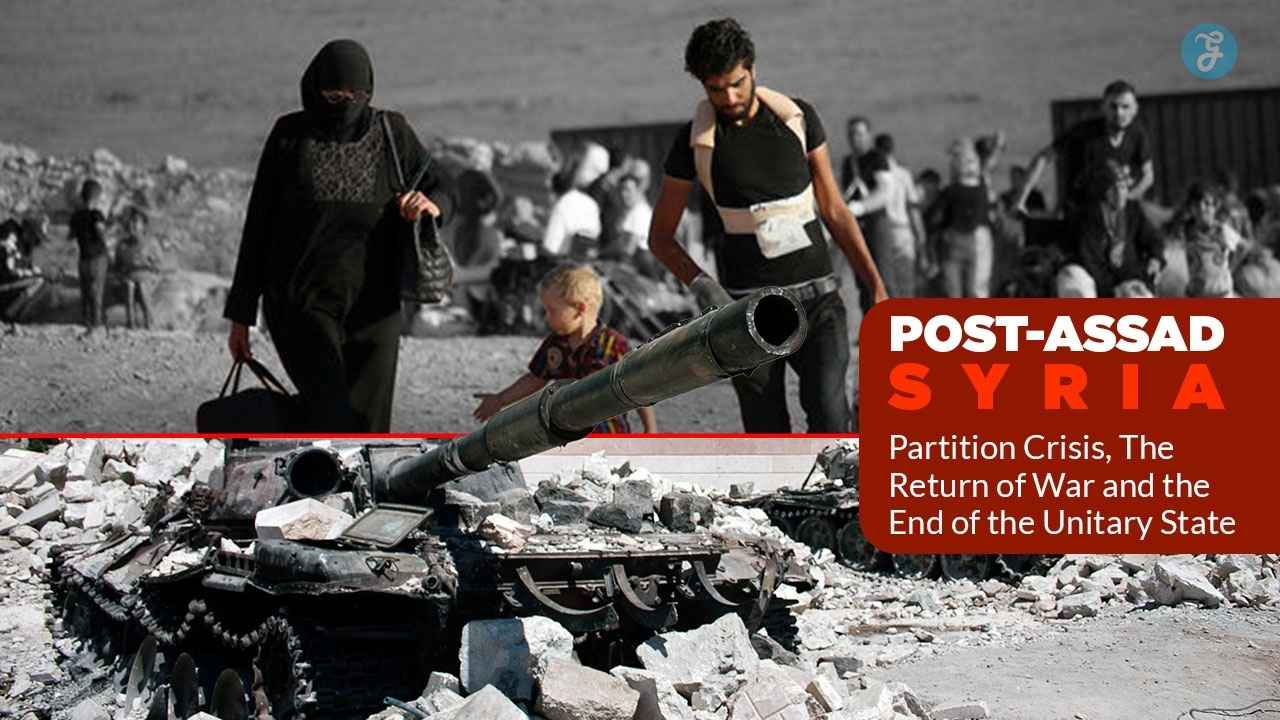
For twelve months, the “Second Syrian Republic” operated on a borrowed currency: hope. President Ahmed al-Sharaa sold the world a vision of a unified, centralized state rising from the ashes of the Assad dictatorship. He promised that the “Damascus Dash” of 2024 was the final battle of the civil war. He was wrong.
In part 01, we learned about the messy birth of the “Second Syrian Republic”, the post-Assad Syria transition. In part 02, we explored the post-Assad Syria shadow state. This final part of our analysis, Syria Partition Crisis 2026, dissects the explosion of violence that ushered in the new year, the geopolitical chess game tearing the country apart, and the grim reality that Syria is no longer one country, but three.
Key Takeaways
- The Aleppo Divorce: The expulsion of the SDF from Aleppo (Jan 2026) marks the permanent end of Kurdish-Damascus integration efforts.
- ISIS Returns: The vacuum created by the Aleppo war has allowed ISIS to seize strategic points in the central desert, threatening energy lines.
- The Hunger War: A mutual blockade, SDF withholding wheat/oil, Damascus withholding medicine/ports—is driving the population toward famine.
- Palace Rift: A dangerous rivalry has emerged between President Sharaa (the politician) and Defense Minister Abu Qasra (the conqueror), threatening a coup.
- The New Map: Syria has ceased to function as a unitary sovereign state, fracturing into zones of influence controlled by competing warlords and foreign powers.
The Death of the Unitary State
As 2025 bled into 2026, the nature of the conflict fundamentally transformed. The Vertical War (The People vs. The Regime) that defined the last decade has ended. In its place, a “Horizontal War” has erupted. This is no longer a struggle for who sits in the Presidential Palace; it is a primal struggle between the Center (Damascus) and the Peripheries (the Kurds in the North, the Druze in the South, and the Alawites on the Coast).
We stand today, witnessing the final collapse of the “unitary state.” The ceasefire signed yesterday in Aleppo is not a peace treaty; it is a divorce settlement. The expulsion of Kurdish forces from the country’s second capital marks the definitive end of the “March 2025 Agreement” and the beginning of a de facto partition.
The Kurdish Divorce: The Battle for Aleppo [Jan 2026]
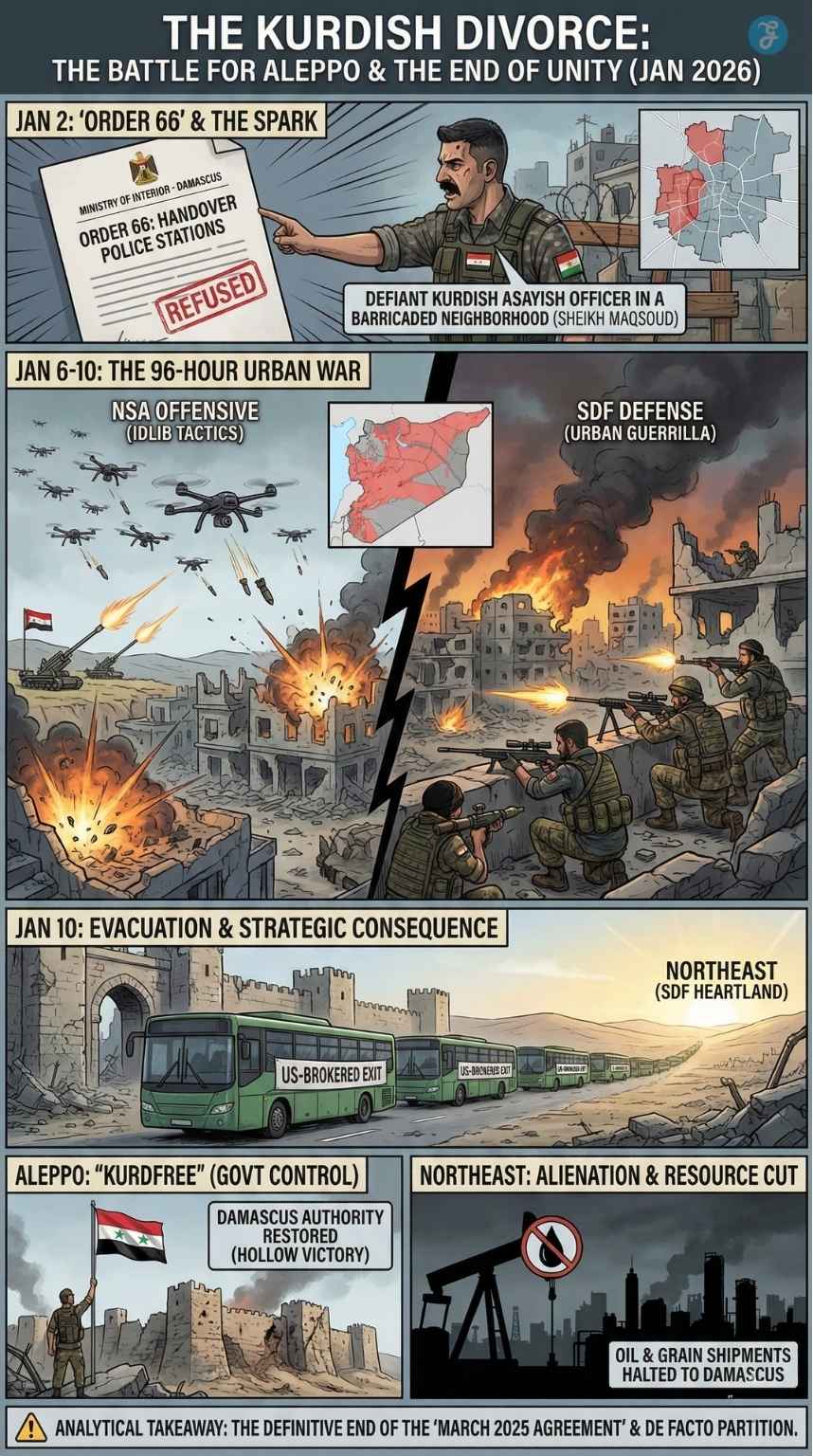
The fragile peace between the Transitional Government and the Syrian Democratic Forces (SDF) was always a ticking time bomb. The “March 2025 Agreement,” negotiated under US pressure, promised the integration of the SDF into the national army in exchange for local autonomy. But Damascus, emboldened by Turkish support, never intended to honor it.
The Spark: The “Integration” Ultimatum
On January 2, 2026, the Ministry of Interior issued “Order 66,” demanding the immediate handover of all police stations in the Kurdish-majority neighborhoods of Sheikh Maqsoud and Ashrafieh to the central government. It was a calculated provocation. Sharaa knew the SDF would refuse to surrender their internal security apparatus (Asayish).
- The Reaction: The Kurdish forces barricaded the neighborhoods, declaring them “Zones of Self-Defense.” On January 6, the New Syrian Army (NSA), the rebranded agglomeration of former rebels, launched a multi-pronged offensive using heavy artillery and suicide drones.
The 96-Hour War
The fighting that raged from January 6 to January 10 was the fiercest urban combat Aleppo has seen since 2016.
- Tactics: The NSA employed the “Idlib Tactics” used against Assad, swarming FPV drones to pin down Kurdish snipers, while Turkish artillery provided “over-the-horizon” support from the Al-Bab axis.
- The Evacuation: By the evening of January 10, the SDF defensive lines collapsed. Under a US-brokered deal, a convoy of “Green Buses”, a dark irony echoing Assad’s displacement tactics, transported 2,000 Kurdish fighters and their families out of Aleppo to the SDF heartland in the northeast.
- The Strategic Consequence: As of today, Aleppo is “Kurd-free” for the first time in decades. But the cost was the total alienation of the northeast. The SDF has cut oil shipments to Damascus, plunging the capital into a blackout. The “United Syria” project is effectively dead.
The Phantom Menace: ISIS 3.0
The most dangerous unintended consequence of the “Aleppo War” was the security vacuum it created in the central Syrian desert (Badiya). With the NSA pulling elite units to fight in Aleppo and the SDF retreating to defend Hasakah, the containment lines around the ISIS sleeper cells collapsed.
The T4 Incident
On January 8, while the world’s eyes were fixed on Aleppo, ISIS militants briefly seized the control tower of the T4 Airbase. Although they were repelled after six hours, the raid proved that the terror group has reconstituted. Intelligence reports indicate they are no longer just “remnants” but are actively recruiting disgruntled Sunni tribesmen who feel betrayed by Sharaa’s “Turkish Client State.” The “Badia Vacuum” now threatens the main highway connecting Damascus to the gas fields, putting the country’s energy security at risk.
The Sectarian Time Bomb: The Coast and The Mountain
While the north burns, the south and west are simmering with a different kind of fire. The “Idlibification” of the state described in Part 02 has triggered an existential panic among Syria’s minorities.
The Coastal Insurgency [Latakia/Tartus]
The Alawite community, having lost its protector (Assad) and its guarantor (Russia), is fighting a survivalist insurgency.
- The “Ghosts of Jableh”: What started as sporadic “revenge attacks” by NSA units against former regime officers has spiraled into a communal war. In late 2025, Alawite militias, calling themselves the “Coastal Defense Brigades,” began ambushing government convoys on the M4 highway.
- Damascus’s Response: Interior Minister Anas Khattab responded with the “Iron Fist” operation in December 2025, besieging the town of Qardaha (the Assad ancestral home). The optics of Sunni Islamist troops besieging Alawite villages have radicalized the entire coastal population. They are no longer fighting for Assad; they are fighting against what they perceive as an impending genocide.
The Druze Standoff [Suwayda]
In the south, the Druze province of Suwayda has effectively seceded in all but name.
- The “Civil State” Demand: Unlike the Alawites, the Druze leadership under Sheikh Hikmat al-Hijri initially offered to work with Sharaa. However, the government’s refusal to remove references to Sharia from the constitution ended that dialogue.
- The “Iron Dome” Temptation: The most dangerous development is the growing link between Suwayda and Israel. Following a Bedouin raid on Druze villages in July 2025 (which the Druze accused the government of orchestrating), rumors began circulating of an Israeli offer to extend a “security umbrella” over the Druze mountain. As of January 2026, Suwayda’s local militias have completely expelled NSA forces from the province, creating a “grey zone” on the Jordanian border.
Palace Intrigue: The Hawk vs. The President
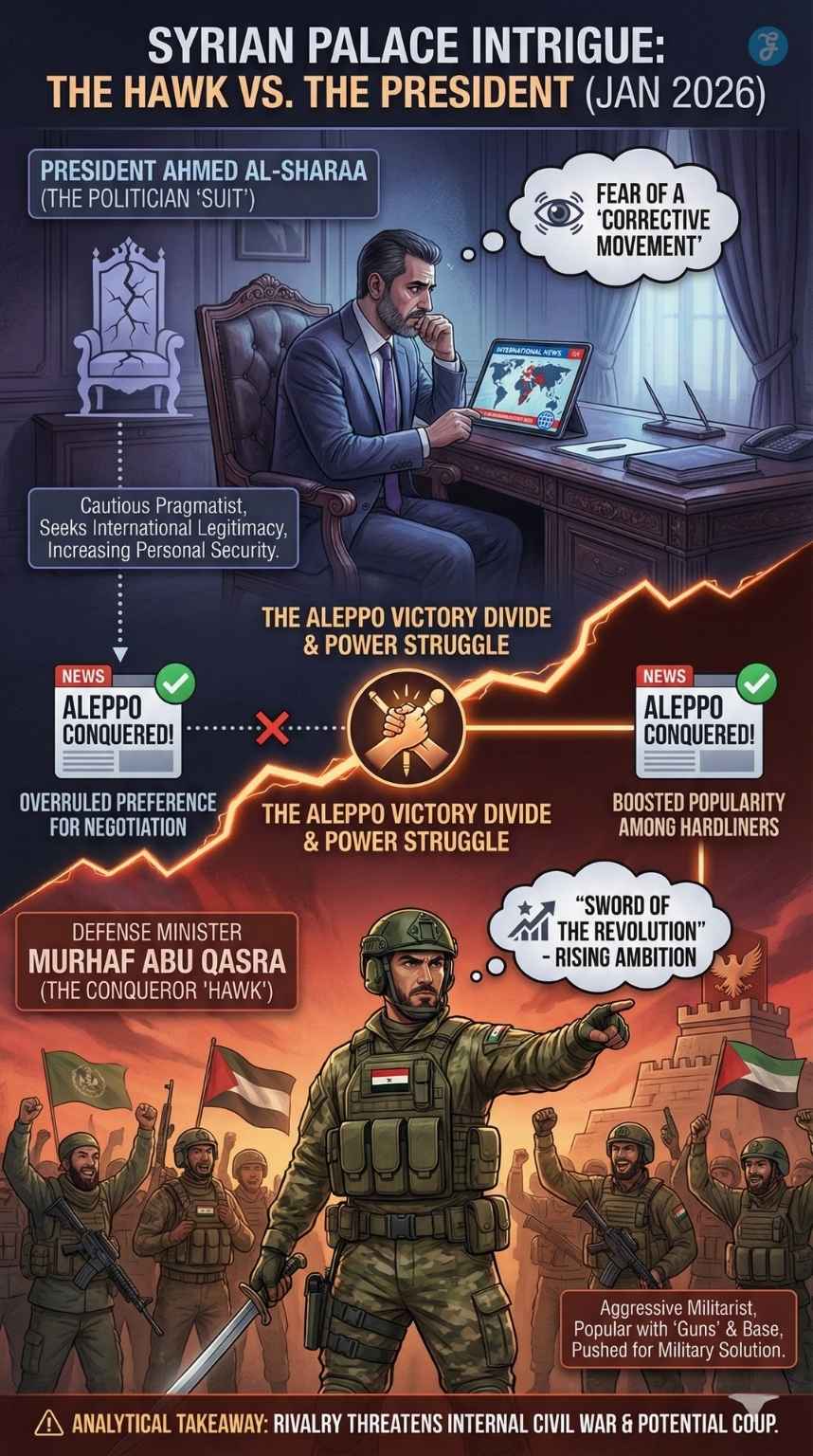
The victory in Aleppo was celebrated in the streets of Idlib, but inside the Presidential Palace in Damascus, it triggered a dangerous power struggle. President Sharaa is no longer the undisputed master of the house.
The Rise of Abu Qasra
Defense Minister Murhaf Abu Qasra has emerged as a potent rival. It was Abu Qasra who pushed for the Aleppo offensive, overruling Sharaa’s preference for continued negotiation. Sharaa feared the economic blowback; Abu Qasra cared only for the military victory.
- The Victory Paradox: Now that Aleppo is “conquered,” Abu Qasra’s popularity among the hardline fighters and the NSA rank-and-file has skyrocketed. He is being hailed as the “Sword of the Revolution,” while Sharaa is increasingly viewed by the base as a “politician in a suit.”
- The Coup Threat: Rumors are swirling in the corridors of power that Sharaa is becoming paranoid. He has reportedly increased his personal security detail, replacing them with trusted kin from his home village. The “Second Republic” may soon face its first internal civil war—not between sects, but between the “Suits” (Sharaa’s political wing) and the “Guns” (Abu Qasra’s military wing).
The Economics of Partition: The Weaponization of Bread
The partition of Syria is not just drawn with checkpoints; it is being enforced through starvation. The “Horizontal War” has mutated into a lethal economic siege.
The Wheat vs. Port Standoff
The de facto partition has created a lethal economic deadlock based on geography.
- The Northeast’s Leverage: The “Autonomous Administration” (SDF) controls 70% of Syria’s wheat production and the majority of its oil fields.
- The West’s Leverage: The “Transitional Government” (Damascus) controls the Mediterranean ports (Latakia/Tartus) and the pharmaceutical factories.
The Starvation Siege
As of January 11, the SDF has officially halted all grain and oil shipments to Damascus in retaliation for the Aleppo offensive. In response, Damascus has blocked all pharmaceutical imports and industrial machinery from entering the northeast.
The Human Cost
This “Siege of Resources” guarantees that 2026 will see a famine not caused by drought, but by political spite. The price of a bread bundle in Damascus hit 25,000 SYP yesterday, an all-time high. Hospitals in Qamishli are running out of insulin, while bakeries in Damascus are running out of flour. The country is effectively strangling itself.
The Geopolitics of Fragmentation
The internal fragmentation is being accelerated by external powers that have accepted that a unified Syria is no longer feasible.
Turkey: The “Northern Cyprus” Model
Ankara is the only clear winner of the January 2026 escalation.
- The Strategy: President Erdogan has effectively created a “safe zone” that extends from Idlib to Aleppo. Turkish companies are rebuilding the infrastructure, the Turkish Lira is the currency, and the Turkish military has permanent bases.
- The End Game: Turkey does not want to annex Syria; it wants a vassal state in the north to act as a permanent buffer against the Kurds. Sharaa’s government is increasingly viewed as a “mayoralty of Damascus” acting on Ankara’s behalf.
Israel: The “Buffer Zone Plus”
Tel Aviv has moved from a policy of containment to active reshaping.
- The Expanded Golan: Taking advantage of the chaos, Israel has pushed its “security fence” 10km deeper into Syrian territory, effectively demilitarizing the Quneitra and Deraa countrysides.
- The Strategy: Israel is actively courting the Druze and the Sunni tribes of the south to create a “South Lebanon Army” style buffer state. The goal is to ensure that no Iranian or hostile Islamist force can ever approach the Golan again.
The US and Russia: The Great Disengagement
- The US: The administration has adopted a “Containment Lite” policy. They are maintaining the SDF in the northeast to prevent an ISIS resurgence, but have washed their hands of the political process in Damascus. The message to the SDF after Aleppo was clear:
Defend your oil fields, but don’t expect us to fight for your neighborhoods.
- Russia: Putin retains the Khmeimim Air Base, but it is an island in a hostile sea. Russia’s influence is limited to the perimeter of its base. It has ceased trying to be a kingmaker in Damascus.
Final Words: The Three-State Solution
As we close this Syria Partition Crisis 2026 analysis, we must look at the map with clear eyes. The “Syrian Arab Republic” exists only on UN letterhead. On the ground, three distinct entities have emerged:
- The Turkish Protectorate (North/West): Ruled by Sharaa’s Transitional Government. It is militarily strong but economically fragile, enforcing Islamist-lite governance, and is hostile to minorities.
- The Autonomous Administration (Northeast): A Kurdish-led, US-backed, semi-state struggling under economic blockade but holding the keys to the country’s resources.
- The Southern/Coastal Anarchy: A patchwork of Alawite and Druze autonomous zones, increasingly looking toward Israel or Jordan for protection, with the central government having no real authority.
President Sharaa navigated the collapse of Assad, but he failed to navigate the peace. By choosing to rule as a conqueror rather than a unifier, by prioritizing the “Idlibification” of the state over the reassurance of minorities, he has shattered the mosaic. The “Post-Assad” era is over. The “Era of Partition” has begun.