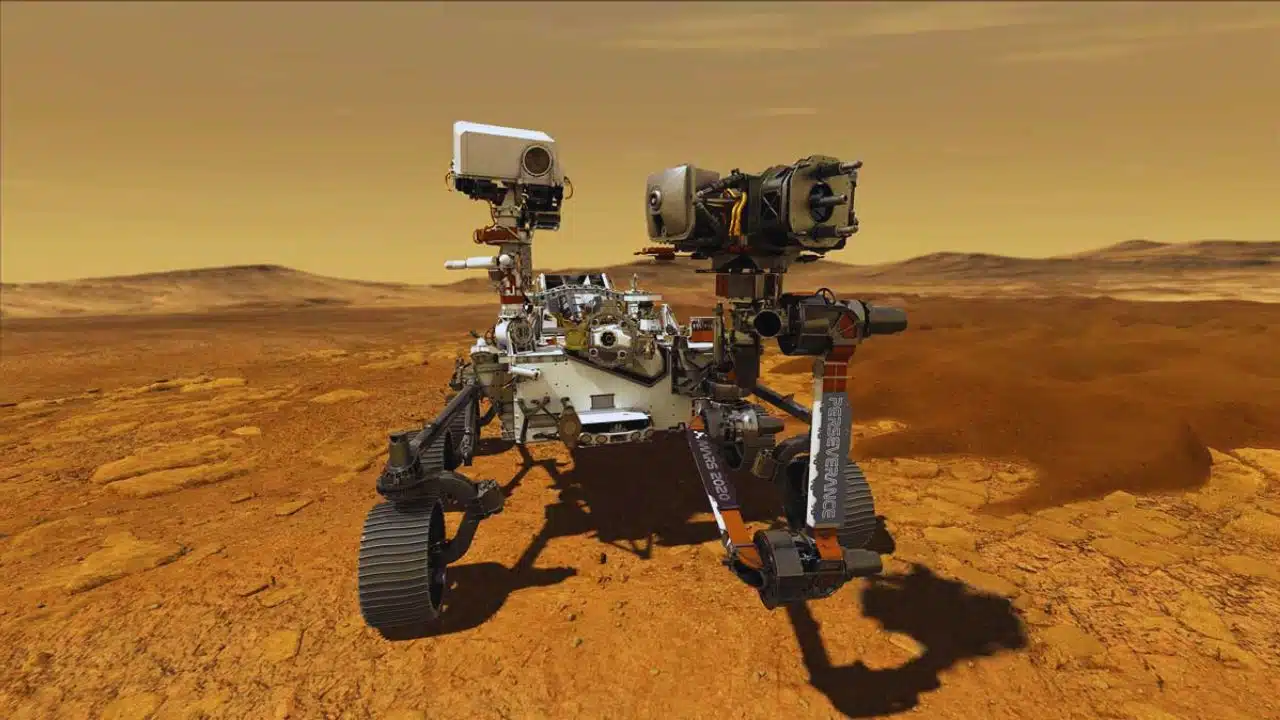
NASA says the Perseverance mission to 2031 is feasible after engineers certified key wheel and arm actuators, as a new study of the rover’s “Sapphire Canyon” core from Jezero Crater describes potential biosignatures and shapes its next sample hunt.
NASA’s Perseverance rover has spent nearly five years exploring Jezero Crater, a 28-mile-wide (45-kilometer-wide) impact basin that once held a lake and river delta. The rover’s job is straightforward but historic: look for signs of ancient microbial life, collect and seal carefully chosen rock and regolith samples, and help pave the way for future human exploration.
Now, two developments are converging into one larger story: Perseverance’s hardware appears healthy enough for an extended campaign through at least 2031, and a core sample taken from a rock nicknamed “Cheyava Falls” has become one of the mission’s most closely watched scientific prizes.
Why NASA is confident the Perseverance mission to 2031 can happen
Perseverance has already logged almost 25 miles (40 kilometers) on Mars—far more ground than many rover missions cover in their early years. NASA says internal checks show key mobility and arm components can keep going for a long haul, including certifications that the rover’s rotary actuators should support at least another 37 miles (60 kilometers) of driving.
The rover has also pushed daily operations faster through software upgrades such as “Enhanced Autonomous Navigation” (ENav), which helps the rover pick safer routes and drive with less human planning time. NASA highlighted a single-sol driving record of 1,350.7 feet (411.7 meters) set on June 19, 2025.
Operational resilience matters too. In 2024, the SHERLOC instrument suffered a motor issue that left its dust cover and autofocus mechanism in trouble. NASA says engineers recovered the instrument and returned it to science operations, and SHERLOC later detected some of the mission’s most compelling organics in the Cheyava Falls target area.
Key durability and performance markers
| What NASA evaluated | What NASA reported | Why it matters |
| Wheel/arm actuator health | Actuators certified for substantial additional distance; rover assessed as operable through at least 2031 | Extends the mission’s reach into new geology and new sampling opportunities |
| Driving capability | Nearly 25 miles (40 km) traveled; record single-sol drive in June 2025 | Faster traverses increase time available for science and sampling |
| Instrument recovery | SHERLOC returned to operations after a 2024 fault | Protects the mission’s ability to detect organics and interpret habitable environments |
What Perseverance found at “Cheyava Falls”—and why scientists are cautious
The “Cheyava Falls” rock drew intense attention after Perseverance encountered it in July 2024 while exploring Neretva Vallis, an ancient river valley on Jezero’s western edge. NASA imagery shows “leopard spot” patterns—millimeter-scale light patches with darker halos—along with large white calcium sulfate veins and reddish bands suggestive of iron-bearing minerals.
NASA’s September 2025 announcement tied the most important step to something tangible: the rover drilled a core sample from Cheyava Falls, sealing it in a tube named “Sapphire Canyon.” NASA described the sample as containing potential biosignatures—features that might have a biological origin but need more study to confirm.
Scientists emphasized why the word “potential” matters. NASA reported that detailed instrument measurements found mineral patterns consistent with “reaction fronts” and iron-rich minerals associated with redox (electron-transfer) chemistry. Two minerals highlighted were likely vivianite (hydrated iron phosphate) and greigite (iron sulfide). On Earth, these minerals can appear in settings tied to microbial activity—but they can also form through non-biological pathways.
What’s “biosignature-like” here, and what else could explain it?
| Observation in Cheyava Falls / Bright Angel rocks | Why it’s interesting | Plausible non-biological routes NASA says must be ruled out |
| “Leopard spot” textures and reaction-front patterns | Could reflect chemical energy gradients that microbes exploit on Earth | Abiotic mineral reactions, catalysis by organics, or other geochemical processes |
| Organic-carbon-bearing mudstones | Mudstones/clays can preserve chemical traces over long times | Organics can form without life (e.g., geological/chemical synthesis) |
| Vivianite- and greigite-like signatures | On Earth, can be linked to redox cycling in sediments | Can also form without biology under certain conditions |
“Sapphire Canyon” becomes a high-priority sample in the Mars life debate
“Sapphire Canyon” is not just a headline-grabber; it is part of a growing collection of sealed tubes intended for eventual return to Earth. NASA’s public materials describe Perseverance as a cornerstone of the Mars Sample Return campaign—built to collect and cache samples so that future spacecraft can retrieve them for high-sensitivity lab work that rovers cannot do on Mars.
NASA says Perseverance has collected dozens of cores and other sample types since landing in February 2021. In the September 2025 release, NASA reported “Sapphire Canyon” as one of 27 rock cores collected at that time.
The Nature paper linked to NASA’s announcement frames the scientific case more narrowly: instrument data show organic-carbon-bearing mudstones in the Bright Angel formation with nodules and reaction fronts enriched in iron-, sulfur-, and phosphorus-bearing minerals. The authors argue that Earth-based laboratory measurements on the returned core will be necessary to determine origins and rule out alternative pathways.
New clues from Jezero’s “Margin Unit” add context for habitability
While Cheyava Falls highlights potential biosignatures, NASA also points to a broader geological storyline: Jezero preserves multiple chapters of Mars’ environmental history.
In December 2025, NASA described a new peer-reviewed result based on samples and data from Jezero’s “Margin Unit”—a region interpreted as part of an ancient lakeshore environment. NASA says the findings indicate interactions among water, rock, and atmosphere, and the rover’s sealed cores provide a way to test these hypotheses more rigorously if and when they reach Earth labs.
This matters for the life question because habitability is bigger than a single rock. It depends on whether Mars provided liquid water, chemical energy, and stable environments long enough for biology to emerge and leave traces.
Where Perseverance goes next: crater rim science and new sampling targets
Perseverance’s extended runway through 2031 increases access to terrain that is “fundamentally new geology,” including crater rim materials that may represent some of the oldest crustal rocks accessible anywhere on Mars.
NASA’s Jet Propulsion Laboratory previously reported that the rover climbed to the top of Jezero’s crater rim in late 2024 after a ~3.5-month ascent of about 1,640 vertical feet (500 meters), tackling steep grades while still pausing for science observations. The mission’s “Northern Rim” campaign was planned to include multiple sites, several samples, and miles of driving over its first year.
A key near-term destination NASA highlighted is “Lac de Charmes,” a plains area beyond the rim that may preserve rock records less altered by the impact that formed Jezero. After that, Perseverance is expected to investigate large “megabreccia” blocks—ancient crustal fragments potentially excavated by the massive Isidis impact event.
Why longevity ties directly to Mars Sample Return
Perseverance’s ability to operate through at least 2031 is especially significant because Mars Sample Return is still being reworked.
NASA has said returning Mars samples is extraordinarily complex and that earlier plans carried high cost and long timelines. In 2024, NASA described a path forward that included seeking innovative designs, and stated that under then-current constraints, a return date could stretch to 2040—prompting calls for more affordable approaches.
In January 2025, NASA announced it would explore two landing architectures in parallel—one using a sky crane-style approach and one leveraging commercial capabilities—before selecting a single path. NASA said it expected to confirm the program design in the second half of 2026. NASA also described design changes such as replacing solar panels with a radioisotope power system on the lander platform and planning for an orbiting sample container that can hold 30 tubes.
Mars Sample Return decision points (as described by NASA)
| Date | NASA decision/update | What it changes |
| Apr 2024 | NASA outlined a revised path and said cost/timeline pressures required new approaches | Sets the push for redesigns and industry input |
| Jan 2025 | NASA said it would evaluate two landing options in parallel | Builds competition/innovation into the design phase |
| 2H 2026 (expected) | NASA said it would confirm MSR and select a design | Determines how and when samples can realistically get to Earth |
| Through at least 2031 | NASA says Perseverance can keep operating | Keeps sample collection and contextual science moving while MSR is finalized |
Final Thoughts
The Perseverance mission to 2031 is not just a durability milestone—it is a science and strategy multiplier. It gives NASA more time to gather diverse samples, revisit puzzling targets, and explore older crater-rim rocks that could rewrite the early story of Mars.
At the same time, “Sapphire Canyon” underscores the careful pace of astrobiology: even the most intriguing textures and minerals remain potential biosignatures until Earth-based laboratory work can test competing explanations. The extended mission increases the odds that Perseverance can collect the kind of “context samples” that make a future sample return scientifically decisive—whenever that return architecture is finally locked in.