Dmitry Shevelenko, Chief Business Officer of the generative AI startup Perplexity AI, made headlines this week as he stepped into an unlikely spotlight during the U.S. Justice Department’s antitrust trial against Google. Though subpoenaed to testify about the impact of Google’s alleged search monopoly, Shevelenko took the opportunity to pitch his startup as a serious contender to acquire the Chrome browser, should the court decide to break it away from Google’s broader tech empire.
His appearance, intended by prosecutors to demonstrate how Google’s dominance hinders new AI companies, turned into something far more dramatic — a bold business proposal made from the witness stand.
Backdrop: DOJ vs. Google – The Search Monopoly Fight
The trial is part of a historic legal battle — the largest tech antitrust case since the DOJ took on Microsoft in the 1990s. The U.S. government has accused Google of abusing its dominant position in the search engine market by entering into exclusive contracts with device manufacturers (like Apple and Samsung), browser developers (like Mozilla), and wireless carriers. These deals made Google the default search engine across billions of devices, locking out competitors and stifling innovation.
Judge Amit Mehta, who is presiding over the case, has already ruled that Google’s behavior was anti-competitive, particularly its use of exclusionary agreements to maintain its search engine monopoly. Now, the court is hearing remedy arguments — essentially, what actions should be taken to restore competition. One major remedy on the table: forcing Google to spin off Chrome, its globally dominant web browser.
Perplexity’s Unexpected Proposal: Let Us Run Chrome
Shevelenko told the court that although he was hesitant to testify — fearing retaliation from Google — he saw the moment as a chance to make a real business pitch. If the court decides Google must divest Chrome, he said, Perplexity AI is ready to take over.
When asked directly if any company other than Google could maintain Chrome’s quality and scale, he didn’t hesitate:
“I think we could do it.”
It was a bold claim. Perplexity AI, founded in 2022, is less than three years old. It specializes in AI-powered search and conversational responses — positioning itself as an alternative to traditional search engines. Taking over Chrome, a browser with billions of users, would be a mammoth leap.
Barriers to Competition: Shevelenko Describes Google’s Grip
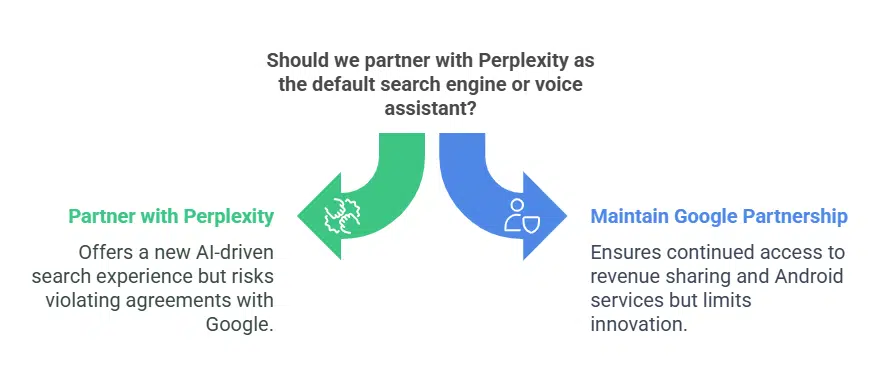
During his testimony, Shevelenko painted a vivid picture of the difficulties new AI companies face in gaining visibility. He revealed that Perplexity tried negotiating with multiple smartphone manufacturers and wireless carriers to become the default search engine or voice assistant on their devices — but every conversation “hit a wall.”
Why? The unnamed companies feared violating their existing agreements with Google, which could result in losing access to revenue sharing or critical Android services.
He compared the experience to having a “gun to their head”, describing Google’s control over the search distribution pipeline as immense and suffocating. Even when a phone maker wanted to preload Perplexity on its devices, Google’s contracts often made it impossible to replace Google as the default.
He cited one deal — believed to be with Motorola — where both sides wanted Perplexity as the default assistant but couldn’t proceed due to restrictions tied to Google’s licensing.
Technical Challenges: Android’s Labyrinth of Settings
Shevelenko also gave firsthand examples of how user-unfriendly the process is when someone tries to switch from Google to a competitor. He explained that on Android phones, setting Perplexity as the default assistant requires navigating through multiple complicated settings, so much so that he had to ask a colleague for help.
Even then, Perplexity doesn’t function like Google Assistant — users must tap a button to activate it, rather than use a simple wake word like “Hey Google.” This built-in disadvantage reflects Google’s prioritization of its own products, even on what’s supposed to be an open platform.
Chrome’s Open Source Future: A Concern for the Industry
Shevelenko’s pitch to take over Chrome was cautious, not celebratory. He warned that if Chrome were sold to a company with a less community-friendly vision — for instance, OpenAI, which has expressed similar interest — it could endanger the open-source Chromium project that underpins not only Chrome but also Microsoft Edge, Brave, and others.
“We wouldn’t want a remedy that cripples Google’s ability to keep building great products,” Shevelenko added, acknowledging Google’s contributions to the industry.
This is a key point: many of Google’s competitors don’t necessarily want to see Google dismantled, but they do want fair access to distribution channels and an end to coercive business practices.
A Pattern of Opportunism? Perplexity’s Bigger Ambitions
This isn’t the first time Perplexity has inserted itself into a high-profile regulatory dispute. The company has also expressed interest in acquiring TikTok, which is currently under threat of a U.S. ban due to its Chinese ownership via ByteDance.
Perplexity, it seems, is trying to position itself as a buyer of last resort — a politically neutral, innovation-driven alternative — whenever regulators look to break up or ban controversial tech platforms.
Industry Impact: What This Could Mean for Big Tech
The trial’s outcome could reshape not just Google’s operations but the entire browser and search engine landscape. Chrome currently commands more than 63% of the global browser market, and any forced sale or regulatory breakup could set a precedent for future tech antitrust remedies.
Smaller players like Perplexity, DuckDuckGo, and Brave are watching closely, knowing that any crack in Google’s dominance might finally give them room to grow.
From Witness Box to Bidding War?
Whether or not Google will be forced to divest Chrome remains to be seen. But Shevelenko’s testimony marked a turning point in the conversation — from simply criticizing Google’s practices to imagining what comes next.
If Chrome does go up for sale, Perplexity AI has thrown its hat in the ring — and in doing so, has taken a bold step toward becoming a major name in the AI and search space.
For now, the court’s next decision — on what remedy is both fair and effective — will be watched not only by Google and its competitors but by an entire tech industry standing at a crossroads.