Learning can feel difficult when lessons feel like a one-way street. Many students have experienced sitting through a class, taking pages of notes, and still leaving with countless unanswered questions. It often makes learning feel passive and even isolating.
This is where peer-to-peer learning changes the experience.
Research shows that students who teach their classmates tend to remember more than those who only listen. This approach to knowledge sharing transforms quiet classrooms into active learning environments where students support each other’s understanding and success.
This article explores what Peer-to-Peer Learning: The Future of Education really means. It examines why this method matters, how it works, the key benefits it offers, and practical strategies that help groups learn more effectively together.
What Is Peer-to-Peer Learning?
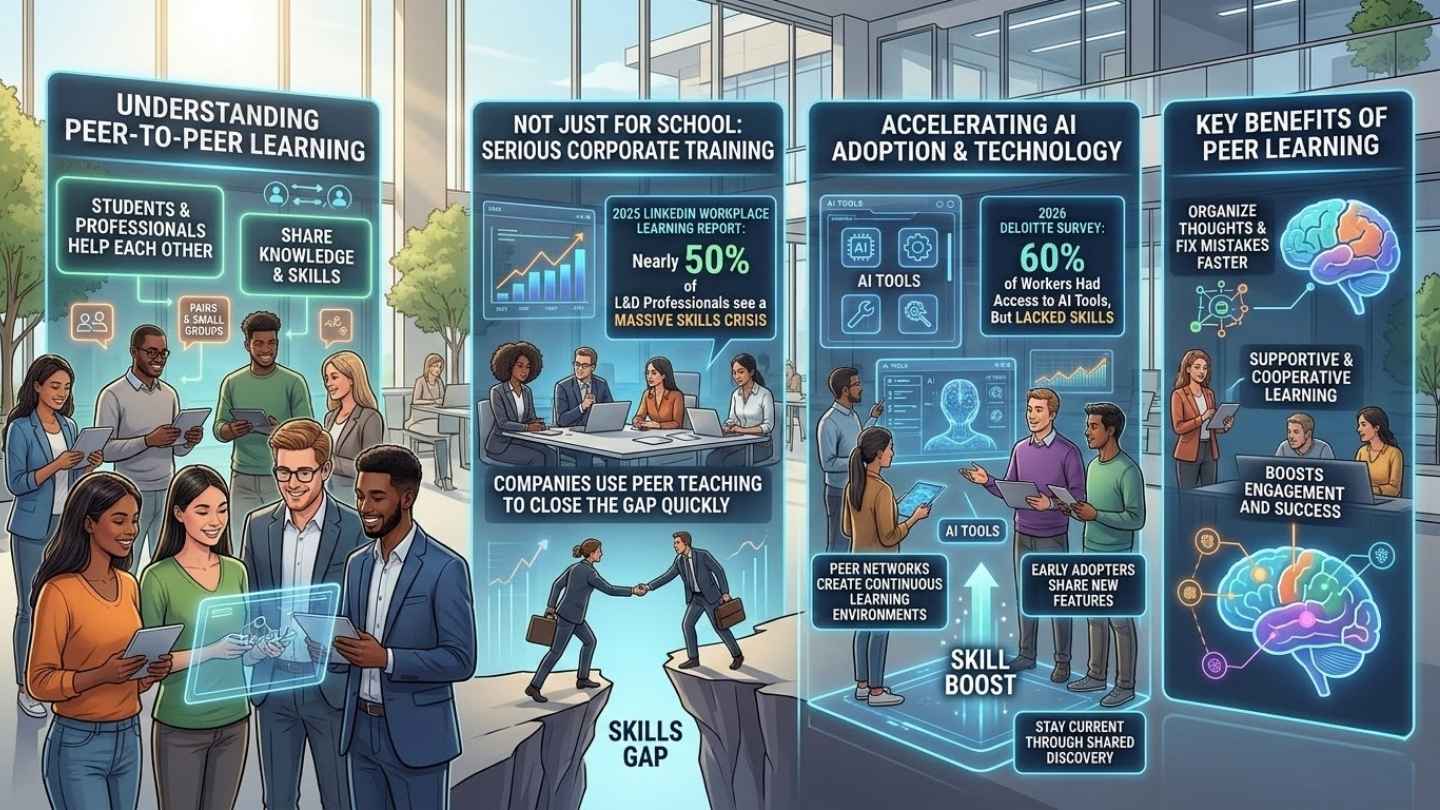
Peer-to-peer learning simply means students help each other learn. They share their knowledge and skills with classmates in pairs or small groups. This setup uses the power of student interaction and mutual support to reach goals together.
This method is no longer just for informal school settings. Organizations across the United States now rely on it for serious corporate training.
In fact, the 2025 LinkedIn Workplace Learning Report noted that nearly half of learning professionals see a massive skills crisis right now. Companies use peer teaching to close this gap quickly. For example, a 2026 Deloitte survey found that 60 percent of workers had access to new AI tools but lacked the skills to use them properly.
Peer networks create continuous learning environments where early adopters can share new features, helping everyone stay current through shared discovery.
Sharing lessons with peers helps learners organize their thoughts and fix mistakes faster. It supports cooperative learning instead of strict competition.
Why Peer-to-Peer Learning Matters
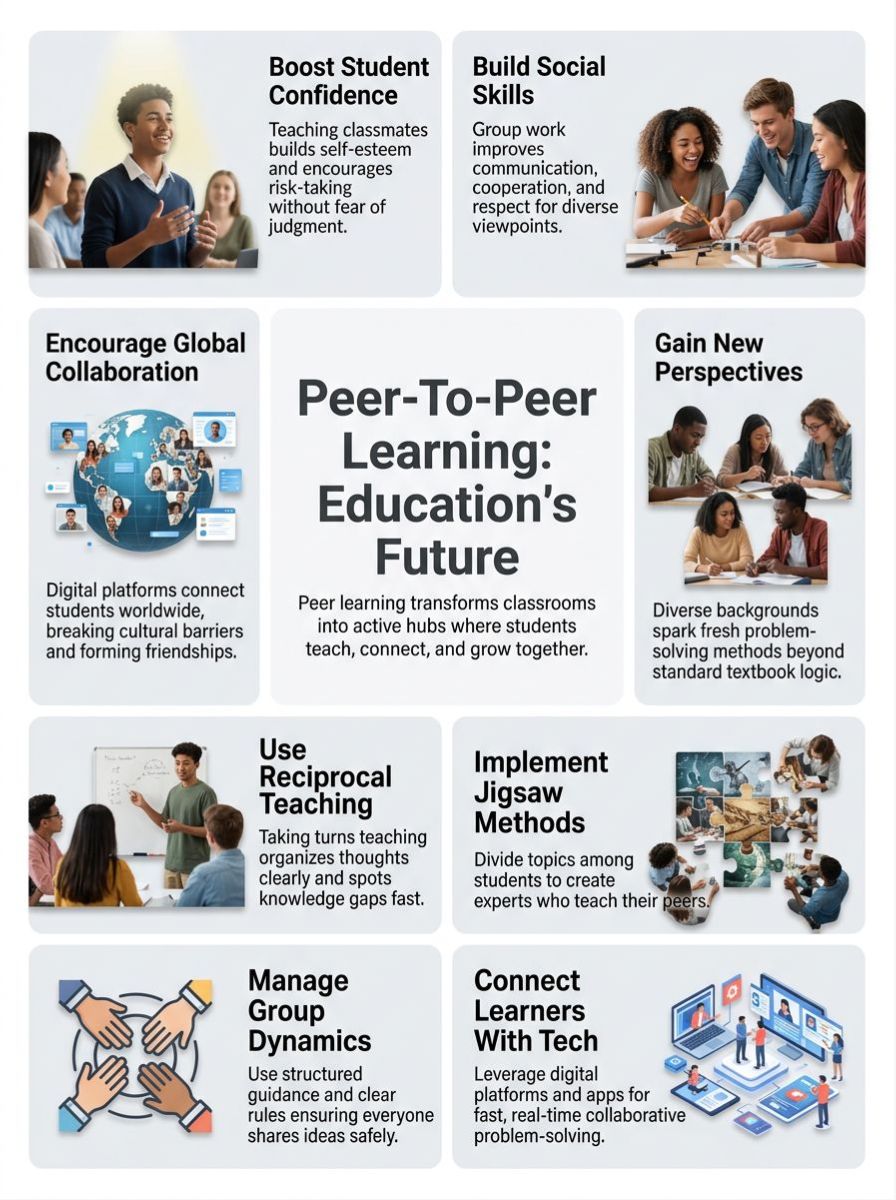
This approach puts students at the absolute center of their own growth. They pick up life skills while sparking new ideas together. This makes it easier to reach complex educational goals.
Promotes confidence
Standing up and teaching a classmate helps a student see their own hidden strengths. Their self-esteem grows as they explain ideas and answer questions.
Making mistakes in front of peers feels much less scary than messing up in front of a teacher. Using structured software tools makes this even more effective. Platforms like Kritik, a popular US peer assessment tool, allow students to give anonymous feedback safely.
Students report much higher confidence when they can privately review a peer’s work and receive guidance in return. Mentors gain deep knowledge while peer mentoring builds real leadership skills.
This style of education supports serious social growth by forcing teamwork. Learners have to talk, listen, share ideas, and solve problems as a unit.
A 2025 report from Engageli showed that adding peer-to-peer elements to training software increases problem-solving abilities by 35 percent. Here is a quick look at how individual study compares to group collaboration:
| Skill Area | Individual Learning | Collaborative Learning |
|---|---|---|
| Problem Solving | Relies on one perspective | Combines diverse viewpoints for better solutions |
| Communication | Internal thought process | Requires active listening and clear speaking |
| Social Accountability | Self-driven focus | Group motivation keeps effort high |
With practice in these mutual support settings, even shy kids find their voice.
Enhances communication abilities
Students learn to speak and listen clearly by practicing with each other. Words must be chosen with care if you want to explain a complex math step or a new science theory.
This builds real-world communication abilities for every learner involved. A recent WGU Labs study looked at university students using Peerceptiv in the US.
- 79 percent of students reported the platform allowed them to interact heavily with peers.
- More than half said giving and receiving feedback made them better students.
- Reviewing others helped them detect and fix their own writing mistakes.
Encourages global collaboration
Digital tools now connect people from every corner of the globe. A student in New York can easily share ideas with classmates in India or Brazil right from their laptop.
Universities use Collaborative Online International Learning programs to mix cultures. Placing students in multicultural teams helps them develop vital intercultural competencies alongside their regular curriculum.
This builds strong, diverse communities that shape modern education. Projects online turn into friendship-building exercises and culture swaps all at once.
Key Benefits of Peer-to-Peer Learning
This method opens new doors and sparks deep curiosity in any classroom or boardroom.
Provides new perspectives
Sharing ideas allows everyone to see things from many different sides. One person might use a clever trick to solve a math problem, while another shares a visual way to remember history dates.
Groups with diverse backgrounds bring fresh ways of thinking. The collective intelligence of a diverse group consistently outperforms individual efforts.
Diverse perspectives naturally lead to better, more innovative solutions than isolated thinking.
Working together pushes students to find answers far beyond basic textbook logic.
Makes studying more engaging
Peer-to-peer setups take boring study routines and flip them entirely upside down. Learners work in groups, share funny stories, and crack jokes while figuring out a tricky concept.
Psychologists warn about the Forgetting Curve, which shows humans forget 50 percent of new information within just one hour of learning it.
Active peer teaching stops this massive memory loss. Teaching each other sparks excitement that traditional lectures usually miss. Every lesson feels more like an interactive game than a chore.
Improves understanding through teaching others
Teaching someone else is like shining a bright flashlight on your own knowledge. You have to organize your thoughts and spot any missing pieces in your own memory.
Educators call this the Protégé Effect. It completely changes how we retain information.
- Reading a textbook gives you about a 10 percent retention rate.
- Practicing real applications bumps retention to 75 percent.
- Teaching the material to a peer leads to an incredible 90 percent retention rate.
Sharing what you just learned is simply the best way to make the information stick permanently.
Fosters teamwork and collaboration
Students lean on each other to solve hard problems and reach specific goals. Simple group projects force true cooperation, going way beyond just splitting up tasks.
Group members have to listen carefully and build trust by sharing ideas openly. This naturally builds intrinsic motivation, keeping effort high.
This teamwork translates directly into serious career success. A 2026 Deloitte study found that high-performing organizations unlocking worker growth through peer collaboration are 1.8 times more likely to outperform their competitors financially.
Popular Peer-to-Peer Learning Models
These creative setups help students teach each other in highly effective ways.
Proctor model
In the Proctor model, students take turns acting as teachers or guides. One student explains a concept while the others listen, ask questions, and share their own ideas.
Schools often use older students who just finished the class to proctor the incoming group. They help in a few specific ways:
- Answering common questions immediately.
- Guiding discussions during difficult topics.
- Sharing personal study tips that worked for them.
Their knowledge is fresh. This makes the material highly relatable for the younger classmates. This simple switch boosts confidence and encourages very open communication.
Peer assessment schemes
Peer assessment puts students right in the driver’s seat. Peers review each other’s work and give direct, actionable feedback.
For example, university classes use software like Peerceptiv or Kritik to automate this safely.
| Feature | How It Helps Students |
|---|---|
| Double-Blind Reviews | Removes bias and makes grading entirely fair. |
| Instructor Analytics | Shows the teacher exactly where the class is struggling. |
| Feedback on Feedback | Grades the reviewer on how helpful their comments were. |
Students stay engaged while checking others’ work, building social skills with every single score they give out.
Collaborative projects
Students team up to solve problems, create presentations, or build detailed models. These hands-on tasks encourage active knowledge sharing and deep focus.
Teachers frequently use digital platforms to make this happen easily.
- Padlet acts as a virtual bulletin board where students post links, videos, and images in real time.
- Canva for Education allows multiple students to design a single presentation simultaneously.
- Google Workspace lets teams edit the exact same document without overwriting each other.
This kind of cooperative learning sharpens communication skills instantly.
Reciprocal teaching
Reciprocal teaching uses heavy student interaction to boost reading comprehension. Each person in a small group takes a turn acting as the primary teacher.
Peers specifically practice four skills. They ask questions, clarify confusing words, predict what happens next, and sum up the main points.
Explaining new topics out loud leads to much better understanding for both the speaker and the active listeners.
Many US schools use this exact method for complex science texts. People learn from their mistakes in a very safe, informal education space.
Jigsaw method
Teachers break the class into small groups and give each group one specific piece of a much larger topic. Each student becomes the resident expert on their piece, and then they return to teach it to their original group.
Social psychologist Elliot Aronson designed this method to improve classroom integration.
Recent meta-analyses show the Jigsaw method massively improves academic performance. It forces students to rely on peer teaching rather than just listening to a lecture. The method builds major confidence while strengthening daily communication abilities.
Challenges of Peer-to-Peer Learning
This style of education can hit a few speed bumps if you do not plan ahead.
Potential knowledge gaps
Major gaps in understanding spring up if students share the wrong information. A confident student might explain a formula the wrong way, and the whole group will learn a bad habit.
This is often called the blind leading the blind.
Without a teacher’s final review, small misunderstandings in a peer group can quickly turn into deeply ingrained bad habits.
Teachers play a smaller role during the actual group work. You need a structured review at the end of the session to clear up any lingering misconceptions.
Managing group dynamics
This method works best with highly positive group dynamics. Loud voices easily take over, making it incredibly hard for quiet students to join the chat.
This leads to social loafing, where one or two people do all the heavy lifting. You can fix this easily:
- Use a physical talking stick to guarantee equal speaking time.
- Assign specific roles like timekeeper or note-taker.
- Use digital discussion boards so shy students can type their thoughts safely.
A 2024 survey by People Managing People showed that 22 percent of workers actually prefer learning from their peers. You just have to guide the dynamic carefully.
How to Implement Peer-to-Peer Learning Effectively
Mix things up, invite everyone to join in, and watch how fast the process becomes fun.
Encourage participation
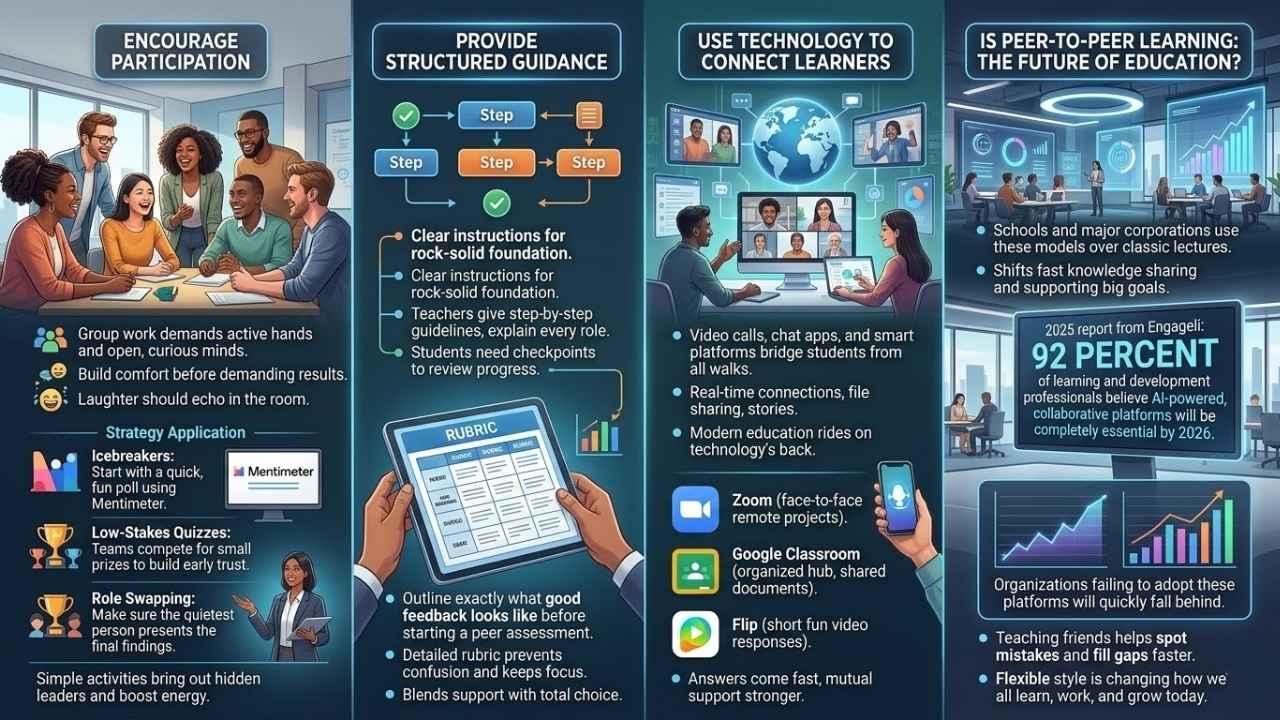
Group work demands active hands and open, curious minds. You have to build comfort before you demand results.
Laughter should echo in the room as everyone solves problems together.
| Strategy | Application |
|---|---|
| Icebreakers | Start with a quick, fun poll using Mentimeter. |
| Low-Stakes Quizzes | Let teams compete for small prizes to build early trust. |
| Role Swapping | Make sure the quietest person presents the final findings. |
Simple activities bring out hidden leaders and boost the energy in the room.
Provide structured guidance
Clear instructions always create a rock-solid foundation. Teachers must give step-by-step guidelines and explain every single person’s role.
Students need checkpoints to review their progress. For instance, outline exactly what good feedback looks like before starting a peer assessment.
Providing a clear, detailed rubric prevents confusion and keeps the entire group focused on the main goal.
Structured guidance blends support with total choice. It makes every interaction highly valuable without feeling overwhelming.
Use technology to connect learners
Video calls, chat apps, and smart platforms bridge students from all walks of life. Learners connect in real time to share files and swap stories.
Modern education rides directly on technology’s back.
- Zoom powers face-to-face student interaction for remote group projects.
- Google Classroom keeps all shared documents in one organized hub.
- Flip allows students to record short, fun video responses to discussion prompts.
Answers come fast with a few quick taps, making mutual support stronger than ever before.
Is Peer-to-Peer Learning: The Future Of Education?
Schools and major corporations now use these models far more than classic, boring lectures. This shift helps people share knowledge fast and support each other’s biggest goals.
The statistics prove this is not a passing fad.
A 2025 report from Engageli revealed that 92 percent of learning and development professionals believe AI-powered, collaborative platforms will be completely essential by 2026. Organizations that fail to adopt these platforms will quickly fall behind.
Teaching friends helps people spot their own mistakes and fill in knowledge gaps faster than reading alone. This flexible style is changing how we all learn, work, and grow today.
Final Thoughts
Thinking about Peer-to-Peer Learning: The Future Of Education? It sparks pure curiosity, boosts confidence, and brings students together in ways that old classroom methods simply cannot match.
Teachers who use these strategies find their students eager to share ideas. They help each other and push through tricky subjects as a unified team. Anyone can start with simple steps like digital group projects or peer tutoring.
You will see quick results without fancy plans or expensive tools. Try out these collaborative approaches and notice how learning turns into a fun, productive journey for everyone involved.