
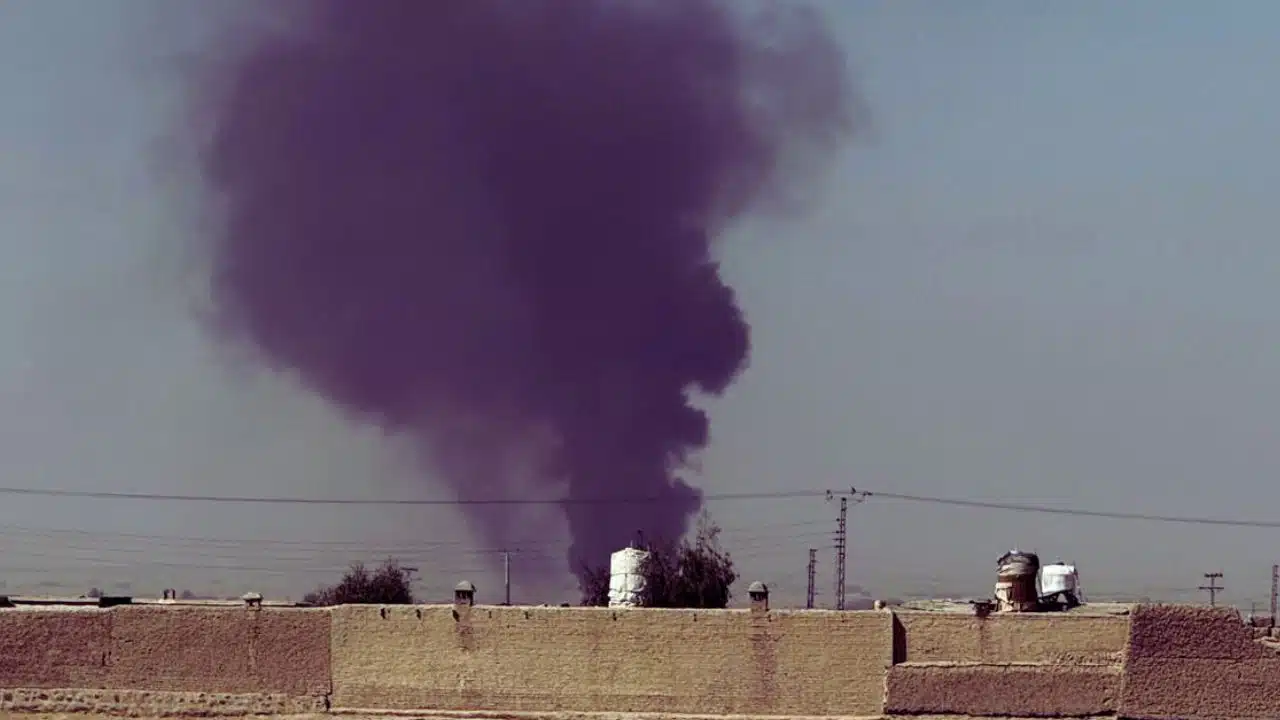
Pakistan launched retaliatory airstrikes near Kabul late Wednesday following days of intense cross-border fighting with Afghan forces that left dozens dead and wounded, diplomatic and military sources confirm. A fragile 48-hour ceasefire has now been agreed upon, halting a significant escalation of tensions between the two neighbors.
The Pakistan strikes Afghan’s Kabul outskirts, a rare military action so deep inside Afghan territory, signal a hardening of Islamabad’s stance on border security and Taliban-led Afghanistan’s alleged inaction against militant groups.
The Escalating Conflict
- Pakistani Airstrikes: For the first time in recent memory, Pakistani jets struck targets in the She-gai area of Afghanistan’s Kabul province, approximately 35 kilometers from the capital city center, on the night of October 15, 2025.
- Heavy Casualties: At least 38 people, including Afghan civilians and security personnel, have been killed since clashes erupted on October 12 at the Chaman-Spin Boldak border crossing. Pakistan has reported at least 9 military casualties.
- Ceasefire Agreement: Following intense diplomatic engagement, both sides agreed to a 48-hour ceasefire, effective from 6:00 AM local time on Thursday, October 16, 2025, to allow for de-escalation talks.
- Core Dispute: The clashes were reportedly triggered by Afghan forces attempting to erect a new checkpoint in a disputed border area, which Pakistan claims violates previous agreements. The underlying issue remains the contested nature of the Durand Line, the 2,670-kilometer border.
- Militant Sanctuaries: Islamabad has repeatedly accused the Afghan Taliban of providing safe havens to the Tehreek-e-Taliban Pakistan (TTP), a charge Kabul denies.
What Happened: From Border Skirmish to Airstrikes
The situation spiraled on Sunday, October 12, when Afghan forces reportedly began construction on a new security post near the Chaman-Spin Boldak border, one of the busiest and most vital trade and transit points between the two nations. Pakistani border guards objected, leading to a heated exchange that quickly escalated into heavy machine gun and mortar fire.
Fighting intensified over the next 72 hours, spreading to adjacent areas in Balochistan (Pakistan) and Kandahar (Afghanistan) provinces. Both sides accused the other of initiating the violence and targeting civilian areas. The Chaman border crossing, a lifeline for thousands of traders and travelers, was immediately sealed, stranding hundreds of trucks laden with perishable goods.
The conflict reached a critical point late Wednesday night. In a significant military escalation, the Pakistan Air Force (PAF) conducted what it termed “precision counter-terrorism strikes” against suspected TTP hideouts in the mountainous She-gai region on the fringes of Kabul province. A senior Pakistani military official, speaking on condition of anonymity, stated the strikes were “a necessary response to a clear and present threat” and targeted specific militant camps used to launch attacks inside Pakistan.
The Afghan Taliban’s Ministry of Defense swiftly condemned the strikes as an “act of aggression” and a “violation of Afghanistan’s sovereignty.” In a statement released early Thursday, ministry spokesman Enayatullah Khwarazmi warned, “The Islamic Emirate of Afghanistan has the right to retaliate against any aggression. Such provocative actions will have consequences that will not be in Pakistan’s control.”
Latest Data and Statistics
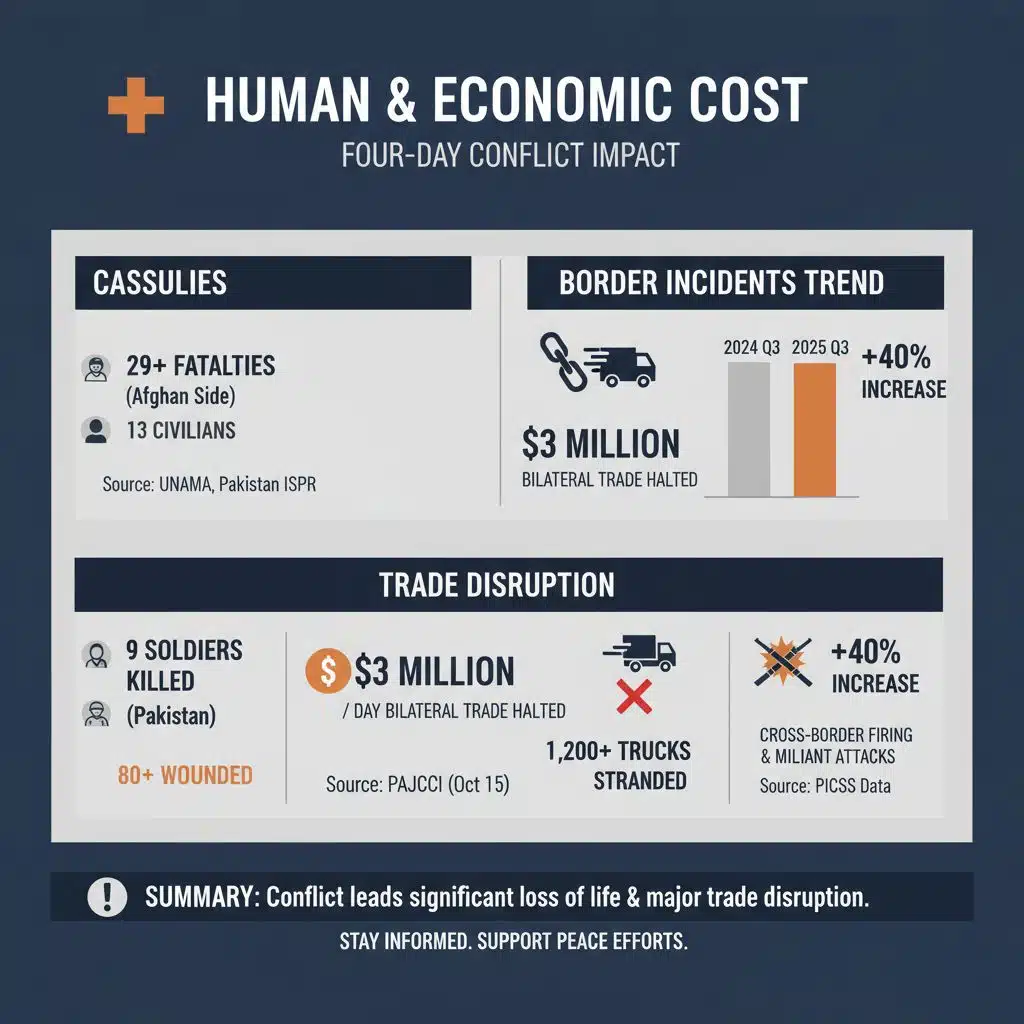
The human and economic cost of the four-day conflict has been substantial.
- Civilian and Military Casualties: As of 10:00 AM local time, October 16, Afghan sources report at least 29 fatalities on their side, including 13 civilians, and over 80 wounded. Pakistan’s military media wing, the ISPR, has officially confirmed the deaths of 9 soldiers and injuries to 22 others. (Source: United Nations Assistance Mission in Afghanistan – UNAMA, Pakistan ISPR Press Release).
- Trade Disruption: The closure of the Chaman-Spin Boldak crossing has halted an estimated $3 million in daily bilateral trade. The Pakistan-Afghanistan Joint Chamber of Commerce and Industry (PAJCCI) reported on October 15 that over 1,200 trucks are stranded on both sides, carrying fresh produce, medical supplies, and other essential goods.
- Border Incidents Trend: Cross-border security incidents have surged in 2025. Data compiled by the Pakistan Institute for Conflict and Security Studies (PICSS) shows a 40% increase in cross-border firing incidents and militant attacks originating from Afghanistan in the third quarter of 2025 compared to the same period in 2024.
Official Responses and Expert Analysis
Official Statements
The international community has urged restraint. The U.S. State Department called for “immediate de-escalation” and dialogue to resolve the border disputes.
In Islamabad, Pakistan’s Foreign Minister, Jalil Abbas Jilani, defended the military action. In a press conference on Thursday morning, he stated:
“Pakistan has exercised immense restraint for months. We have repeatedly provided actionable intelligence to the interim Afghan government about TTP sanctuaries. Their failure to act has forced our hand. Our sovereignty is paramount, and we will not allow our soil to be attacked with impunity from foreign territory.
The Afghan Taliban’s Deputy Prime Minister for Political Affairs, Mawlawi Abdul Kabir, chaired an emergency meeting in Kabul, reportedly telling attendees that while Afghanistan seeks peaceful relations, its “territorial integrity is a red line.”
Expert Analysis
Dr. Asfandyar Mir, a senior expert at the U.S. Institute of Peace, noted that the strikes near Kabul represent a major strategic shift for Pakistan. “This is no longer just about border skirmishes. Striking near the capital is a powerful and risky message from Islamabad to the Taliban leadership: your inaction on the TTP has consequences that can reach the heart of your power,” he explained in a analysis for a security forum. (Paraphrased from a public webinar). He added that the risk of miscalculation is now “extremely high,” as the Taliban may feel pressured to retaliate to maintain their credibility.
The move puts the Afghan Taliban in a difficult position. Cracking down on the TTP, their ideological allies, could cause internal friction, while failing to do so invites further Pakistani military action.
Impact on Local Populations
For residents on both sides of the border, the conflict has been terrifying.
“We spent two nights in our basement. The sound of mortars was constant,” said Abdul Ghafoor, a 55-year-old shopkeeper from the Pakistani border town of Chaman, in a telephone interview. “My cousin’s house was hit by a stray shell. We don’t care about the politics; we just want this to stop so we can live in peace.”
In Afghanistan’s Spin Boldak, the situation is equally grim. “Hospitals are overwhelmed with injured people,” a local doctor told the BBC’s Pashto service. “We are running low on blood and medical supplies because the border is closed. Civilians are paying the highest price for this fight.”
What to Watch Next
The next 48 hours are critical. The success or failure of the ceasefire will depend on several factors:
- De-escalation Talks: A flag meeting between local commanders is scheduled for Thursday afternoon. The focus will be on restoring the status quo at the disputed border point.
- Taliban’s Response to TTP: The key long-term factor is whether the Afghan Taliban will take verifiable action against TTP militants on their soil. Pakistan will be watching for concrete steps, not just promises.
- International Mediation: The role of third parties, such as China or the United Nations, could be crucial in mediating a more permanent solution to the border demarcation and security issues.
The strikes near Kabul have fundamentally altered the dynamic between the two countries. While the ceasefire provides a brief respite, the underlying sources of conflict remain unresolved, and the path forward is fraught with uncertainty.