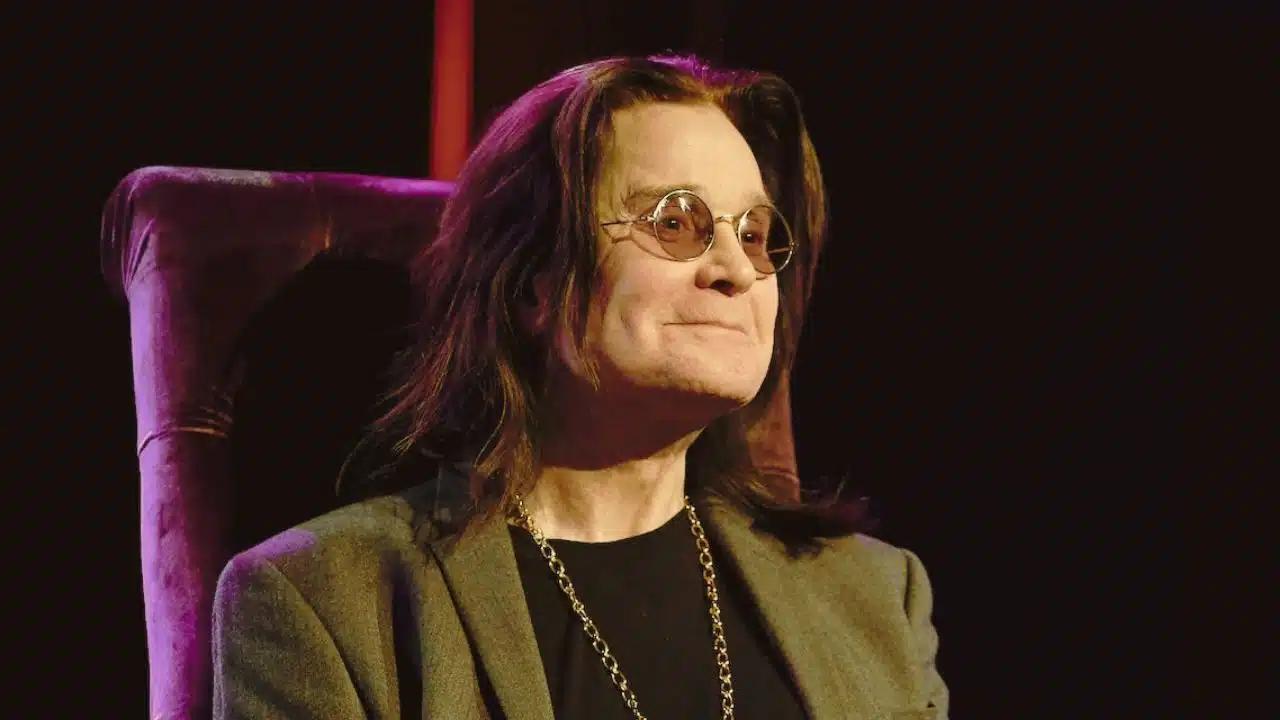
British rock legend Ozzy Osbourne, widely regarded as the “Prince of Darkness” and one of the most influential figures in the history of heavy metal, has died at the age of 76. His death was confirmed by his family in a public statement on July 22, 2025. Osbourne passed away peacefully at his home in Birmingham, England, surrounded by his wife, Sharon Osbourne, and their children.
His passing marks the end of an era for heavy metal, rock, and global popular culture.
Final Days: A Peaceful Goodbye Surrounded by Family
Osbourne had been struggling with multiple chronic health conditions in recent years, including Parkinson’s disease, spinal injuries, and infections. His health had significantly deteriorated by mid-2025. Despite these challenges, he made a public appearance earlier this month, performing what would become his final concert at Villa Park Stadium in his hometown of Birmingham.
During that July 5 event, which was framed as a farewell celebration for Black Sabbath’s enduring legacy, Ozzy appeared onstage seated due to reduced mobility. The performance was emotionally charged and drew over 45,000 fans, serving as a symbolic close to a groundbreaking musical journey that spanned over five decades.
His family confirmed that he was not alone at the time of death and passed in a peaceful and dignified manner after months of illness.
Health Struggles and Long-Term Medical Conditions
In 2020, Osbourne publicly revealed that he had been diagnosed with Parkinson’s disease, a degenerative neurological condition that affects motor function and speech. However, it later emerged that he had been living with the condition since at least 2003. Over time, his ability to walk, perform, and even engage in interviews became increasingly limited.
In addition to Parkinson’s, Osbourne had undergone multiple spinal surgeries, especially after a fall in 2019 that aggravated injuries from a prior ATV accident in 2003. He also battled a serious staph infection in 2018 that required hospitalization, as well as bouts of pneumonia and respiratory complications.
By 2023, these cumulative health issues had forced him to cancel his farewell tour, citing that travel and live performances had become physically impossible. His condition had reached a stage where daily life involved round-the-clock medical care and physical limitations that kept him largely homebound.
Despite these obstacles, Osbourne continued to record music, connect with fans online, and express gratitude for the support he received from the public and the music industry.
A Music Career That Defined Generations
Born John Michael Osbourne on December 3, 1948, in Aston, Birmingham, Ozzy grew up in a working-class household with limited resources. In 1968, he co-founded the band Black Sabbath, alongside guitarist Tony Iommi, bassist Geezer Butler, and drummer Bill Ward. The group pioneered a new genre of music that would come to be known as heavy metal, combining dark, distorted guitar riffs with apocalyptic lyrics and occult themes.
Black Sabbath released their debut album Black Sabbath in 1970, followed by classics like Paranoid, Master of Reality, and Vol. 4. Songs like “War Pigs,” “Iron Man,” and “Paranoid” became international hits, establishing the band’s legacy as the godfathers of metal. Their music inspired countless acts across rock, punk, and metal in the decades to follow.
Ozzy was dismissed from the band in 1979 due to struggles with substance abuse. However, his departure launched an even more successful solo career, starting with the 1980 album Blizzard of Ozz, which included iconic tracks like “Crazy Train” and “Mr. Crowley.” He released 13 solo albums, many of which achieved multi-platinum status.
Over the course of his career, Osbourne sold over 100 million albums worldwide as both a solo artist and a member of Black Sabbath.
Recognition and Industry Honors
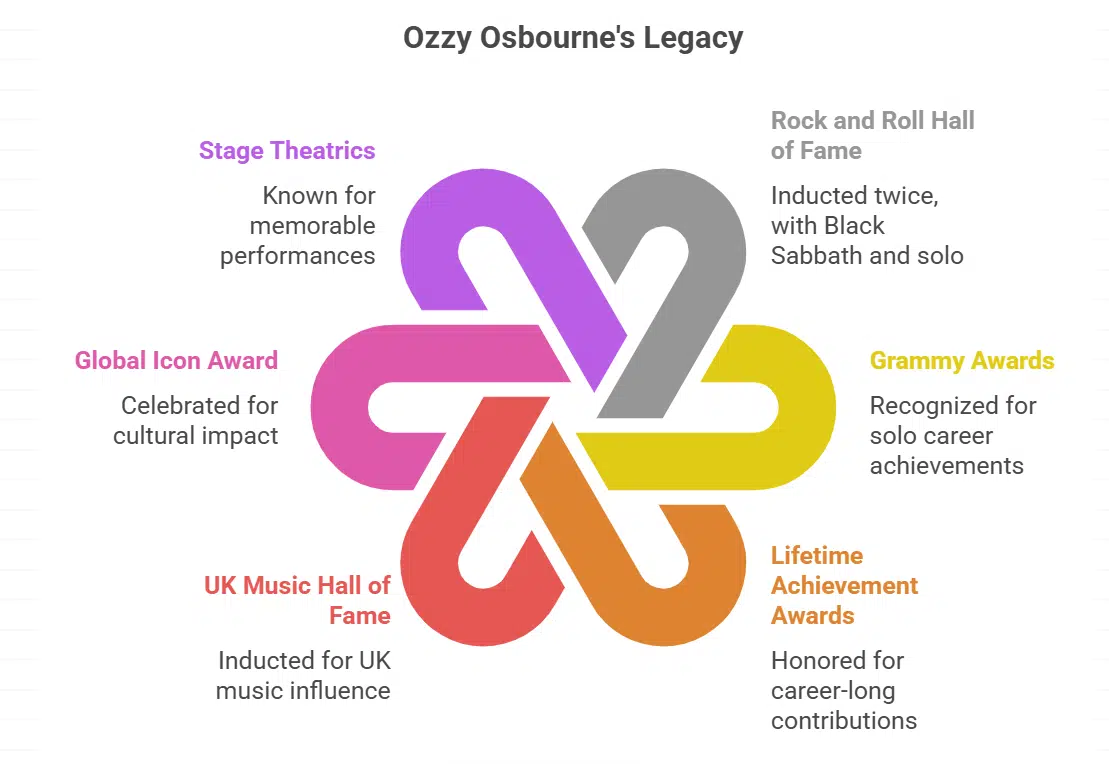
Ozzy Osbourne’s influence on the music world was acknowledged through numerous awards and accolades. He was inducted into the Rock and Roll Hall of Fame twice—first in 2006 as a member of Black Sabbath and then again in 2024 as a solo artist.
His solo career was also honored with Grammy Awards and Lifetime Achievement recognitions. In the UK, he was inducted into the UK Music Hall of Fame and received a Global Icon Award for his cultural impact.
Beyond traditional accolades, Osbourne’s persona and legacy were cemented through decades of stage theatrics, such as his infamous act of biting off the head of a bat during a 1982 performance—a moment that, for better or worse, became one of the most talked-about events in rock history.
Crossover into Reality TV and Pop Culture
In 2002, Osbourne and his family starred in The Osbournes, an MTV reality show that became a pop culture phenomenon. The show offered an unfiltered look into the chaotic but loving home life of Ozzy, Sharon, and their children, Kelly and Jack. It broke records for viewership and marked a turning point in how celebrities were portrayed on television.
While the show brought laughter and insight into Osbourne’s offstage life, it also highlighted the challenges he faced with substance abuse, aging, and his attempts at sobriety. The program ran for four seasons and helped launch the media careers of his children.
The show contributed significantly to the rise of reality television and changed public perception of heavy metal artists, showing a softer, more vulnerable side of an otherwise larger-than-life figure.
Personal Life and Family
Ozzy Osbourne was married twice. His first marriage to Thelma Riley produced three children—Jessica, Louis, and Elliot (who was adopted). His second and most publicly known marriage to Sharon Osbourne in 1982 resulted in three more children—Aimee, Kelly, and Jack Osbourne. Sharon Osbourne, a prominent television personality and businesswoman, played a significant role in managing Ozzy’s career post-1980s and supported him during his long health battles.
Despite personal struggles and public controversies, Osbourne maintained a strong bond with his children and grandchildren. His family described him as deeply committed to them and dedicated much of his later life to spending time at home, away from the spotlight.
Global Tributes and Industry Response
The announcement of Ozzy Osbourne’s death sparked a wave of tributes from fans and celebrities around the world. Fellow musicians from Metallica, Iron Maiden, Jack White, and Elton John honored his musical legacy and personal impact on their careers. Rock stations globally held tribute shows, and streaming platforms highlighted his most iconic performances.
At Black Sabbath’s Birmingham headquarters, fans gathered spontaneously to light candles and place flowers beneath the band’s commemorative plaques. Memorial concerts and tributes are being planned in both the UK and the U.S., with London’s O2 Arena and Los Angeles’ Hollywood Bowl expected to host large-scale remembrances.
Final Reflections: A Lasting Legacy in Rock and Beyond
Ozzy Osbourne’s legacy extends far beyond his music. He redefined performance, bridged the gap between underground and mainstream rock, and introduced millions to the raw, unfiltered emotion that heavy metal embodies.
From Birmingham pubs to sold-out arenas around the world, from controversial headlines to beloved family man on reality TV, Osbourne’s journey reflects the full spectrum of human experience—chaotic, creative, tragic, and triumphant.
His influence will live on in the riffs, lyrics, and voices of future generations of artists who follow in his footsteps, forever echoing the sound of a man who turned darkness into music and pain into power.