OpenAI is deepening its presence in Asia by announcing its first corporate office in India, with New Delhi set as the launch site. The decision underscores India’s importance as a global hub for digital adoption, given it is the world’s second-largest internet and smartphone market after China. The move also comes just days after the company rolled out its first India-focused subscription plan for ChatGPT, designed specifically to meet the needs of price-sensitive users in the region.
The New Delhi office will serve as a regional hub where OpenAI plans to build a dedicated team tasked with strengthening relationships across government, enterprise, academia, and developer communities. Recruitment has already begun, with senior roles in sales, partnerships, and enterprise strategy being prioritized.
Recent Leadership Moves in India
OpenAI’s expansion builds on a series of recent hires in the country. In April 2024, the company appointed Pragya Misra, formerly with Meta and Truecaller, as head of public policy and partnerships in India. Around the same time, Rishi Jaitly, former head of Twitter India, was brought on board as a senior advisor. Both executives have been central to helping the company navigate India’s regulatory landscape and forge connections with policymakers, as the country develops its AI governance framework under the IndiaAI Mission.
These early moves signaled OpenAI’s intent to anchor itself within India’s fast-growing AI ecosystem rather than operating solely from abroad.
ChatGPT Go: A Subscription for the Masses
Alongside the office announcement, OpenAI introduced ChatGPT Go, its most affordable plan to date, priced at ₹399 per month (approximately $4.60). This marks the company’s first region-specific pricing strategy.
ChatGPT Go is designed to appeal to India’s large user base by offering:
-
Ten times higher usage limits compared to the free plan.
-
More messages, image generations, and file uploads.
-
Extended memory features for more personalized interactions.
-
Access to GPT-5, the company’s most advanced model.
Importantly, OpenAI has integrated support for domestic payment methods including UPI platforms such as PhonePe, Paytm, and Google Pay, making it accessible to everyday users.
The launch comes at a competitive moment: rival AI platform Perplexity has partnered with telecom giant Bharti Airtel, giving more than 360 million Airtel subscribers free access to Perplexity Pro for a year. OpenAI’s pricing move is widely seen as a direct response to this push.
Expanding Engagement Through Summits and Developer Events
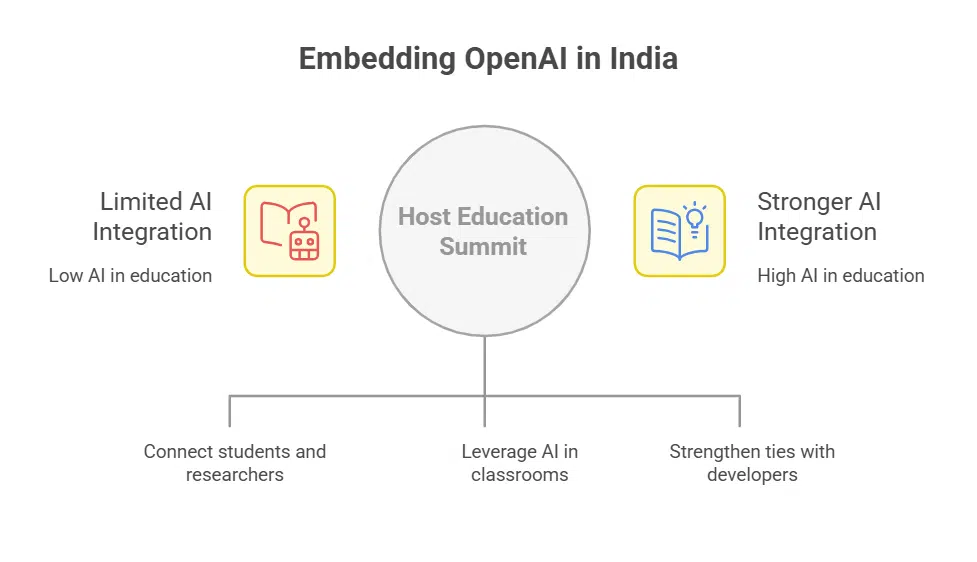
OpenAI has also announced plans to host its first Education Summit in India this month. The event will bring together students, researchers, and educators to explore how generative AI can be leveraged in classrooms and professional training. Later in the year, the company will host its first Developer Day in India, offering workshops and early access previews to strengthen ties with India’s thriving developer community.
These events reflect OpenAI’s focus on not just selling AI services but also embedding itself into the country’s academic and professional pipelines, which produce some of the world’s largest numbers of engineers and computer scientists.
Government Support and the IndiaAI Mission
The Indian government has been pushing aggressively to position the country as a global AI leader. The IndiaAI Mission, launched earlier this year, is investing in research, AI innovation hubs, and policy frameworks to ensure responsible and inclusive AI deployment.
OpenAI’s announcement has been welcomed by policymakers, who view the company’s entry as a validation of India’s potential. The synergy between India’s tech talent, developer ecosystem, and strong government backing is seen as an opportunity for global AI firms to innovate while also contributing to the domestic digital economy.
Challenges: Monetization and Policy Risks
Despite optimism, OpenAI faces significant hurdles. The Indian market is notoriously price-sensitive, making monetization difficult for subscription-based services. Many Indian users rely heavily on free services, meaning converting them into paying customers is a long-term challenge.
There are also legal and regulatory risks. In late 2024, Indian news agency Asian News International (ANI) filed a lawsuit against OpenAI for allegedly using copyrighted material without permission in AI-generated outputs. Several publishers later joined the case, signaling wider concerns about how generative AI platforms handle intellectual property.
These issues highlight the delicate balance OpenAI must strike between expanding its user base, respecting local legal frameworks, and ensuring compliance with India’s evolving AI policies.
India as a Priority—But Not Without Competition
India is one of OpenAI’s fastest-growing markets by user numbers, but it was not the company’s first Asian priority. OpenAI had already established offices in Japan, Singapore, and South Korea, where enterprise adoption is more mature and monetization opportunities are more straightforward. Rival firm Anthropic, for example, chose Tokyo rather than New Delhi for its Asian base, citing stronger enterprise readiness in Japan.
Silicon Valley investors note that India presents unique challenges, particularly when it comes to enterprise AI adoption. Convincing Indian businesses—many of which operate with slim margins—to invest in premium AI services has historically been difficult.
Leadership Commitment and Next Steps
To underline the importance of India, OpenAI CEO Sam Altman is scheduled to visit New Delhi in September 2025, coinciding with the opening of the office. His visit is expected to include high-level meetings with policymakers, industry leaders, and academic partners.
The new office, combined with localized services like ChatGPT Go and community engagement programs, represents OpenAI’s most concrete step yet toward making India a cornerstone of its global AI strategy.
OpenAI’s decision to establish a permanent base in India signals a turning point in how global AI firms view the country. By pairing an affordable local plan with an office presence and deeper community engagement, the company is betting on India’s massive developer ecosystem and digital-first population to fuel its next phase of growth.
At the same time, challenges around monetization, copyright, and regulatory compliance will test its ability to succeed in one of the most dynamic yet complex markets in the world. If successful, OpenAI’s expansion could play a key role in making India a global hub for AI innovation over the next decade.
The information is collected from MSN and Yahoo.