OpenAI, best known for creating ChatGPT and pushing AI into the mainstream, is now moving aggressively into consumer hardware. The company has reportedly signed a manufacturing deal with Luxshare Precision Industry, a Chinese firm that is one of Apple’s most important device assemblers. Luxshare is already responsible for building iPhones, AirPods, and other Apple products at scale, giving it the production expertise needed to help OpenAI move from concept to consumer device.
The device itself is still in prototype stages. Early reports describe it as a pocket-sized gadget that is designed to be context-aware and built specifically to work with OpenAI’s AI models. This would allow the product to go beyond the limitations of smartphones and PCs, enabling a more seamless and natural way for people to interact with AI in everyday life.
If successful, the project could mark a turning point for AI companies, showing that the future of artificial intelligence is not only software and cloud platforms but also dedicated devices built around AI from the ground up.
By choosing Luxshare, OpenAI is signaling that it wants to build hardware on a large scale from day one. Luxshare has the capacity to produce millions of units and is deeply integrated into global electronics supply chains. The partnership suggests OpenAI is not aiming for a niche experimental release but a mass-market consumer device.
In addition to Luxshare, OpenAI has reportedly approached Goertek, another major Chinese supplier. Goertek is well known for assembling Apple products such as AirPods, HomePods, and Apple Watches. For OpenAI, Goertek could provide speaker modules and other key components that would be essential for an AI device designed for voice interaction and contextual audio processing.
Together, Luxshare and Goertek could provide OpenAI with a reliable path to develop, test, and scale manufacturing of its first consumer device—something that very few AI companies have attempted at this scale.
Competing with Smartphones and Consumer Electronics Giants
The project is being described as one of the most ambitious bets by any AI company. Instead of relying on the smartphone ecosystem—where AI assistants like Siri, Google Assistant, and Alexa are embedded into existing hardware—OpenAI wants to create a standalone product category.
Such a device could directly challenge the dominance of Apple, Samsung, and Google, which currently control the global market for consumer electronics. Unlike smartphones, which are built as general-purpose devices, OpenAI’s hardware would be purpose-built for AI interactions, potentially giving it an edge in speed, accuracy, and usability for AI-driven tasks.
This strategy reflects a broader trend in the tech industry: companies are beginning to build hardware that puts AI at the center of the experience, rather than treating it as an added feature.
Jony Ive’s Role: From iPhone Design to AI Hardware
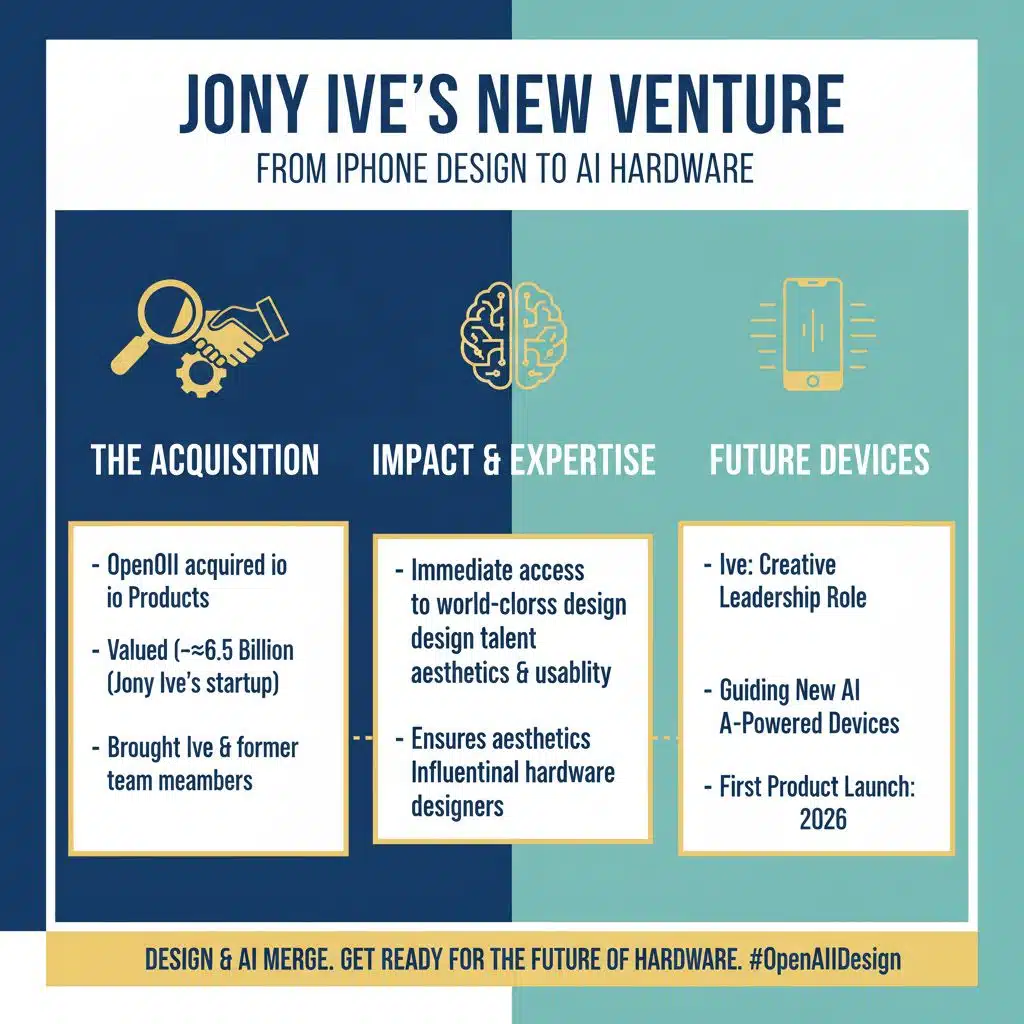
OpenAI’s hardware ambitions became clearer earlier in 2025 when it acquired io Products, a startup founded by Jony Ive, the legendary designer of the iPhone, Apple Watch, and MacBook. Ive’s design studio, LoveFrom, has been working closely with OpenAI since the acquisition, which was valued at about $6.5 billion.
The deal not only brought Ive but also several members of his former Apple design team into OpenAI. This includes some of the most influential hardware designers of the last two decades. The acquisition gave OpenAI immediate access to world-class design expertise, ensuring that its AI hardware would not only function well but also meet the expectations of modern consumers in terms of aesthetics and usability.
Ive has taken on a creative leadership role, guiding the design of what is expected to be a new generation of AI-powered consumer devices. The first product under his leadership is scheduled to launch in 2026, though some reports suggest it may not reach mass production until late 2026 or early 2027.
What We Know About the Device So Far
While details remain under wraps, several key aspects have been reported:
-
Form factor: The device is said to be pocket-sized, but not a smartphone replacement. It may not feature a traditional screen, suggesting an emphasis on voice-first interaction or possibly ambient computing.
-
Context-awareness: The hardware is expected to be designed around environmental sensing and adaptive AI, meaning it could understand the user’s surroundings and provide more relevant, real-time responses.
-
Audio-centric design: With Goertek potentially supplying speaker modules, the device is likely to focus heavily on voice communication and high-quality audio output.
-
Integration with GPT models: It will be deeply connected to OpenAI’s latest models, possibly GPT-5 or later iterations, ensuring advanced reasoning and conversational ability.
These details suggest that OpenAI is not trying to build a phone competitor but rather a new device category that functions like a dedicated AI companion.
Sam Altman’s Ambitious Goals
OpenAI’s CEO, Sam Altman, has been vocal about the company’s long-term hardware ambitions. Reports suggest that Altman believes OpenAI could eventually sell 100 million AI devices, a target that would rival some of the most successful consumer electronics launches in history.
The plan underscores OpenAI’s belief that AI hardware will become as essential as smartphones are today. Altman sees AI not as an application within devices but as the core function of the device itself—a fundamental shift in consumer technology.
Obstacles and Unanswered Questions
Despite the promise, several challenges lie ahead:
-
Design finalization: Early legal filings indicate the first product will not be a wearable device such as glasses or earbuds, but its exact design remains uncertain.
-
Supply chain risks: Building hardware at scale requires stable access to parts, which can be complicated by global shortages and geopolitical tensions.
-
Branding disputes: OpenAI has already faced a trademark battle over the “io” name for the acquired startup, raising questions about how its hardware will ultimately be marketed.
-
Market adoption: Consumers are familiar with smartphones and PCs as their main gateways to digital life. Convincing them to adopt a new category of device will require clear value and differentiation.
Why This Matters
The development of an OpenAI consumer device signals a new phase in AI’s evolution. Until now, AI has largely lived inside existing platforms—chatbots on the web, apps on smartphones, or integrations in productivity software. By building its own hardware, OpenAI is betting that people will want dedicated, AI-native tools for communication, productivity, and everyday assistance.
If successful, OpenAI could reshape the consumer electronics landscape, challenging decades of dominance by smartphone makers and creating a new wave of AI-first hardware products.
OpenAI’s partnership with Luxshare and its acquisition of Jony Ive’s startup io Products show that the company is serious about building consumer hardware at scale. With a prototype pocket-sized device under development, supply partnerships with Luxshare and Goertek, and creative leadership from Jony Ive, OpenAI is preparing for a 2026 debut of what could be its most ambitious product yet.
The road ahead is filled with uncertainties—supply chain risks, design challenges, consumer adoption, and branding issues—but the vision is clear. OpenAI wants to move beyond apps and cloud services into hardware that redefines how humans interact with AI, potentially creating an entirely new product category in consumer technology.