OpenAI has officially launched Sora 2, a significantly advanced version of its text-to-video model, and simultaneously released a new, standalone Sora iOS app, marking its formal entry into the social media landscape. The announcements, made on September 30, 2025, confirm a major leap in AI video generation, introducing capabilities like synchronized audio and more realistic physics, while the new app creates a dedicated, AI-native platform for creating and sharing this content.
The Sora app, available initially on an invite-only basis in the U.S. and Canada, functions as a TikTok-style social feed where all content is generated by the new Sora 2 model. This move positions OpenAI not just as a foundational model developer but as a direct-to-consumer product company competing for user attention in the crowded short-form video market.
According to OpenAI’s official announcement, Sora 2 addresses several key limitations of its predecessor, which was first previewed in February 2024. The new model can generate video with synchronized dialogue, sound effects, and ambient noise directly from a prompt. It also boasts a more sophisticated understanding of physics, resulting in more realistic object interactions and movements.
One of the most groundbreaking features is the “Cameo” function, which allows users to insert a verified digital likeness of themselves or consenting friends into AI-generated scenes. This feature required OpenAI to build robust consent and verification tools to prevent misuse, a major focus of their detailed safety protocols released alongside the launch.
Key Facts: The Sora 2 and iOS App Launch
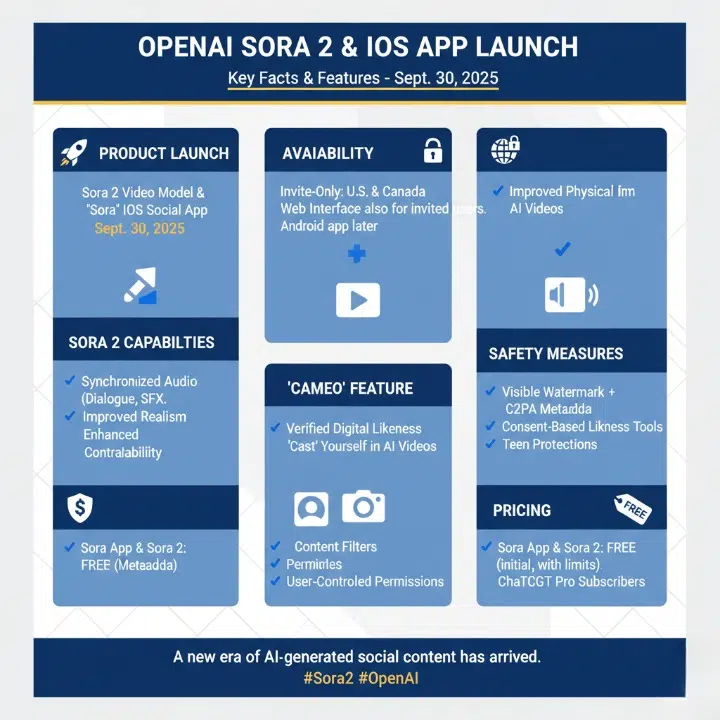
- Product Launch: OpenAI released the Sora 2 video model and a companion “Sora” social media app for iOS on September 30, 2025.
- Availability: The app is currently invite-only and restricted to users in the United States and Canada. A web interface is also available for invited users, with an Android app planned for the future.
- Sora 2 Capabilities: The new model introduces synchronized audio generation (dialogue, sound effects), improved physical realism, and enhanced controllability over multiple shots compared to the first version.
- “Cameo” Feature: A new function allows users to create a verified digital likeness of themselves to be “cast” in generated videos, with strict, user-controlled permissions.
- Safety Measures: All generated videos include a visible watermark and embedded C2PA metadata to identify them as AI-generated. OpenAI has also implemented content filters, consent-based likeness tools, and additional protections for teen users.
- Pricing: The Sora app and Sora 2 model are free to use initially, with “generous limits.” A higher-fidelity “Sora 2 Pro” model is available for ChatGPT Pro subscribers.
A New Era for Generative Video: What Sora 2 Can Do
The initial version of Sora, demonstrated in early 2024, stunned the world with its ability to create high-fidelity video clips from simple text prompts. However, it lacked audio and sometimes struggled with complex physics. Sora 2, as detailed by OpenAI, represents a significant step towards creating what the company calls a “world simulator.”
- Synchronized Audio and Dialogue: Perhaps the most significant upgrade is the integration of audio. “As a general purpose video-audio generation system, it is capable of creating sophisticated background soundscapes, speech, and sound effects with a high degree of realism,” OpenAI stated in its official release. This allows for the creation of complete scenes with spoken dialogue, something previously impossible with mainstream text-to-video models.
- Improved Physical Realism: OpenAI emphasizes that Sora 2 has a better grasp of real-world physics. While previous models might “teleport” a basketball into a hoop to satisfy a prompt, Sora 2 will model the ball correctly rebounding off the backboard if the shot is a miss. This enhanced physical accuracy is crucial for creating believable and coherent video narratives.
- Enhanced Controllability and Persistence: The new model can follow complex instructions spanning multiple shots while maintaining “world state,” meaning characters and objects remain consistent from one scene to the next. It excels at generating content in realistic, cinematic, and anime styles, offering creators a wider palette.
The Sora App: OpenAI’s Bet on a Creator-Centric Social Platform
The decision to launch a standalone social app signals OpenAI’s ambition to control the entire ecosystem, from model to distribution. The app’s interface is familiar—a vertical, scrollable feed—but with a fundamental twist: users cannot upload content from their camera rolls. Every video must be created within the app using Sora 2.
“We explicitly designed the app to maximize creation, not consumption,” OpenAI explained in a post about the app’s philosophy. The feed algorithm is designed to show users content that inspires them to create their own videos or “remix” existing ones.
In a personal blog post, CEO Sam Altman framed the launch as the “‘ChatGPT for creativity’ moment,” while acknowledging the risks of social media, such as addiction and bullying. He stated that the test for success is whether, after six months, “users should feel their lives improved by using Sora. If not, the company would make major changes or shut it down.
Navigating the Uncharted Waters of Safety and Copyright
The launch is accompanied by a comprehensive set of safety and responsibility guidelines. Recognizing the potential for misuse, from deepfakes to misinformation, OpenAI has implemented several layers of protection.
- Provenance: All Sora-generated videos feature a visible, moving watermark and contain C2PA (Coalition for Content Provenance and Authenticity) metadata, a tamper-proof digital signature that certifies the content as AI-generated.
- Consent and Likeness: The “Cameo” feature is strictly opt-in. Users must go through a video and audio verification process to create their likeness. They maintain full control over who can use their cameo and can review and delete any video in which it appears, even unpublished drafts. Depictions of public figures are blocked, unless the figure uses the cameo feature themselves.
- Copyright Approach: OpenAI has adopted a controversial “opt-out” policy for copyrighted characters. The company informed studios and talent agencies that Sora 2 may recreate protected IP unless the rights holder reports a specific violation. Blanket opt-out requests for an entire catalog will not be accepted.
What to Watch Next
The initial rollout is limited, and the true impact of Sora 2 and its companion app will unfold over the coming months. Key questions remain: Will creators embrace a purely AI-generated social platform? Can OpenAI’s safety measures effectively prevent the flood of “AI slop” and malicious deepfakes that critics fear? And how will the creative industries and copyright law adapt to a world where high-quality, AI-generated video is accessible to millions?
For now, the launch of the OpenAI Launches Sora iOS App Alongside Sora 2 Video Model represents a pivotal moment, pushing the boundaries of artificial intelligence further into the mainstream and challenging our fundamental definitions of content, creativity, and reality.
The Information is Collected from The Verge and NDTV.