January 22 is one of those dates that keeps reappearing at the crossroads of power, identity, and public memory. It carries the weight of empires and revolutions, but also the quieter influence of artists, scientists, and reformers whose birthdays and death anniversaries still shape how we think today.
This in-depth guide to On This Day January 22 brings together major events, international observances, and notable anniversaries with special attention to Bangladesh, India, and the wider Global South.
Why On This Day January 22 Still Matters
Some calendar dates feel “busy” in hindsight because they became symbolic markers. January 22 is one of them. It includes moments when:
-
Law reshaped society, like the landmark U.S. Supreme Court decision in Roe v. Wade (1973).
-
Nations affirmed unity, like Ukraine’s Unity Day tied to the 1919 unification act.
-
Rival empires tipped the balance, like the Battle of Wandiwash (1760), a turning point in Britain’s rise in India.
-
Reconciliation was formalized, like the Élysée Treaty (1963), which helped build the modern architecture of European cooperation.
-
Global norms were pushed forward, like the nuclear weapons ban treaty entering into force (2021).
At the same time, January 22 is also a date of cultural remembrance, with important anniversaries in literature, cinema, diplomacy, music, and public activism across regions.
January 22 At A Glance: Key Global Moments
| Year | Region | Event | Why It Still Matters |
|---|---|---|---|
| 1666 | South Asia | Death of Mughal Emperor Shah Jahan | End of a major architectural and imperial era tied to the Taj Mahal |
| 1760 | South Asia | Battle of Wandiwash (Vandavasi) | Shifted the colonial balance toward British dominance in India |
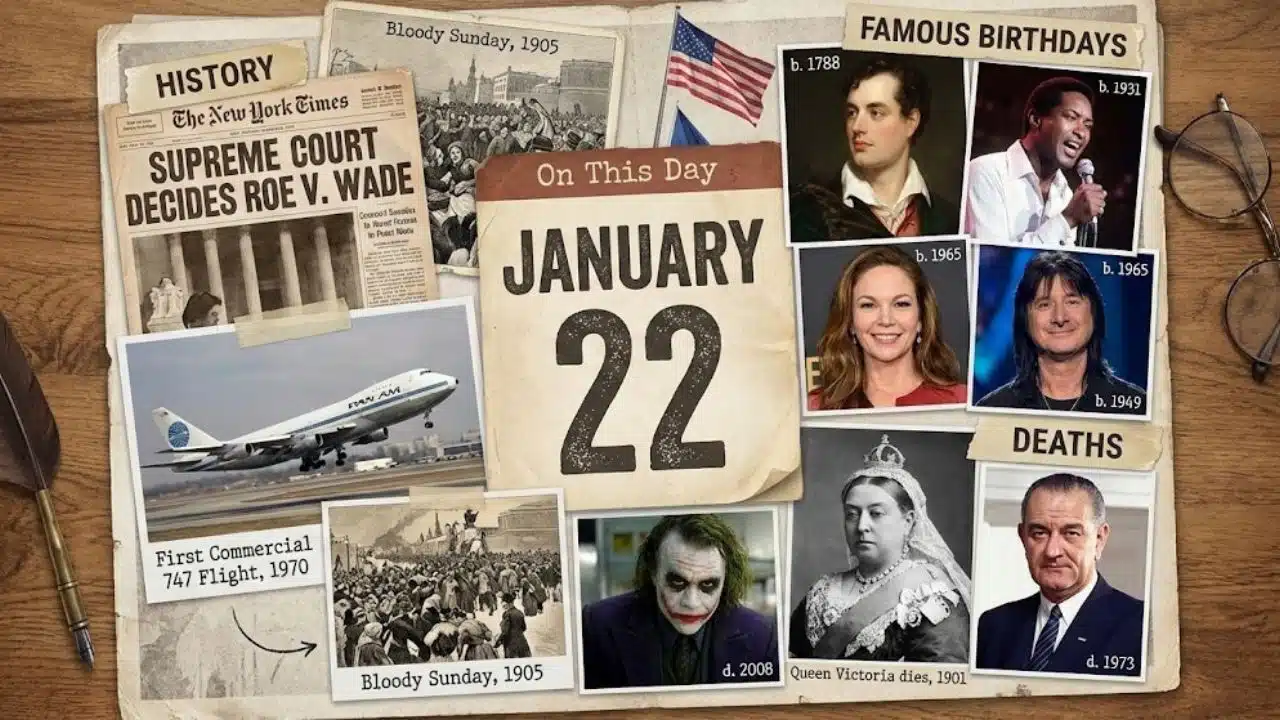
| 1905 | Russia | Bloody Sunday massacre (New Style) | Helped ignite the 1905 Revolution and shook Tsarist legitimacy |
| 1901 | United Kingdom | Death of Queen Victoria | Symbolic end of a long imperial era and a transition in British history |
| 1924 | United Kingdom | First Labour government takes office | A milestone for democratic working-class representation in power |
| 1963 | Europe | Élysée Treaty signed | Foundation for Franco-German cooperation and European integration |
| 1968 | United States | Apollo 5 launch | Lunar Module test that helped enable the Moon landing pathway |
| 1970 | Global aviation | First commercial Boeing 747 flight | Helped usher in mass long-haul travel and the wide-body age |
| 1973 | United States | Roe v. Wade decision | A defining legal and cultural reference point for decades |
| 2021 | Global | Nuclear weapons ban treaty enters into force | A modern disarmament milestone shaping global norms debates |
The Bangalee Sphere
Historical Events And Turning Points
1760: Battle Of Wandiwash (Vandavasi) And The Colonial Pivot
Although not in Bengal itself, the Battle of Wandiwash (1760) mattered for Bengal’s future. It weakened France’s ability to compete and strengthened the East India Company’s position across the subcontinent. The larger consequence was structural: once one European competitor collapsed, Company power could expand with fewer checks, reshaping revenue systems, military control, and political bargaining across regions that included Bengal.
2024: Ayodhya Ram Temple Consecration And Modern Political Memory
On January 22, 2024, the consecration ceremony at the Ram Temple in Ayodhya became a major national event in India. Beyond religious meaning, it reflected how modern states use symbols, ceremonies, and heritage narratives to define collective identity. For many observers, it also highlighted how public rituals can be deeply emotional while also carrying political consequences in a democracy.
2020: Early Covid-19 Border Screening In Bangladesh
On January 22, 2020, Bangladesh began early health screening measures focused on travelers arriving from China. This moment is important as a reminder of how global crises arrive in stages. What begins as a travel alert can quickly shift into national health policy, social behavior change, and economic disruption.
Famous Birth Anniversaries (The Bangalee Sphere)
Dilip kumar Roy (1897)
A Bengali musician, writer, and musicologist remembered for his artistic scholarship and cultural influence. His life is often discussed in the context of how Bengal’s cultural figures bridged classical traditions, devotional music, and modern literary currents.
Vijay Anand (1934)
A major Indian filmmaker linked to classic Hindi cinema and influential storytelling styles. His work is still cited when discussing the golden age of Indian popular filmmaking.
T. M. Krishna (1976)
An Indian Carnatic vocalist and writer known for challenging barriers of caste and class in how classical music is performed and accessed. His career is widely discussed as an example of how art can become public debate, not only entertainment.
Tarun Ram Phukan (1877)
An Assamese freedom movement leader known as “Deshbhakta,” associated with anti-colonial politics and public mobilization. His biography is often used to explain how regional leadership strengthened India’s broader independence struggle.
Cultural Notes For The Date
January 22 does not lock into one fixed, annual Bengali religious festival the way some dates do, but it can align with major observances depending on lunar calendars. It is also a strong date for anniversary storytelling, which is why it often appears in newspapers, radio features, and historical retrospectives.
International Observances And Holidays On January 22
Ukraine: Unity Day (Den Sobornosti)
Ukraine observes Unity Day on January 22, tied to the 1919 Act of Unification. In today’s context, the holiday has gained sharper meaning because unity is not only a ceremonial idea. It is often framed as a survival principle during national struggle, conflict, and rebuilding.
Franco-German Friendship Day
Because the Élysée Treaty was signed on January 22, 1963, the date is also used to highlight modern France–Germany cooperation. It is widely treated as a symbol of reconciliation after centuries of conflict and as a foundation stone in Europe’s post-war political culture.
Nuclear Weapons Ban Treaty Enters Into Force (2021)
On January 22, 2021, the Treaty on the Prohibition of Nuclear Weapons entered into force. Even though nuclear-armed states largely remain outside it, the treaty is significant as a moral and legal milestone. It represents a modern pattern in global governance where coalitions try to shift norms even without universal participation.
United States: Sanctity Of Human Life Day (Observed Around This Date)
In the United States, National Sanctity of Human Life Day is typically proclaimed on or near the anniversary of Roe v. Wade. Its observance shows how the same historical event can generate multiple, competing public traditions and civic meanings.
Global History By Region: What Happened On January 22
United States
1973: Roe v. Wade
Decided on January 22, 1973, Roe v. Wade became one of the most consequential U.S. Supreme Court rulings of the 20th century. For decades it shaped healthcare access, electoral politics, legal theory, and cultural identity. Even after later reversal, its anniversary remains a reference point, showing how legal decisions can outlive their formal status in public consciousness.
1946: A New Intelligence Era Begins
On January 22, 1946, steps toward modern U.S. intelligence organization were formalized through structures that preceded the CIA. This matters historically because it reflects the post-World War II shift from wartime improvisation to permanent security institutions.
Culture And Sports Markers
January 22 is also remembered for major cultural moments and headline achievements that often appear in “today in history” features, including theatre milestones and sports records. These are not only trivia. They show what a society chooses to preserve as shared memory.
Russia
1905: Bloody Sunday (New Style Date)
On January 22, 1905, peaceful demonstrators in St. Petersburg were attacked, and the massacre helped ignite the violent phase of the 1905 Revolution. It mattered because it changed how many Russians viewed the Tsar. When a state uses violence against petitioners, reform movements can rapidly radicalize. Bloody Sunday is often taught as a turning point where legitimacy broke in public view.
China And The Wider East Asian Space
January 22 is frequently connected to modern Asia through disaster events, diplomatic anniversaries, and economic developments that appear in contemporary archives. It is also a reminder that history is not only about war and law. Natural events and infrastructure stress tests shape national planning, migration, and resilience debates for decades.
United Kingdom
1901: Death Of Queen Victoria
Queen Victoria’s death on January 22, 1901 is commonly treated as a symbolic end of an era. Her long reign overlapped with industrial growth, empire, and major shifts in politics and society, including Britain’s relationship with colonial territories.
1924: Britain’s First Labour Government Takes Office
On January 22, 1924, Ramsay MacDonald formed the first Labour government. Even though it was minority and short-lived, it mattered as a democratic landmark. It showed that constitutional systems could absorb major social change through elections rather than rupture.
Europe
1963: The Élysée Treaty
Signed on January 22, 1963, the Élysée Treaty is one of Europe’s most important reconciliation agreements. Its lasting significance is institutional. It built habits of cooperation that helped make later European integration feel practical rather than symbolic.
Australia
2008: Death Of Heath Ledger
Heath Ledger’s death on January 22, 2008 remains one of the most widely remembered Australian-linked cultural losses of the 21st century. It also shaped public discussion about fame, pressure, and mental health, even when the official cause is discussed in terms of prescription drug toxicity.
Rest Of World: Wider Global Events
1944: Anzio Landings (Italy)
On January 22, 1944, Allied forces began the Anzio landings in Italy. Strategically, it is studied as a lesson in amphibious warfare. Surprise means little without rapid exploitation, and delays can turn bold moves into grinding stalemates.
1970: First Commercial Boeing 747 Flight
On January 22, 1970, the Boeing 747 entered commercial service on a flagship route, marking a turning point in mass long-haul travel. This matters beyond aviation history. Wide-body travel reshaped labor mobility, tourism economics, family migration patterns, and global business rhythms.
1968: Apollo 5 Launch
On January 22, 1968, Apollo 5 tested the Lunar Module in orbit. Many “hero missions” are remembered, but test missions like this are what make high-risk exploration possible. They validate systems, expose failure points, and quietly reduce uncertainty before the world watches.
More Famous Birthdays On January 22 (Global)
Here are additional widely noted birth anniversaries that help broaden the global view.
| Name | Born | Country/Region | Known For |
|---|---|---|---|
| Lord Byron | 1788 | United Kingdom | Romantic poet and cultural icon |
| Francis Bacon | 1561 | England | Philosopher linked to modern scientific thinking |
| U Thant | 1909 | Myanmar (Burma) | UN Secretary-General, major Cold War era diplomat |
| Sergei Eisenstein | 1898 | Russian Empire | Film theory pioneer, montage cinema |
| Sam Cooke | 1931 | United States | Soul music pioneer and cultural influencer |
| Diane Lane | 1965 | United States | Film actor with long global popularity |
| Steve Perry | 1949 | United States | Rock vocalist, arena-rock era voice |
| T. M. Krishna | 1976 | India | Carnatic vocalist and social advocate |
| Tarun Ram Phukan | 1877 | India | Freedom movement leader from Assam |
| Namrata Shirodkar | 1972 | India | Actor and former Miss India |
More Notable Death Anniversaries On January 22 (Global)
| Name | Died | Country/Region | Legacy |
|---|---|---|---|
| Shah Jahan | 1666 | Mughal India | Taj Mahal legacy, late Mughal power struggles |
| Queen Victoria | 1901 | United Kingdom | Victorian-era symbol, empire and modern state formation |
| Lyndon B. Johnson | 1973 | United States | Civil rights legislation era, Vietnam War legacy |
| Heath Ledger | 2008 | Australia | Globally influential acting career |
| Pope Benedict XV | 1922 | Vatican/Italy | World War I era papacy and diplomacy |
Did You Know? (January 22 Trivia)
-
Bloody Sunday is a famous “two-date” event in history. It is often listed as January 9 in the old Russian calendar, and January 22 in the modern calendar used internationally. That calendar shift affects how anniversaries are remembered across countries.
-
The Élysée Treaty did more than create friendly speeches. It built routines, meetings, and institutional habits that helped turn reconciliation into a working political system.
-
The Boeing 747’s arrival in commercial service helped normalize the idea that long-distance international travel could be for ordinary people, not only elites. That shift changed everything from tourism to migration patterns.
Why January 22 Still Matters
January 22 stands as a reminder that every date in history carries stories that have helped shape our world. From landmark events and influential decisions to the births of remarkable individuals and the passing of figures who left lasting legacies, this day reflects the continuous flow of human achievement and change.
By looking back at the historical moments, famous birthdays, notable deaths, and global events of January 22, we gain a deeper appreciation of how the past connects to the present. Remembering such days not only honors history but also inspires us to learn from it and move forward with greater awareness and perspective.