January 14 is one of those dates that quietly touches almost every corner of the world. It can feel like a mid-winter day on the Gregorian calendar, yet it sits at the heart of seasonal change for millions who mark harvest festivals, solar transitions, and community traditions.
It is also a date packed with big political turning points, cultural milestones, and modern science achievements. From South Asia’s deep historical memory to Europe’s war conferences, from civil rights-era America to major space exploration, January 14 offers a surprisingly wide window into how societies change and how power moves.
This in-depth guide brings the day to life with a balanced global lens. You will find Bangladesh and India highlights, international observances, major world events, and an expanded list of notable births and death anniversaries, supported by reader-friendly tables.
At A Glance: January 14 Timeline Table
Here is a quick timeline so you can scan the day before diving deeper.
| Year | Region | Event | Why It Matters |
|---|---|---|---|
| 1559 | England | Elizabeth I crowned | Begins an era that reshaped religion, arts, and power politics |
| 1761 | South Asia | Third Battle of Panipat | A major turning point in North Indian power dynamics |
| 1943 | Morocco | Casablanca Conference begins | Sets key Allied strategy in World War II |
| 1952 | USA | “Today” show premieres | Helps define modern daily broadcast news culture |
| 1963 | USA | Wallace inauguration speech | A flashpoint moment in civil rights-era rhetoric |
| 1967 | USA | Human Be-In in San Francisco | Signals the rise of counterculture activism and youth identity |
| 2005 | Space | Huygens lands on Titan | First landing in the outer solar system |
| 2011 | Tunisia | President Ben Ali steps down | A landmark moment that influenced regional political movements |
January 14 In The Bangalee Sphere
Historical Events And Turning Points
For Bengali communities, January 14 often feels like a living cultural day rather than a distant history marker. In Bangladesh and West Bengal, the mid-January season connects family, food, and local identity, especially through kite traditions and winter harvest culture.
At the same time, this date is remembered in the wider South Asian timeline for major political and military milestones. One of the largest is the Third Battle of Panipat, a battle that is still discussed as a decisive moment for North India’s shifting alliances and power balance.
Third Battle Of Panipat, 1761
The Third Battle of Panipat on January 14, 1761 remains one of the most discussed battles in Indian history. The Marathas were defeated by the forces of Ahmad Shah Abdali (Durrani Empire), and the battle shook the political landscape of North India.
Why does it still matter. Because Panipat has become a metaphor for overreach, coalition weakness, and the unforgiving role of logistics. It is not only a story of swords and cavalry. It is a study in planning, alliances, supply lines, and political legitimacy, themes that are still used to interpret conflicts and strategy today.
Cultural Life: What Bengalis Often Celebrate Around January 14
January 14 is closely linked with mid-January seasonal traditions in the Bengali world. While exact customs vary by city and village, the date often falls within celebrations connected to the sun’s movement, harvest time, and winter community life.
Shakrain In Old Dhaka
In Old Dhaka, Shakrain is famous for rooftop kite-flying and neighborhood energy. The city skyline becomes a playground of color, competition, and tradition. It is also a social event. Families gather, friends challenge each other, and the street-level rhythm changes for the day.
Beyond the fun, Shakrain reflects something deeper. It shows how cities preserve identity through rituals that are not official state events but still shape cultural memory.
Poush Sankranti And Poush Parbon In West Bengal
In West Bengal, Poush Sankranti is tied to harvest-season culture and winter foods. Many households associate this period with seasonal sweets, shared meals, and fairs. The celebration can feel religious in some places and more folk-cultural in others.
It is a reminder that calendars are not only about dates. They are about cycles of farming, food, climate, and community.
International Observances And Holidays On January 14
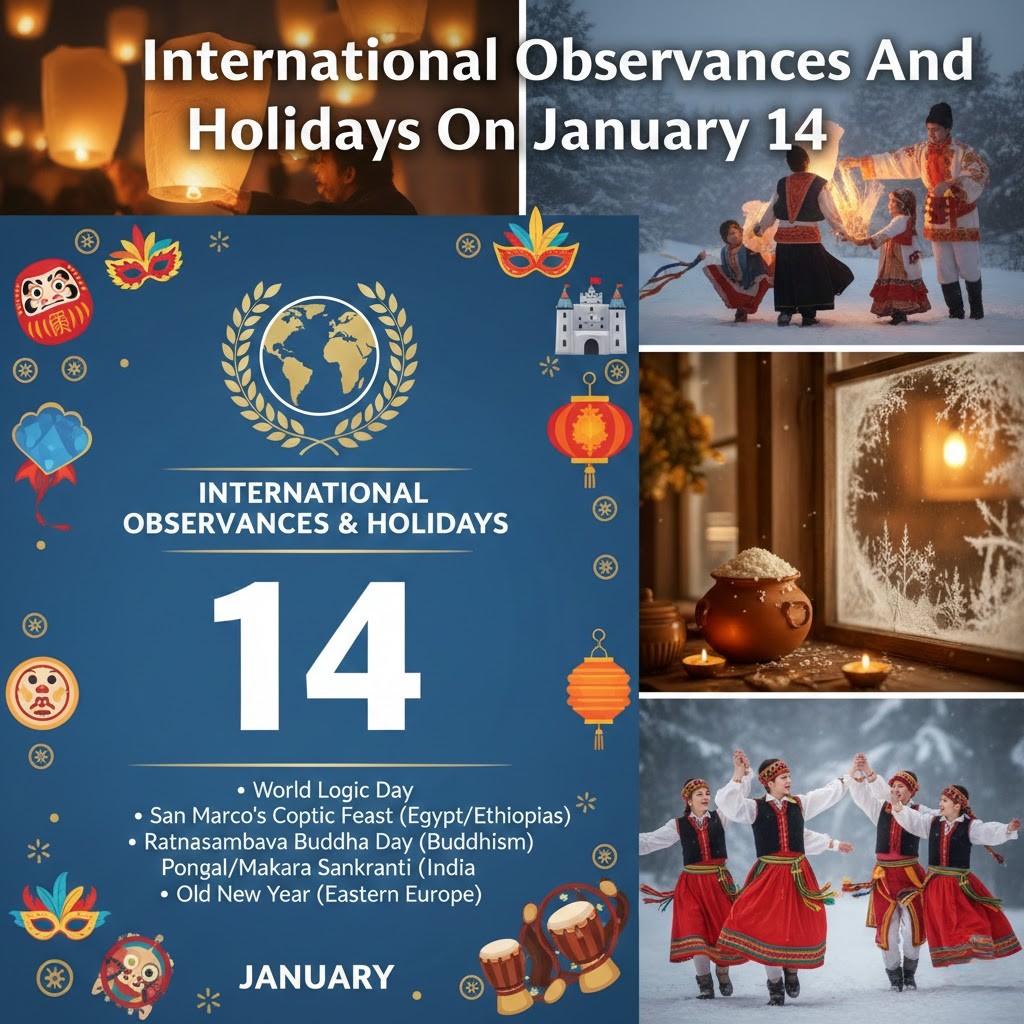
World Logic Day
January 14 is widely recognized as World Logic Day, promoted to highlight the importance of logic in education, scientific reasoning, and public discourse. In practical terms, it is a chance to reflect on how societies make decisions. It also encourages critical thinking, a skill increasingly important in an era of misinformation and fast-moving headlines.
Even if you are not a mathematician, logic affects daily life. It shows up in legal reasoning, journalism ethics, coding, and the way communities argue about truth.
National Days And Notable Country Observances
Some countries treat January 14 as a meaningful national or civic observance. One example is Uzbekistan’s Defenders of the Motherland Day, tied to the modern formation of national armed forces in the post-Soviet era.
In other places, January 14 also overlaps with “Old New Year” celebrations in communities that follow the Julian calendar traditions. It may not be a formal public holiday everywhere, but it remains culturally real in many homes.
Global History: Big Events Across Regions
United States: Politics, Media, And Social Change
January 14 appears often in American historical timelines because it touches politics, civil rights-era conflict, and cultural shifts.
Treaty Of Paris Ratification, 1784
In early U.S. history, the ratification of the Treaty of Paris helped finalize the end of the American Revolutionary War and pushed the country into the complex work of building a new state.
The lesson is timeless. Winning a war or gaining independence is one thing. Building institutions, trust, and stability is another.
The “Today” Show Premieres, 1952
The premiere of NBC’s “Today” helped shape the daily rhythm of broadcast news. Morning television became a routine, blending headlines with lifestyle content, and influencing how large audiences consume information.
This matters today because the format set patterns that continue in modern media, including social platforms. It shows how presentation can shape perception, and how “daily news” can become a habit.
Civil Rights Era Rhetoric, 1963
January 14, 1963 is associated with a well-known segregationist political declaration during the Alabama governor’s inauguration. The moment is still referenced because it reveals how political language can inflame division and how public speech can become a symbol of resistance to equality.
For modern readers, it is a case study in the long afterlife of rhetoric. Words spoken in one ceremony can echo for decades.
The Human Be-In, 1967
The Human Be-In in San Francisco is remembered as a key cultural moment that helped energize counterculture identity, youth activism, and the social atmosphere that later defined the Summer of Love. It was not only about music or style. It was about community, protest, and experiments in new ways of living.
Europe And The Wider World: War, Diplomacy, And Science
January 14 also holds major moments in European and global history.
Casablanca Conference, 1943
In World War II history, the Casablanca Conference stands out as a major strategic meeting of Allied leaders. It shaped military planning and the political messaging of the war effort.
It also demonstrates how wars are not fought only on battlefields. They are shaped in rooms where leaders decide priorities, promises, and postwar visions.
Huygens Lands On Titan, 2005
One of the most exciting science milestones connected to January 14 is the landing of the Huygens probe on Titan, Saturn’s largest moon. It was the first landing in the outer solar system, and it expanded what humanity could observe directly beyond the usual targets like the Moon and Mars.
This matters today because space exploration changes how we understand habitability, atmospheres, and the possibilities of life-supporting environments.
Tunisia, 2011
January 14, 2011 is associated with a dramatic political turning point in Tunisia, when President Zine El Abidine Ben Ali stepped down and left the country amid mass protests. Tunisia’s moment became globally significant because it influenced debates about governance, protest movements, and democratic transitions.
For journalists, it is also a reminder of how quickly public sentiment can overwhelm state narratives, especially when economic pressure and political frustration collide.
Famous Birthdays: January 14
This section expands beyond a handful of names so readers can explore more birthdays at a glance. The list below blends global figures across literature, film, music, science, politics, and public life.
Notable Births Table
| Name | Born | Nationality | Known For |
|---|---|---|---|
| Mahasweta Devi | 1926 | Indian | Writer and activist, powerful social literature |
| Albert Schweitzer | 1875 | European | Physician, humanitarian, Nobel Peace figure |
| Yukio Mishima | 1925 | Japanese | Major modern novelist and cultural figure |
| Faye Dunaway | 1941 | American | Film star of major 20th-century cinema |
| Steven Soderbergh | 1963 | American | Director, modern film innovator |
| LL Cool J | 1968 | American | Rap pioneer and actor |
| Dave Grohl | 1969 | American | Musician, rock icon |
| Jason Bateman | 1969 | American | Actor and director |
| Howard Stern | 1954 | American | Media personality |
| Emily Watson | 1967 | British | Actor, acclaimed performances |
Mahasweta Devi deserves special mention for South Asian readers. Her work is widely read for its sharp moral vision and deep engagement with marginalized communities. She remains influential not only as a literary figure but also as a public voice.
Albert Schweitzer remains a complex figure discussed in ethics, humanitarian work, and the idea of service. His legacy continues to inspire debates about how global aid should work, and how medicine intersects with dignity.
Famous Death Anniversaries: January 14
Death anniversaries can be moments of reflection. They remind us that cultural legacy lasts beyond lifetimes, and that public memory often reshapes itself with each generation.
Notable Deaths
| Name | Died | Nationality | Known For |
|---|---|---|---|
| Kurt Gödel | 1978 | Austrian American | Foundational logician and philosopher of math |
| Lewis Carroll | 1898 | British | Author of Alice books, logic and wordplay |
| Humphrey Bogart | 1957 | American | Film icon of classic Hollywood |
| Alan Rickman | 2016 | British | Actor with major stage and screen legacy |
| Anthony Eden | 1977 | British | UK prime minister, postwar political legacy |
Kurt Gödel’s death date connects to why January 14 is strongly associated with logic and reasoning. Lewis Carroll is another name that bridges logic and culture through storytelling. Humphrey Bogart represents the enduring power of film archetypes, while Alan Rickman remains deeply remembered across global audiences.
More International Events Connected To January 14
Some dates gain power because they link vastly different stories. January 14 is like that. Here are additional categories of events commonly noted in historical records and popular archives.
Politics And Statecraft
Across centuries, January 14 appears in coronations, parliamentary moments, leadership transitions, and wartime diplomacy. Even when the specific country differs, the pattern repeats. Winter can be a season of political decisions because budgets, military planning, and leadership shifts often align with annual cycles.
Culture And Media
From television milestones to major gatherings, January 14 appears as a day that shaped what people watch, listen to, and talk about. Media events matter because they influence public mood and how stories are framed. A new show format, a major speech, or a cultural festival can shape identity as much as a law.
Science And Exploration
The Titan landing stands out because it is a clean, measurable achievement with lasting scientific value. It also symbolizes the power of international collaboration in science. When missions succeed, they become collective human achievements, not only national trophies.
January 14 In Everyday Life: What This Date Teaches Us
A good “On This Day” entry should do more than name events. It should help us understand patterns.
January 14 teaches that history is not a single storyline. It is a network of local traditions, global diplomacy, social conflict, and scientific curiosity happening on the same day across different centuries. It also shows that culture is history. A kite festival is not less meaningful than a summit conference. Both shape how communities remember who they are.
It also teaches that speeches and symbols can outlive the moment. Political declarations, cultural gatherings, and media launches often echo far into the future, influencing identity long after the original audience has gone.
Did You Know: January 14 Trivia
-
World Logic Day is tied to influential figures in logic, linking the date to major contributions in reasoning and formal thought.
-
The Huygens mission to Titan gave humanity one of the most fascinating direct glimpses of an outer solar system world, changing how we imagine moons and atmospheres.
-
In parts of South Asia, mid-January observances blend astronomy, harvest rhythms, and family traditions, proving that calendars can be both scientific and emotional.
Takeaways: The Living Meaning Of January 14
January 14 is not only about famous names. It is a date that reveals how different societies mark time, power, and memory. For Bengali communities, it often arrives with winter traditions and public joy. For historians, it carries major milestones in diplomacy, war, civil rights conflict, and scientific exploration.
If you want a single takeaway, it is this. The same date can contain both celebration and crisis, invention and injustice, endings and beginnings. That is why “On This Day” history remains worth reading, and worth rethinking every year.