Ever wondered why things happen exactly the way they do? Maybe you catch yourself thinking about fate and what it really means for your daily life. You are definitely not alone in that.
People from every corner of the globe ask if their story is written in the stars or shaped by their own hands. It is one of the oldest questions we have.
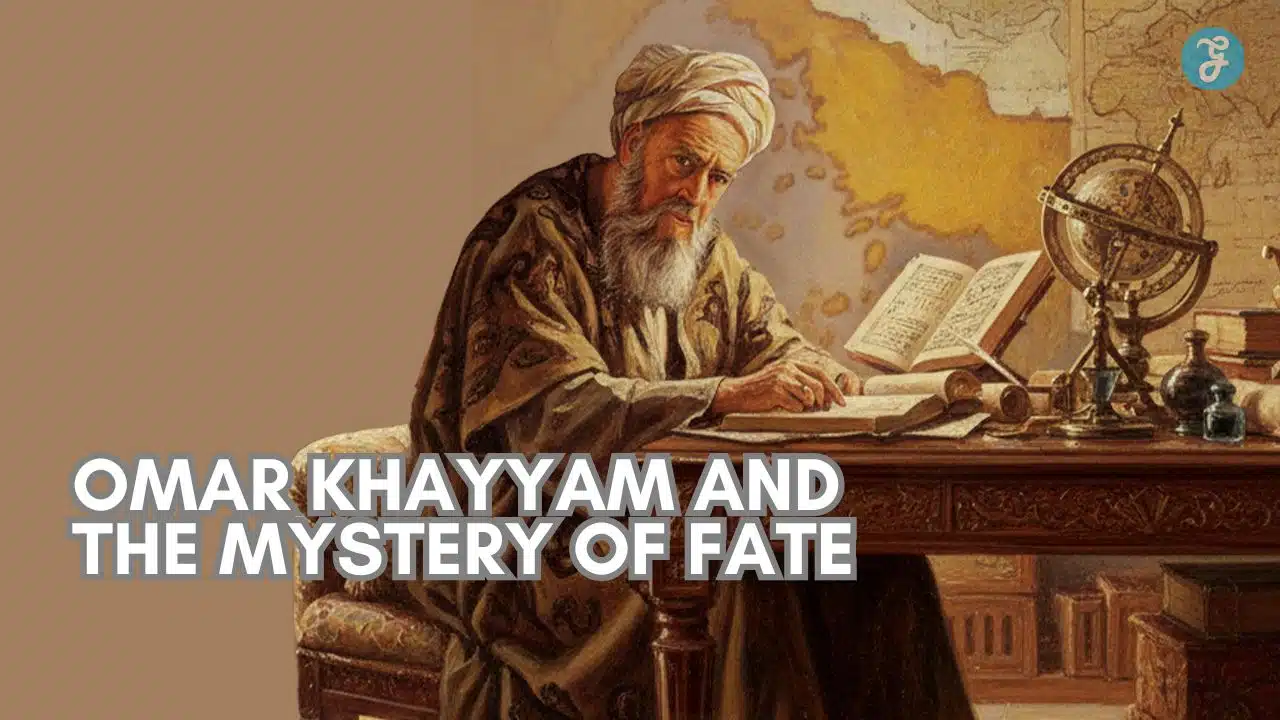
Omar Khayyam And The Mystery Of Fate shines a bright light on these deep puzzles. In his collection of poems known as the Rubaiyat, this Persian thinker explores how life can feel totally planned yet completely random at the same time.
I want to walk you through Khayyam’s fascinating thoughts on destiny and free will. We will look at those big “what ifs” we all face.
Grab a cup of tea and settle in. Let’s unlock some of these secrets together.
Key Takeaways
- Poetry meets philosophy: Omar Khayyam uses the Rubaiyat to explore the tension between fixed destiny and personal choice, often suggesting life is a mix of both.
- The “Master Knot” riddle: This symbol represents the ultimate mysteries of fate that human logic simply cannot untie, no matter how hard we try.
- Time is the enemy: Khayyam was also a mathematician who understood time deeply; he urges us to enjoy the present moment because the future is never guaranteed.
- Cosmic indifference: The stars and planets in his poems represent a vast universe that follows its own rules, often ignoring human desires.
- The Victorian connection: Edward FitzGerald translated these verses in 1859, turning a mathematician’s obscure quatrains into a worldwide phenomenon that still shapes how we view fate today.

The Concept of Fate in Omar Khayyam’s Rubaiyat
Omar Khayyam’s verses often puzzle readers. He mixes ideas of destiny and free choice using simple but deep Persian imagery. Through pictures of spinning stars and tangled knots, he paints fate as both a riddle and an old storyteller at work behind the scenes.
To really understand his view, you have to remember that Khayyam wasn’t just a poet. He was a brilliant astronomer who helped calculate the Jalali calendar in the 11th century. This calendar is actually more accurate than the Gregorian one we use today.
Why does that matter? Because when Khayyam talks about time and fate, he speaks as a scientist who knows exactly how the heavens move. He sees a mathematical order that humans cannot change.
What does Omar Khayyam say about the inevitability of destiny?
Khayyam suggests that destiny holds incredible power. He points out that we do not choose our birth, and we certainly do not choose our death. Like wax poured into a mold, our lives often follow paths that seem ready-made.
You might struggle to change your circumstances, but Khayyam argues that some things will never bend. It does not matter how hard you try.
He famously describes this in Quatrain 71 (in the FitzGerald translation). He writes that “The Moving Finger writes; and, having writ, / Moves on.” This powerful image tells us that history is permanent. Not even your tears or prayers can wash away a single word of what has already happened.
Worrying about what you cannot change only brings pain. Khayyam suggests that accepting this flow gives you peace. It frees your heart from the burden of trying to control the uncontrollable.
Each verse reminds us that life is temporary. This makes every moment precious, like finding gold on a gray, cloudy day.
How does Khayyam explore free will versus predestination?
Khayyam uses the Rubáiyát to paint life as a giant checkerboard. In this metaphor, people move like pawns. We are guided by fate and our past actions.
Think of it like a game where the rules were set long before you sat down to play. Each piece moves according to these ancient rules, yet your specific move right now shapes the board for tomorrow.
The Persian poet mixes destiny and free will using strong images. He tells readers not to blame luck for their place in life. Your choices still matter within the game.
Here is how Khayyam balances these two opposing ideas:

| The Force | What It Controls | Your Role |
|---|---|---|
| Destiny (The Sky) | Birth, death, and the major events of history. | Acceptance. You cannot stop the stars from turning. |
| Free Will (The Player) | How you spend this specific moment right now. | Action. You can choose to be happy and kind today. |
Past deeds shape current moments. This is a central idea in his poetry. Effort and wise decisions give hope for change, even if divine wisdom sets limits above our reach.
This thought links big questions about existence with Persian tradition. Life is not just written by divinity. People play a part with every action on fate’s chessboard, weaving between threads tied by choice and those fixed tight by destiny.
Literary Themes of Life and Mortality
Many lines in The Rubaiyat of Omar Khayyam whisper that time is a trickster. It never waits for anyone. His verses urge us to cherish each moment before it fades into memory, much like sand slipping through an hourglass.
This is not just a poetic mood; it is a philosophy often called “Carpe Diem,” or “Seize the Day.” However, Khayyam’s version is a bit darker than the Roman version. He implies we should seize the day specifically because the darkness of night is coming fast.
Why is life described as fleeting in Khayyam’s poetry?
Omar Khayyam paints life as brief and tricky. He uses short stories to show how fast time slips away. In one famous quatrain, he compares humanity to a “magic shadow show” played in a box whose candle is the Sun.
You simply cannot guess what tomorrow brings. Fate does not ask for your plans or your permission.
The poetry often hints that if things were fair all the time, you might not get the chance to live at all. Life stands on thin ice. It is always at risk of breaking without warning.
Khayyam urges his readers to stop worrying about big problems we cannot fix. Instead, we should enjoy small joys while they last. His most famous recipe for happiness is simple: a book of verses, a jug of wine, a loaf of bread, and a loved one beside you.
As Edward FitzGerald translated it, we must seize each day because nothing stays forever. Not love, not pain, and not even the stars above us.
How should we accept life’s uncertainties according to Khayyam?
Khayyam urges us to let go of our anxiety about tomorrow. He argues that the future hides its secrets intentionally. Why waste today fretting over a riddle you cannot solve?
His verses invite us to face fate head-on. We should do it with joy for each moment.
“Ah, take the Cash, and let the Credit go, / Nor heed the rumble of a distant Drum!”
This line serves as practical financial and emotional advice. He paints the universe as huge and our lives as short. We are almost like grains of sand under a giant sky. By accepting fate’s twists, we find peace.
The Rubaiyat teaches that living true and loving well matter more than guessing what comes next. Khayyam’s words act as gentle advice and quiet laughter at life’s surprises.
Symbolism and Metaphors in Khayyam’s Poetry
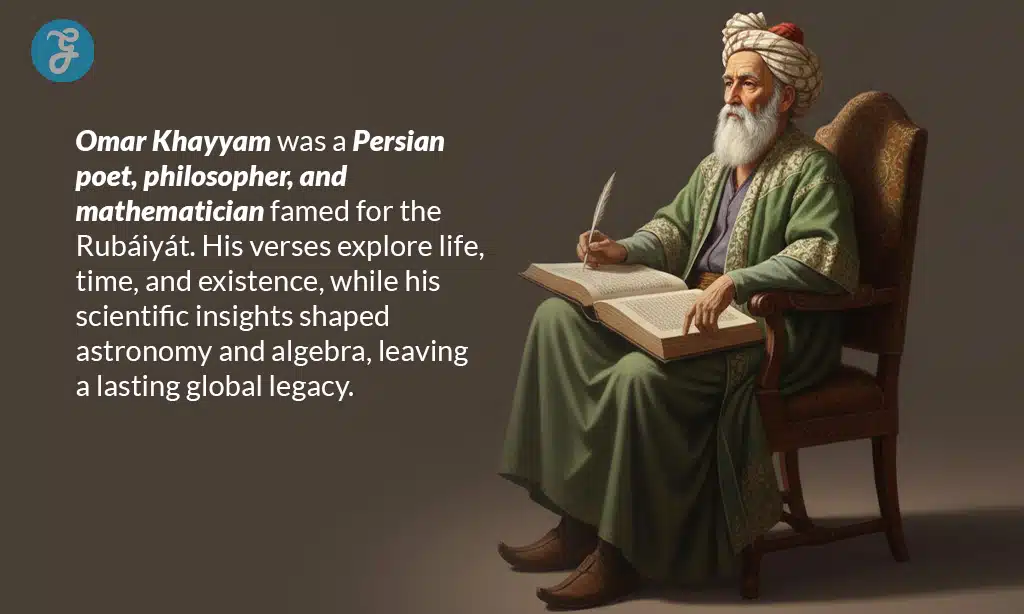
Khayyam lines up his words like chess pieces. He hints that our every move may be tied to something much bigger. He spots fate in the sky, turning planets and stars into storytellers that whisper about our place on earth.
His metaphors are not just pretty words. They are codes for his scientific and philosophical views. He often uses the tavern to represent the world and wine to represent the “spirit” or truth that makes life bearable.
What is the meaning of the “Master Knot” in human fate?
The “Master Knot” stands for the ultimate puzzle of existence that people cannot solve. Omar Khayyam uses this term to show how destiny is twisted and tight.
You might know the story of Alexander the Great and the Gordian Knot. Alexander solved that problem by cheating—he cut the knot with his sword. Khayyam’s “Master Knot” is different. It cannot be cut by force or untied by logic.
The master knot tells us there are hard limits to what humans can understand. It represents the questions of “Why are we here?” and “Where do we go?”
Edward FitzGerald translated these lines to show that even wise scholars run into dead ends. This knot points right at big topics like predestination versus free will. These are topics seen in ancient stories and even Dante’s Divine Comedy.
People might guess or hope about destiny. But some answers tie themselves up tighter each time we ask them. In Khayyam’s poetry, solving every secret is not possible. Some mysteries remain beyond anyone’s reach except the stars themselves.
How is celestial imagery used to explore destiny?
Omar Khayyam fills his Persian poetry with images of stars, planets, and the “throne of Saturn.” In Verse 31 of the Rubaiyat, he takes readers on a mental journey from Earth’s center up to the highest point in the sky.
This wild trip demonstrates how small we are compared to the size of destiny. Celestial objects stretch far beyond what people can see or grasp.
Khayyam does not get bogged down by scientific debates here. He uses these cosmic pictures as metaphors for fate itself. Fate is vast, puzzling, and mostly out of reach.
Even a modern astronaut floating near Saturn might feel lost about life’s purpose. It is much like the feeling Arthur C. Clarke hints at in 2001: A Space Odyssey. Stars become symbols in Khayyam’s hands.
They remind us that some things lie too far away for answers. Yet, they light our path as we wonder about human fate and destiny.
Takeaways
Fate pulls at every thread of our lives. It does not matter how hard we try to untangle it. Omar Khayyam’s verses in the Rubáiyat wink at us, teasing that big “Master Knot” nobody can undo.
Persian poetry has rarely felt more alive with questions about life, death, and free will. Khayyam forces us to look at the hard truth that we are not in total control.
We may search from the earth’s core to Saturn’s throne for answers. Still, some mysteries simply laugh back at us. Next time you look up at the stars, you might wonder about it all. The answer might just slip through your fingers like sand, and Khayyam would tell you that is perfectly okay.
FAQs on Omar Khayyam
1. Who was Omar Khayyam, and why do people still talk about him today?
Omar Khayyam, sometimes spelled Umar Khayyam, was a brilliant 11th-century Persian scholar who is actually more famous in history books for designing the precise Jalali calendar than for the verses we love today. While he spent his days solving complex algebra problems, he is best remembered now for the wisdom he poured into his timeless poetry.
2. What makes The Rubáiyat so important in Persian poetry?
The Rubáiyat is a collection of quatrains that revolutionized Persian poetry by exploring heavy existential themes like mortality and the importance of seizing the moment.
3. How did Edward Fitzgerald play a role in sharing Omar Khayyam’s work?
Edward Fitzgerald took these medieval verses and reimagined them for a Western audience in his famous 1859 translation, effectively turning a forgotten mathematician into a literary icon. He focused on capturing the mood rather than a literal word-for-word translation, which helped the poems resonate with English speakers everywhere.
4. Why do people call Omar Khayyam’s writing mysterious or puzzling?
Readers are often puzzled because his writing walks a fine line between spiritual Sufi mysticism and skeptical hedonism. You never quite know if he is praising the divine or just praising a good glass of wine, and that riddle is exactly what keeps people reading.