Walk into any bookstore in London or New York and the shelves groan under the weight of self-help titles. Millions of people spend billions of pounds chasing a phantom called “purpose.” We treat it like a hidden treasure or a complex riddle that only a life coach can solve. Yet, in the quiet villages of northern Okinawa, the oldest people on the planet are waking up with a sense of clarity that no paperback can provide. They live by the Okinawan Ikigai philosophy, a way of being that makes the modern search for meaning look remarkably frantic.
In places like Ogimi, often referred to as the “Village of Longevity,” there are no motivational seminars. There are no five-year plans or “find your why” workshops. It is as natural as the salt air and as steady as the tide.
What is Okinawan Ikigai Philosophy?
At its core, the Okinawan Ikigai philosophy is the “reason for waking up in the morning.” Unlike the Western interpretation, which often demands a singular, world-changing mission, the traditional Japanese concept is grounded in an awareness of the present moment and the joy of small, everyday rituals.
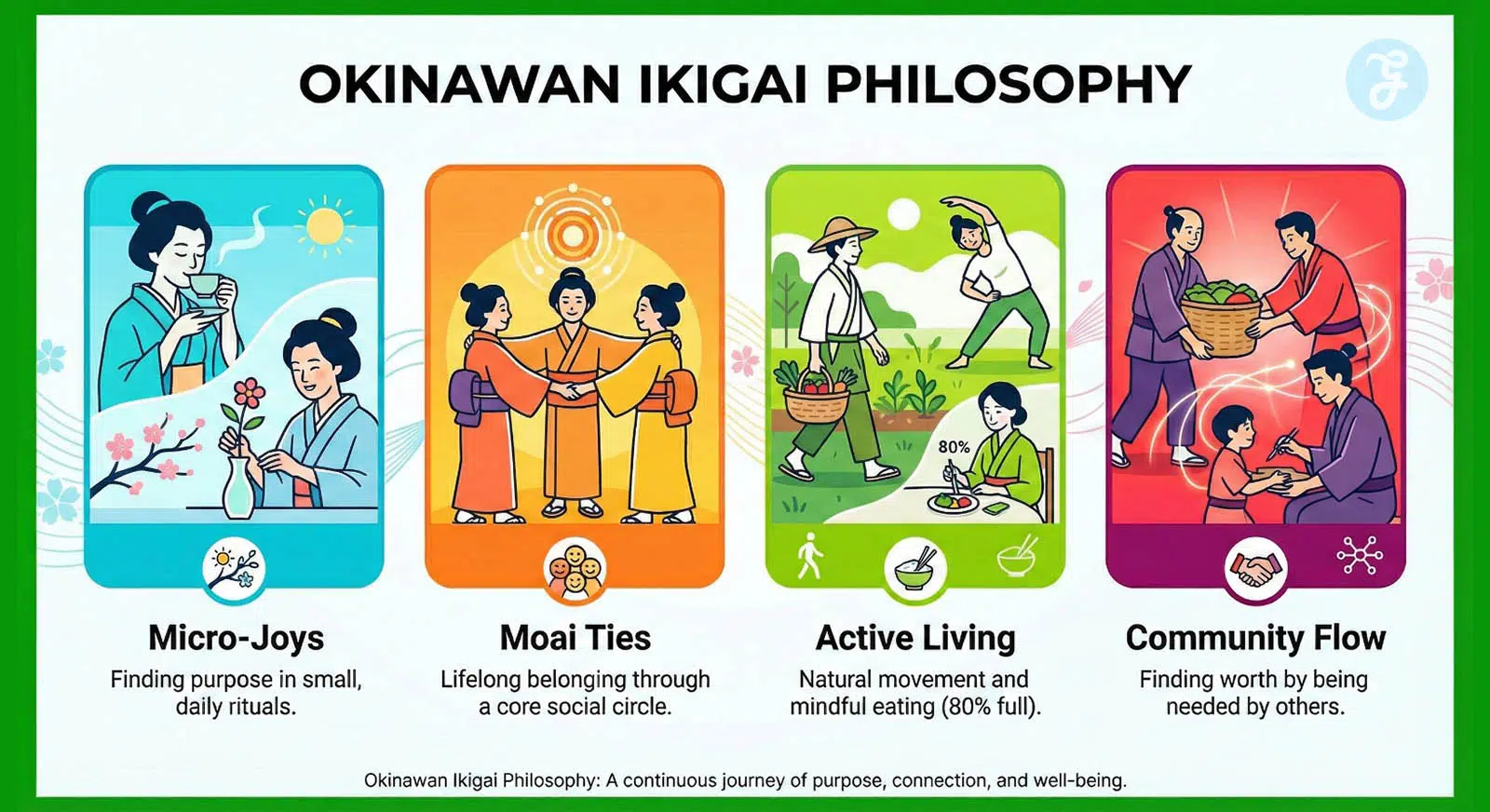 It is a state of mind where one’s sense of worth is woven into community contribution, physical vitality, and a deep connection to nature. For an Okinawan, Ikigai is not a professional milestone to be achieved, but a quiet, sustainable energy that fuels longevity through a life of belonging and simple, intentional action.
The Problem with the Western Search
The West has turned the search for purpose into a high-stakes project. We treat it as a destination. We think that if we just think hard enough or journal long enough, we will finally arrive at our “reason for being.” This creates a heavy burden. It suggests that if you haven’t found a grand mission, your life is somehow on hold.
Okinawan elders do not have this problem. They do not look for purpose within themselves. They do not treat the “self” as a puzzle to be solved. Instead, they find their meaning in the system around them. Their lives are built on three sturdy pillars: communal structure, constant movement, and a shift from macro ambition to micro joy.
Why the System Beats the Book
A self-help book is a solitary tool. You read it alone. You apply it alone. But human beings are not meant to find meaning in a vacuum. The elders of Okinawa never needed these books because their culture does the heavy lifting for them.
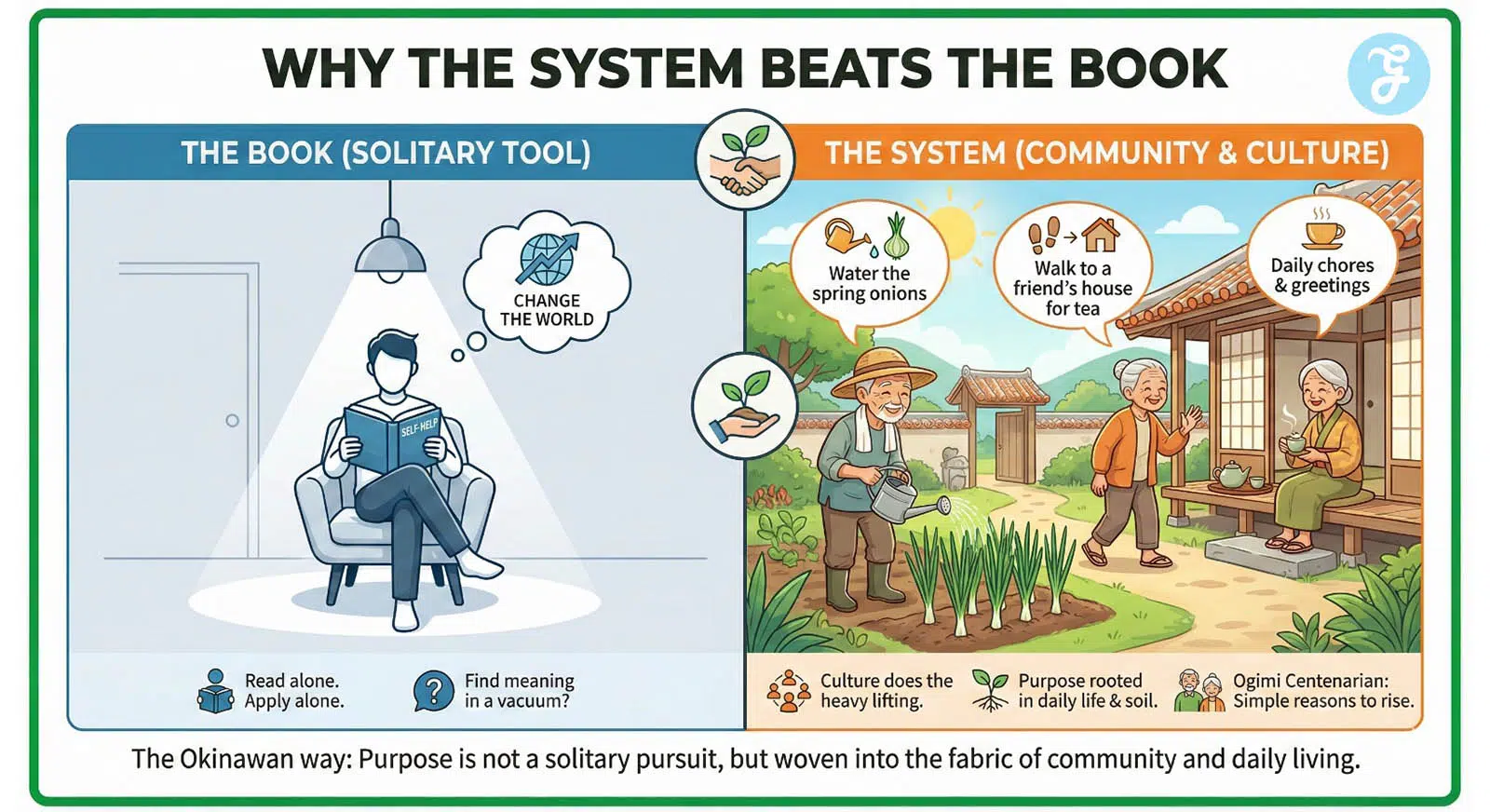 Their purpose is woven into the daily chores. It is found in the way they greet their neighbours. It is rooted in the soil of their gardens. For a centenarian in Ogimi, the reason to get out of bed is not to “change the world.” It is to water the spring onions or to walk to a friend’s house for tea.
Moving from Macro to Micro
We are taught to dream big. We are told to reach for the stars. Okinawan wisdom suggests we should reach for the watering can instead. By focusing on small, tangible acts, the elders avoid the paralysis of choice.
They understand a truth that the modern world has forgotten. A meaningful life is not one giant leap. It is a series of small, intentional steps. When your purpose is small, it is impossible to lose. When your “why” is tied to the people around you, you never have to wonder if you matter.
The elders of Okinawa are not living long lives because they found a secret. They are living long lives because they stopped searching for one and started living for each other.
Beyond the Venn Diagram
If you search for Ikigai online, you will likely find a colourful diagram of four overlapping circles. It suggests that your purpose sits at the intersection of what you love, what you are good at, what the world needs, and what you can be paid for. This is a modern invention.
Around 2014, a blogger named Marc Winn popularised the now-famous four-circle diagram, adapting a purpose model created by Spanish author Andrés Zuzunaga. It went viral because it promised a way to monetise your soul. But for an Okinawan elder, this diagram is confusing. They do not need to be paid for their purpose to feel it. They do not need a career path to feel alive.
Academic research, including studies published in the Journal of Happiness Studies, describes Ikigai as ‘something to live for’, a feeling that life is worth living. It is not a professional milestone. It is a psychological state.
In the villages of the north, Ikigai is found in the small things. It is the first sip of tea in the morning. It is the feeling of damp soil between your fingers as you plant beni-imo (purple sweet potatoes). It is the sight of the sun breaking over the East China Sea. By keeping their purpose small, the elders make it indestructible. You cannot fail at a sunrise. You cannot be “fired” from your garden.
Moai: The Social Architecture of Meaning
We often think of purpose as a solo mission. We go on retreats to “find ourselves.” In Okinawa, you are found by your community. This happens through the Moai.
A Moai is a group of five friends who commit to each other for life. They meet daily or weekly to talk, share gossip, and pool their money. If one member falls on hard times, the others step in. This is not just a social club. It is a biological shield.
Research on social isolation, including large meta-analyses by psychologist Julianne Holt-Lunstad, suggests chronic loneliness can be as harmful as smoking fifteen cigarettes a day. It physically wears down the heart and the brain. In Okinawa, loneliness is far less common. The Moai provides a permanent sense of being needed.
An elder does not need a self-help book to tell them they matter. They know they matter because if they do not show up for tea, someone will come knocking on their door. They know they matter because their friends rely on their wisdom and their company.
When you are part of a Moai, your purpose is external. It is tied to the survival and happiness of four other people. This shift from “me” to “us” is the quiet engine of Okinawan longevity. It turns the burden of living into a shared joy.
The Science of Staying Power
A strong soul needs a sturdy house. The elders of Okinawa have built their bodies to last through habits that are as old as the islands themselves. This is not guesswork. It is backed by the Okinawa Centenarian Study, co-founded by Dr Makoto Suzuki in 1975. The study reveals exceptionally clean arteries and low inflammation.
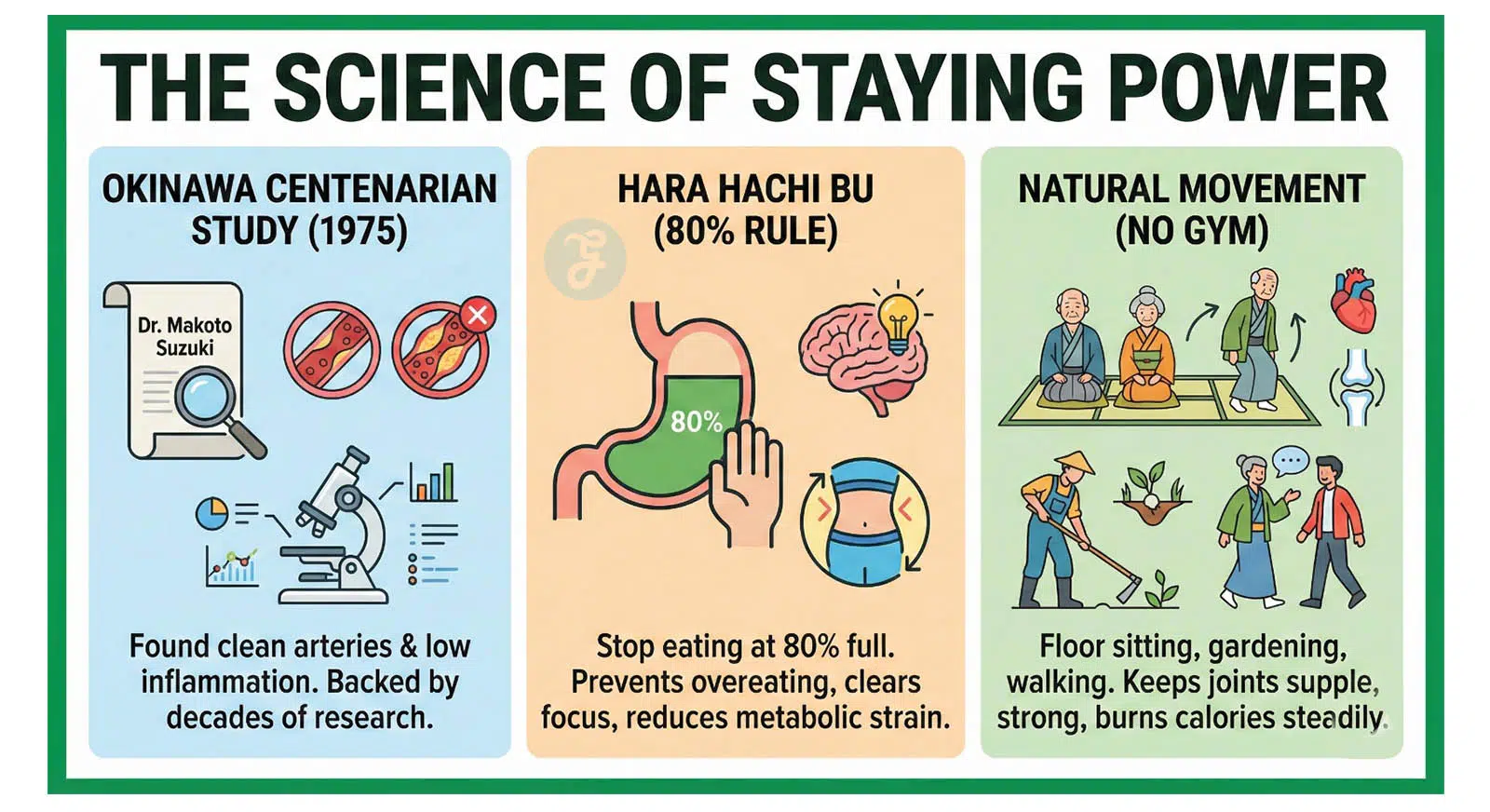 One reason for this is Hara Hachi Bu. It is a simple rule. You stop eating when your stomach is 80% full. This helps prevent overeating and may reduce metabolic strain. Many researchers associate moderate caloric intake with lower inflammation and better cognitive ageing. When you are not weighed down by a heavy meal, your focus remains clear. You have the energy to pursue your daily tasks.
There is also the matter of how they move. You will not find many gyms in rural Okinawa. You will find people who sit on the floor. They get up and down dozens of times a day. They spend hours in their gardens. They walk to visit friends. This is “natural movement.” It burns calories steadily without the stress of high-intensity workouts. It keeps the joints supple and the heart strong. A body that can move is a body that can fulfill its purpose.
Purpose Forged in Fire
It is easy to find meaning when life is beautiful. It is much harder when the world is falling apart. The elders of Okinawa are a generation of survivors. They lived through the Battle of Okinawa. They saw their homes destroyed and their land scarred by war.
In the aftermath, they had to rebuild from nothing. This gave birth to the spirit of Yuimaru. This is the philosophy of joint effort. If a neighbour needed a roof, the whole village arrived to help. If a family was hungry, others shared their harvest.
This period of hardship did not break their spirit. It solidified it. They learned that their survival was linked to the person standing next to them. This created an “anti-fragile” mindset. Like a bone that becomes stronger after a break, their sense of purpose became more resilient.
They do not need a book on “grit” because they have lived it. They do not need a guide to “resilience” because they are its living embodiment. Their Ikigai was born out of a literal need to keep each other alive. That kind of purpose does not fade with time. It only grows deeper.
The Trap of the Individual
The modern world is obsessed with the self. We are told to look inward for answers. We are told to build our personal brand and optimise our daily routines. This focus on the “I” is the very thing that breeds anxiety. When you are the only person responsible for your happiness, the pressure is immense. If you feel lost, you feel it is your personal failure.
Okinawan elders avoid this trap by looking outward. Their lives are a masterclass in collectivism. They do not spend their days wondering who they are. They spend their days knowing who they are to others. This external focus creates a natural state of “flow.”
Mihaly Csikszentmihalyi famously described flow as the state of being so involved in an activity that nothing else seems to matter. For an Okinawan centenarian, flow is not a rare peak experience. It is the steady rhythm of their day. They lose themselves in the repetitive motion of weaving cloth or the slow pace of a walk. They do not worry about productivity. They do not care about “hustle.” They simply do the work for the sake of the work.
The Hustle Myth vs The 2026 Reality
Critics of the Okinawan model argue that “micro-joy” is a luxury for the retired. They claim that in a competitive global economy, the Venn diagram is a survival tool. They say we must monetise our passions to afford the very life we want to enjoy. It is a persuasive argument. It suggests that financial security is the only floor upon which purpose can be built.
However, the 2026 Workforce Trends Report by DHR Global, recently highlighted by the Global Wellness Institute, tells a different story. Despite a decade of “optimising” our careers, purpose fatigue has soared, and a staggering 83% of workers globally now report struggling with burnout. We are wealthier but lonelier. The data shows that professional success fails to protect the heart from the physical toll of isolation. The Western model fails because it treats purpose as a solo race. It ignores the biological truth that humans are wired for collective safety, not just individual achievement.
To fix this, we must shift our architecture. Start by “down-capping” your ambition. Spend 20% less time on your personal brand and 20% more on a local Moai. Invest in people who do not care about your job title. Build a life where you are needed for your presence, not your productivity. True resilience is not a better CV. It is a full table of friends.
The Faces of Living Wisdom
To see the Okinawan Ikigai philosophy in action, you must look at the people. Take the example of a 102-year-old karate master. He does not train to win medals or to beat an opponent. His purpose is the quiet perfection of a single strike. He moves with a grace that defies his age. His focus is entirely on the present moment. He is not trying to get somewhere else. He is exactly where he needs to be.
Then there is the 100-year-old fisherman. Every morning before the sun is high, he is out on the water. He does not do this because he needs the money. He does this because he is a provider. He knows that the fish he catches will feed his family and his neighbours. His purpose is tangible. It is something he can hold in his hands. It keeps him strong and gives his day a clear structure.
Finally, consider the great grandmother who sits with the village children. Her purpose is the transmission of Nuchigusui (the “medicine of life”) or traditional wisdom. She tells stories of the old days. She teaches the young ones how to respect the land and each other. She is the bridge between the past and the future. She does not need a book to tell her she is important. She can see her legacy in the eyes of the children listening to her words. These lives are not “optimised.” They are simply full.
Bringing the Islands Home
We cannot all move to a remote Japanese island. Most of us live in cities where the noise of the “hustle” is deafening. But we can still adopt the Okinawan Ikigai philosophy by choosing simplicity over complexity. The first step is to stop looking for a grand purpose and start building small habits. Meaning is not found in a bolt of lightning. It is found in the repeated acts of a life well lived.
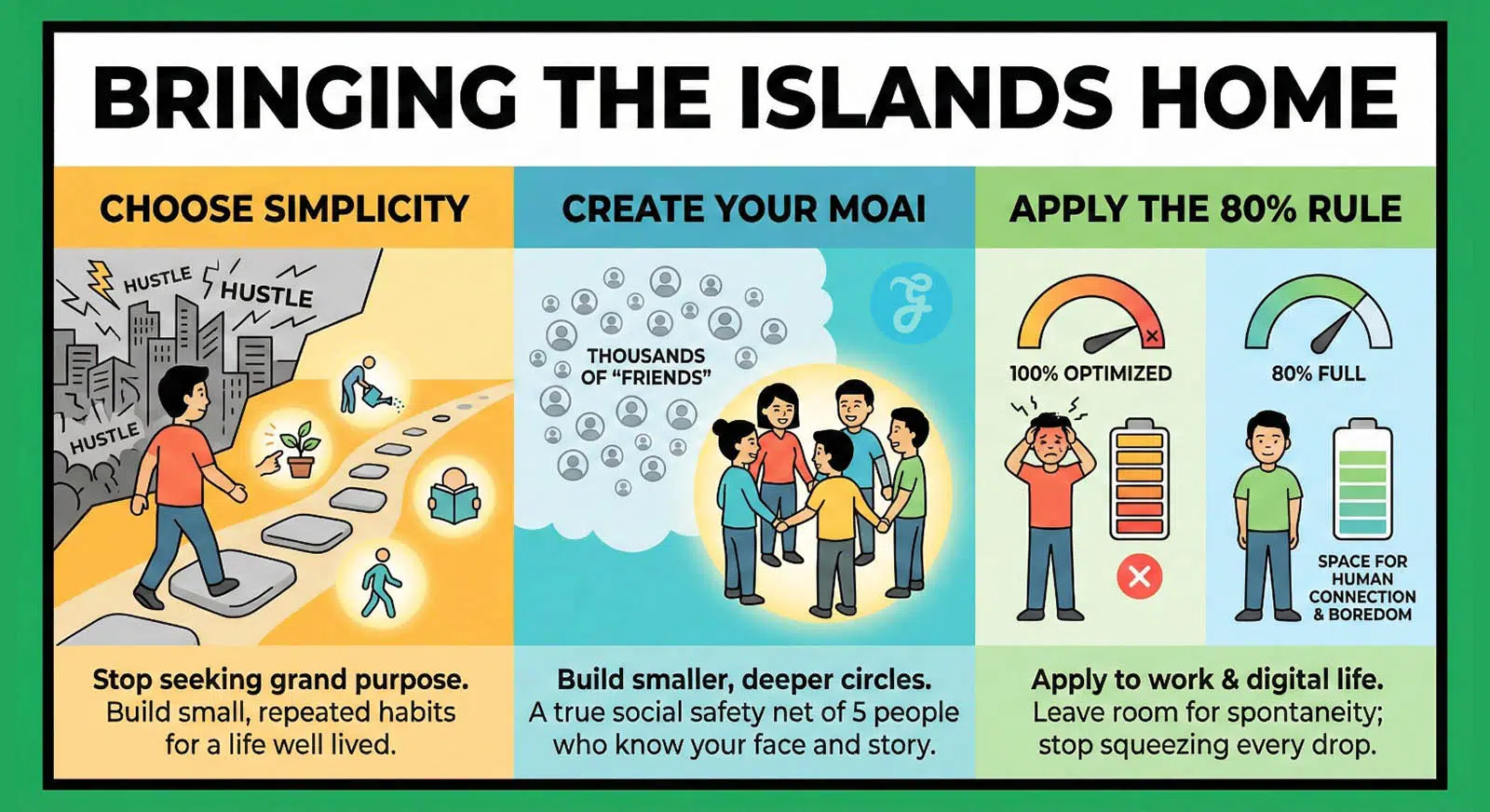 You can start by creating your own Moai. In a digital age, we have thousands of “friends” but very few people who would show up at our door if we went silent. We need to build smaller, deeper circles. Find four people you can rely on completely. Make a pact to support each other through the mundane and the difficult. A true social safety net is not a LinkedIn network. It is a group of people who know your face and your story.
We can also apply the 80% rule to more than just our dinner plates. Apply it to your work. Apply it to your digital consumption. Stop trying to squeeze every last drop of productivity out of your day. Leave a little room for boredom. Leave a little room for spontaneous connection. When you stop trying to be 100% optimised, you finally have the space to be human.
The Wisdom of Looking Outward
The elders of Okinawa never needed a self-help book because they had each other and the earth. They did not spend their energy trying to “unlock” their potential. They spent it showing up for their neighbours. They understood that the more you focus on yourself, the smaller your world becomes.
Purpose is not a secret hidden deep inside you. It is the result of showing up for the people and the tasks that need you. If you are feeling lost, the answer is rarely found in a mirror. It is found by looking out of the window and seeing who needs your help.
Stop searching for the “Big Why” that will solve all your problems. Start noticing the “Small Why” that is right in front of you. It might be the book you are reading to your child. It might be the meal you are cooking for a friend. It might be the simple act of being present. The elders have shown us the way. Meaning is not something you find. It is something you do.