Listen to the Podcast:
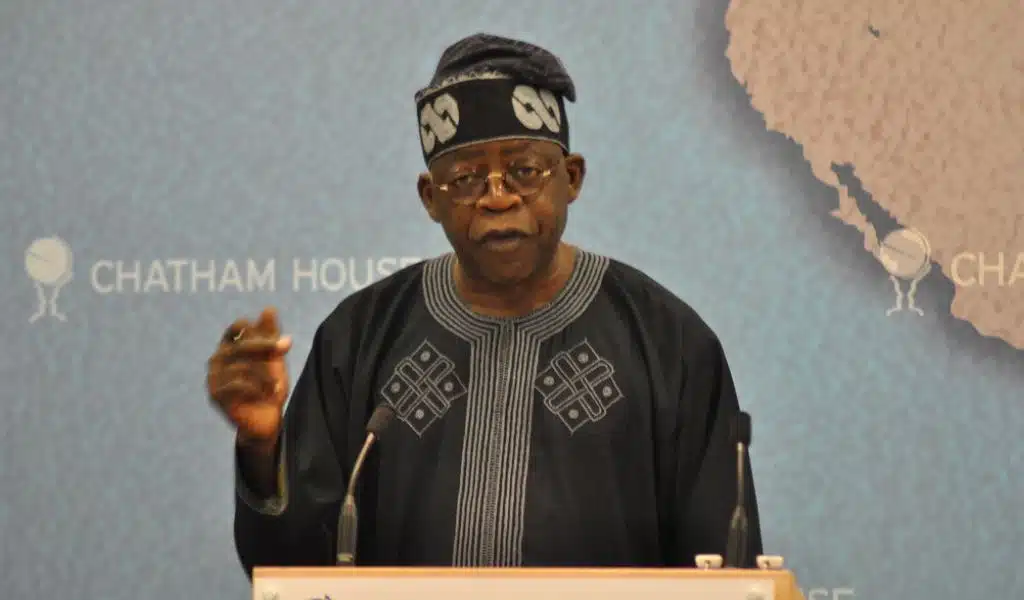
The new president of Nigeria, Bola Ahmed Tinubu, has a hard job ahead of him: he needs to bring peace to a society and economy that are in trouble, and he needs to give hope to a young population that feels like its voice has been ignored for decades.
The 71-year-old became the continent’s most populous country’s 16th president on Monday, and its sixth since the end of three decades of military rule in 1999. He succeeds Muhammadu Buhari, a member of the All Progressives Congress (APC) party who is leaving office after receiving harsh criticism for his handling of the economy.
Judges are currently debating a court lawsuit filed by opposition leaders Atiku Abubakar of the Peoples Democratic Party (PDP) and Peter Obi of the Labour Party, which challenges the validity of the results of the presidential election in February and alleges fraud.
A record amount of debt weighs down the economy, and inflation has reached a nearly two-decade high of more than 22%. There are also shortages of gasoline and foreign exchange reserves, a highly depreciated naira, a strained power grid, and diminishing oil production, all of which Tinubu inherits.
Economic Turmoil
As governor of Lagos state from 1999 to 2007, Tinubu was credited with making Nigeria’s commercial hub more modern and growing the income of the region by a huge amount.
At his swearing-in event on Monday, he talked about his past work and promised to grow the Nigerian economy by at least 6% per year, unify the foreign exchange rate, and get rid of expensive fuel subsidies. He also promised to deal with the country’s widespread insecurity.
Tinubu told the crowd in Abuja’s Eagle Square, “I have a message for our investors, both local and foreign: our government will look into all their complaints about multiple taxes and other barriers to investment.” He also promised a “thorough house cleaning” of monetary policy.
Buhari, who came before him, used a number of protectionist economic policies that scared away foreign investors. In a farewell speech on Sunday, he said that many of the “tough decisions” had made the country’s economy stronger, but the facts showed that unemployment and poverty were getting worse.
According to the National Bureau of Statistics of Nigeria, 133 million people, or 63% of the country’s population, are now considered to be multidimensionally poor, a rise of 10% since the start of Buhari’s administration in 2015. More than 23 million people are unemployed, representing a 33.3% unemployment rate that has consistently increased over the past eight years.
Samson Itodo, executive director of the civic advocacy group YIAGA Africa in Nigeria, told CNBC that while he anticipates the country to go past the legal challenges process with little disruption, Tinubu’s administration would confront numerous problems in its first 60 days in office.
There is a lot of expectation that Tinubu, who he is, will take on this responsibility because “he is inheriting a broken economy, a broken country, very polarized along religious and ethnic lines. But I do believe Nigeria will pull out of this because of our resilient character,” Itodo said on Monday.
Although widely accepted, the long-standing subsidy for petroleum products has been a financial burden on governments, and numerous governments have vowed but failed to do away with it since it was put in place in the 1970s.
Itodo claimed that by keeping his campaign pledges and hiring “competent people” with the required background, Tinubu will be able to win back the trust of an electorate that has been through two recessions in the past eight years.
A Country Divided
Nigeria’s population, which is already close to 220 million and is expected to treble by 2050, is one of the fastest growing in the world. With 42% of its population under the age of 15 and a median age of just over 18, according to U.N. figures, it also has one of the youngest average populations in the world.
Peter Obi of the Labour Party harnessed public resentment over rampant youth unemployment, a lack of opportunities, and police brutality before of the election in February to attract sizable swaths of young people who desired a change from the nation’s traditional two big parties, the APC and PDP.
In a poll plagued by technical difficulties, barely a quarter of Nigeria’s 93 million registered voters were able to cast a ballot, giving Tinubu just 37% of the national vote. He would face a challenging task in demonstrating his abilities on both economic and social concerns to many disenfranchised Nigerians.
Many disgruntled voters would perceive Tinubu’s presidency as bolstering the “dominance of the entrenched political elite,” according to Mucahid Durmaz, senior West Africa analyst at risk intelligence firm Verisk Maplecroft.
Tinubu’s electoral success has strengthened the belief among common Nigerians that the political arena is a playground for powerful old guards that prioritize patronage, according to Durmaz.
“State positions at the national and federal level will probably be awarded to the extensive clientelist networks and potent regional brokers behind his victory.”
Durmaz predicted that one of the most important questions for the first 100 days in office will be if the incoming president has the “will and the ability” to connect with marginalized minorities and urban youth.
“Tinubu will need to eradicate the grievances felt by the majority of Nigerians on issues like insecurity, police brutality, and inequality,” Durmaz added. “He will need to promote an inclusive national identity in a deeply fractured society.”
Widespread violence, such as murders and kidnappings in the northwest, conflicts between farmers and cattle herders in the “Middle Belt” of the nation, and attacks by both gangs and separatists in the southeast, will be addressed by Tinubu’s promise to overhaul the security apparatus of Nigeria.
According to Durmaz, “Nigeria’s overworked state security apparatus has a history of committing serious human rights violations and needs extensive structural reforms, thorough training programs, and modern equipment.”
“Economic development plans in violence-affected areas must come after any military advancement to address the main causes of insecurity, which are poverty, youth unemployment, and a lack of state presence.”