
As the world embraces a fresh start in the new year, Singapore celebrates a major milestone in global mobility by regaining the number one position on the Henley Passport Index 2025 — the definitive ranking of passport strength worldwide. This small Southeast Asian city-state has once again proven its influence on the global stage, offering its citizens the broadest access to international travel anywhere on Earth.
Singapore Leads with Access to 195 Countries
Singaporean passport holders now enjoy visa-free or visa-on-arrival access to 195 destinations out of a possible 227. This makes the Singapore passport the most powerful in the world, placing it above every other nation on the Henley list. This achievement reflects Singapore’s strong international relations, its consistent diplomatic efforts, and a stable, trustworthy national image recognized by immigration authorities across the globe.
With access to nearly 86% of the world’s countries without the need for a visa beforehand, Singaporeans benefit from exceptional travel freedom — a privilege that many countries can only aspire to offer their citizens.
Japan Follows Closely in Second Place
Japan, which previously held the top spot in earlier rankings, has moved to second place in 2025 with visa-free access to 193 destinations. A major factor influencing Japan’s recovery in the rankings is the restoration of visa-free travel to China — a significant diplomatic step forward following restrictions introduced during the COVID-19 pandemic. This access enhances Japan’s regional mobility and strengthens its position as a leading Asian passport power.
Six Nations Tie for Third Place
In third place are six countries — France, Germany, Italy, Spain, Finland, and South Korea — each granting their citizens visa-free access to 192 destinations. This ranking reflects the strength of European Union member states in maintaining diplomatic agreements with numerous countries around the world. South Korea’s inclusion in this group further demonstrates its robust foreign policy and increasing global connectivity.
The Power of the European Union’s Schengen Zone
Seven EU member states share the fourth position: Austria, Denmark, Ireland, Luxembourg, the Netherlands, Norway, and Sweden. Their citizens enjoy visa-free access to 191 destinations. The unified visa policy within the Schengen Area significantly enhances mobility for these countries, offering seamless cross-border travel and access to international destinations through collective visa agreements.
The EU’s Schengen system has long been a model of regional travel cooperation, allowing over 400 million EU residents to travel freely within the bloc. This collaborative visa policy boosts the rankings of many European passports and provides their holders with unmatched ease of travel, both regionally and globally.
UK and Other High-Ranking Countries in Fifth Place
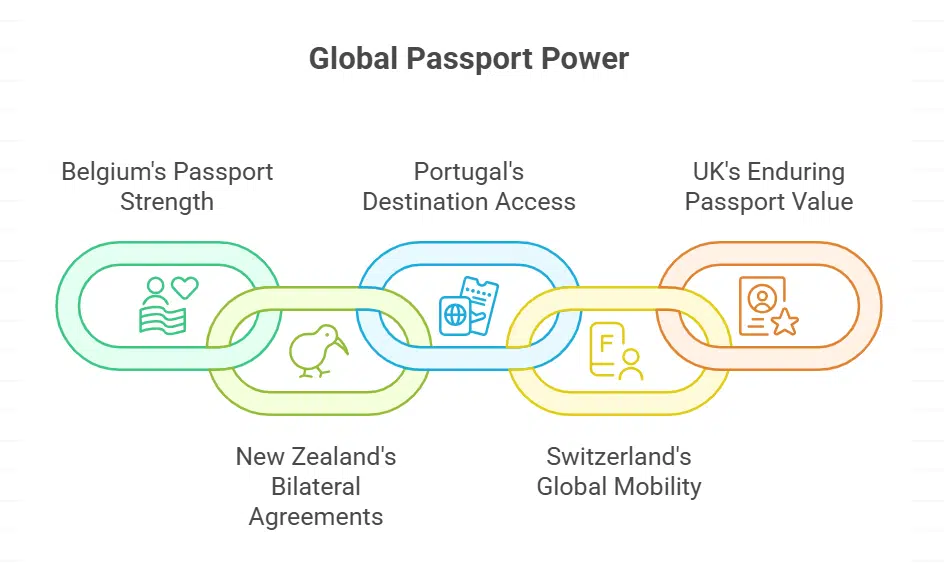
Five countries share the fifth spot with access to 190 destinations: Belgium, New Zealand, Portugal, Switzerland, and the United Kingdom. Although the UK has dropped in ranking since Brexit, its passport still remains highly valuable. New Zealand, which continues to build strong bilateral visa agreements, has consistently maintained its position among the top-ranking nations.
Australia and Greece at Sixth, Canada and Poland at Seventh
The sixth position is held by Australia and Greece, with both countries’ passports providing access to 189 destinations. These nations benefit from strong diplomatic outreach, as well as extensive visa-exemption agreements across Europe, Asia, and the Americas.
At seventh place are Canada, Malta, and Poland, each with visa-free access to 188 countries. While Canada has seen a slight drop in its overall ranking over the past decade, it continues to maintain an impressive level of international mobility.
Remaining Countries in the Top 10
-
Eighth place: Shared by Czechia and Hungary, offering visa-free travel to 187 destinations.
-
Ninth place: Held by Estonia and the United States, with access to 186 countries. The U.S., once in the top two, has seen a steady decline in recent years, attributed to complex foreign policies and shifting international perceptions.
-
Tenth place: Occupied by Lithuania, Latvia, Slovenia, and notably, the United Arab Emirates (UAE) — a country that has seen a dramatic rise in the rankings.
UAE’s Remarkable Climb in Global Passport Rankings
The United Arab Emirates stands out as one of the biggest success stories in the world of global mobility. In 2015, the UAE passport ranked 42nd, granting visa-free access to just over 100 destinations. Over the past decade, it has added visa-free access to 72 more countries, bringing the total to 185 in 2025. Now tied at 10th place, the UAE’s climb by 32 places reflects its aggressive diplomatic strategies, investment in foreign relations, and role as a key international hub for business and tourism.
China’s Gradual Climb and Resumed Access to Major Markets
China’s passport has also experienced growth. It now ranks 60th in 2025, up from 94th in 2015. Chinese citizens can travel to more destinations without needing a visa than ever before. Notably, China has re-established visa-free access with major trade partners and tourist hotspots, contributing to this improvement.
Widening Gap in Global Mobility
While many countries have improved their rankings, others remain stuck or have dropped further. Afghanistan remains at the bottom of the Henley Passport Index, ranking 106th with visa-free access to just 26 destinations — down from 28 in the previous year. Syria (27 destinations) and Iraq (31 destinations) follow closely behind. Citizens of these nations face severe restrictions in international mobility due to ongoing conflict, sanctions, and global security concerns.
The disparity between the most and least powerful passports is now the widest it has ever been. In 2006, the average number of visa-free destinations for top-ranking passports was around 122. In 2025, it’s increased to 165 — while the bottom-ranking passports remain virtually unchanged or have worsened, reflecting growing inequality in global access and freedom of movement.
Countries That Lost Passport Power
Only 22 out of the 199 passports ranked by Henley & Partners have dropped in ranking over the past 10 years. Some of the most significant fallers include:
-
Venezuela, which has experienced the sharpest decline in mobility due to political instability and diplomatic isolation.
-
United States, which has dropped from second place in 2014 to ninth in 2025 — a fall attributed to growing visa restrictions from foreign governments and a cooling of global relations.
-
Vanuatu, a Pacific island nation known for its citizenship-by-investment program, has seen a reduction in visa-free access.
-
United Kingdom, once holding the top spot, has now slipped to fifth. This is widely attributed to the long-term effects of Brexit, which ended automatic EU travel privileges.
-
Canada, despite its global popularity, has also slipped three places over the last decade.
Alternative Indexes: Arton Capital’s Real-Time Rankings
While the Henley Passport Index remains the most widely cited source of passport rankings, Arton Capital also maintains a Passport Index, which is updated in real-time based on government and immigration authority data.
According to Arton’s Global Passport Power Rank 2025:
-
UAE holds the top spot, with a visa-free or visa-on-arrival score of 180.
-
Spain comes in second with a score of 179.
-
The difference in rankings between Henley and Arton reflects differing methodologies — Henley uses IATA data and counts only visa-free destinations, while Arton considers real-time policy changes and includes visa-on-arrival destinations more broadly.
Top 10 Most Powerful Passports in 2025 (Henley Index)
| Rank | Countries | Visa-Free Access |
|---|---|---|
| 1 | Singapore | 195 |
| 2 | Japan | 193 |
| 3 | France, Germany, Italy, Spain, Finland, South Korea | 192 |
| 4 | Austria, Denmark, Ireland, Luxembourg, Netherlands, Norway, Sweden | 191 |
| 5 | Belgium, New Zealand, Portugal, Switzerland, United Kingdom | 190 |
| 6 | Greece, Australia | 189 |
| 7 | Canada, Malta, Poland | 188 |
| 8 | Czechia, Hungary | 187 |
| 9 | Estonia, United States | 186 |
| 10 | Lithuania, Latvia, Slovenia, United Arab Emirates | 185 |
Passports Reflect Global Inequality and Diplomacy
A passport is more than just a travel document — it symbolizes opportunity, freedom, and in many cases, privilege. The 2025 rankings highlight the vast disparities in global mobility and how some countries are rapidly expanding their international relationships, while others remain constrained by conflict, politics, and global perception.
For countries at the top, passport power opens doors to business, education, and leisure across the world. For those at the bottom, it reflects the harsh realities of restricted movement and limited opportunities.
As geopolitical dynamics continue to shift, and as the world faces growing challenges from climate change, conflict, and migration, passport rankings will remain a key measure of how nations interact, cooperate, and evolve on the global stage.